Winter Trees and Shrubs: Sweetgum

Sweetgum is a distinctive tree at any time of year. It stands out among most other deciduous trees with its excurrent growth habit, which gives it a narrowly conical or pyramidal shape. Only in its advanced age does it begin to develop a more rounded and irregular form. Its leaves are star-shaped with either five or seven lobes and span between four and seven inches. Their glossy green color gives way to a wide range of colors in the fall, including yellow, orange, red, and maroon, remaining on the tree for several weeks depending on weather conditions. The fruits are particularly distinct, especially in the winter after the leaves have dropped. Woody balls made up of a series of capsules with pointed beaks hang from long stalks throughout the winter, windborne seeds having been released from small openings in the fall. Without even bothering to look at the twigs, seeing these durable, spiky balls hanging from branches (or feeling them under your feet) is a quick indication that you are looking at a sweetgum.

one of many fall colors found on sweetgum (Liquidambar styraciflua)

Liquidamabar styraciflua (one of the funnest botanical names to say) was previously placed in the family Hamamelidaceae but is now one of the few members of Altingiaceae. Its natural distribution is broad, covering a large portion of the eastern United States and west into Missouri then down into Texas, Mexico, and much of Central America. Outside of its natural range it has been widely planted as an ornamental, and there are several popular sweetgum cultivars currently in cultivation. Both the common and botanical names for this tree refer to the resin found in its bark, which historically has had many uses.

The winter twigs of sweetgum are stout, round, smooth, and yellow-brown to green or olive-green to brown-purple in color. They can also be glossy and feature a few scattered lenticels. Older twigs (or branchlets) are brown at first and then light grey with dark grey lenticels. They are occasionally adorned with corky wings similar to those of bur oak. Because the wings aren’t always present, it can be a fun thing to encounter when you are out looking at twigs.

corky wings on the branchlets of sweetgum

The winter buds of sweetgum twigs are egg-shaped and made up of bud scales with acute tips and ciliate margins. They are green to orange-brown or reddish in color and occasionally sticky. Lateral buds are alternately arranged, are much smaller than terminal buds, and are stalkless and flattened against the twig. They sit above a slightly raised leaf scar that is half-elliptical to triangular in shape and has three distinct vascular bundle traces. The pith of sweetgum twigs is solid, continuous, brownish, and irregularly shaped.

winter twig of sweetgum tree

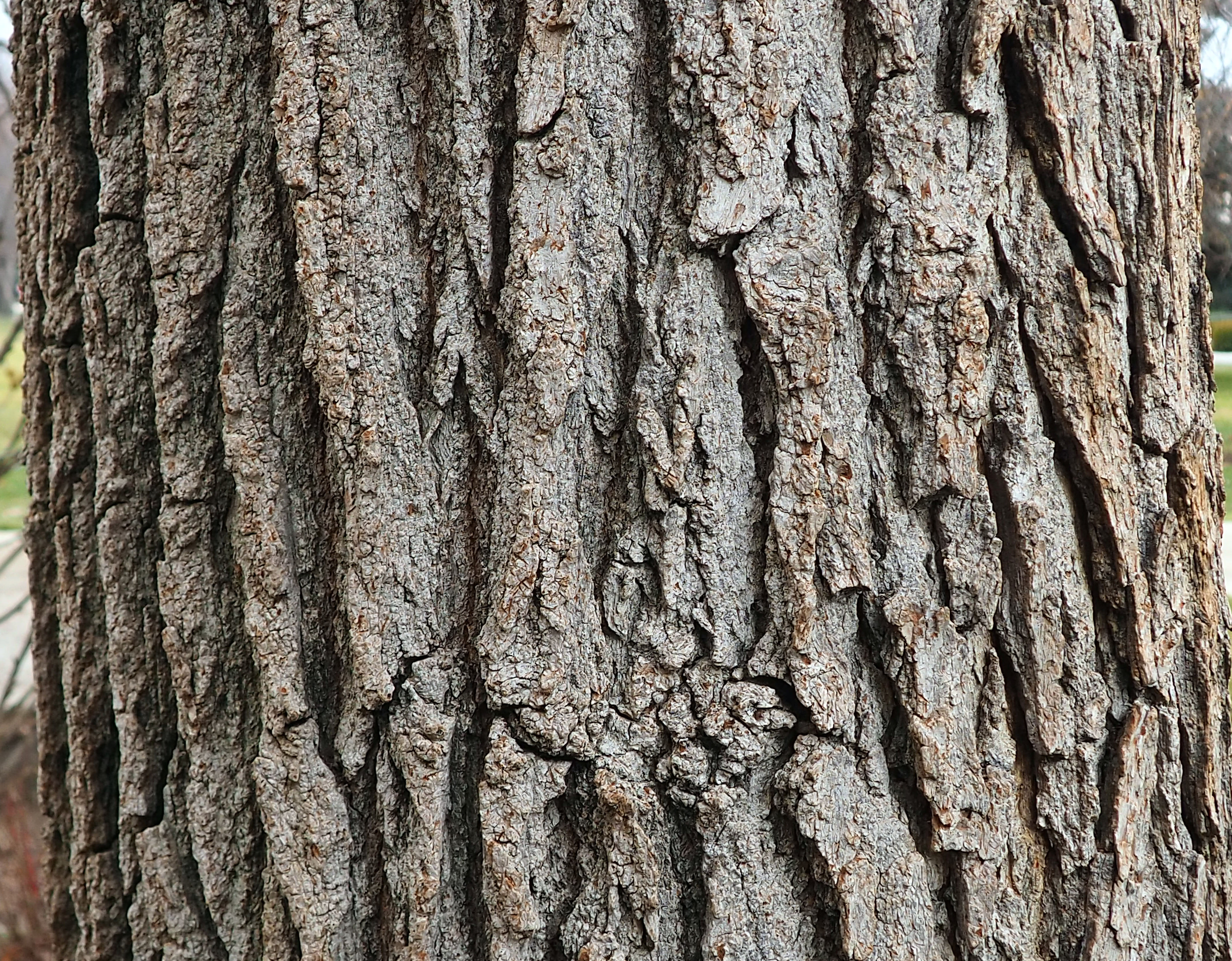
Sweetgum bark is light to dark grey and is made up of a series of rough, vertically arranged, scaly ridges that become deeply furrowed with age. The mace-like fruits of sweetgum are about one inch wide and, at a glance, are similar in appearance to the seed balls of sycamore trees; however, sycamore seed balls easily break apart when compressed, while the pointed, woody capsules that make up a sweetgum ball are held firmly together and can hold their shape for long periods of time. When these “gumballs” collect on the ground below, they can become a hazard, especially where there is lots of foot traffic. Speaking from experience, they are also obnoxious when operating a mower. This polarizing feature has resulted in bad opinions of the sweetgum tree. Luckily, some people are out there defending it.

sweetgum bark
the persistent fruits of sweetgum

More Winter Trees and Shrubs:

Weeds of Boise: Boise State University Campus, part two

In part one of this two part series, I introduced you to the Boise State University campus, located in the heart of Boise, Idaho. I’ve been spending the past year walking the campus and cataloging the weeds that I find there. Boise has a fairly mild climate compared to the rest of Idaho, so weeds are generally easy to find just about any time of year. What weeds are present depends on what time of year it is. To get a complete picture of the suite of weeds that can be found on a site, it’s important to make observations throughout the year. Weeds can also come and go, with certain species becoming more abundant in some years than others, so making observations over multiple years also helps. This is why I try to update posts that are part of the Weeds of Boise series as I make return visits and encounter additional weed species.

What follows is the second half of the list of weeds I’ve documented so far at Boise State University. I’m including a photograph for each month of the year (July – December), as well as a list of what I’ve encountered up to this point. I’m also including a list of weeds that I didn’t come across but that are documented on iNaturalist.

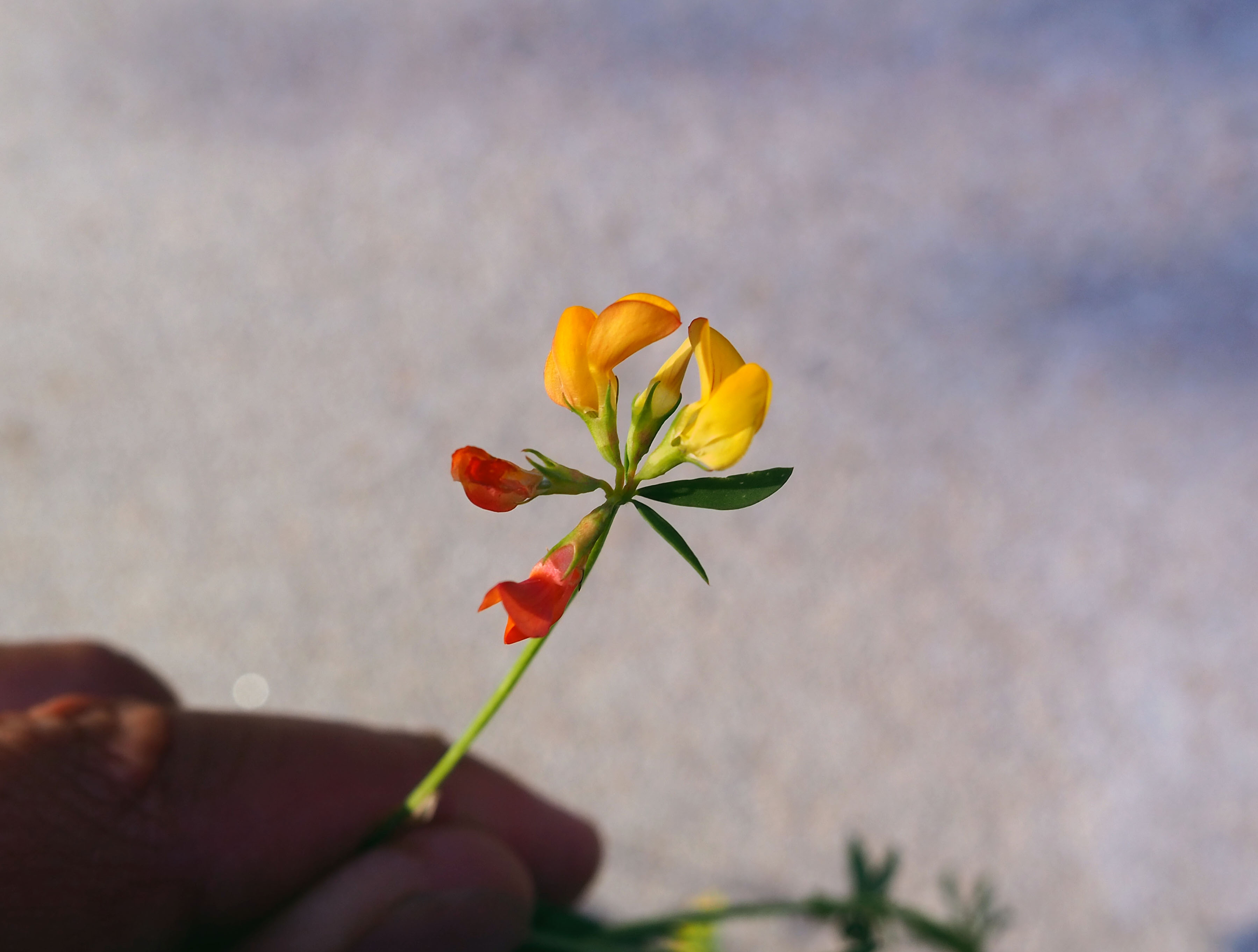
birdsfoot trefoil (Lotus corniculatus) at BSU in July 2023
yellow nutsedge (Cyperus esculentus) at BSU in August 2023
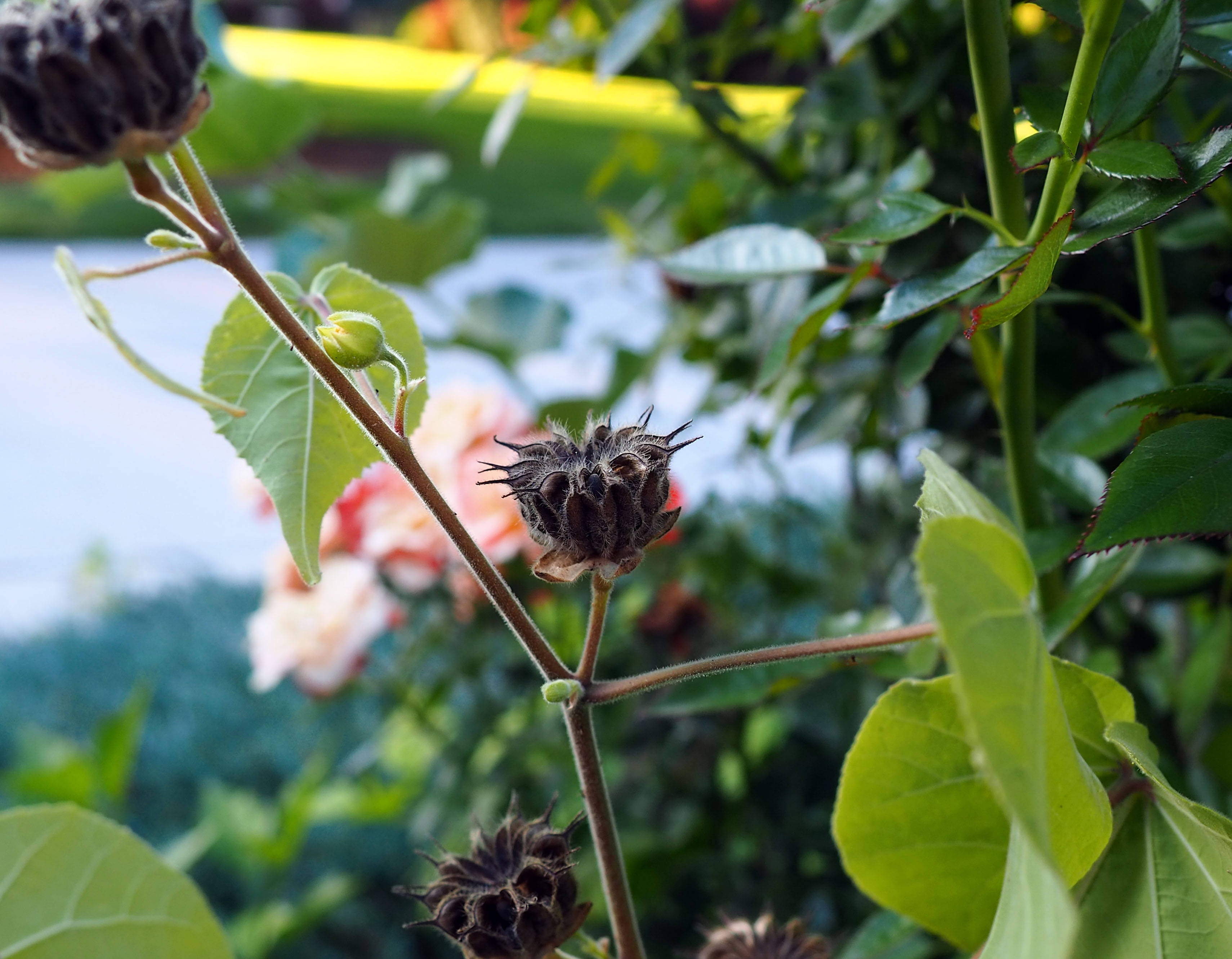
velvetleaf (Abutilon theophrasti) at BSU in September 2023
chicory (Cichorium intybus) at BSU on October 2023
puncturevine (Tribulus terrestris) at BSU in November 2023
bull thistle (Cirsium vulgare) at BSU in December 2023

Additional weeds found on the BSU campus from July – December 2023:

  • Abutilon theophrasti (velvetleaf)
  • Cichorium intybus (chicory)
  • Cirsium vulgare (bull thistle)
  • Cyperus esculentus (yellow nutsedge)
  • Eragrostis cilianensis (stinking lovegrass)
  • Lotus corniculatus (birdsfoot trefoil)
  • Medicago sativa (alfalfa)
  • Melilotus alba (white sweetclover)
  • Solanum nigrum (black nightshade)
  • Sonchus asper (prickly sowthistle)
  • Tribulus terrestris (puncturevine)

Additional weeds observed on the BSU campus by iNaturalist users as of December 2023:

  • Aegilops cylindrica (jointed goatgrass)
  • Bromus diandrus (ripgut brome)
  • Cerastium nutans (nodding chickweed)
  • Chorispora tenella (blue mustard)
  • Elymus repens (quackgrass)
  • Hypericum perforatum (St. John’s wort)
  • Lepidium perfoliatum (clasping pepperweed)
  • Matricaria discoidea (pineappleweed)
  • Ornithogalum umbellatum (star-of-Bethlehem)
  • Vicia tetrasperma (four-seeded vetch)

Getting to Know a Grass – Basic Anatomy and Identification

Have you ever tried to identify a grass? Most of us who like to look at plants and learn their names will probably admit that we often give up on grasses pretty quickly, or just ignore them entirely. They aren’t the easiest plants to identify to species, and there are so many of them. Without close inspection, they can all look pretty similar. Their flowers aren’t particularly showy, and their fruits are fairly forgettable. They are strands or clumps of green that create a backdrop for more intriguing forms of vegetation. Yet, they are among the most ecologically and economically important groups of plants on the planet. And actually, if you can ascend the hurdles that come with getting to know them, they are beautiful organisms and really quite amazing.

Kōura in the Grass

The grass family – Poaceae – consists of nearly 8oo genera and about 12,000 species. Grasses occur in a wide range of habitats across the globe. Wherever you are on land, a grass is likely nearby. Grasses play vital roles in their ecosystems and, from a human perspective, are critical to life as we know it. We grow them for food, use them for building materials and fuel, plant them as ornamentals, and rely on them for erosion control, storm water management, and other ecosystem services. We may not acknowledge their presence most of the time, but we very likely wouldn’t be here without them.

The sheer number of grass species is one thing that makes them so difficult to identify. Key identifying features of grasses and grass-like plants (also known as graminoids) tend to be very small and highly modified compared to similar features on other flowering plants. This requires using a hand lens and learning a whole new vocabulary in order to begin to understand a grass’s anatomy. It’s a time commitment that goes beyond a lot of other basic plant identification, and it’s a learning curve that few dare to follow. However, once you learn the basic features, it becomes clear that grasses are relatively simple organisms, and once you start identifying them, it can actually be an exciting and rewarding experience.

Quackgrass (Elymus repens) and Its Rhizome

Depending on the species, grasses can be annuals – completing their life cycle within a single year – or perennials – coming back year after year for two or more years. Most grasses have a fibrous root system; some are quite shallow and simple while others are extremely deep and extensive. Some species of perennial grasses spread by either rhizomes (underground stems), stolons (horizontal, above ground stems), or both. Some grasses also produce tillers, which are essentially daughter plants that form at the base of the plant. The area where roots, rhizomes, stolons, and tillers meet the shoots and leaves of a grass plant is called the crown. This is an important region of the plant, because it allows for regrowth even after the plant has been browsed by a grazing animal or mown down by a lawn mower.

The stem or shoot of a grass is called a culm. Leaves are formed along the lengths of culms, and culms terminate in inflorescences. Leaves originate at swollen sections of the culm called nodes. They start by wrapping around the culm and forming what is called a leaf sheath. Leaves of grasses are generally long and narrow with parallel venation – a trait typical of monocotyledons. The part of the leaf that extends away from the culm is called the leaf blade or lamina. Leaves are alternatively arranged along the length of the stem and are two-ranked, meaning they form two distinct rows opposite of each other along the stem.

The area where the leaf blade meets the leaf sheath on the culm is called the collar. This collar region is important for identifying grasses. With the help of a hand lens, a closer look reveals the way in which the leaf wraps around the culm (is it open or closed?), whether or not there are hairs present and what they are like, if there are auricles (small flaps of leaf tissue at the top of the collar), and what the ligule is like. The ligule is a thin membrane (sometimes a row of hairs) that forms around the culm where the leaf blade and leaf sheath intersect. The size of the ligule and what its margin is like can be very helpful in identifying grasses.

The last leaf on the culm before the inflorescence is called the flag leaf, and the section of the culm between the flag leaf and the inflorescence is called a peduncle. Like the collar, the flower head of a grass is where you’ll find some of the most important features for identification. Grass flowers are tiny and arranged in small groupings called spikelets. In general, several dozen or hundreds of spikelets make up an inflorescence. They can be non-branching and grouped tightly together at the top of the culm, an inflorescence referred to as a spike, or they can extend from the tip of the culm (or rachis) on small branches called pedicels, an inflorescence referred to as a raceme. They can also be multi-branched, which is the most common form of grass inflorescence and is called a panicle.

Either way, you will want to take an even closer look at the individual spikelets. Two small bracts, called glumes, form the base of the spikelet. Above the glumes are a series of florets, which are enclosed in even smaller bracts – the outer bract being the lemma and the inner bract being the palea. Certain features of the glumes, lemmas, and paleas are specific to a species of grass. This includes the way they are shaped, the presence of hairs, their venation, whether or not awns are present and what the awns are like, etc. If the grass species is cleistogamous – like cheatgrass – and the florets never open, you will not get a look at the grass’s sex parts. However, a close inspection of an open floret is always a delight. A group of stamens protrude from their surrounding bracts bearing pollen, while feathery stigmas reach out to collect the pollen that is carried on the wind. Depending on the species, an individual grass floret can have either only stamens, only pistils (the stigma bearing organs), or both. Fertilized florets form fruits. The fruit of a grass is called a caryopsis (with a few exceptions) and is indistinguishable from the seed. This is because the seed coat is fused to the wall of the ovary, unlike other fruit types in which the two are separate and distinct.

If all this doesn’t make you want to run outside and take a close look at some grasses, I don’t know what will. What grasses can you identify in your part of the world? Let me know in the comment section below or check out the linktree and get in touch by the means that suits you best.

Tea Time: Kentucky Coffeetree

Learning to identify Kentucky coffeetree in the winter brings you one step closer to making a coffee-like (albeit caffeine-free) beverage from its seeds. Humans have a long history of occasionally using the “beans” of Gymnocladus dioicus to make this tisane, which explains common names like coffeetree, American coffee berry, and coffeenut. The process is a bit time consuming, and the end result is mixed, but foraging adventures like this are all about the experience. This drink is not likely to replace whatever you are currently drinking in the morning, but it does offer an interesting diversion.

fruit of Kentucky coffeetree (Gymnocladus dioicus)

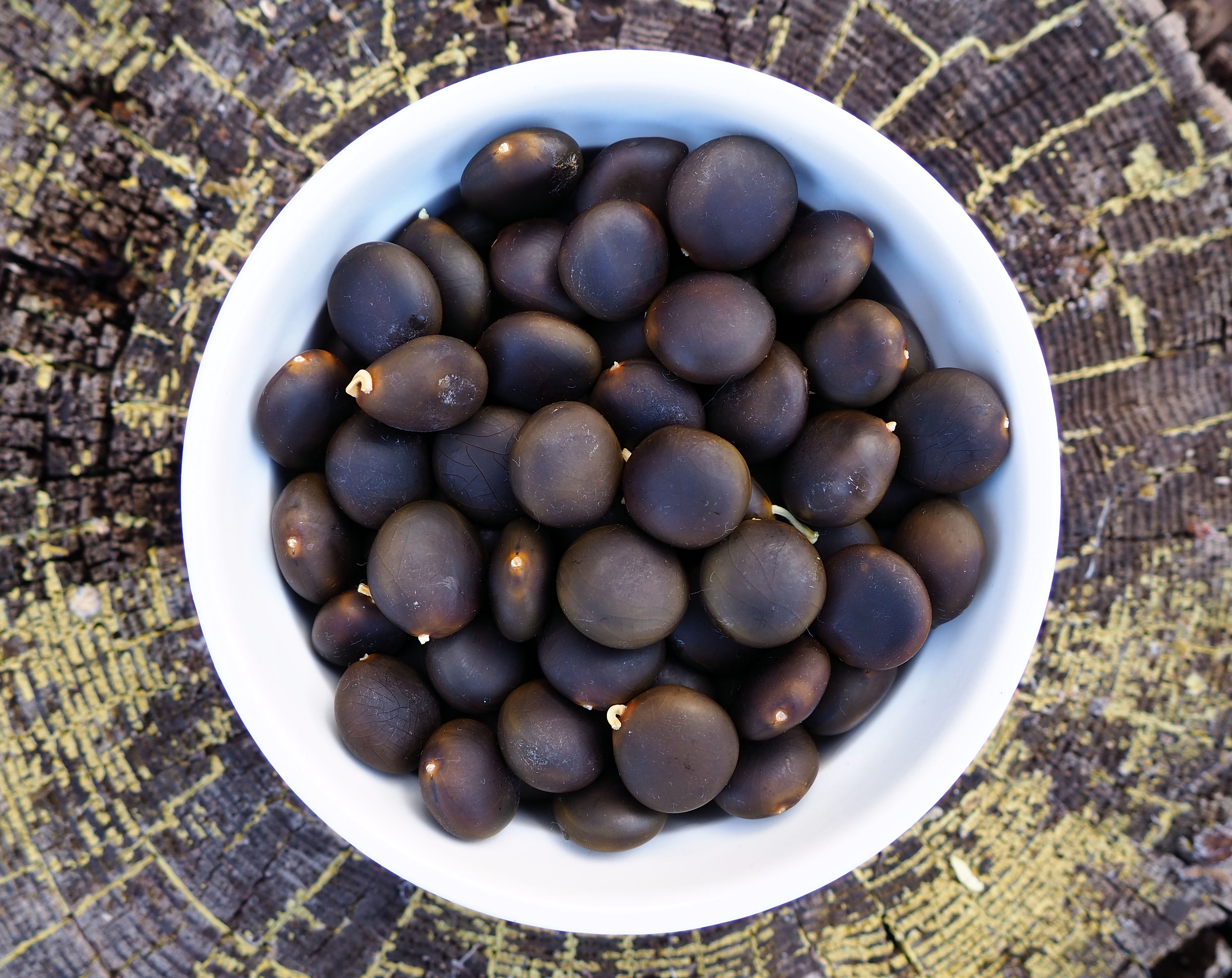
Winter is the best time to collect the pods, which are flat, leathery, brown to black in color, and about 2 inches wide and 6 inches long. The stocky fruits are often found hanging from the tips of the tree’s bare branches. Many also fall to the ground over the course of the season, making them easier to collect. If you split the pods open early in the season, you’ll find the seeds embedded in a sticky, neon green goo that will stick to your hands and clothes. As the year progresses, the glue-like substance dries out and is easier to deal with. The seeds are dark, extremely hard, rounded and flattened, and about the size of a penny or nickel. The funiculus, which is a short stalk that connects the ovule/seed to the ovary, tends to be fairly prominent and something you don’t often get to see on seeds.

inside the fruit of a Kentucky coffeetree

Once you’ve collected several pods and removed the seeds from the gooey innards, soak the seeds for an hour or two and then rinse them, making sure to remove dried up goo and any remaining funiculi. Pat the seeds dry and place them in a baking dish with a lid for roasting. The roasting process is said to eliminate the toxicity of the seeds. The lid is important because several of the seeds will pop open during roasting and will fly around in your oven if they aren’t contained.

The fruits of Kentucky coffeetree contain a toxic compound called cytisine, an alkaloid that is similar in action to nicotine. The Handbook of Poisonous and Injurious Plants by Nelson, et al. states that “the cytisine content of the seeds is quite low; and chewing one or two would not be expected to produce toxic effects.” Actually, the bigger risk of chewing one of these rock hard seeds is breaking your teeth. Cytisine poisoning includes typical symptoms like diarrhea and vomiting; in extreme cases it can lead to coma and death. If the seeds are properly roasted, you won’t have to worry about any of this, but as with anything you are trying for the first time, start with small amounts.

seeds of Kentucky coffeetree

Times and temperatures for roasting vary depending on who you’re getting your information from. I went with 300° F for 3 hours (which ended up being 3 and a half hours because I forgot to take them out in time). One source suggested roasting the seeds for only 2 hours for better flavor, but I decided to err on the side of caution and roast them for longer. Many of the seeds will have popped open during the roasting process. For those that haven’t you will need to use a nutcracker or some other comparable tool to crack the seed coat and remove the insides. Dispose of the seed coats and grind the remaining bits into a fine powder using either a coffee grinder or mortar and pestle. You’ll end up with a fine, chocolate-colored powder which you will use to make your “coffee.”

You can prepare this beverage in the same way you would typically choose to make coffee, but keep in mind that upon adding water, the fine grounds quickly turn to a mud-like substance and will block up the filter you are using. For this reason, I recommend small batches. I found Kentucky coffeetree “coffee” to be very earthy and rich and somewhat similar to strong black coffee. Sierra tried it and immediately exclaimed, “That’s nice!” and then proceeded to give it two thumbs up. Some people like black coffee. I added cream to it and found it much more pleasant to drink. Other people don’t think this beverage tastes like coffee at all and instead call it tea-like, chocolaty, fruity, or “akin to mud,” among other more negative reviews. I think it’s a drink that could grow on me, but considering the effort it takes to make one cup, I don’t see that happening any time soon.

Kentucky coffeetree “coffee grounds”

Have you tried making “coffee” from the seeds of Kentucky coffeetree? Let us know what you think about it in the comment section below.

More Tea Time Posts on Awkward Botany:

Winter Trees and Shrubs: Kentucky Coffeetree

A few years ago, I was on the hunt for a Kentucky coffeetree. I was aware that a few could be found in some of the parks around Boise, but not being familiar with them, I wasn’t sure where exactly to find one or what I was even looking for. One winter while riding my bike to work, I noticed a tree at the edge of a golf course. No doubt I had passed this tree hundreds (if not thousands) of times. What caught my eye were thick, bean-like pods hanging from the ends of branches. They were unlike any other tree fruits I was familiar with. I stopped and, with a little effort, knocked one of the pods free from the tree. When I split it open, I found three or four large, smooth, black seeds inside. Later, I confirmed that the tree was indeed Kentucky coffeetree. Passing by it during any other time of year, it may have never caught my eye – just another deciduous tree with green leaves that, from a distance at least, looks like so many other deciduous trees. But in winter, with several chunky pods hanging from the tips of its stout branches, it really stood out. This is the joy of looking at trees and shrubs in the winter, where features that may otherwise be obscured, become glaringly obvious against the plainness of a winter backdrop.

fruits of Kentucky coffeetree (Gymnocladus dioicus)

Kentucky coffeetree (Gymnocladus dioicus) is in the bean family (Fabaceae). It occurs in forests across the eastern and central United States and north into southern Ontario, Canada. It is also planted in urban areas both within and outside of its native range. It is a medium to large tree, averaging 60-70 feet (18-21 meters) high and 40-50 feet (12-15 meters) wide. It generally branches out at around 10-15 feet high and forms a narrow, rounded to pyramidal crown. It is a fairly sparsely branched tree compared to other trees its size, which is much easier to observe in the winter after all of its leaves have dropped.

winter twigs of Kentucky coffeetree

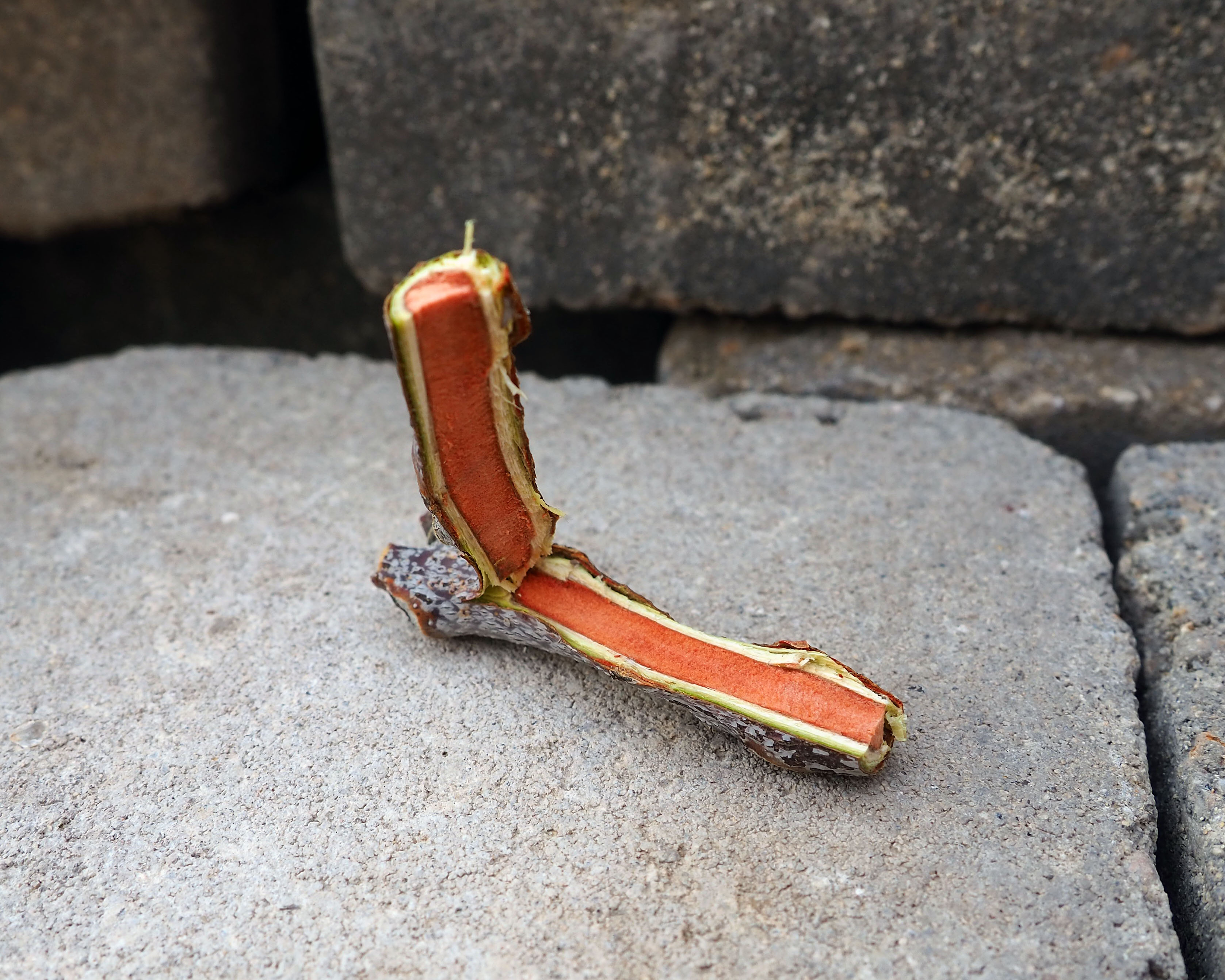
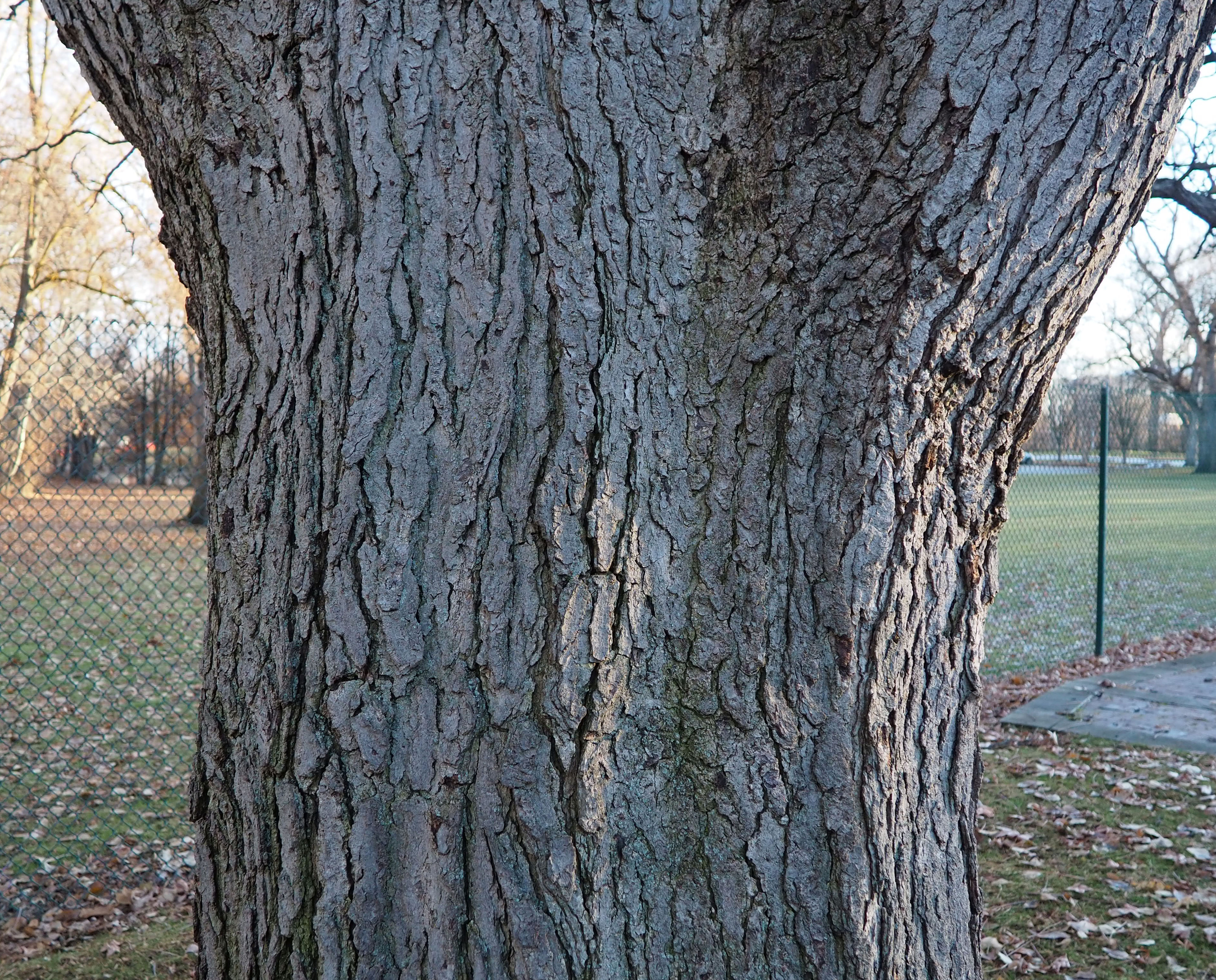
The winter twigs of Kentucky coffeetree are thick and stubby with few hairs and can be greenish, orange, brown, or deep wine-red in color. They have small, scattered lenticels that are either white, orange, or orange-brown. Their leaf scars are alternately arranged and are heart- or sheild-shaped and very large with 3 to 5 distinct bundle traces. It’s pretty obvious from the leaf scars that Kentucky coffeetree bears a sizeable leaf. These massive, bipinnately compound leaves are demonstrated in this Plant Sleuth YouTube video. Leaf buds are tiny and found directly above the leaf scar. There are usually two of them, one of which is sterile and can be difficult to see. They are round, hairy, olive-colored, and sunken like fuzzy, little craters, although you’ll need a hand lens to really see the hairs (which I highly recommend). The twigs lack a terminal leaf bud. Their pith is rounded, thick, and either orange, brown, or salmon colored. The young bark of Kentucky coffeetree is pale gray and fairly smooth. As the tree ages, it breaks into shallow ridges that run the length of the tree. At maturity, the bark is shades of grey and scaly with long, defined, narrow ridges.

pith of Kentucky coffeetree twigs

Kentucky coffeetree is dioecious, meaning that there are “male” trees and “female” trees. The tree that I found on the golf course was a “female” tree because it was bearing fruit, which the “males” and certain cultivars won’t have. If there are no seed pods present, you will have to rely on other features to identify the tree; however, when the pods are present, the tree is unmistakable. Its fruits are thick-walled, flat, oval-shaped, smooth, leathery, and orange-brown to black in color. They measure around 5 to 10 inches long and up to 4 inches wide. They are indehiscent and can persist on the tree for more than a year, and even those that fall to the ground can take months or years to break down enough to release the seeds, which have a hard, dark seed coat. Inside the pod, the seeds are embedded in a thick, gooey, yellow-green pulp, which some descriptions call sweet. However, it doesn’t look appetizing enough to try, and considering that the seeds are toxic, I’d be hesitant to consume any part of the fruit without first verifying its safety with a reputable source. That being said, the seeds can be roasted and used to make a coffee substitute and, as long as it’s done correctly, is safe to drink.

mature bark of Kentucky coffeetree

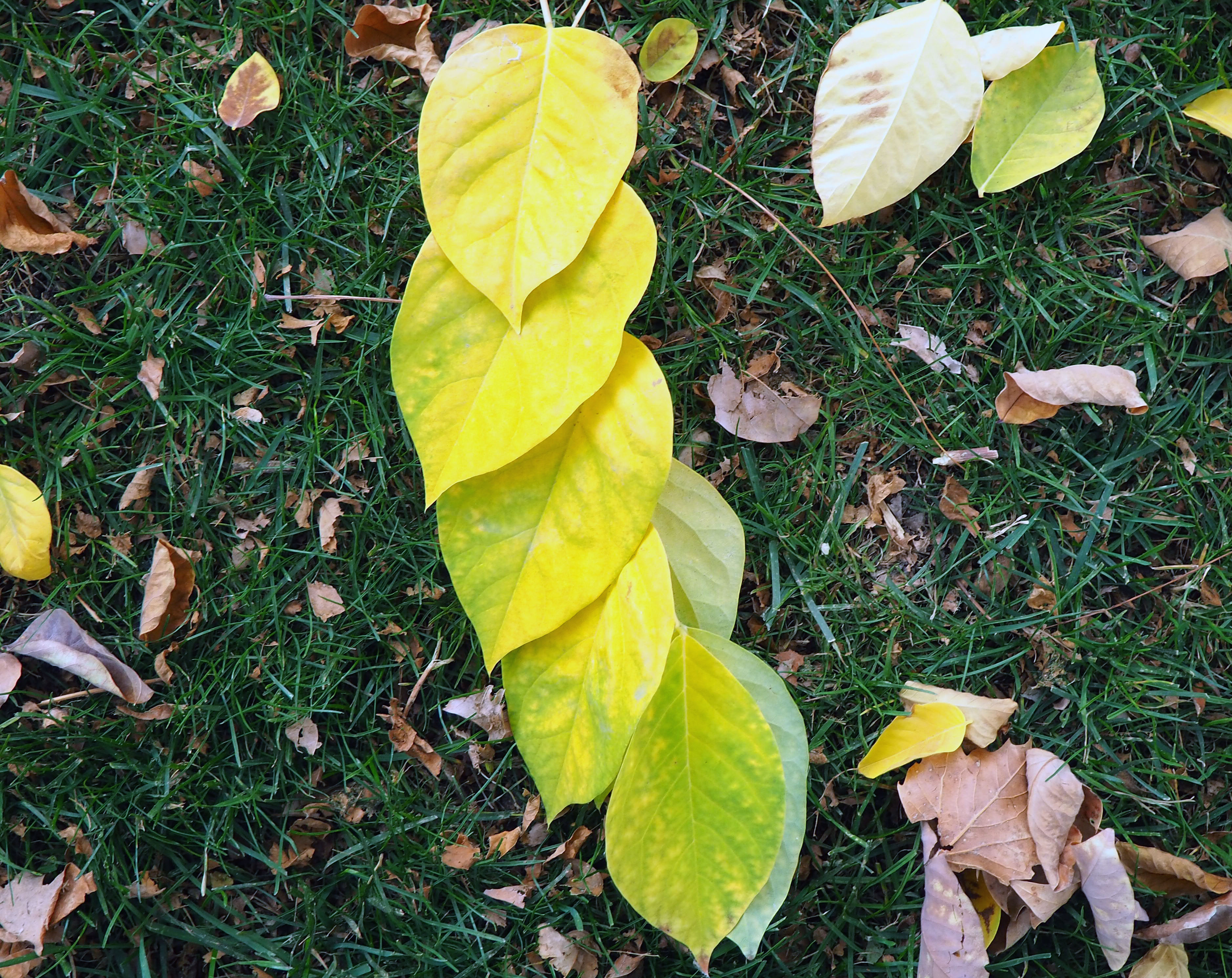
Kentucky coffeetree is one of the last trees to leaf out in the spring and one of the first to drop its leaves in the fall. Flowers appear in mid to late spring. The leaves have a pink to bronze color as they first emerge, and in the fall they turn bright yellow before they drop.

fall foliage of Kentucky coffeetree

More Winter Trees and Shrubs:

Eating Weeds: Cleavers Coffee

One of the world’s most beloved beverages comes from a species of plant found in the fourth largest family of flowering plants. Rubiaceae, also known as the coffee or bedstraw family, consists of around 13,500 species, placing it behind just Asteraceae, Orchidaceae, and Fabaceae for the most number of species. Coffea arabica, and other species in the genus Coffea, are grown for their fruits which are used to make coffee. This makes Rubiaceae one of the most economically important plant families. A family this size is bound to be home to a weed or two, and in fact, one of the most widespread and obnoxious weeds is also a member of Rubiaceae.

Galium aparine, known commonly by a slew of names including cleavers, occurs naturally across large portions of Europe, Asia, North Africa, and possibly even parts of North America. It has been introduced as a weed in many locations across North America, South America, Australia, New Zealand, Japan, and parts of Africa. It is of particular concern in agricultural settings where its lengthy, sprawling branches and sticky leaves get tangled up in harvesting equipment, while its tiny, prickly fruits get mixed in with seeds of similar size like canola.

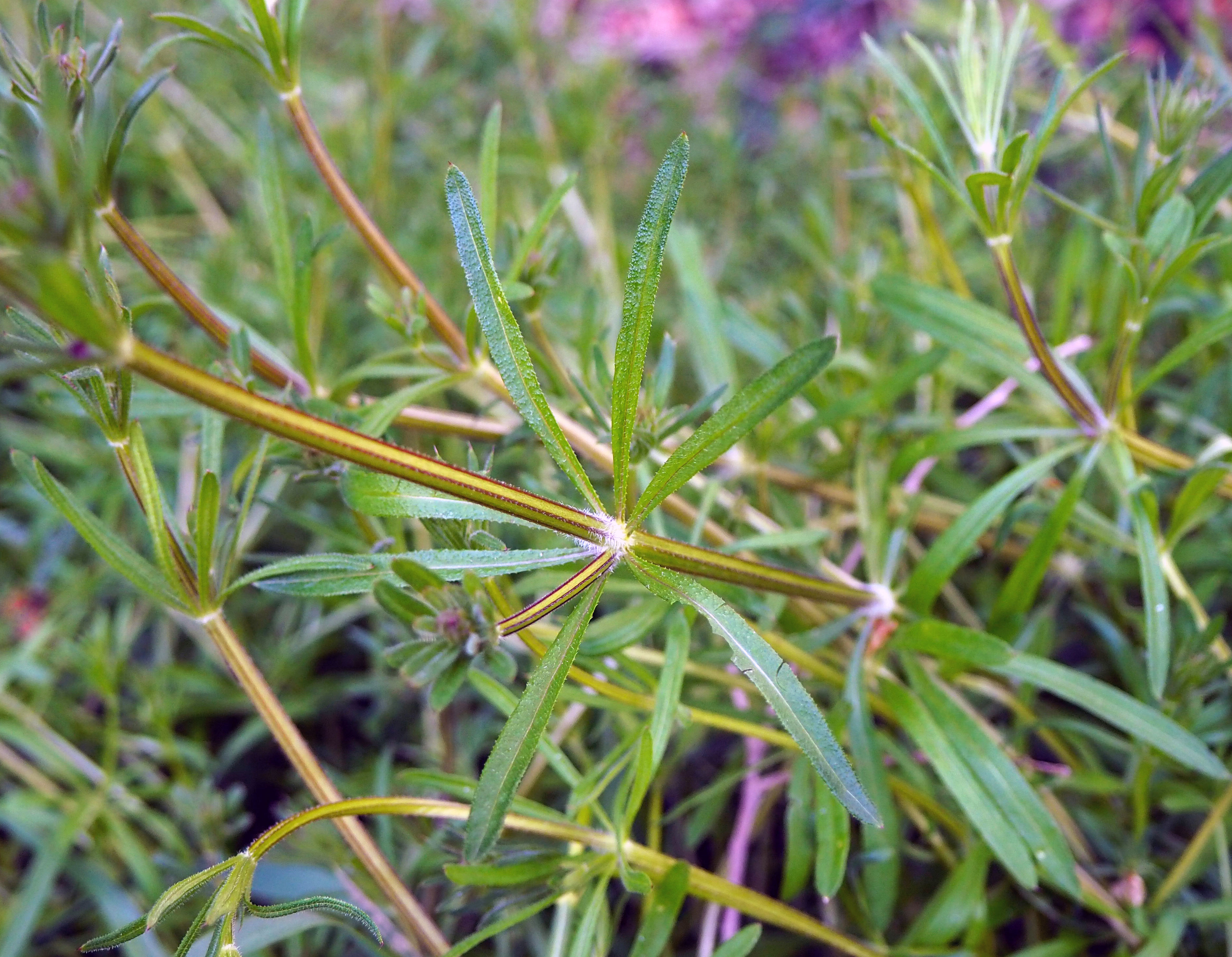
Galium aparine

Sticky willy, as it is also known, is an annual plant that, in some cases, can have two generations per year – one in the spring (having germinated the previous fall) and one in the summer. Its stems are square, though not as sharply square as plants in the mint family, and can grow to around six feet long. They are weak, brittle, and don’t stand upright on their own; instead they are found scrambling across the ground or, when given the opportunity, climbing up the lengths of other plants in order to reach the sunlight. Leaves occur in whorls of six to eight and are simple and slender with entire margins. Flowers are produced at leaf axils along the lengths of the branches and are tiny, four-petaled, star-shaped, and greenish white. Fruits are borne in pairs and are round, single-seeded, indehiscent nutlets. The stems, leaves, and fruits are covered in stiff, hooked hairs or trichomes, earning it other names like catchweed bedstraw, grip grass, stickyweed, and velcro plant.

flowers and immature fruit on Galium aparine

Galium aparine is a climbing plant, but unlike other climbing plants, it doesn’t twine up things or produce structures like tendrils to hold itself up. Instead, its ability to climb is made possible by its abundant bristly hairs. A paper published in Proceedings of the Royal Society B (2011) investigates the way G. aparine climbs up other plants using the hairs on its leaves. A close inspection of the leaves reveals that the trichomes on the top of the leaf (the adaxial leaf surface) differ significantly from those found on the bottom of the leaf (the abaxial leaf surface). Adaxial trichomes curve towards the tip of the leaf, are hardened mainly at the tip, and are evenly distributed across the leaf surface. Abaxial trichomes curve towards the leaf base, are hardened throughout, and are found only on the midrib and leaf margins.

Having different types of hairs on their upper and lower leaf surfaces gives cleavers an advantage when it comes to climbing up neighboring plants. The authors of the paper describe the technique as a “ratchet mechanism.” When the upper surface of their leaf makes contact with the lower surface of another plant’s leaf, the flexible, outwardly hooked trichomes inhibit it from slipping further below the leaf and allow it to easily slide out from underneath it. When the lower surface of their leaf makes contact with the upper surface of another plant’s leaf, the stiff, inwardly hooked trichomes keep it attached to the leaf even if the other leaf starts to slip away and allows it to advance further across the leaf for better attachment and coverage. Using this ratchet mechanism, cleavers climb up the leaves of other plants, keeping their leaves above the other plant’s leaves, which gives them better access to sunlight. The basal stems of cleavers are highly flexible, which keeps them from breaking as the plant sways in the wind, tightly attached to their “host” plant.

fruits of Galium aparine

The hooked trichomes on the tiny fruits of cleavers readily attach to the fur and clothing of passing animals. The nutlets easily break free from the plants and can be transported long distances. They can also be harvested and made into a lightly caffeinated tea. Harvesting the fruit takes time and patience. I spent at least 20 minutes trying to harvest enough fruits for one small cup of cleavers coffee. The fruits don’t ripen evenly, and while I tried to pick mostly ripe fruits, I ended up with a selection of fruits in various stages of ripeness.

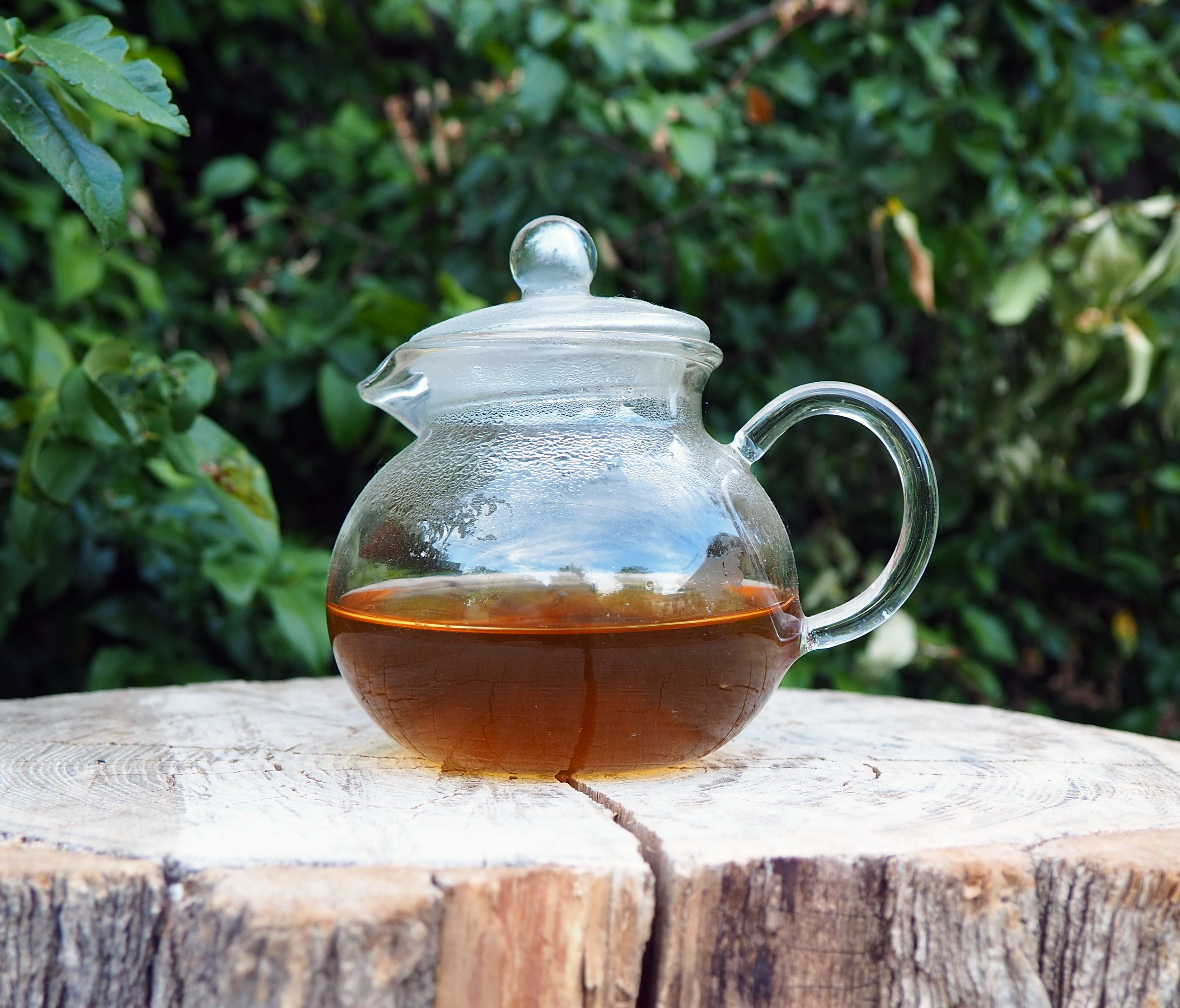
To make cleavers coffee, first toast the seeds for a few minutes in a pan heated to medium high, stirring them frequently. Next, grind them with a mortar and pestle and place the grinds in a strainer. Proceed as you would if you were making tea from loose leaf tea.

The toasted fruits and resulting tea should smell similar to coffee. The smell must not be strong, because my poor sense of smell didn’t really pick up on it. The taste is coffee-like, but I thought it was more similar to black tea. Sierra tried it and called it “a tea version of coffee.” If the fruits were easier to collect, I could see myself making this more often, but who has the time?

The leaves and stems of Galium aparine are also edible, and the plant is said to be a particular favorite of geese and chickens, bringing about yet another common name, goosegrass. In the book Weeds, Gareth Richards discusses the plant’s edibility: “It’s edible for humans but not that pleasant to eat; most culinary and medicinal uses center around infusing the plant in liquids.” Cooking with the leaves or turning them into some sort of spring tonic is something I’ll consider for a future post about eating cleavers.

More Eating Weeds Posts on Awkward Botany

Permaculture Lessons, part two: Disabled Permaculture

This is a guest post by Laura-Marie River Victor Peace Nopales (see contact info below).


Hello! I made a guest post on Awkward Botany in March, introducing myself and my spouse, and talking a little about my life with permaculture. Permaculture is a way I learn about plants, love the earth, grow delicious foods, and connect with others. Permaculture has a community aspect, and respect for all beings is part of that. Permaculture is a great idea for disabled people.

Being disabled is a lot of work, and butting up against ableism all around is part of that. A default assumption many have, including many permaculture teachers, is that people are full of abundant energy and can live our values if we choose to. But being disabled means that what we want to do often isn’t the same as what we can accomplish. Disabled permaculture is a great take on permaculture that Ming and I have been doing together for 11 years of friendship and partnership.

Disabled permaculture is a valuable concept that many people can benefit from and customize to their own needs. Throughout this essay, I’ll mention many ways it helps me and Ming live a beautiful interdependent life.

how we’re disabled

My spouse Ming and I are both disabled. He has narcolepsy, so he falls asleep at unwanted times, doesn’t get restful sleep, and many aspects of life are impacted by his low energy and lack of wakeful cognition. Narcolepsy can contribute to struggles with memory, language, and reality comprehension. Ming also has a diagnosis of OCD.

Ming endures heartache trying to get his medical needs met, since a medication he uses for wakefulness is a controlled substance. The drug war plus health insurance nonsense means he has to jump through more hoops than anyone should need to, let alone a disabled person.

As for me, I have psychiatric diagnoses and hear voices, along with social differences and sensory sensitivities. Some terms that might apply to me are anxious and autistic. I like “crazy” as a reclaimed term, like queer and fat, which also apply. I have a schizoaffective disorder, bipolar type diagnosis. I was sedated on a bipolar cocktail for around 11 years.

how permaculture suits us

Permaculture is a helpful design system for disabled people such as ourselves. We have limited energy and fluctuating capabilities. Sometimes we’re not up for much. Permaculture is helpful as a realistic, forgiving, less energy intensive way of growing plants and doing community.

Permaculture is about working with the land forms and nature’s rhythms, not fighting against them. It’s observantly respectful to Mother Earth and one another.

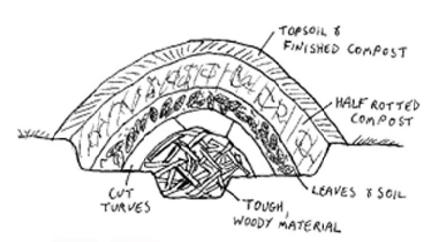
A goal is to create food forests that are self-sustaining. We permaculturists like to take a long view, start small, design for resilience, and rest in hammocks. We create closed loop systems. It’s fun to consider the weaknesses of our systems’ interdependence and arrange backups for our backups, with layers of redundancy. Problems are seen as opportunities. We have a thing for hugelkultur. We enjoy rich diversity, especially at the edges.

image credit: wikimedia commons

Permaculturists love nourishing the land, with compost, generous mulching, water catchment in swales, and other ways of making the land more rich than the scraggly vacant lots and neglected yard space we arrived to. We like doing land justice, so inviting people in, opposing food deserts by sharing our bounty, organizing community gardens, and working together with locals.

We prefer collaboration over gentrification. Smiling, we get a lot of joy out of seed bombs, guerilla gardening wild areas, and having a lemonade party, when life gives us lemons and we make lemonade.

I’ve enjoyed gleaning fruit to share with Food Not Bombs, harvesting olives with neighbors, and lots of sheet mulching with discarded cardboard to unmake lawns. Permaculture has helped me by giving me a framework for the regenerative, earth-nourishing impulses that stirred within me already.

community and energy

If all of this sounds fun, that’s because it is. Why is permaculture especially good for people who are disabled?

Inviting people in and nourishing community means more people care about our garden, and are willing to step in when Ming and I are less out and about. Thank you to the kind community members who see what needs doing and are empowered to contribute to the thriving of garden life.

Also, permaculture is less energy intensive than other ways of growing plants. Long term solution is a relief. Food forests are like Eden. Creating and tending food forests means there can be a bit by bit accumulation of plants that work well together.

It’s not a stressful, all-at-once venture. There’s not the once or twice annual “rip everything out and start over” that I’ve seen other gardeners do. It feels relaxed and cumulative, good for a disabled pace.

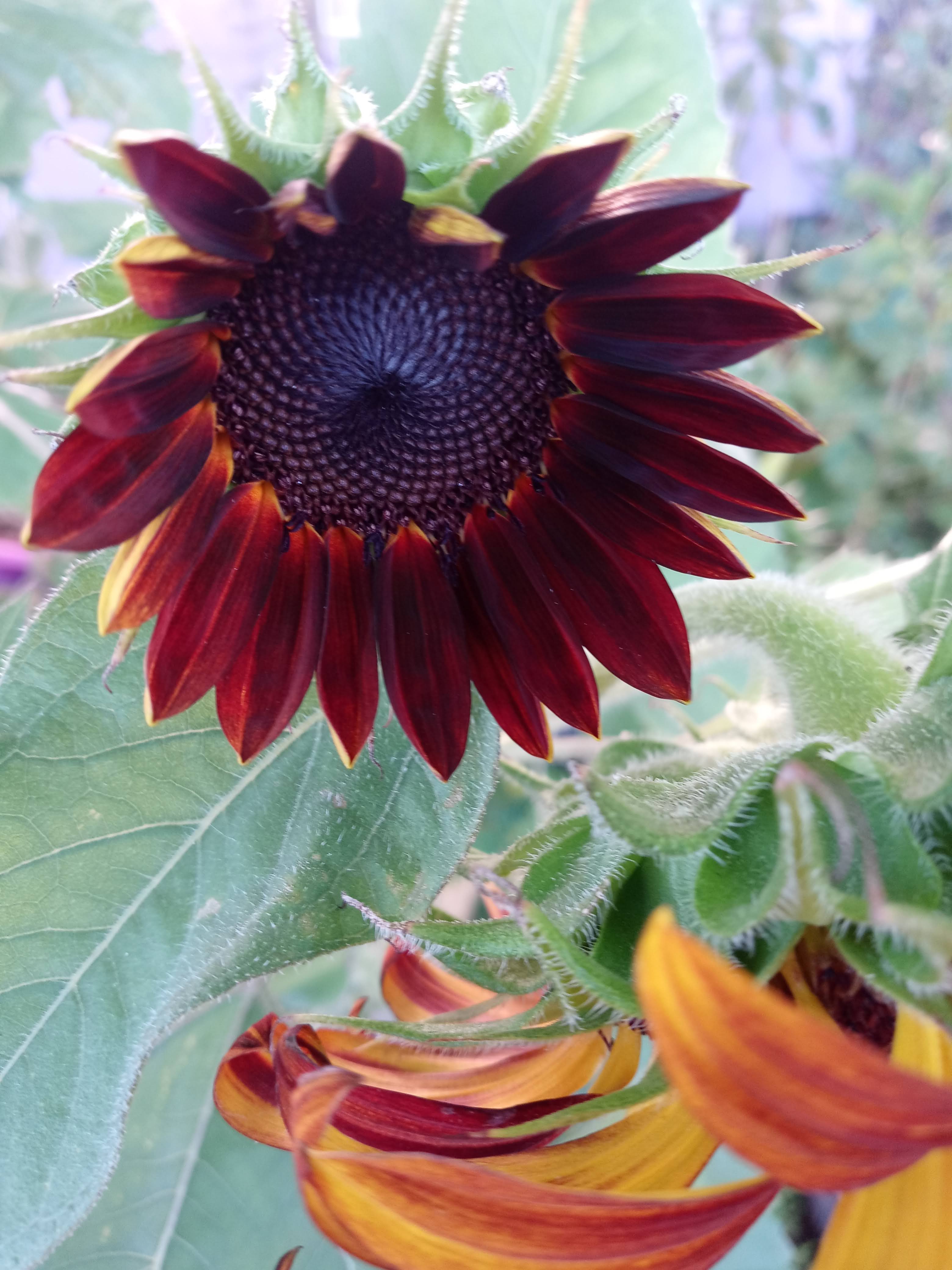
When we have the energy and the weather is cooperative, we evaluate how the garden overall is doing. Do we have room for more herbs? Are enough flowers blooming to attract pollinators and keep them happy? What foods do we want to eat more of, in the next few months? Should we put sunflowers somewhere different this time? It’s unrushed, experimental, fun, and slow.

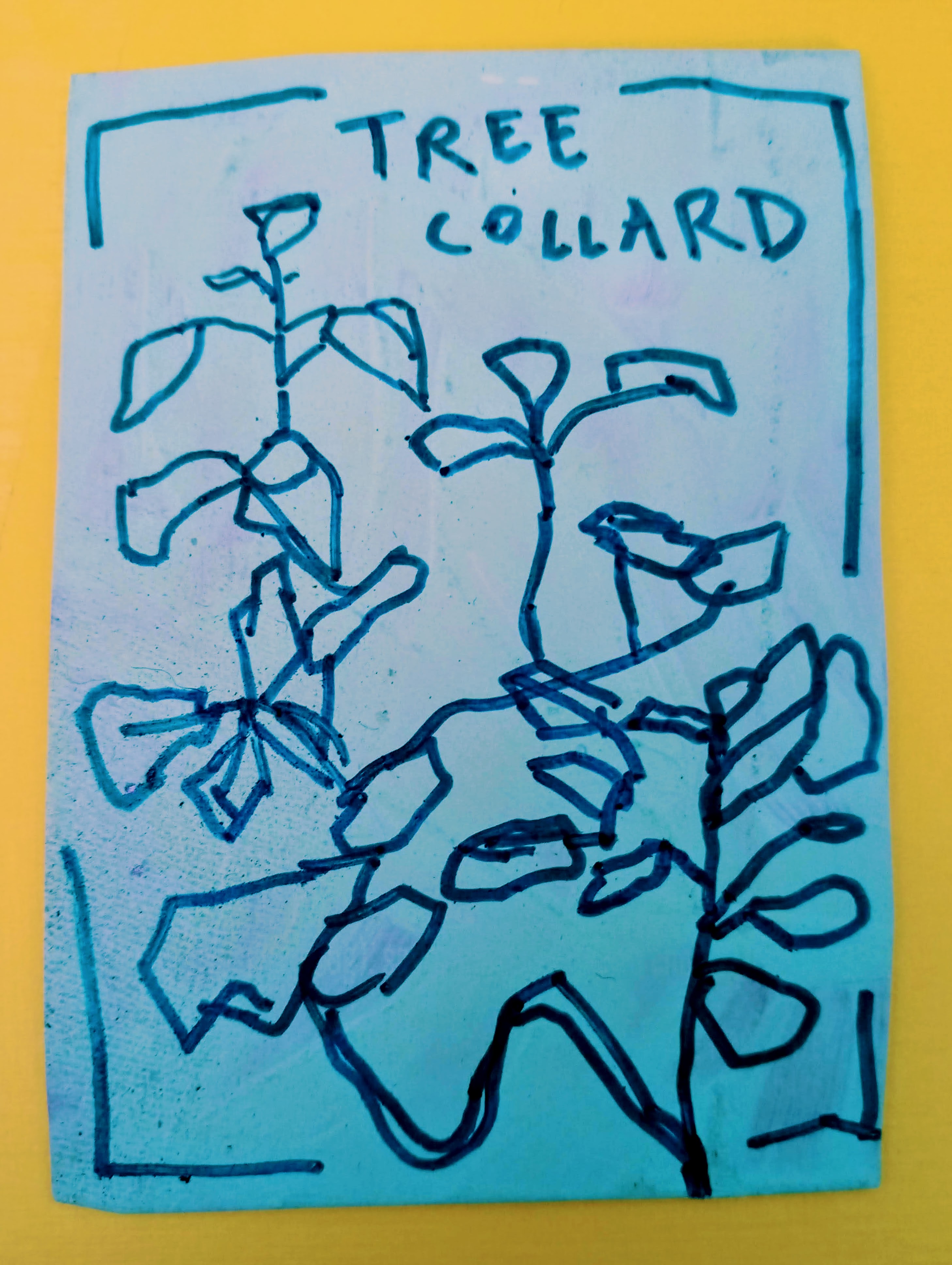
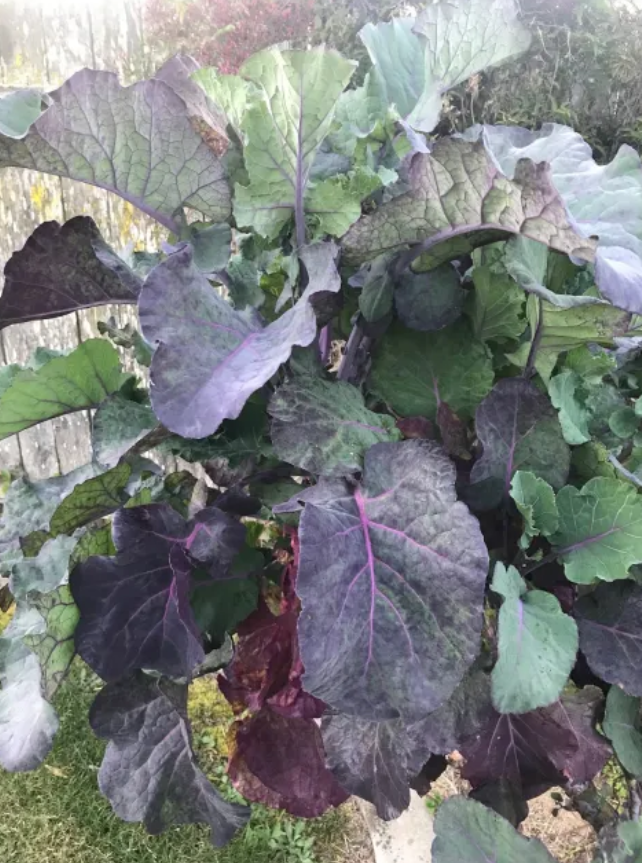
tree collards for disabled permaculture

The tree collards I mentioned last post are easier to grow than regular collards and kale. Let me tell you about these delicious leafy brassicas as a disabled permaculture example. Tree collards give tasty greens perennially, for years. We get a lot of delicious food from them!

Tree collards are easy to propagate. No need to buy or save seeds, then tend tender seedlings. Just break off a branch, stick it in the garden ground, make sure it stays moist for a few weeks, and hope for the best. It may root and start growing soon.

The tree collards we have are purple with the green. They’re gorgeous and can get lush in the winter. They’re tasty by themselves, sautéed with garlic, added to beans. We had some on our Passover Seder plate recently. When I cook rice, I might add a few tree collard leaves at the end to steam and greenly compliment my carbs.

When I make pesto, I throw in a few leaves of tree collard with the basil. When Ming is gardening, he often munches a few leaves. I smell them, pungent on his breath, when he returns indoors and kisses me.

It’s fun to give cuttings to friends and share the bounty. We talk about perennial vs annual and biennial. We talk about permaculture as an important guiding force in our disabled family. Even if the cuttings die, ideas and love were propagated. By sharing our values, we’ve inviting them into our life.

I like watching tree collards age, lean over, flower, die back, surge forth, reach for the sun. We keep them in our permaculture zone 1, right by our front door, as they are our darlings. They’re available to us all the time.

inevitable

Many people are disabled one way or another, and many people will become disabled, if lucky enough to live into old age. Disabled permaculture is a way most anyone can garden. The investment can be small and gradual.

Some people think of gardening as expensive, requiring tools and the building of raised beds, remaking the garden seasonally, and the accumulation of books and arcane knowledge. But permaculture is humble, less expensive, and becomes an intuitive part of life.

Our garden is not a separate thing that we can choose to do or not do, this spring. It’s always happening, like the other aspects of our creativity, our health, our family, and the cycles of nature.


Laura-Marie River Victor Peace Nopales is a queer trikewitch who enjoys zines, ecstatic dance, and radical mental health. Find her at listening to the noise until it makes sense.

Dispersal by Open Sesame!

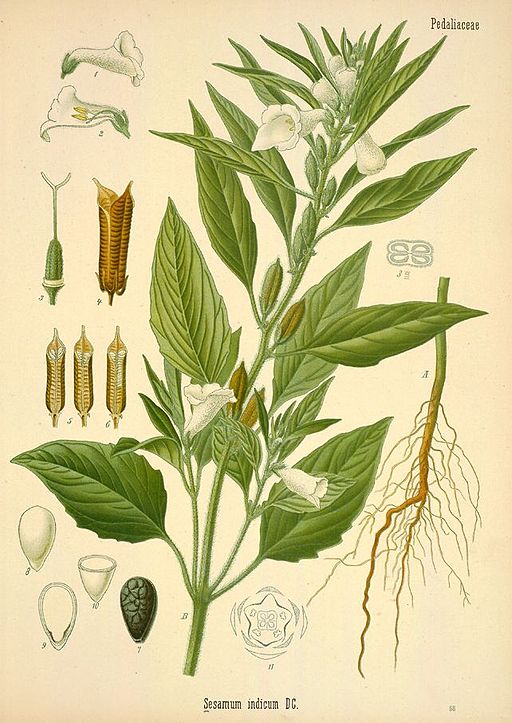
In certain instances, “open sesame” might be something you exclaim to magically open the door to a cave full of treasure, but for the sesame plant, open sesame is a way of life. In sesame’s case, seeds are the treasure, which are kept inside a four-chambered capsule. In order for the next generation of plants to have a chance at life, the seeds must be set free. Sesame’s story is similar to the stories of numerous other plant species whose seeds are born in dehiscent fruits. But in this instance, the process of opening those fruits is fairly unique.

Sesamum indicum is a domesticated plant with a 5000 plus year history of cultivation. It shares a genus with about 20 other species – most of which occur in sub-Saharan Africa – and belongs to the family Pedaliaceae – the sesame family. Sesame was first domesticated in India and is now grown in many other parts of the world. It is an annual plant that is drought and heat-tolerant and can be grown in poor soils and locations where many other crops might struggle. However, the best yields are achieved on farms with fertile soils and adequate moisture.

image credit: wikimedia commons

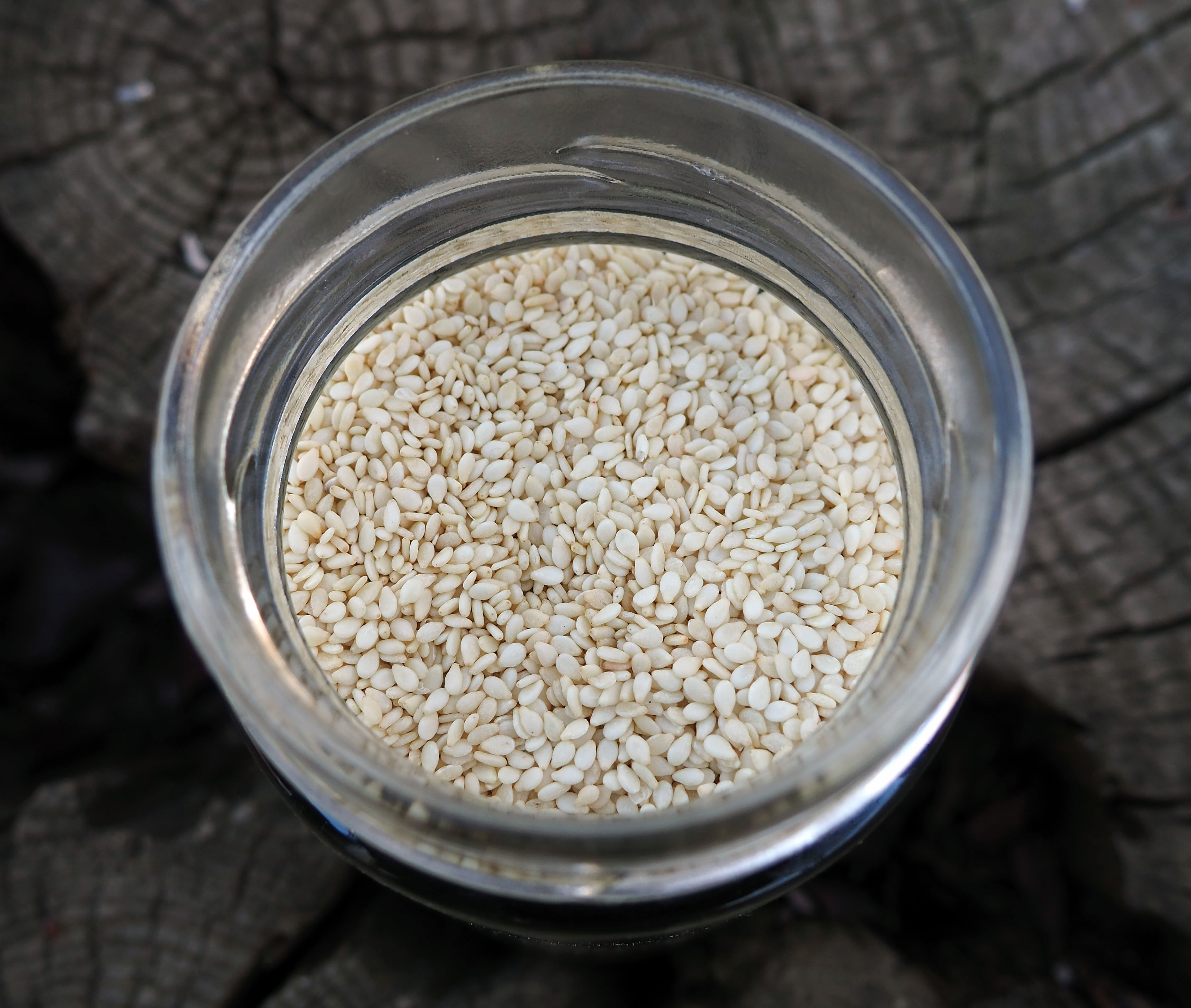
Depending on the variety and growing conditions, sesame can reach up to 5 feet tall and can be unbranched or highly branched. Its broad lance-shaped leaves are generally arranged directly across from each other on the stem. The flowers are tubular, similar in appearance to foxglove, and are typically self-pollinated and short-lived. They come in shades of white, pink, blue, and purple and continue to open throughout the growing season as the plant grows taller, even as fruits formed earlier mature. The fruits are deeply-grooved capsules with at least four separate chambers called locules. Rows of tiny, flat, teardrop shaped seeds are produced in each chamber. The seeds are prized for their high oil content and are also used in numerous other ways, both processed and fresh. One of my favorite uses for sesame seeds is tahini, which is one of the main ingredients in hummus.

The fruits of sesame are dehiscent, which means they naturally split open upon reaching maturity. Compare this to indehiscent fruits like acorns, which must either rot or be chewed open by an animal in order to free the seeds. Dehiscence is also called shattering, and in many domesticated crop plants, shattering is something that humans have selected against. If fruits dehisce before they can be harvested, seeds fall to the ground and are lost. Selecting varieties that hold on to their seed long enough to be harvested was imperative for crops like beans, peas, and grains. In domesticated sesame, the shattering trait persists and yield losses are often high.

Most of the world’s sesame crop is harvested by hand. The plants are cut, tied into bundles, and left to dry. Once dry, they are held upside down and beaten in order to collect the seeds from their dehisced capsules. When harvested this way, naturally shattering capsules may be preferred. But in places like the United States and Australia, where mechanical harvesting is desired, it has been necessary to develop new, indehiscent varieties that can be harvested using a combine without losing all the seed in the process. Developing varieties with shatter-resistant seed pods, has been challenging. In early trials, seed pods were too tough and passed through threshers without opening. Additional threshing damaged the seeds and caused the harvest to go rancid. Mechanically harvested varieties of sesame exist today, and improvements in these non-shattering varieties continue to be made.

In order to develop these new varieties, breeders have had to gain an understanding of the mechanisms behind dehiscence and the genes involved in this process. This research has helped us appreciate the unique way that the capsules of the sesame plant dehisce. As in the seed bearing parts of many other plant species, the capsules of sesame exhibit hygroscopic movements. That is, their movements are driven by changes in humidity. The simplest form of hygroscopic movement is bending, which can be seen in the opening and closing of pine cone scales. A more complex movement can be seen in the seed pods of many species in the pea family, which both bend and twist as they split open. In both of these examples, water is evaporating from the plant part in question. As it dries it bends and/or twists, thereby releasing its contents.

dehisced capsules of sesame (Sesamum indicum); photo credit: wikimedia commons (Dinesh Valke)

The cylindrical nature and cellular composition of sesame fruits leads to an even more complex form of hygroscopic movement. Initially, the capsule splits at the top, creating an opening to each of the four locules. The walls of each locule bend outward, then split and twist as the seed falls from the capsule. In a study published in Frontiers in Plant Science (2016), researchers found that differences in the capsule’s inner endocarp layer and outer mesocarp layer are what help lead to this interesting movement. The endocarp layer is composed of both transvere (i.e. circumferential) and longitudinal fiber cells, while the mesocarp is made up of soft parenchyma cells. The thicknesses of these two layers gradually changes along the length of the capsule. As the mesocarp dries, the capsule initially splits open and starts bending outwards, but as it does, resistance from the fiber cells in the endocarp layer causes further bending and twisting (see Figure 1 in the report for an illustration). As the researchers write, “the non-uniform relative thickness of the layers promotes a graded bi-axial bending, leading to the complex capsule opening movement.”

All this considered, a rock rolling away from the entrance of a cave after giving the command, “Open sesame!” almost seems simpler than the “open sesame” experienced by the fruit of the sesame plant.

See Also: Seed Shattering Lost – The Story of Foxtail Millet

Permaculture Lessons, part one

This is a guest post by Laura-Marie River Victor Peace Nopales (see contact info below).


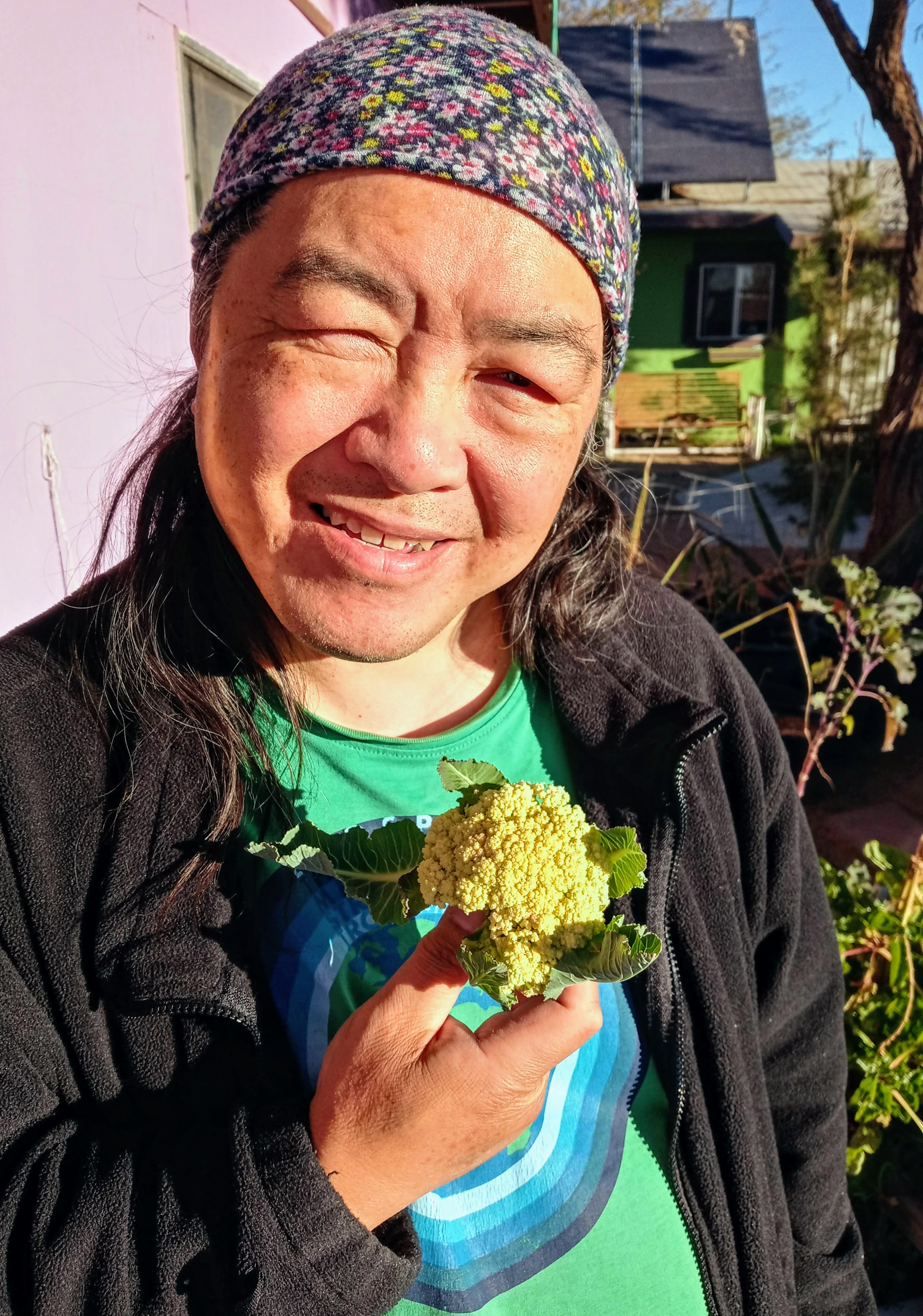
Hello, I’m Laura-Marie. I love plants, permaculture, and learning what grows wherever I find myself. This guest post is about the permaculture lessons I’ve learned gardening with my spouse Ming. Ming is a kind, brilliant person who enjoys interdependence, being a street medic, and helping our garden grow. He’s a long-time permaculturist with two permaculture design certificates.

I’ve studied permaculture for ten years. I enjoy it for many reasons: responsibility and interdependence of organisms, long view, appreciation of small. Thinking a lot about water storage, microclimates, and what makes sense for a particular place. That “you don’t have too many snails–you have too few ducks” mentality. Anything you have too much of to use can be pollution, even something usually considered good.

origins

Ming and I are both from California. We moved to this Las Vegas desert from Sacramento, which is at the north part of the Central Valley and inland from the Bay Area. I love Sacramento for its diversity of humans, plentiful parks, and proximity to many other wonderful places. Ming likes that it’s compact, but not too dense. Things are close together and easy to get to, but not overly scrunched up and piled on each other. 
Sacramento gets hot in the summers but cools off at night with a breeze from The Delta. There are rivers, a wet feel, many trees. We liked helping with Food Not Bombs and being part of the peace community there.
When Ming and I gardened in Sacramento, our relationship grew and changed as our plants grew. At Fremont Community Garden, I turned compost for the first time. I ate the most delicious Asian pears I’ve ever tasted and learned what espalier pruning is, for easy reach of fruits. 
I learned how to be a good garden neighbor. The man who grew long beans in the plot next to ours went on vacation and asked us to water his plot. Our reward was harvesting from his garden. I never knew green beans could grow like that, and so delicious.

In that climate and soil, the oregano we had in our herb spiral went wild, like mint does some places. It turned into a delicious weed, and we would harvest whole trays of oregano to deliver to a local restaurant in exchange for cookies and drinks. It was informative to watch the oregano choke out the tarragon, as the herb spiral spiraled out of control.

Our lavender bush got bigger and bigger–I liked my fragrant attempts to divide it, as I learned how to use a shovel. I enjoyed our basil forest, pinching its flowers, and seeing basil wood for the first time.

tree collards

Tree collards are a quintessential permaculture plant. People who want food forests do well to grow this charming perennial brassica. Ming and I grew lush, gorgeous tree collards in Sacramento. They are so productive and delicious to eat. I loved to make curried greens with beans, and I added ripped up tree collard leaves to a stir fry or any veg dish for more deliciousness. Yes, I adored those pretty leaves, whether they were green or purple.  

Our biggest, first tree collard we called Sideshow Bob. Its leaves floofed up like the hair of Sideshow Bob on the cartoon tv show The Simpsons. Sideshow Bob got infested with Harlequin bugs, and I learned how to save a tree collard from Harlequin bug infestation. Squishing around 300 Harlequin bugs between my gloved fingers and putting their bug bodies into a bucket of soapy water was a thought-provoking scene of carnage.  

What am I willing to do, to defend my favorite plant and meal ingredient? I considered what must die to keep my own body alive, what’s worth it. I miss those cute orange gardening gloves that I would never look at the same way again.

Sideshow Bob tipped over, and Ming found ways to support its “trunk” as it grew diagonally. It was fun to watch Sideshow Bob’s adjustment to sideways life, and we liked to give cuttings away.

Tree collards are easy to propagate, so we had several tree collard plants in our garden after some time. We brought one to my mom’s house and planted it at the edge of her garden. She lived in a different part of California, further south near the coast. Her tree collard flourished there. Every time we visited my mom, I felt excited to see how the tree collard had grown.

sharing

For a while we had two gardens. We had our plot at Fremont Community Garden, but we also lived in an apartment complex with shared beds.There were four beds when we got there, and then two more were added.  

We learned about sharing garden space with friends, including emotions, not wanting to encroach on someone else’s space, challenges of communication and expectations. I had a clump of rainbow chard that I loved to eat and watch grow. It got infested with aphids, but I was hoping to win that battle.  After some time, a well-meaning neighbor ripped it out, and I cried.

We learned how much space is the right amount, and which plants we like to eat grow well in Sacramento.  Tomatoes do well there.  I learned a permaculture lesson about the wave of energy: how having a high yield might not correspond to having enough energy to harvest it.  

One summer, so many cherry tomatoes grew that we couldn’t harvest them fast enough. Big changes were happening in the lives of everyone who lived in that apartment building, when the tomato plants were covered in hundreds of fruits. It was sad, not to have the capacity to share surplus with people in need.

There’s a mushroom farm in Sacramento that gave away spent substrate, which intrigued us.  We decided to try using substrate as mulch. “It could take nutrients from the soil, since it’s just sawdust.  Maybe this is a silly idea,” we wondered.  But we opened the bags and spread the sawdust on our garden beds, curious,

Then there was a rainy couple weeks in the winter, and we found ourselves with more oyster mushrooms than we could eat. They fruited out like mad. That felt magical and was a tasty experiment in trying something out just to see what happens.

promise

In future guest posts, I’d like to tell you what I’ve learned doing permaculture in the desert, and how doing permaculture as a disabled person is a great idea. Please let this post serve as an introduction to how my spouse Ming and I see plants and enjoy garden life.  

We enjoy new experiences, and we have a slow, grateful pace of loving the land. We love plants as food and sibling organisms on this beautiful earth.


Laura-Marie River Victor Peace Nopales is a queer permaculturist trikewitch who enjoys zines, ecstatic dance, and radical mental health. Find her at https://www.listeningtothenoiseuntilitmakessense.com.

Burr Tongue, or The Weed That Choked the Dog

It is said that the inspiration for Velcro came when Swiss inventor, George de Mestral, was removing the burrs of burdock from his dog’s coat, an experience we had with Kōura just days after adopting her. I knew that common burdock was found on our property, and I had made a point to remove all the plants that I could easily get to. However, during Kōura’s thorough exploration of our yard, she managed to find the one plant I had yet to pull due to its awkward location behind the chicken coop.

I knew when I saw the clump of burrs attached to her hind end that we were going to spend the evening combing them out of her fur. However, not long after that we discovered that Kōura had already started the process and in doing so had either swallowed or inhaled some. What tipped us off was her violent hacking and gagging as she moved frantically around the living room. She was clearly distraught, and so were we. Recognizing that she had probably swallowed a burr, we made a quick decision to take her to an emergency vet. This was our unfortunately timed (this happened on Christmas Eve) introduction to burr tongue and all the frightening things that can happen when a dog swallows burdock burrs.

The roots, shoots, and leaves of both greater burdock (Arctium lappa) and common burdock (Arctium minus) are edible, which I have already discussed in an Eating Weeds post. The burrs, on the other hand, are clearly not. While sticking to the fur of animals and the clothing of people is an excellent way for a plant to get their seeds dispersed, the sharp, hooked barbs that facilitate this are not something you want down your throat. When this occurs, the natural response is to try to hack them up, which Kōura was doing. Salivating heavily and vomiting can also help. In many cases, this will be enough to eliminate the barbs. However, if they manage to work their way into the soft tissues of the mouth, tongue, tonsils, or throat and remain there, serious infection can occur.

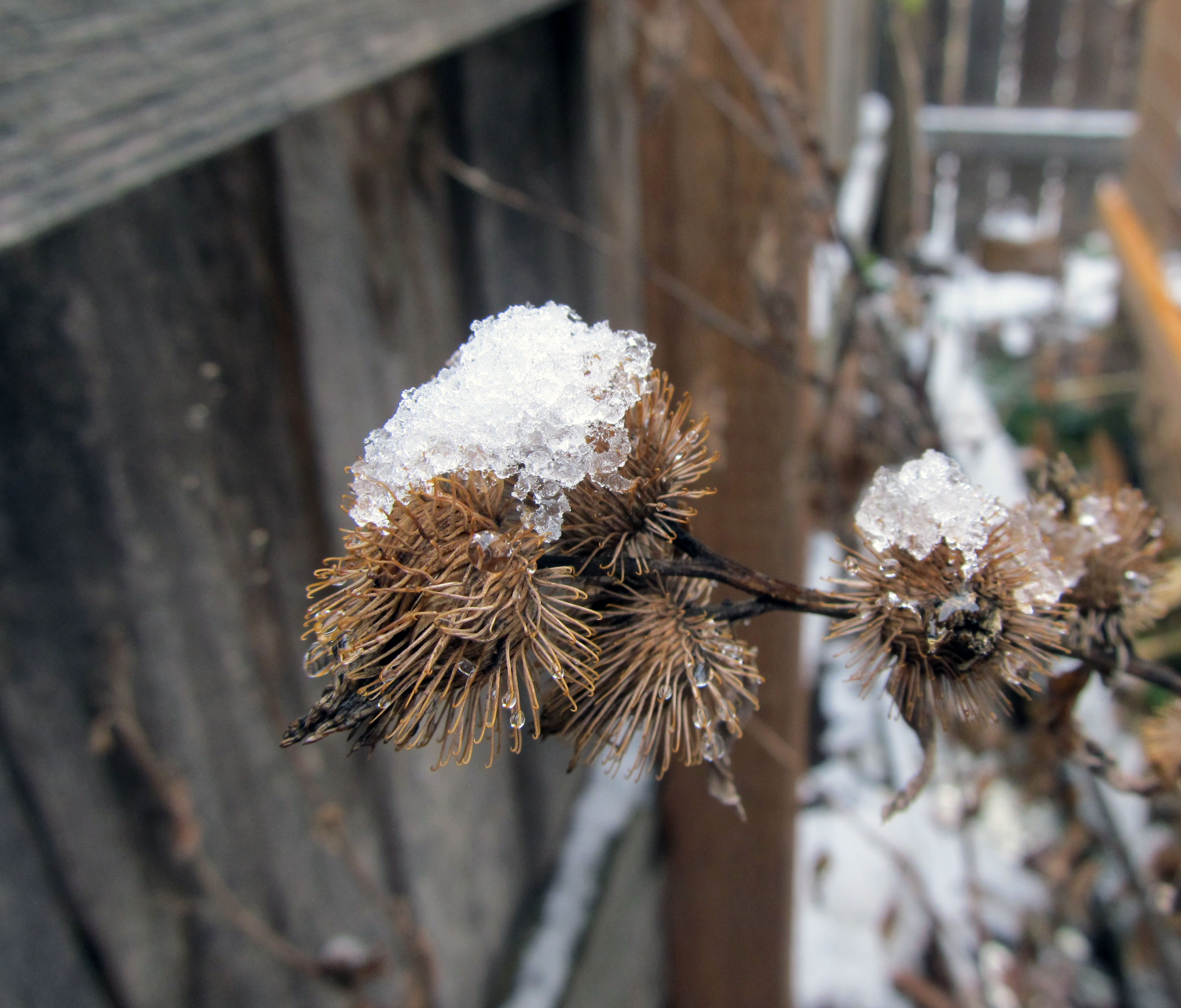
burr of common burdock (Arctium minus)

A paper published in The Canadian Veterinary Journal in 1973 describes the treatment for what is commonly known as burr tongue and technically referred to as granular stomatitis. The paper gives an account of what can happen when “long-haired breeds of dogs … run free in areas where [burdock] grows” and the hooked scales of the burrs consequently “penetrate the mucous membrane of the mouth and tongue.” Dogs with burrs imbedded in their mouths may start eating less or more slowly, drinking more water, and drooling excessively. As infection progresses, their breath can start to stink. A look inside the mouth and at the tongue will reveal lesions where the burrs have embedded themselves. Treatment involves putting the dog under anesthesia, scraping away the infected tissue, and administering antibiotics. Depending on the severity of the lesions, scar tissue can form where the barbs were attached.

To prevent infection from happening in the first place, a veterinarian can put the dog under anesthesia and use a camera inside the dog’s mouth and throat to search for pieces of the burr that may have gotten lodged. There is no guarantee that they will find them all or be able to remove them, and so the dog should be monitored over the next several days for signs and symptoms. At our veterinary visit, the vet also warned us that if any burrs were inhaled into the lungs, they could cause a lung infection, which is another thing to monitor for since it would be practically impossible for an x-ray or a camera to initially find them.

Luckily, now more than three weeks later, Kōura appears to be doing fine, and the offending burdock has been taken care of. One thing is for sure, as someone who is generally forgiving of weeds, burdock is one weed that will not be permitted to grow at Awkward Botany Headquarters.


For more adventures involving Kōura, be sure to follow her on Instagram @plantdoctordog.