When Milkweed Kills

When you think of milkweed, you probably think of the life it supports. The monarch butterfly, for one. As the sole food source for its leaf-eating larvae, monarchs would be a thing of the past if milkweeds disappeared. Numerous other insects feed on its foliage as well, and there are a plethora of organisms that feed on its nectar, including bees, butterflies, beetles, wasps, and other insects, as well as hummingbirds. And speaking of birds, some birds use the silky hairs attached to the seeds to line their nests, while other birds strip stringy fibers from the stems for nest building. And while it is not a major food source for mammals, deer and other animals have been known to sample it. Indeed, milkweed is a veritable life force.
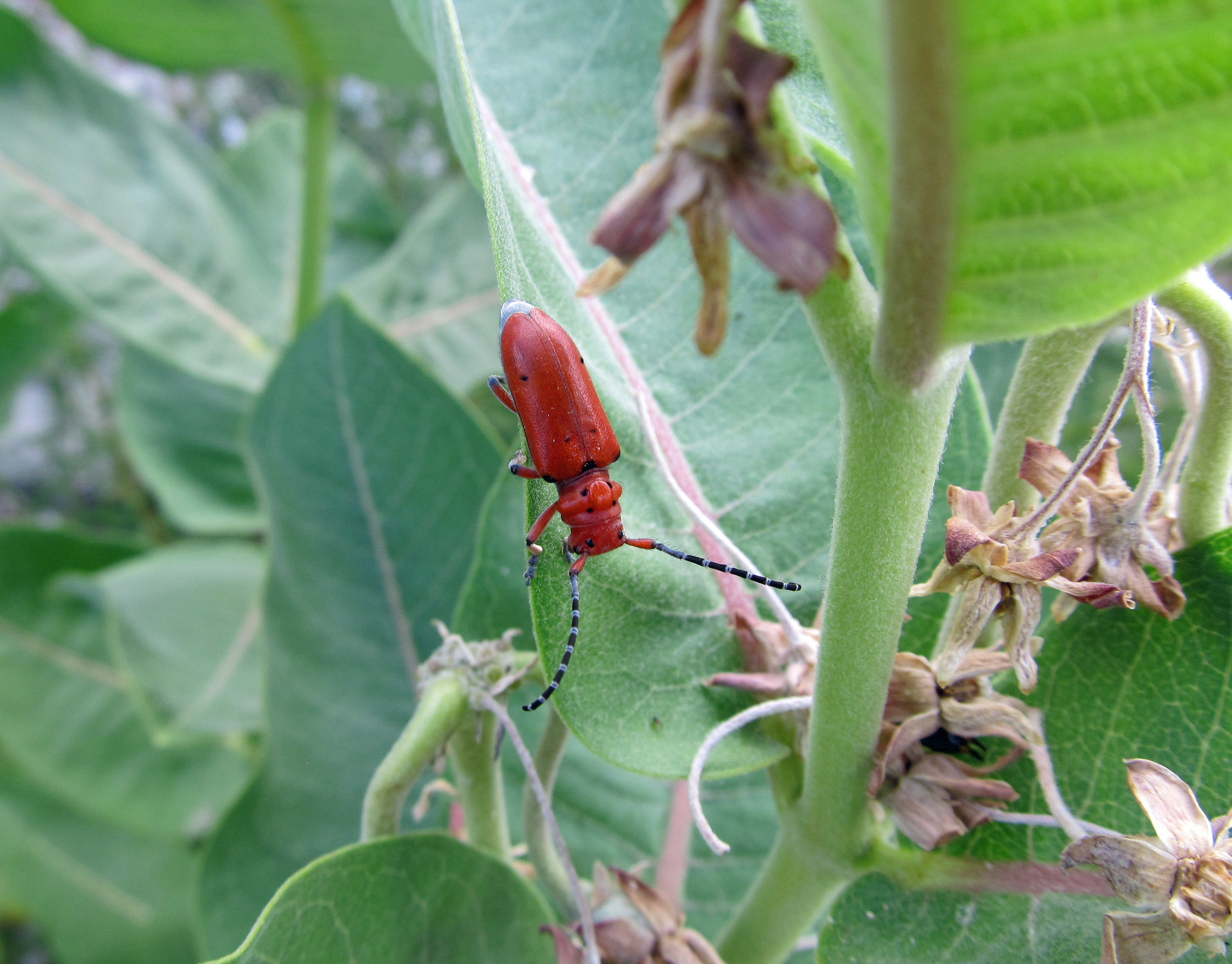
red milkweed beetle (Tetraopes sp.) feeds on milkweed

But it’s also a poisonous plant. The latex sap of milkweed contains cardiac glycosides, among a variety of other toxic chemicals. The plant produces these chemicals to defend itself from herbivory, and so the insects that feed on it have adapted a variety of strategies to avoid being poisoned. Some bite a hole in a leaf vein and wait for the milky sap to drain before proceeding to eat the leaf. Others are able to consume the toxic foliage without being poisoned by it. Some even store the toxic chemicals in their bodies, making themselves poisonous to other organisms that dare consume them.
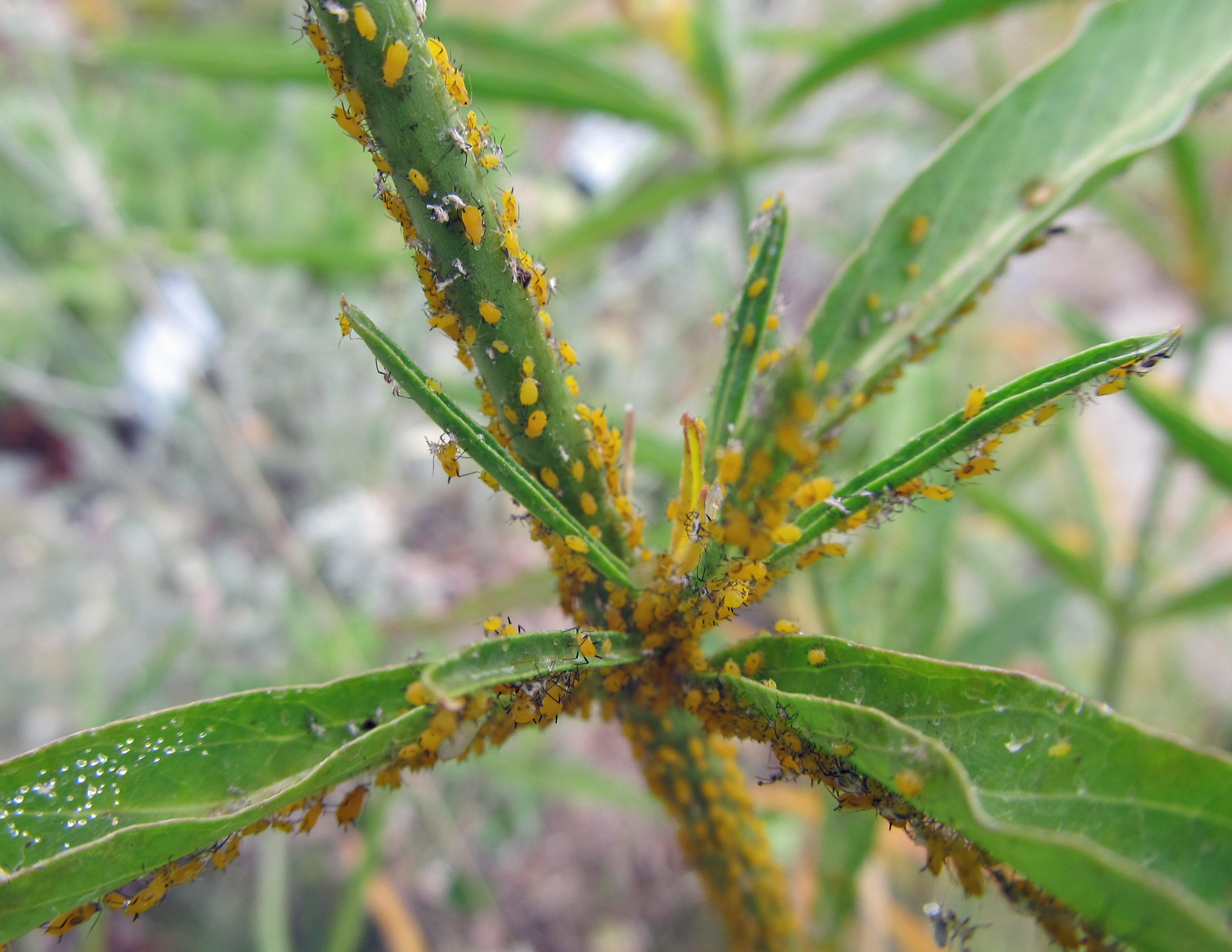
Aphids on Mexican whorled milkweed (Asclepias fascicularis). One species commonly found on milkweed is the oleander aphid (Aphis nerii), an introduced species that feeds on milkweeds and other plants in the dogbane family.

While milkweed is generally found to be unpalatable to most livestock, those that venture to eat it risk being poisoned and even killed. A guide to milkweed written by the Xerces Society states, “sheep and goats are the most likely to be poisoned because they are browsers and often prefer to feed on weeds over other forages.” Weeds of the West calls Utah milkweed (Asclepias labriformis) “the most poisonous of all western milkweeds,” claiming that “as little as one ounce of green leaf material … can kill an adult sheep.” It also lists swamp milkweed (Asclepias incarnata) as “suspected of causing livestock deaths.” To make matters worse, dead and dried milkweed plants retain their toxicity, which is a problem when they end up in animal feed.

Despite their toxicity, humans have been consuming milkweed for centuries. Young shoots and leaves can be eaten after boiling them several times, refreshing the water each time, and a medicinal tea can be made from the roots. While fatal poisonings of humans haven’t been reported, Nancy Turner and Patrick von Aderkas warn in their book The North American Guide to Common Poisonous Plants and Mushrooms that “uncooked shoots and the mature plants should never be consumed”

But milkweed’s toxic sap is not its only method for killing.

In fact, it may not even be its most deadly. And this is where things get interesting. Last month I arrived at work one morning to find a portion of a dried-up milkweed inflorescence on my desk that had been left there by a friend and co-worker. Stuck to the inflorescence were three, dead, dried-up honey bees, their legs trapped in the slotted hoods of the flowers. Apparently this is a common occurrence; one that is mentioned in nearly every resource about milkweeds that I have read now, and yet I had never heard of it nor seen it until this gift was left for me. I then went out to a patch of milkweed to see this for myself. Sure enough, I found a few dead bees trapped in the flowers of showy milkweed.
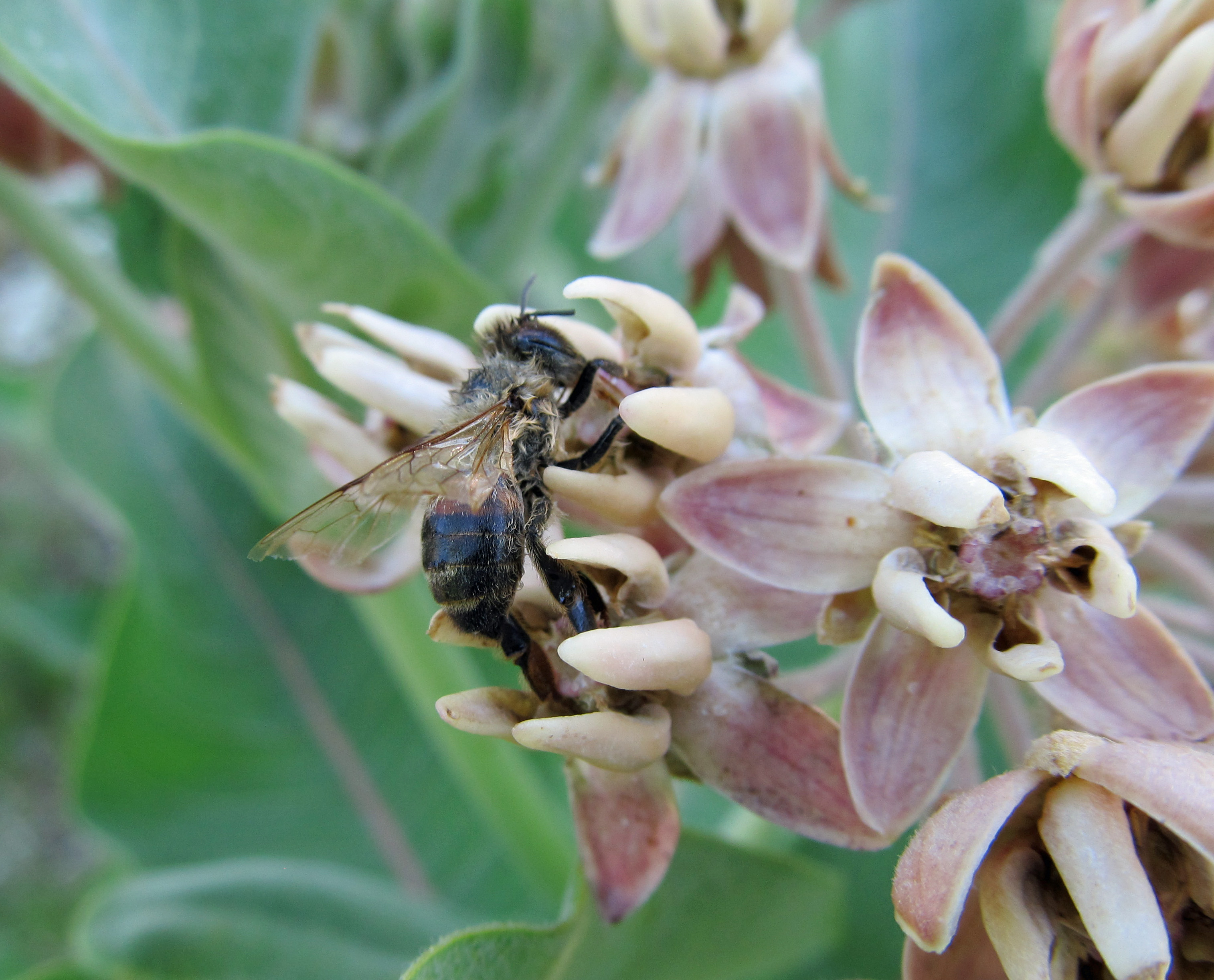
dead honey bee stuck in the flowers of showy milkweed (Asclepias speciosa)

Milkweed flowers do not always give up their pollen sacs easily. The slits where the pollinia are found can, on occasion, trap the legs of visiting insects. John Eastman describes this in The Book of Field and Roadside, “insects sometimes become permanently wedged as the fissures trap their feet or the pollinia entangle them, and they die hanging from the flowers.” While milkweed species are native to North America, honey bees are not; they have not evolved alongside the flowers of milkweed, yet they are drawn in, like so many other insects, to the nutritious and abundant nectar.

Native or not, honey bees are not the only insects getting trapped in the flowers. Eastman reports seeing various species of butterflies ensnared as well, and a paper by S.W. Frost lists cluster flies, soldier beetles, and a couple species of moths as unsuspecting victims of these unruly flowers. Frost goes on to observe that, “in spite of the hazards,” bees, wasps, and various other insects “visited the flowers of milkweeds freely.”

In a paper published in 1887, Charles Robertson describes the insect visitors of several different milkweed species. He found an occassional dead insect on the flowers of swamp milkweed, adding that “this occurs only when all or most of the feet are entangled simultaneously, so as to render the insect absolutely helpless.” Observing common milkweed (Asclepias syriaca), Robertson finds that “even when small and short-legged insects succeed in extracting pollinia and inserting them into the stigmatic chambers, they have great difficulty in breaking the retinacula, and often lose their lives in consequence.”

Honey bees were easily the most common victims observed in Robertson’s study, leading him to quip, “it seems that the flowers are better adapted to kill [honey bees] than to produce fruit through their aid.” And a honey bee’s trouble doesn’t always end when she escapes the grasp of the flowers. Pollinia and its connecting tissues can get so tangled around her legs and other body parts that she can no longer forage, subjecting herself to starvation and predation.

To add insult to injury, dead and dying insects stuck to flowers result in another interesting phenomenon. Robertson writes, “many fall prey to predacious insects. I have seen them while still alive, attacked by ants, spiders and [predatory stink bugs].” Eastman adds daddy longlegs to the list of “scavengers” or “cleanup specialists” that come to feed on “flower trapped insects.” As it turns out, visiting the flowers of milkweed can be a dangerous, even deadly, game.

See Also: Idaho’s Native Milkweeds

Idaho’s Native Milkweeds

An updated version of this post was posted on August 14, 2019. See it here.

———————-

Concern for monarch butterflies has resulted in increasing interest in milkweeds. Understandably so, as they are the host plants and food source for the larval stage of these migrating butterflies. But milkweeds are an impressive group of plants in their own right, and their ecological role extends far beyond a single charismatic insect. Work to save the monarch butterfly, which requires the expansion of milkweed populations, will in turn provide habitat for countless other organisms. A patch of milkweed teems with life, and the pursuit of a single caterpillar helps us discover and explore that.

Asclepias – also known as the milkweeds – is a genus consisting of around 140 species, 72 of which are native to the United States and Canada. Alaska and Hawaii are the only states in the United States that don’t have a native species of milkweed. The ranges of some species native to the United States extend down into Mexico where there are numerous other milkweed species. Central America and South America are also home to many distinct milkweed species.

The habitats milkweeds occupy are about as diverse as the genus itself – from wetlands to prairies, from deserts to forests, and practically anywhere in between. Some species occupy disturbed and/or neglected sites like roadsides, agricultural fields, and vacant lots. For this reason they are frequently viewed as a weed; however, such populations are easily managed, and with such an important ecological role to play, they don’t deserve to be vilified in this way.

Milkweed species are not distributed across the United States evenly. Texas and Arizona are home to the highest diversity with 37 and 29 species respectively. Idaho, my home state, is on the low end with six native species, most of which are relatively rare. The most common species found in Idaho is Asclepias speciosa commonly known as showy milkweed.

showy milkweed (Asclepias speciosa)

Showy milkweed is distributed from central U.S. westward and can be found in all western states. It occurs throughout Idaho and is easily the best place to look for monarch caterpillars. Side note: the monarch butterfly is Idaho’s state insect, thanks in part to the abundance of showy milkweed. This species is frequently found growing in large colonies due to its ability to reproduce vegetatively via adventitious shoots produced on lateral roots or underground stems. Only a handful of milkweed species reproduce this way. Showy milkweed reaches up to five feet tall and has large ovate, gray-green leaves. Like all milkweed species except one (Asclepias tuberosa), its stems and leaves contain milky, latex sap. In early summer, the stems are topped with large umbrella-shaped inflorescences composed of pale pink to pink-purple flowers.

The flowers of milkweed deserve a close examination. Right away you will notice unique features not seen on most other flowers. The petals of milkweed flowers bend backwards, allowing easy access to the flower’s sex parts if it wasn’t for a series of hoods and horns protecting them. Collectively, these hoods and horns are called the corona, which houses glands that produce abundant nectar and has a series of slits where the anthers are exposed. The pollen grains of milkweed are contained in waxy sacs called pollinia. Two pollinia are connected together by a corpusculum giving this structure a wishbone appearance. An insect visiting the flower for nectar slips its leg into the slit, and the pollen sacs become attached with the help of the corpusculum. When the insect leaves, the pollen sacs follow where they can be inadvertently deposited on the stigmas of another flower.

Milkweed flowers are not self-fertile, so they require assistance by insects to sexually reproduce. They are not picky about who does it either, and their profuse nectar draws in all kinds of insects including bees, butterflies, moths, beetles, wasps, and ants. Certain insects – like bumble bees and other large bees – are more efficient pollinators than others. Once pollinated, seeds are formed inside a pod-like fruit called a follicle. The follicles of showy milkweed can be around 5 inches long and house dozens to hundreds of seeds. When the follicle matures, it splits open to release the seeds, which are small, brown, papery disks with a tuft of soft, white, silky hair attached. The seeds of showy milkweed go airborne in late summer.

follicles forming on showy milkweed (Asclepias speciosa)

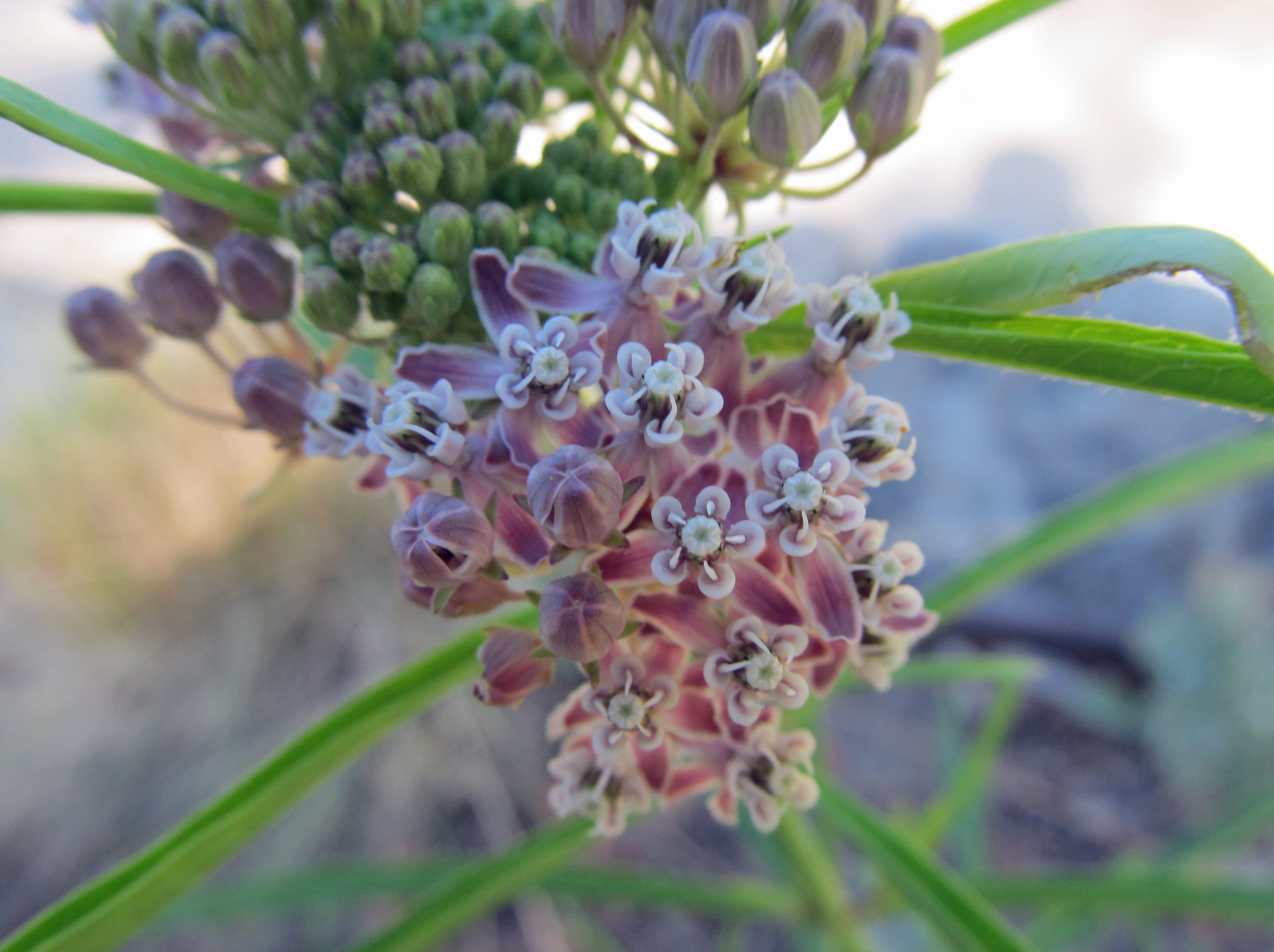
Whorled or narrowleaf milkweed (Asclepias fascicularis) is widespread in western Idaho and neighboring states. It is adapted to dry locations, but can be found in a variety of habitats. Like showy milkweed, it spreads rhizomatously as well as by seed. Its a whispy plant that can get as tall as four feet. It has long, narrow leaves and produces tight clusters of greenish-white to pink-purple flowers. Its seed pods are long and slender and its seeds are about 1/4 inch long.

flowers of Mexican whorled milkweed (Asclepias fascicularis)

seeds escaping from the follicle of Mexican whorled milkweed (Asclepias fascicularis)

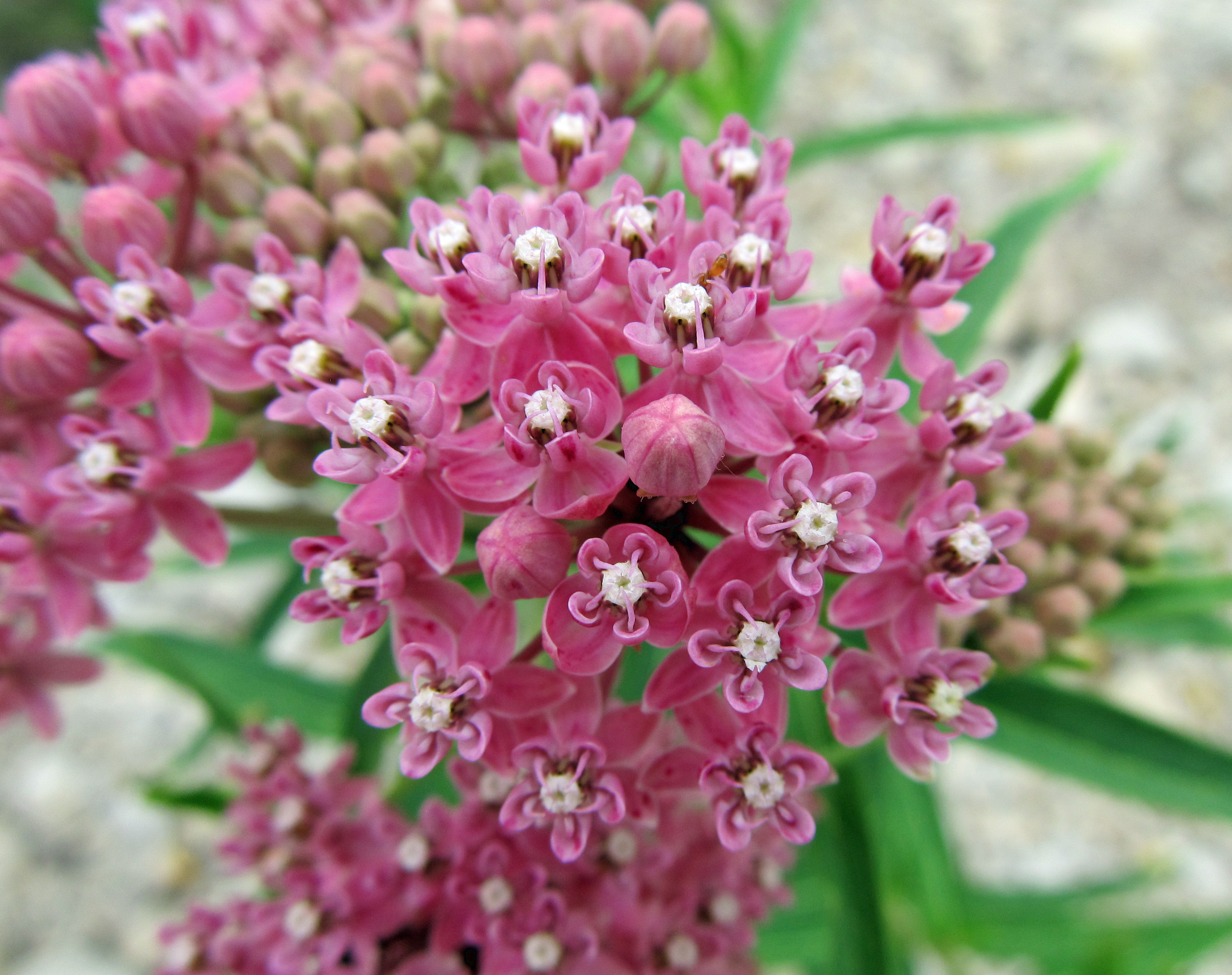
Swamp or rose milkweed (Asclepias incarnata) is more common east of Idaho, but occurs occasionally in southwestern Idaho. As its common names suggests, it prefers moist soils and is found in wetlands, wet meadows, and along streambanks. It can spread rhizomatously, but generally doesn’t spread very far. It reaches up to four feet tall, has deep green, lance-shaped leaves, and produces attractive, fragrant, pink to mauve, dome-shaped inflorescenses at the tops of its stems. Its seed pods are narrow and around 3 inches long.

swamp milkweed (Asclepias incarnata)

Asclepias cryptoceras, or pallid milkweed, is a low-growing, drought-adapted, diminutive species that occurs in southwestern Idaho. It can be found in the Owyhee mountain range as well as in the Boise Foothills. It has round or oval-shaped leaves and produces flowers on a short stalk. The flowers have white or cream-colored petals and pink-purple hoods.

pallid milkweed (Asclepias cryptoceras)

The two remaining species are fairly rare in Idaho. Antelope horns (Asclepias asperula) is found in Franklin County located in southeastern Idaho. It grows up to two feet tall with an upright or sprawling habit and produces clusters of white to green-yellow flowers with maroon highlights. Horsetail milkweed (Asclepias subverticillata) occurs in at least two counties in central to southeastern Idaho and is similar in appearance to A. fascicularis. Its white flowers help to distinguish between the two. Additional common names for this plant include western whorled milkweed and poison milkweed.

Eating Weeds: Burdock

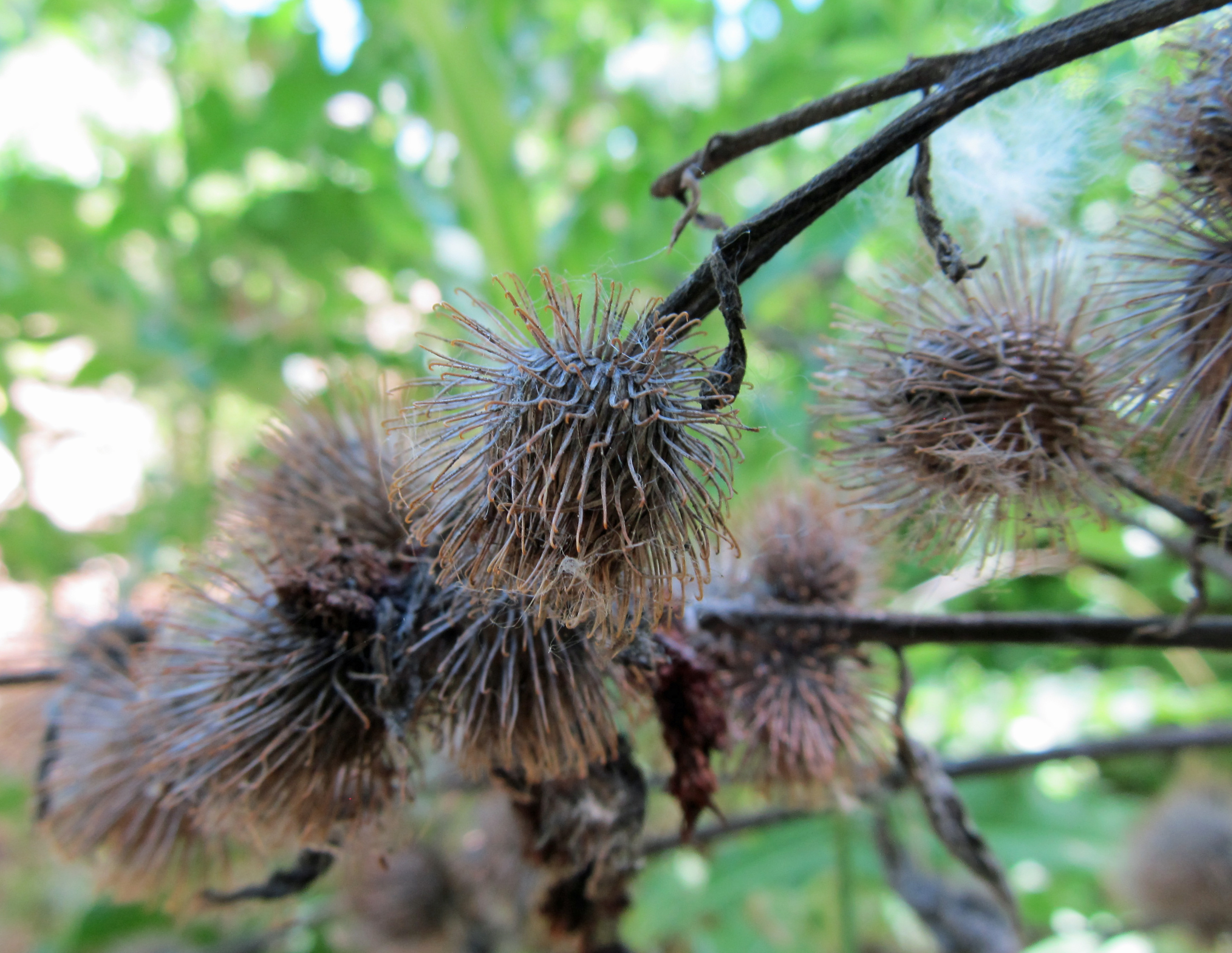
If we agree that weeds can be famous while simultaneously being infamous, a list of famous weeds must include burdock. Its fame largely comes from being an inspiration for the hook-and-loop fastener, Velcro. The idea for this revolutionary product came when Swiss inventor, George de Mestral, was removing burs – the dried inflorescences of burdock – from his dog in the early 1940’s. Most of us have experienced this, pulling out burs from animal hair or our own clothing, but few have felt inspired to develop a new product. Infamy reigns supreme.

But burdock’s fame isn’t tied to Velcro. Its tenacious, sticky burs, which house the seeds, have been attaching themselves to humans and other animals for centuries, frustrating those who have to remove them but finding new places to grow in the process. And what better way to pay tribute to this phenomenon than to dress oneself in hundreds of burs and parade around town calling yourself the Burry Man? Lest you think I’m crazy, just such a thing has been part of an annual celebration for over 300 years in a town outside of Edinburgh, Scotland.

burs of common burdock (Arctium minus)

Of course, burdock is more than its burs. Other, perhaps less celebrated features, are its edible roots and shoots. Its leaves are also edible, but most people find them too bitter to bother. Green Deane suggests wrapping the leaves around food to cook on a campfire. Both the roots and shoots can be eaten raw or cooked, and the fermented roots along with dandelion roots are traditional ingredients in the British beverage, dandelion and burdock. The roots, shoots, and leaves of burdock have also had a wide variety of medicinal uses.
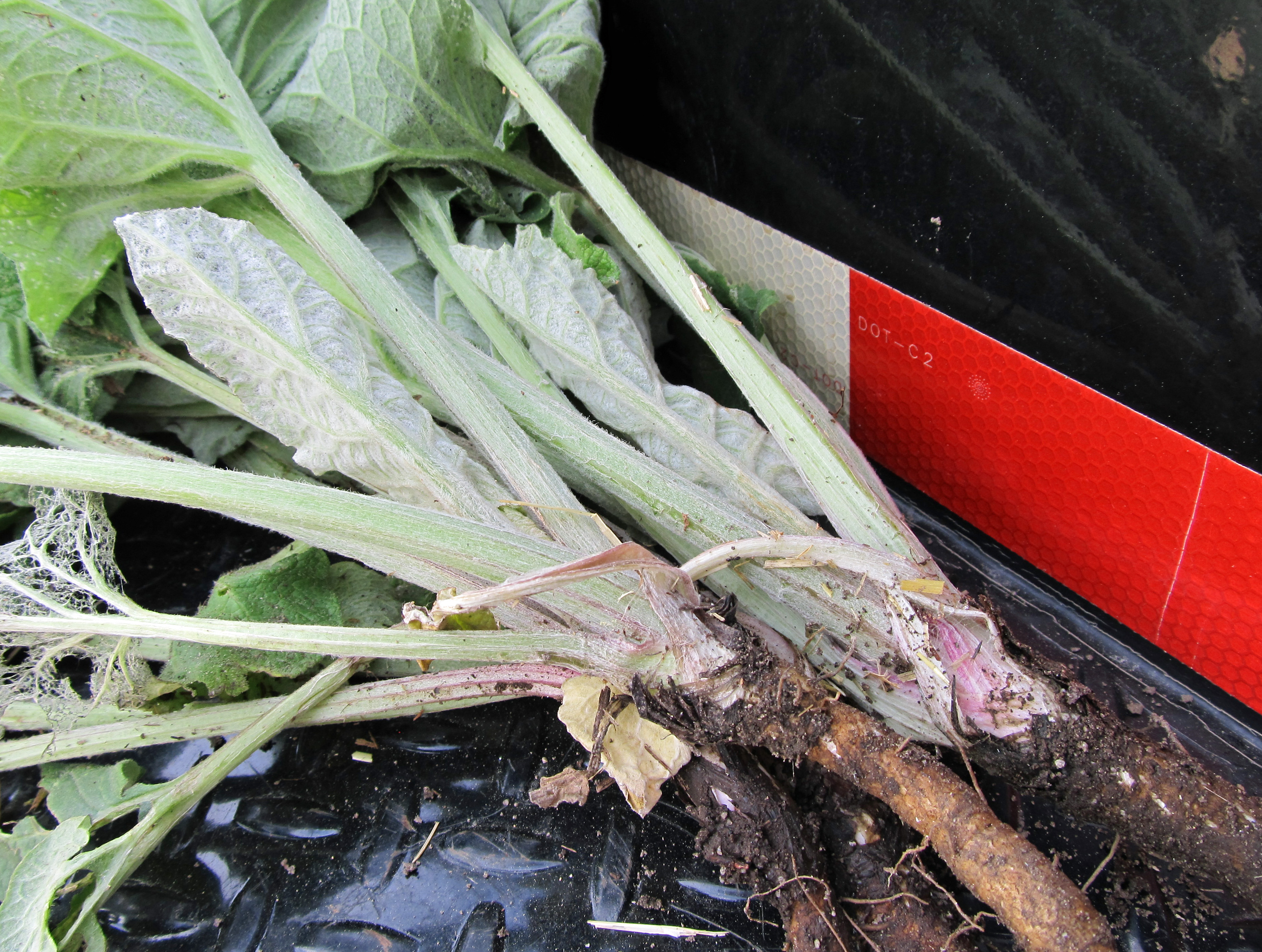
Two species of burdock have become naturalized in North America – Arctium minus and Arctium lappa. Both species are biennials or short-lived perennials. They start out as rosettes of large leaves with woolly undersides. The leaves grow to a foot or more long and wide. At this stage burdock is similar in appearance to rhubarb. Burdock has a large taproot, which can extend down to three feet in the ground. The taproot continues to grow as the rosette expands. When the plant has reached a certain size it begins to put up a branching flower stalk. It is in the rosette stage, before the plant bolts, that the taproot should be harvested.

As the flower stalk grows, the plant takes on a pyramidal shape, with the leaves along the stalk getting increasingly smaller with height. The plant can reach several feet tall, with one source describing them as towering up to ten feet. The stalks should be harvested before the plants start flowering. Multiple flower heads are produced at the ends of the branching stalk. The inflorescences are composed of purple, tubular, disc florets that are encased and encircled in a series of hooked bracts. The flower heads resemble thistle flowers, but the plant is easy to distinguish from thistles due to its large, soft leaves. Speaking of the leaves, one photographer found them alluring enough to compile a series of photos of them.

Common burdock (Arctium minus): the woolly undersides of the leaves and the tops of the taproots

While burdock can be nuisance plant, it is not particularly noxious. In The Book of Field and Roadside, John Eastman writes, “Burdock cannot be labeled a truly invasive weed, for it rarely intrudes into cultivated fields. Tilling usually controls and eradicates burdock populations. Its favored havens are the disturbed soils of roadsides, railroads, fence rows, vacant lots, and around sheds and old buildings.” In Wild Urban Plants of the Northeast, Peter Del Tredici also comments on burdock’s preference for minimally maintained locations including “vacant lots and rubble dump sites; the edges of emergent woodlands; the sunny borders of freshwater wetlands, ponds, and streams; and on unmowed highway banks and median strips with frequent salt applications.”

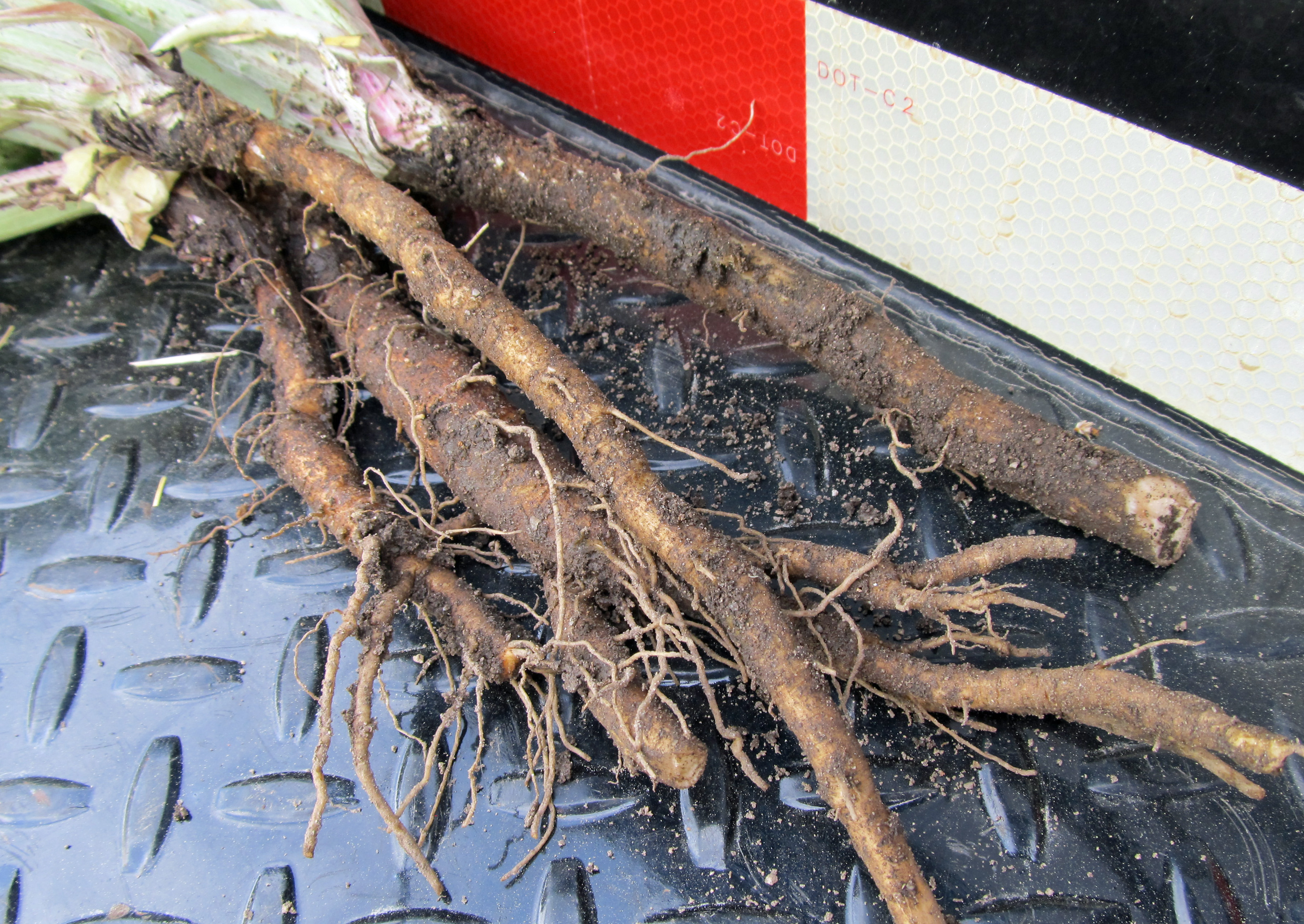
I harvested my burdock roots along an unmaintained fence line surrounding a series of raised flower beds. I chose a simple recipe for making burdock chips that involved peeling the roots, cutting them into thin slices, dressing them with olive oil and salt, and baking them in the oven. Since the author of this recipe mentioned buying burdock from a store, they were probably using Arctium lappa, or greater burdock, which is commonly cultivated, especially in Asian countries. Both species can be prepared in similar ways.

burdock roots

The burdock chips had a pleasant nutty flavor, but they were also a little stringy and tough to chew. If I were to do it again, I would probably use a recipe like this one that involves parboiling and then frying. Sierra suggested grating the roots and frying them in bacon grease, which would probably do the trick. There are also recipes for pickled burdock roots, which would be fun to try.

Because the plants I harvested were still in their rosette stage and there weren’t any other plants in the area that were bolting, I didn’t try the shoots. But I’ll keep my eye out, and when I find some I may have to write a part two.

Eating Weeds: Pineapple Weed

When I wrote about pineapple weed (Matricaria discoidea) last year during the Summer of Weeds, I knew that it was edible but I didn’t bother trying it. Pineapple weed is one of my favorite native weeds (yes, it happens to be a native of northwestern North America). I enjoy its sweet fragrance, its frilly leaves, its “petal”-less flowers, and its diminutive size. I also appreciate its tough nature. Now that I have tried pineapple weed tea, I have another thing to add to this list of pros.

pineapple weed (Matricaria discoidea)

One thing about pineapple weed that always impresses me is its ability to grow in the most compacted soils. It actually seems to prefer them. It is consistently found in abundance in highly trafficked areas, like driveways, parking lots, and pathways, seemingly unfazed by regular trampling. Referring to pineapple weed in one of his books about wildflowers, botanist John Hutchinson wrote, “the more it is trodden on the better it seems to thrive.” This is not something you can say about too many other plants.

Both the leaves and flowers of pineapple weed are edible. The flowers seem to be the more common of the two to consume, generally in tea form. In his book Wild Edible and Useful Plants of Idaho, Ray Vizgirdas writes, “A delicious tea can be made from the dried flowers of the plant. The leaves are edible, but bitter. The medicinal uses of pineapple weed are identical to that of chamomile (Anthemis). Used as a tea it is a carminative, antispasmodic, and mild sedative.” In Wild Urban Plants of the Northeast, Peter Del Tredici writes, “A tea made from the leaves has been used in traditional medicine for stomachaches and colds.”

I harvested my pineapple weed at the end of a dirt parking lot and in an adjacent driveway/pathway. I noted how the pineapple weed’s presence waned as I reached the edges of the parking lot and pathway where, presumably, the ground was less compact. Maybe it has more to compete with there – other weeds – and so it shows up less, or maybe its roots simply “prefer” compact soils. Perhaps a little of both. Once I got my harvest home, I rinsed it off and left it to dry. Later, I snipped off the flower heads and made a tea.

I probably used more water than I needed to, so it was a bit diluted, but it was still delicious. It smelled and tasted a lot like chamomile. Sierra agreed. With a little honey added, it was especially nice. Sierra agreed again. The flowers of pineapple weed can be used fresh or dried. They can also be mixed with other ingredients to make a more interesting tea, like the recipe found here.

If you are hesitant to take the leap into eating weeds, a tea may be the simplest thing you can try. Pineapple weed tea is a great way to ease yourself into it. Apart from maybe having to harvest it from strange places, it probably isn’t much different from other teas you have tried, and, from my experience, it’s delightful.

Eating Weeds: Lambsquarters

Last year during the Summer of Weeds I inadvertently wrote about several edible weeds, one of which I even ate. It’s not surprising that so many weeds are edible; there are plenty of plants out there – both native and introduced – that are, despite the fact that most of us stick with whatever is made available at the grocery store. Some edible weeds, dandelion included, were once commonly grown for food, while other weeds are close relatives of present day agricultural crops. The more I read about these things and the more my weeds obsession grows, the more I feel compelled to eat them (the edible ones, at least). Hence, a new series of posts: Eating Weeds.

I might as well start with an easy one. Chenopodium album, or lambsquarters, which I wrote about last summer, is a close relative of a number of common crops and a spitting image of quinoa. It happily grows alongside other plants in our vegetable gardens without even being asked to. It is highly nutritious and palatable – particularly the young leaves – and can be eaten raw or cooked. It is often compared to spinach and can be prepared and used in similar ways.

lambsquarters seedling (Chenopodium album)

For the purposes of this post, I decided to try lambsquarters pesto. While pesto is traditionally made using basil leaves, all kinds of other leaves – or combinations thereof – can be substituted. I have made pesto with parsley, which was interesting, as well as watercress, which was delicious. The possibilities are endless. So, why not lambsquarters?

Making pesto is incredibly simple. Blend together a combination of leaves, garlic, nuts or seeds, Parmesan cheese (or something similar), olive oil, salt, and pepper. Pine nuts are traditionally used to make pesto, but like the leaf component, a number of different nuts or seeds can be substituted. I rarely make pesto with pine nuts because, despite being delicious, they are pricey.

lambsquarters pesto

I made two batches of lambsquarters pesto. For the first I used walnuts, and for the second I used sunflower seeds. Both batches were delicious. How could they not be with all of that garlic and cheese in there? Lambsquarters is not a very bitter or strong-tasting green, so lambsquarters pesto might be perfect for anyone who is otherwise not fond of pesto (although that is a stance that I personally cannot fathom).

This is definitely something I will make again. I understand the frustration people have with lambsquarters. It can be prolific and hard to eliminate from a garden. Luckily, it makes an excellent pesto.

Resources:

———————

This series of posts was inspired in part by the book Dandelion Hunter, in which the author, Rebecca Lerner, attempts to go a full week eating only things she is able to forage in her hometown of Portland, Oregon. As you might imagine, many of the plants she forages are weeds.  

Field Trip: Hyatt Hidden Lakes Reserve

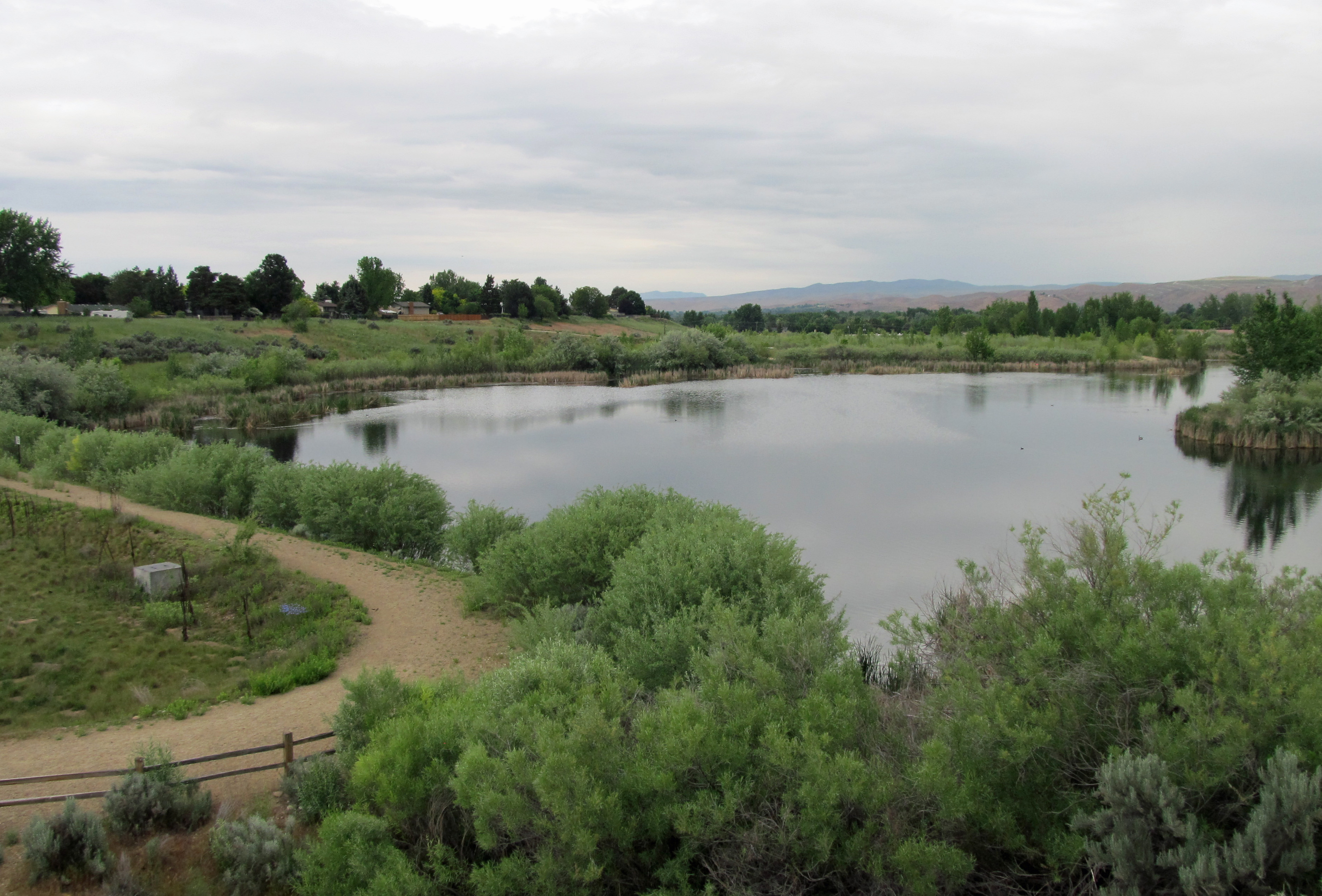
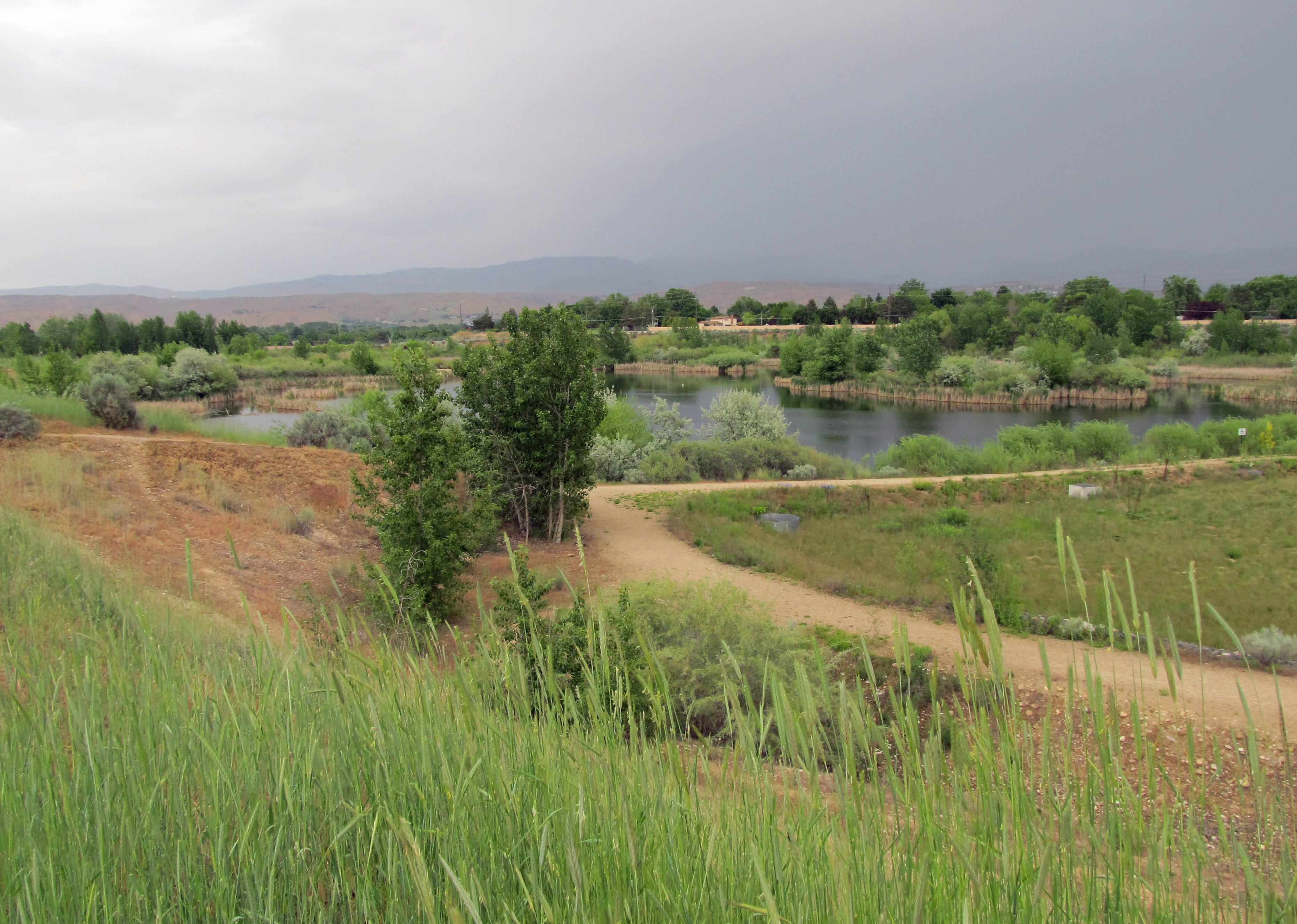
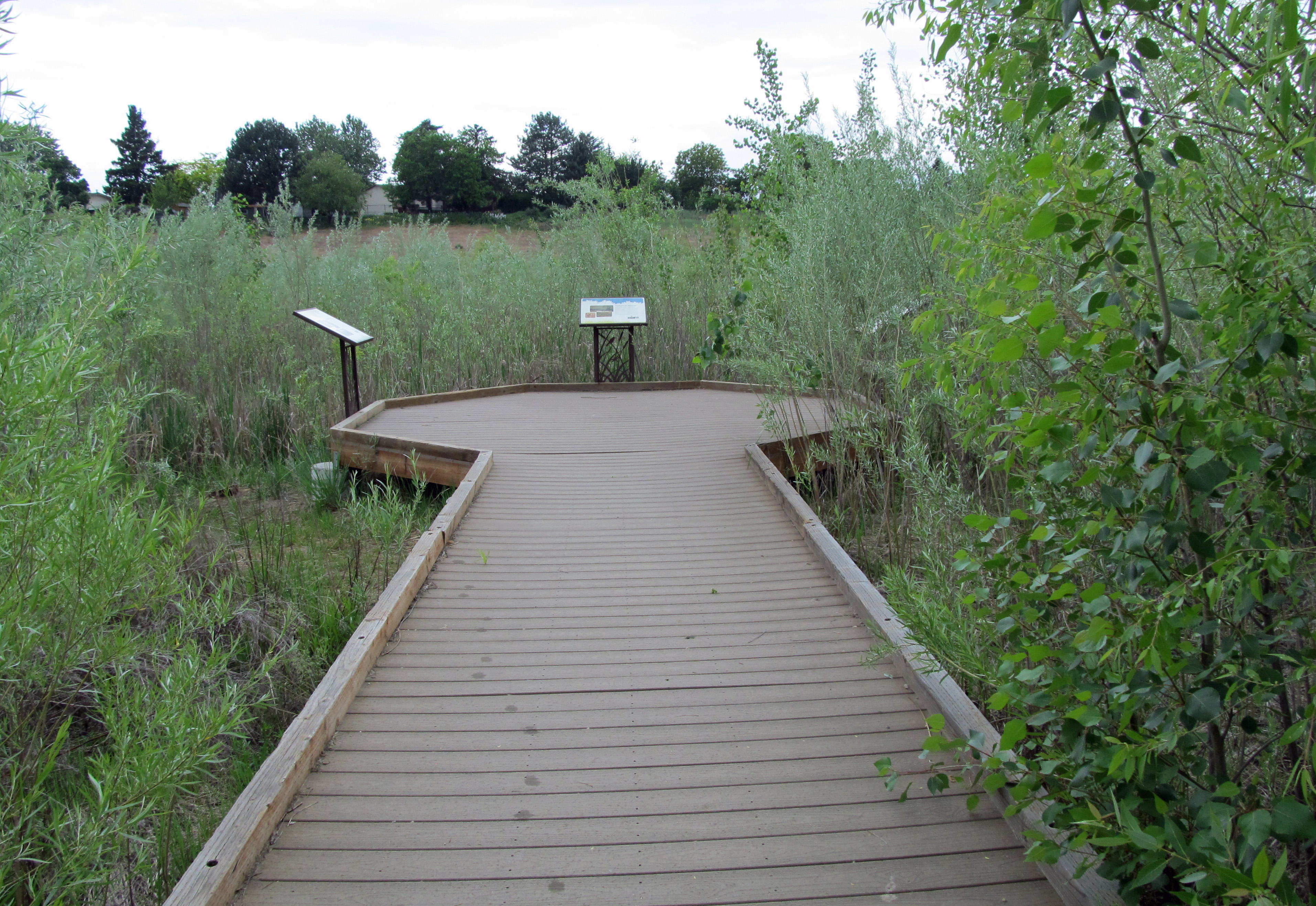
May is American Wetlands Month, which I have written about a few times here. The way we like to celebrate is to find a wetland nearby and spend a couple hours exploring and learning about the area. Luckily there is a wetland a few miles from our house. Hyatt Hidden Lakes Reserve is a 54 acre, city-owned wetland and nature reserve that is open to the public. It features a series of trails designed for nature viewing and recreation. Along the way there is a series of interpretative signs with lots of information about wetlands and the flora and fauna that call them home.

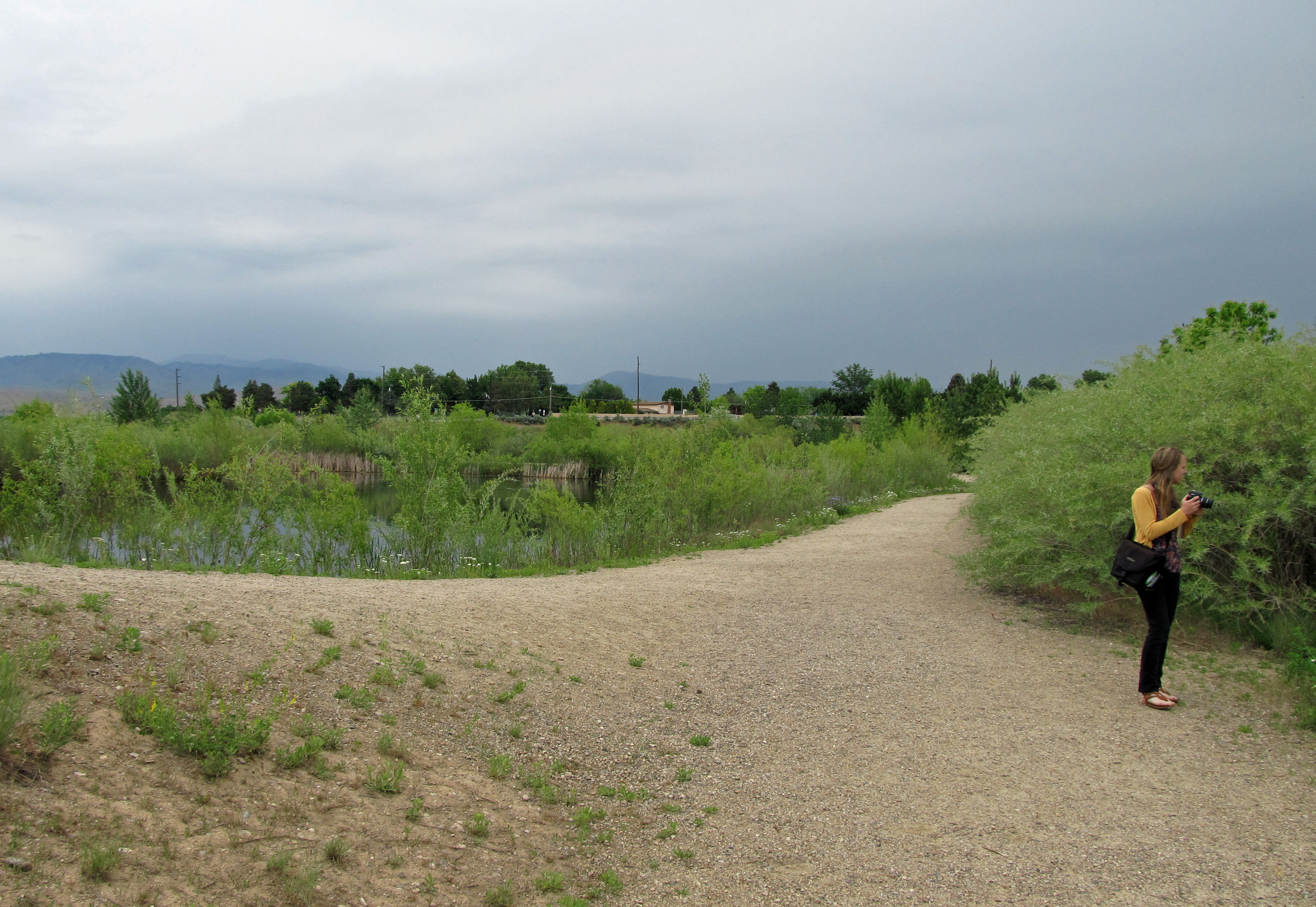
One cloudy Sunday morning, Sierra and I ventured out to our neighborhood wetland. What follows is a photo diary of a few of the things we saw while we were there.

The southwest corner of Hyatt Hidden Lakes Reserve

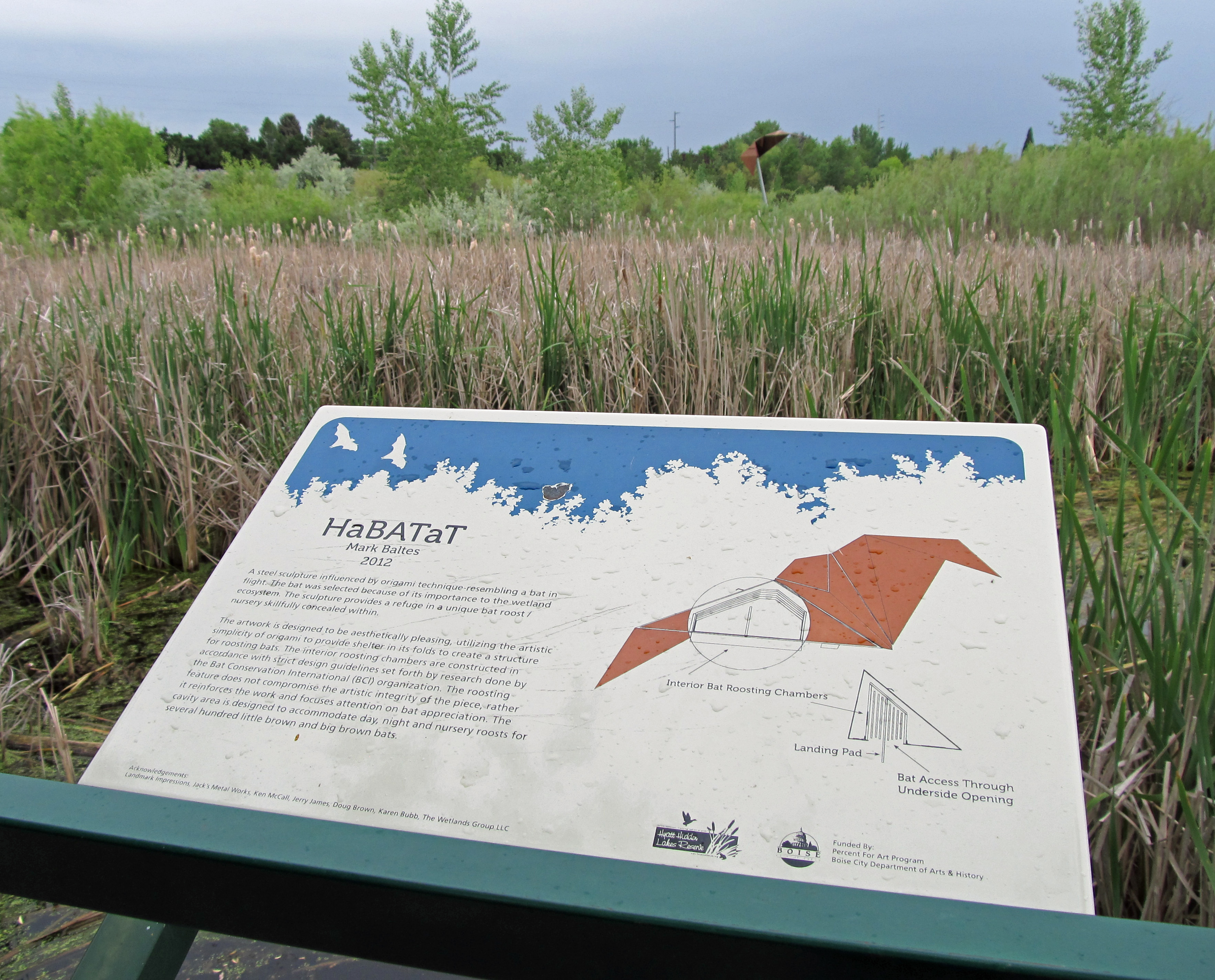
One of the coolest features of the reserve is this bat house called HaBATat.

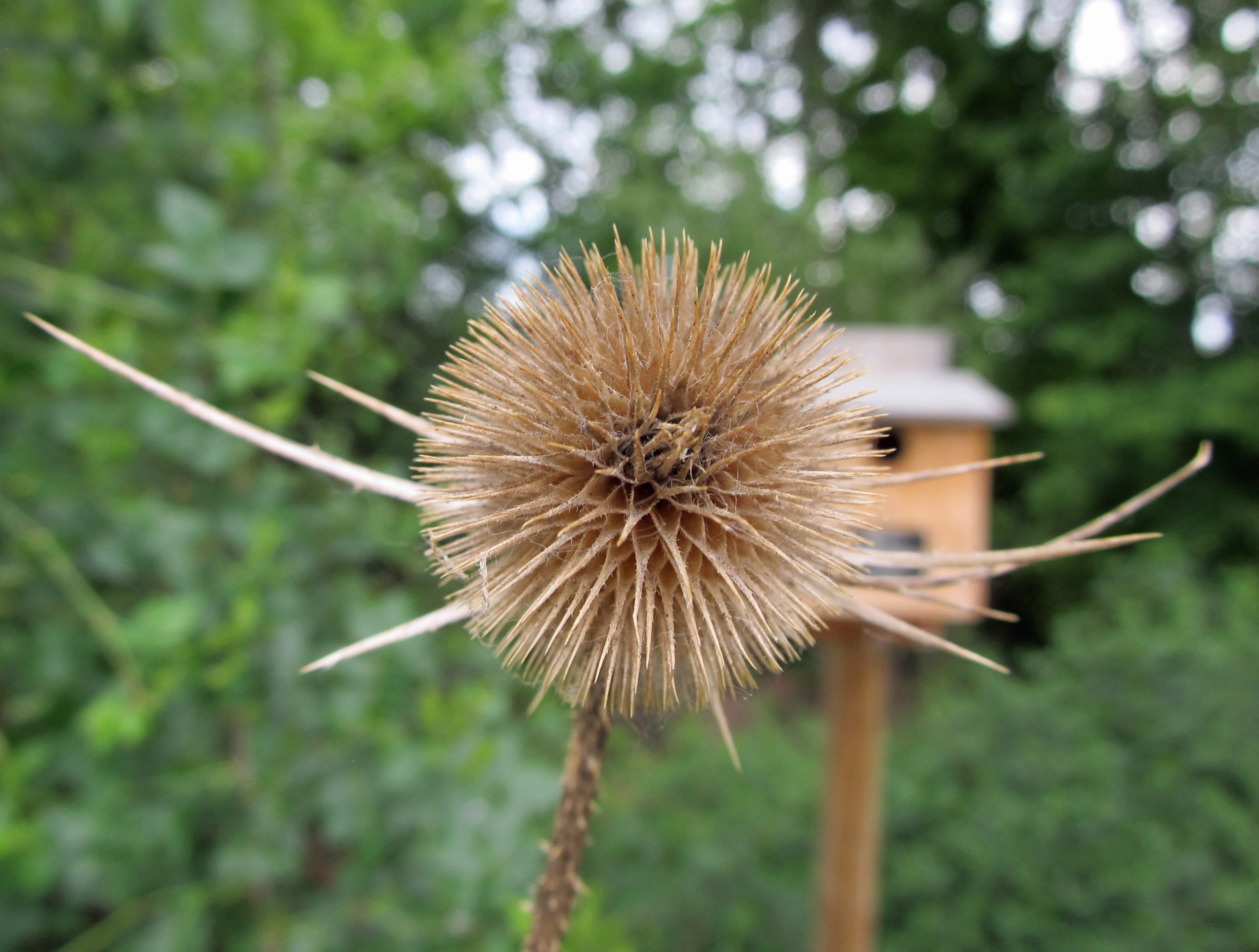
Seed head of teasel (Dipsacus fullonum); behind it are a series of bird nests designed for various species of cavity nesters.

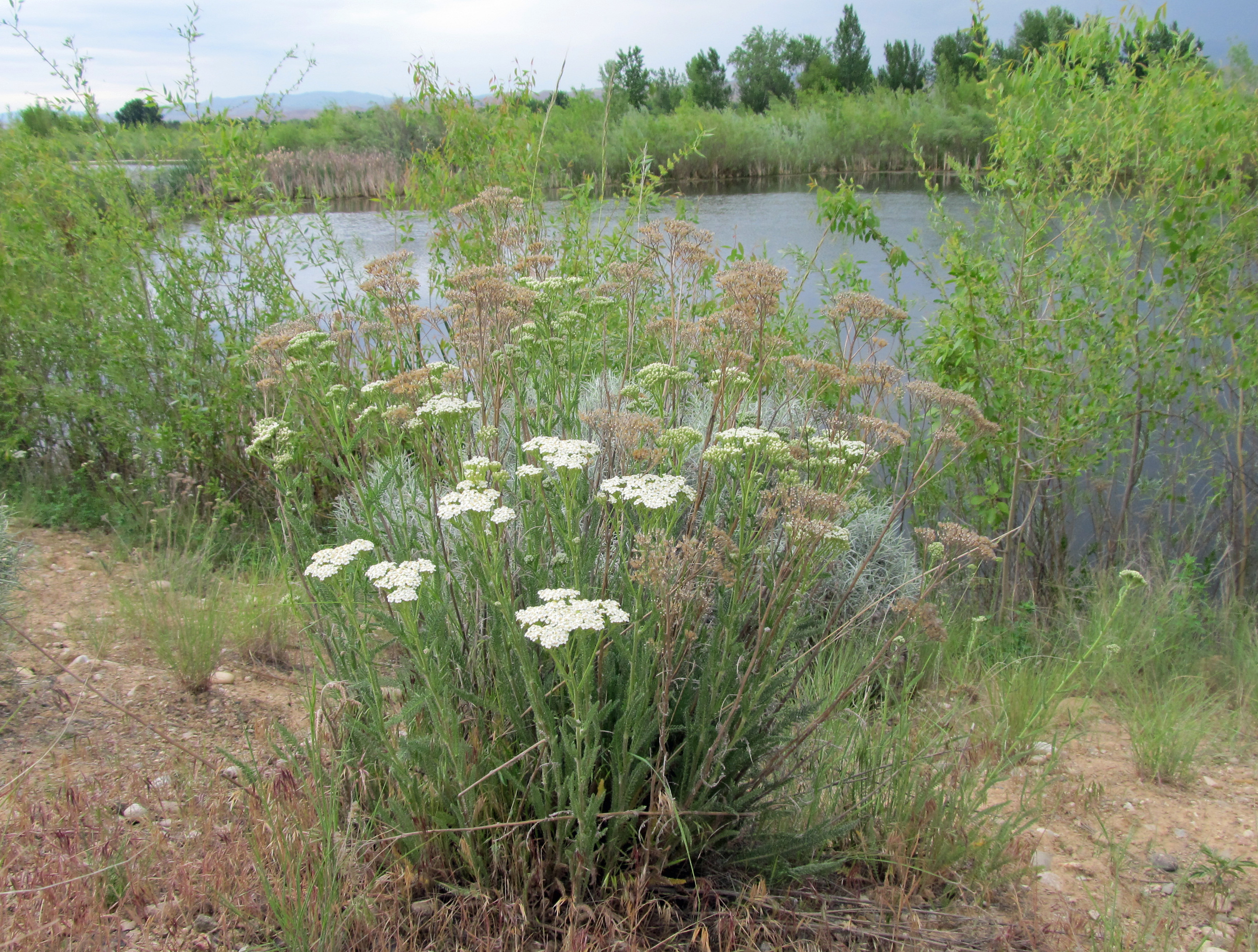
Common yarrow (Achillea millefolium) with a view of one of the ponds behind it.

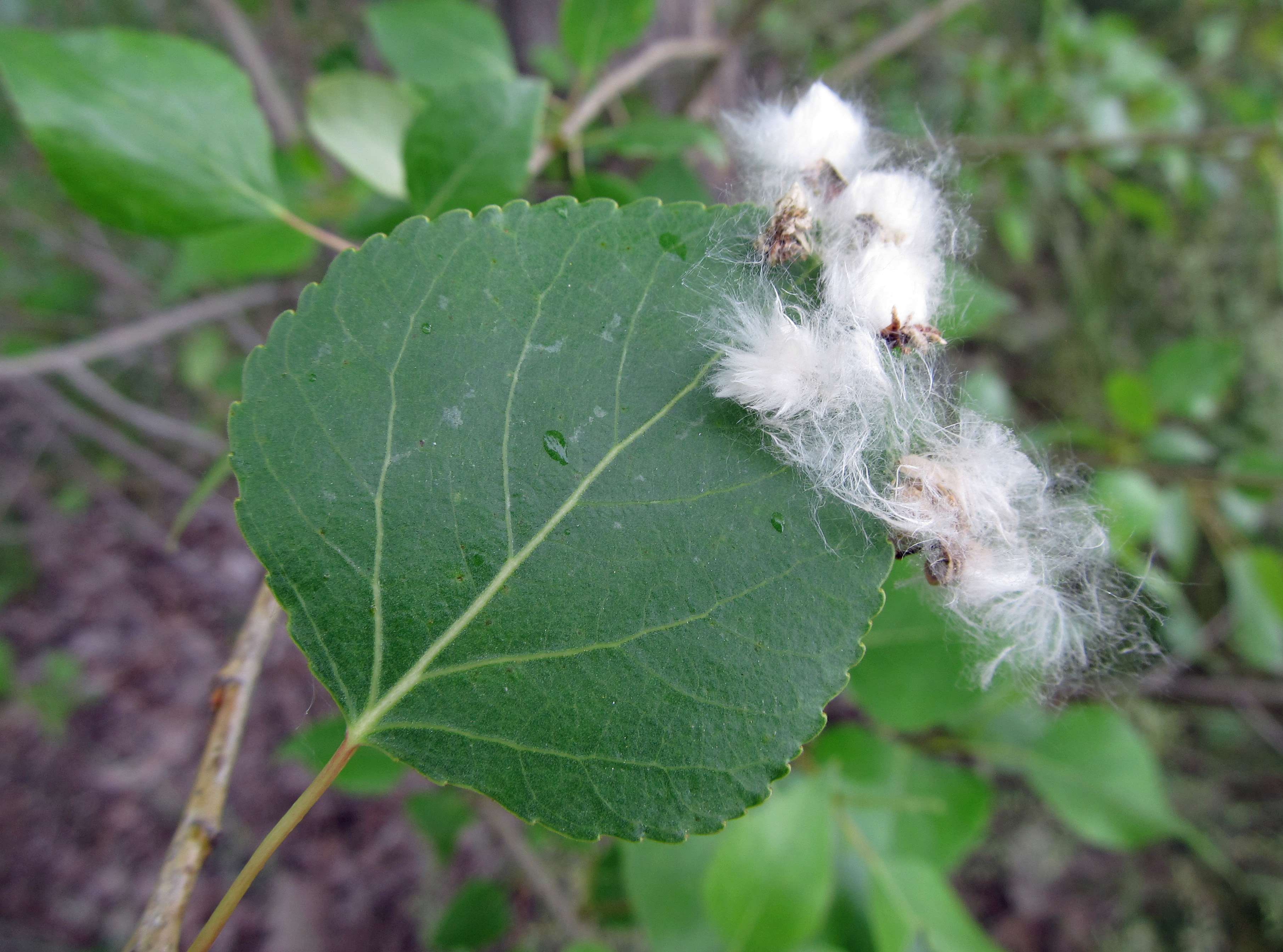
We visited shortly after the cottonwoods (Populus spp.) had dropped their fluffy seeds.

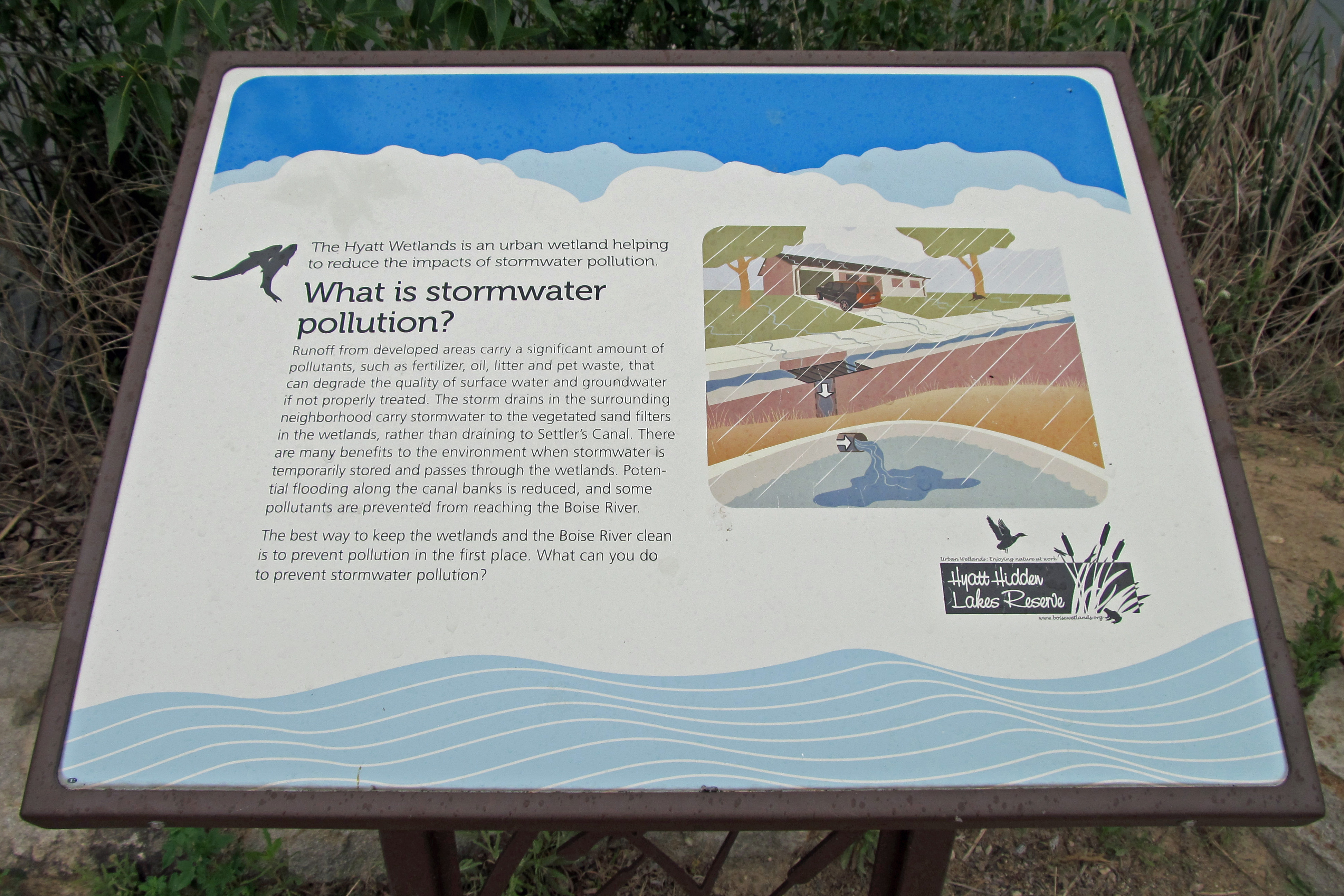
Interpretive signage like this teach visitors about the various features and benefits of wetlands.

Walkways like this one allow for a closer view of the wetlands and feature additional interpretive signage.

Sierra spots something in the shrubbery.

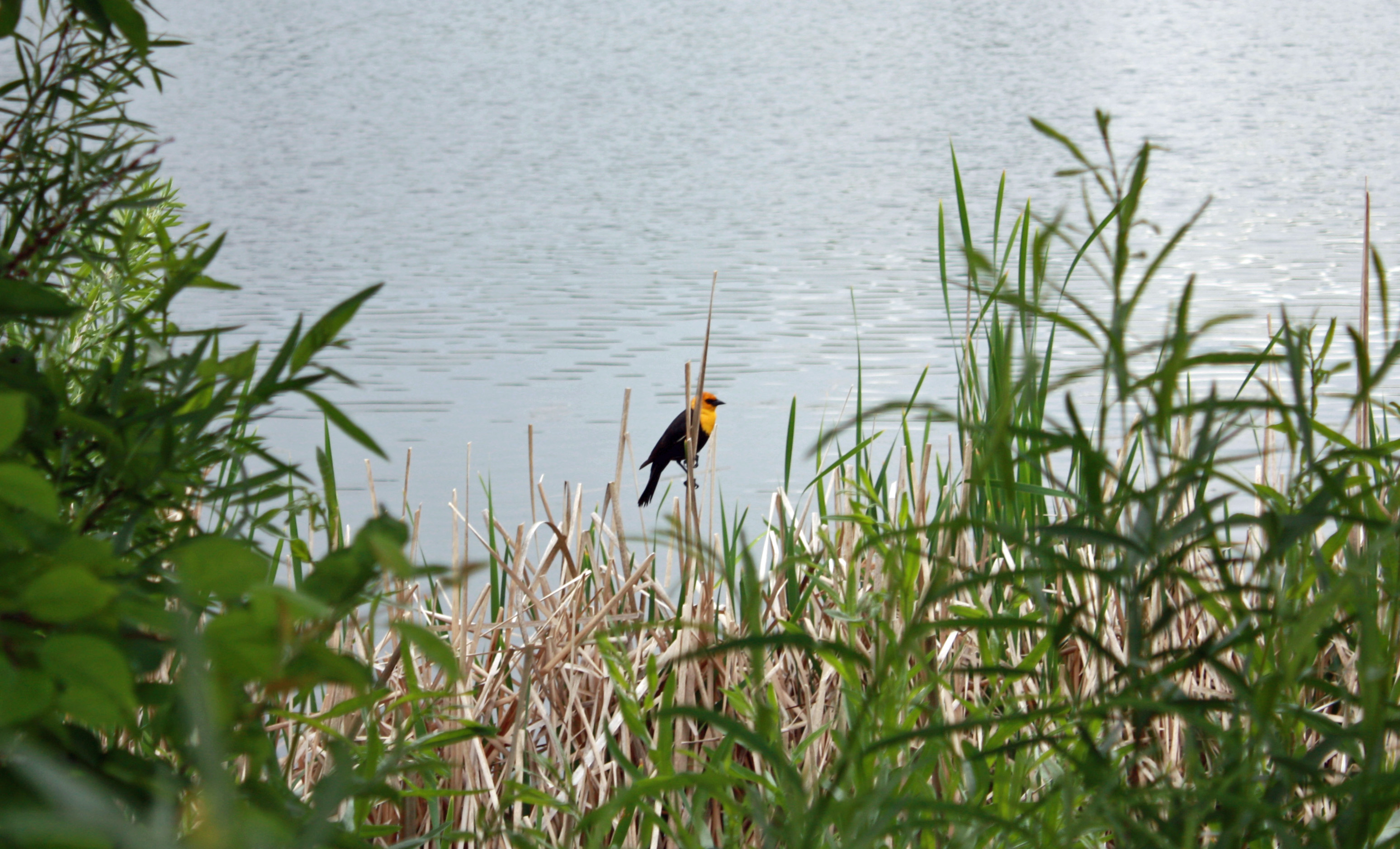
Perhaps it was this yellow-headed blackbird.

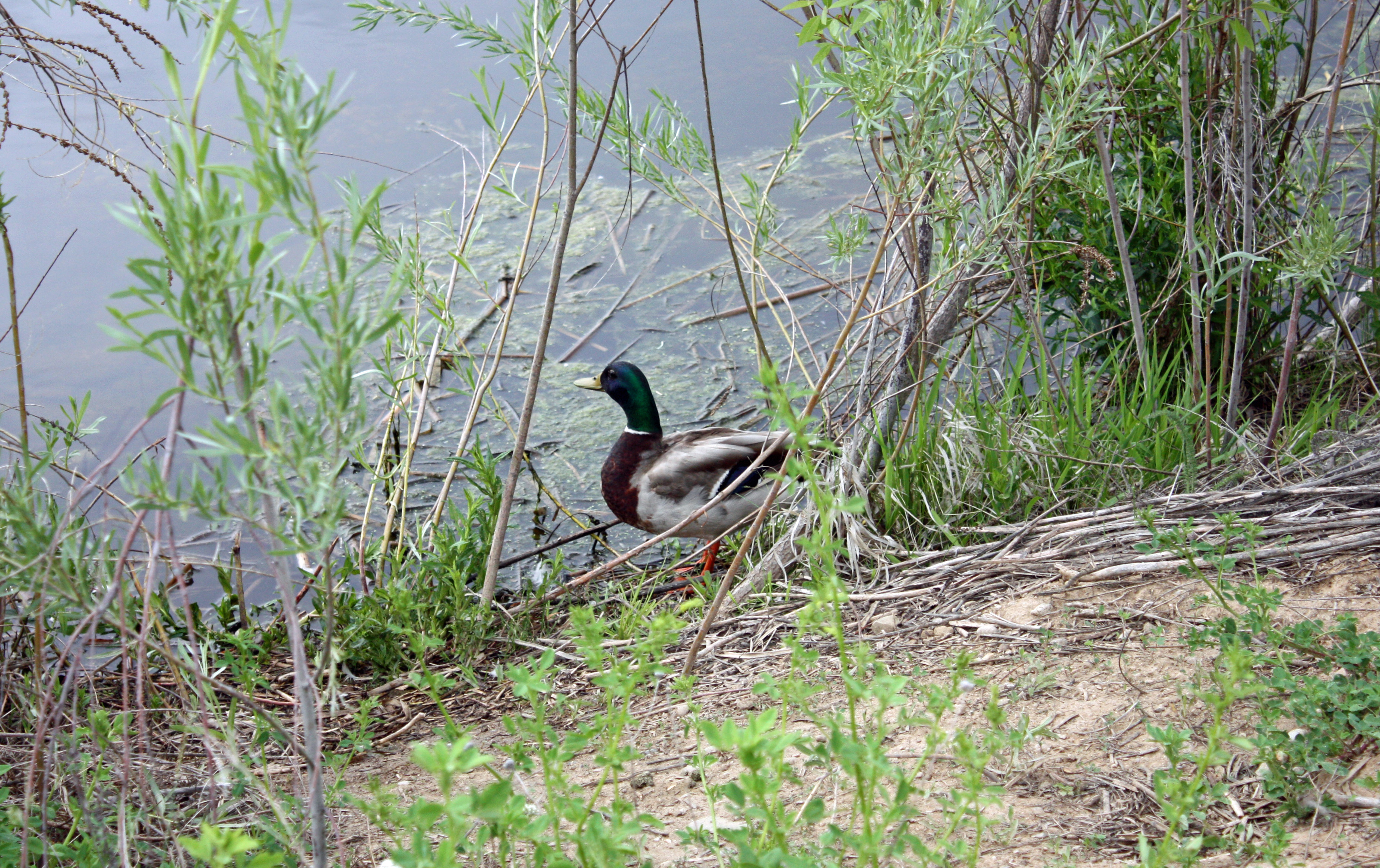
Or maybe this male mallard.

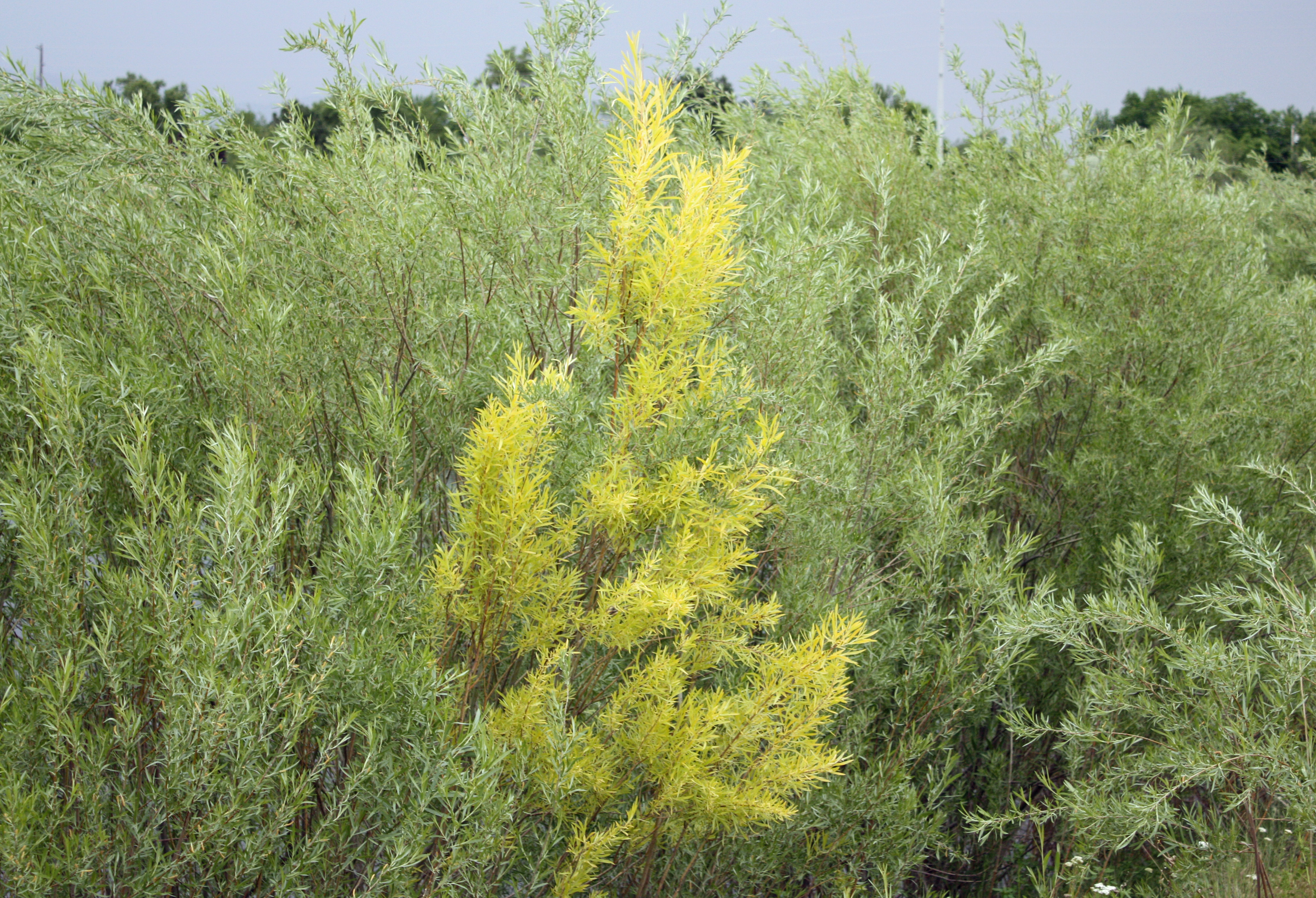
One strange-looking, yellow-leaved branch among the willows (Salix sp.); Sierra and I wondered why.

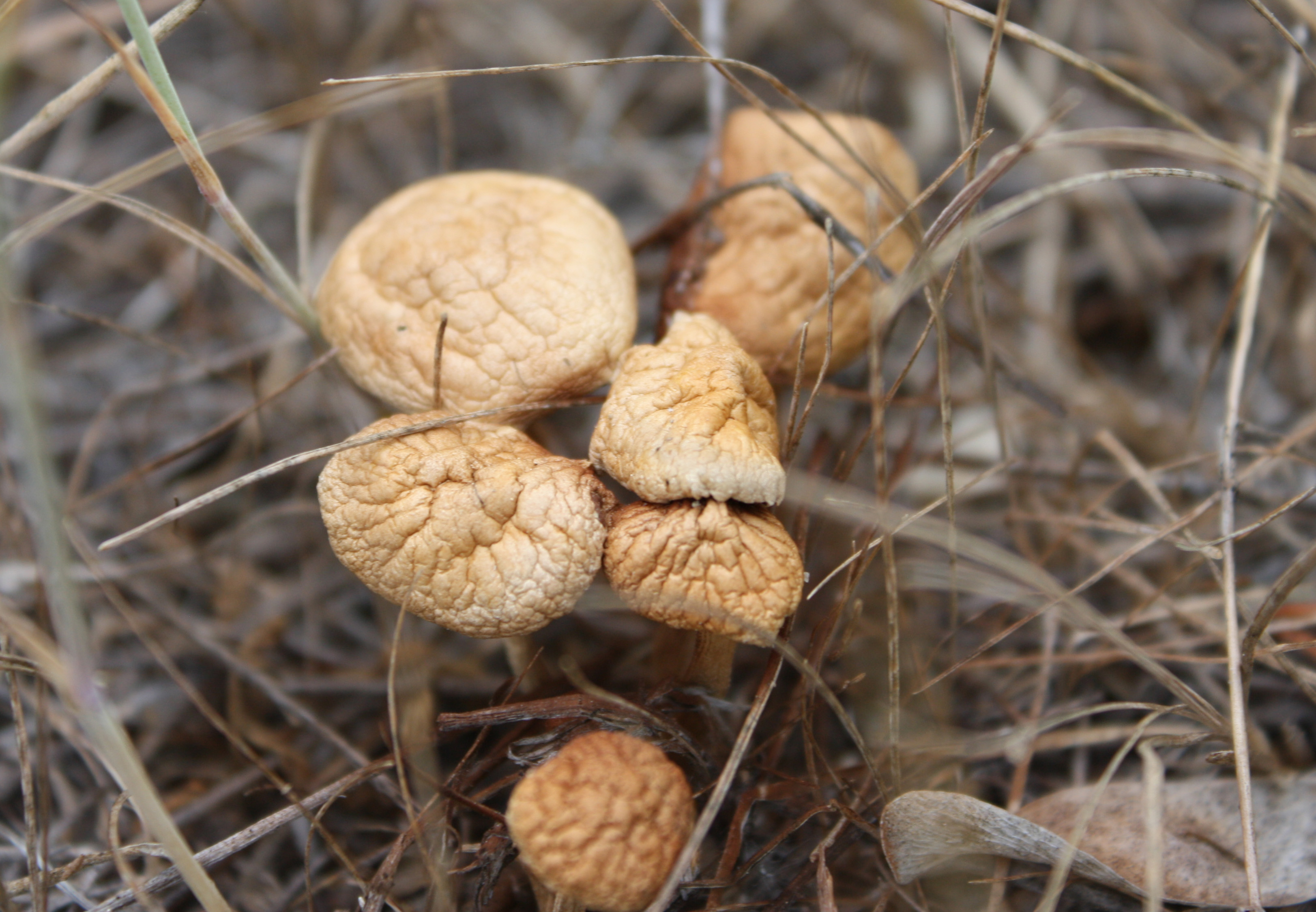
Some wrinkly mushrooms that Sierra discovered.

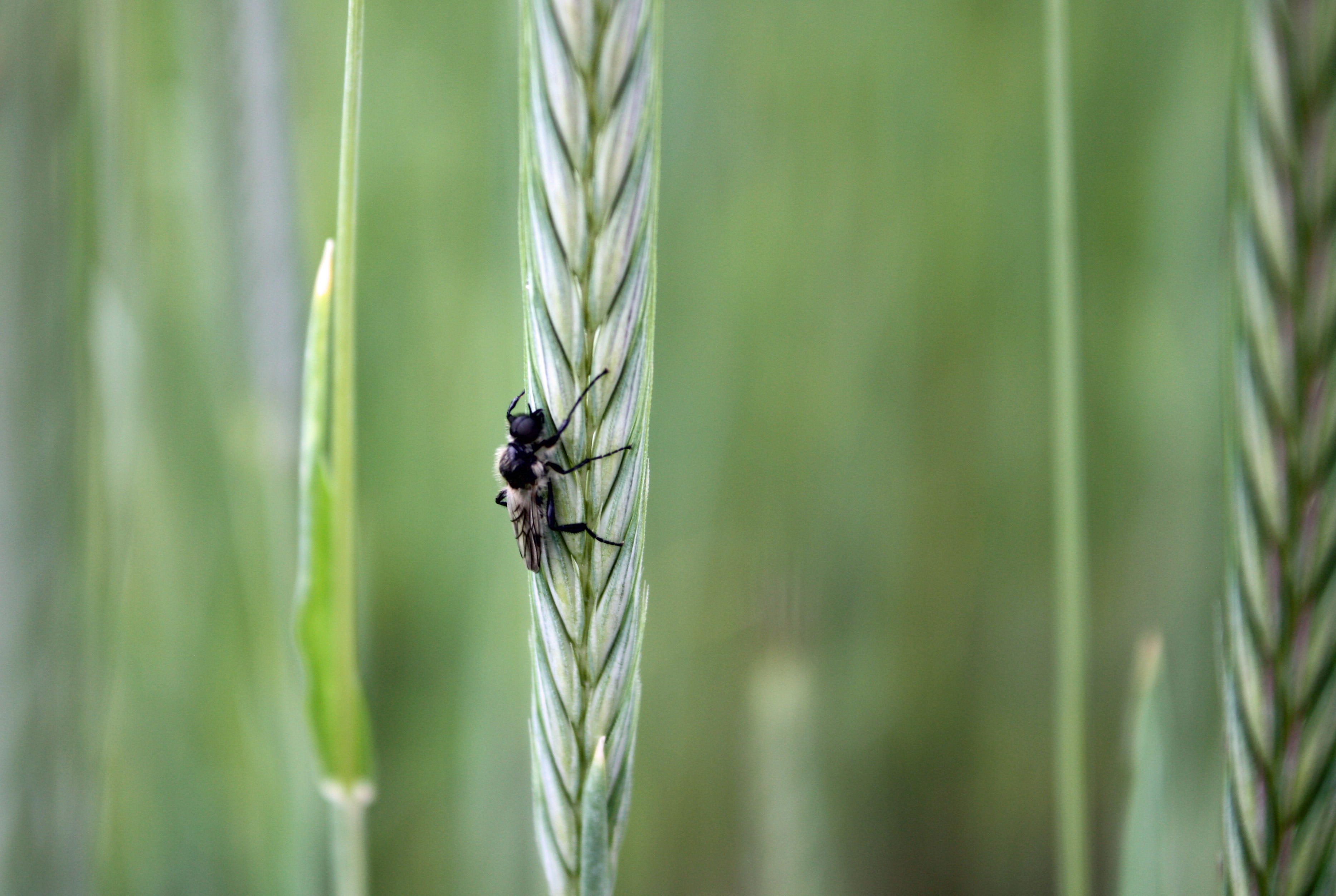
We kept seeing this interesting insect on the flower heads of the grasses.

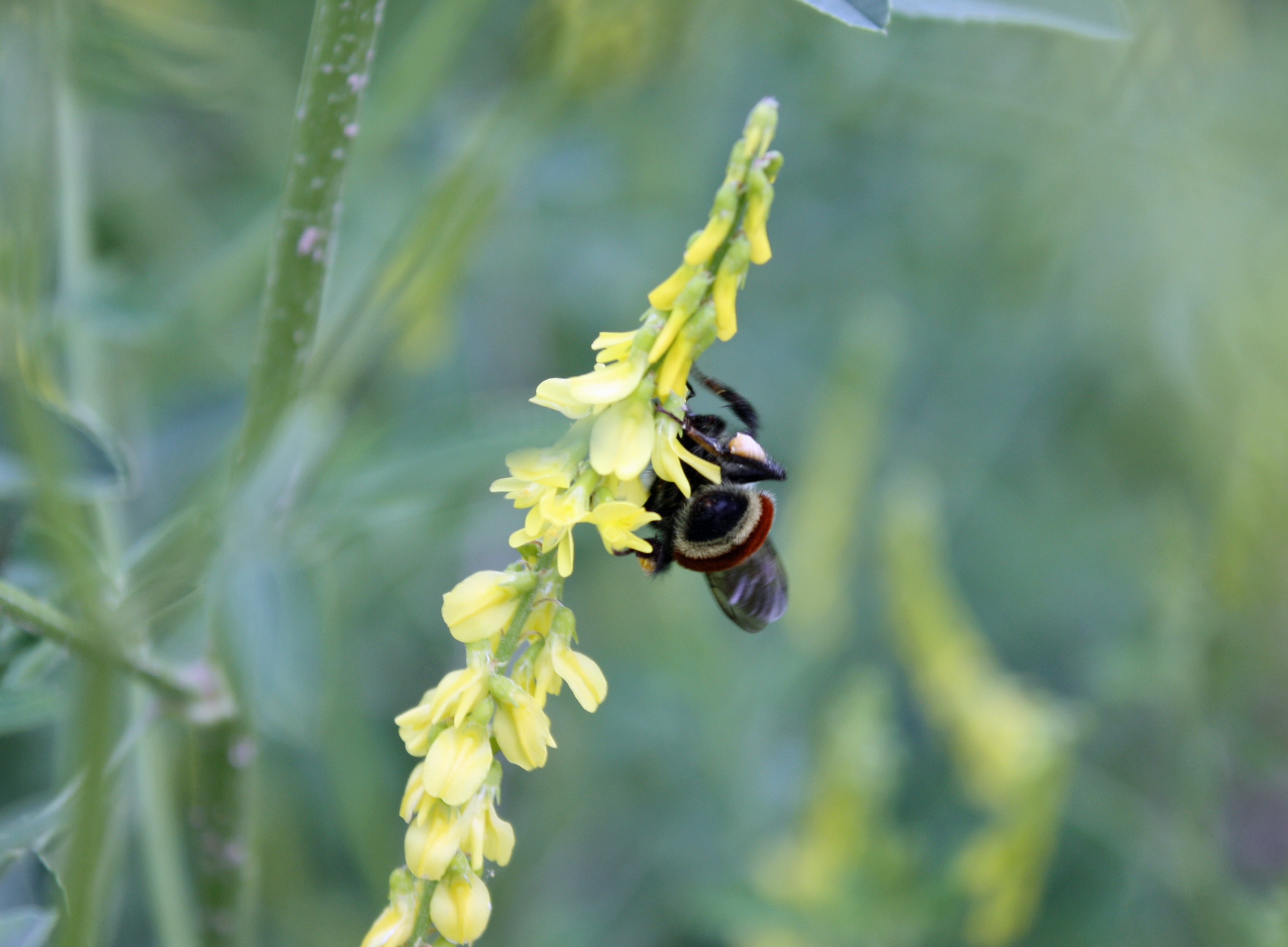
The butt of a bumblebee on the flowers of yellow sweet clover (Melilotus officinalis), captured by Sierra.

What wetlands did you visit this May? Let us know in the comment section below.

See Also: Field Trip: Bruneau Dunes State Park

Tiny Plants: Draba verna

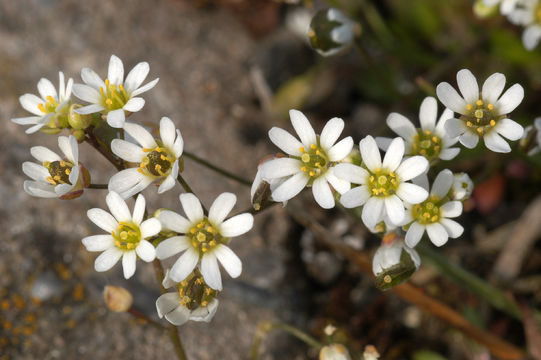
Draba verna is a small but memorable plant. Common names for it include early whitlowgrass, vernal whitlowgrass, and spring whitlow-mustard. Sometimes it is simply referred to as spring draba. As these common names suggest, Draba verna flowers early in the spring. It is an annual plant that begins its life by germinating the previous fall. While its flowers are minuscule, multiple plants can be found packed into a single section of open ground, making their presence more obvious. This and the fact that it flowers so early, are what make it so memorable. After a cold, grey winter, our eyes are anxious for flowers, and even tiny ones can be enough.

Draba verna

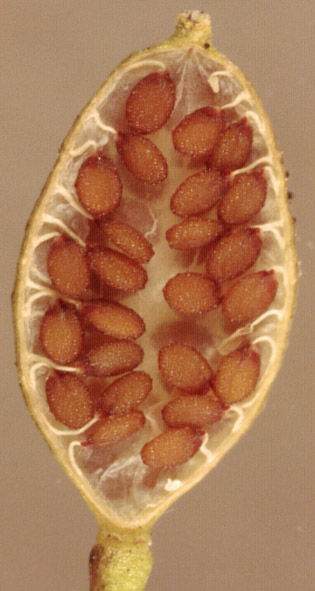
Draba verna is in the mustard family (Brassicaceae), which is easy to determine by observing its flowers and fruits. The flowers are about 1/8 inch across, with four, deeply-lobed petals. The fruits are oblong, “football-shaped,” flattened capsules that are divided into two chambers and hold up to forty seeds or more. Flowers and fruits are borne at the tips of branched stems that are leafless, hairless, and very thin. Stems arise from a small rosette of narrow leaves that are green to purplish-red and slightly hairy. The plant itself is generally only an inch or two wide and a few inches tall, easily missed other than its aforementioned tendency to be found en masse.

flowers of Draba verna via eol.org

Draba verna occurs throughout much of eastern and western North America, but is said to be introduced from Eurasia. A few sources claim that it is native to North America, but as far as I can tell, that is unverified. Either way, it is naturalized across much of its present range, and even though many of us consider it a weed, it doesn’t seem to be causing too much concern. It’s too tiny and short-lived to really be a problem. It makes its home in disturbed and neglected sites – along roadsides; in fields, pastures, and garden beds; and in abandoned lots. The one place it may be trouble is in nurseries and greenhouses, where it might be able to compete with young plants in pots.

open capsule and seeds of Draba verna via eol.org

The flowers of Draba verna are self-fertile, but they are also visited by bees that have ventured out in early spring. The foliage might by browsed by rabbits and other small mammals, but otherwise this plant is of little use to other creatures. Being in the mustard family, it is likely edible, but again it is so small that harvesting it would hardly be worth it. Instead, maybe its best to leave it in place and enjoy it for what it is: a tiny, brave reminder that spring is on its way and an encouragement to get down low once in a while to admire the little things.

An attempt at sketching Draba verna fruits on a raceme.

See Also: Tiny Plants: Duckweeds

The Creeping Charlies and Common Name Confusion

This is a guest post by John Tuttle.

———————

Most of us know creeping charlie as the all-too-often irritating weed which takes over our grassy lawns. This evergreen plant’s life cycle is year round. The garden-invading variety which sprouts little bluish-purple flowers has been given the title Glechoma hederacea (or sometimes Nepeta glechoma) via binomial nomenclature and is a member of the mint family, Lamiaceae. Additional common names for this creeping charlie include ground ivy, catsfoot, and field balm.

Travelers from Europe took the plant with them, distributing it throughout other parts of the globe, and it is now deemed an aggressive, invasive weed in various areas in North America. It has crenate leaves, and its size varies depending on its living conditions. It has two methods of reproduction. The first is made possible by offshoots called stolons (or runners), stems with the special function of generating roots and transforming into more plants. Thus, you will often find not an individual creeping charlie plant, but a whole patch, all of them connected via the runners. The other self-distribution method is simple: seeds.

creeping charlie (Glechoma hederacea) via John Tuttle

The creeper is edible, and if you were in a spot where you didn’t know when your next meal would be, this type of creeping charlie would probably be a welcome source of energy. Wild food educator, Karen Stephenson, suggests its use in simple dishes such as soups and omelets, but that’s probably for those who are cooking at home and not trying to fend for their lives in some forest. Starving in the woods is a bit of an extreme, but it has happened. Glechoma hederacea has also been used for making tea. It contains minerals like copper and iron, as well as a significant amount of vitamin C.

The weed also has a number of possible health benefits such as being a diuretic, anti-inflammatory, and antiviral. However, other researchers have cautioned people to be leery of consuming it as it has been known to be fatal to equines and bovines. It contains chemicals that can discomfit the gastrointestinal tract. It is further suggested that during pregnancy women should not intake any amount of any type of creeping charlie.

Up to this point you may have found the terms I’ve used, such as “this type of creeping charlie,” to be a little odd. In fact, the term creeping charlie does not refer to only a single species of creeper. It’s actually used for several.

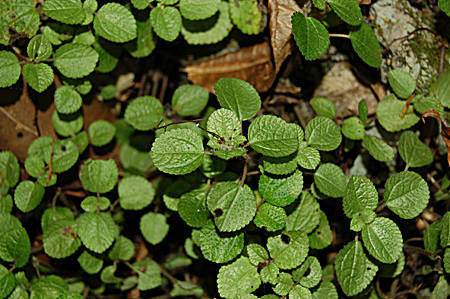
Another plant hailed as “creeping charlie” is Pilea nummulariifolia of the family Urticaceae, a grouping otherwise known as the nettles. Pilea is the name of the genus of creeping plants; the artillery plant is also classified under this genus. Pilea nummularifolia is also known as Swedish ivy and is often grown as a houseplant. It is native to the West Indies and parts of South America. This viney plant flourishes when supplied with an ample amount of water.

creeping charlie (Pilea nummularifolia) via eol.org

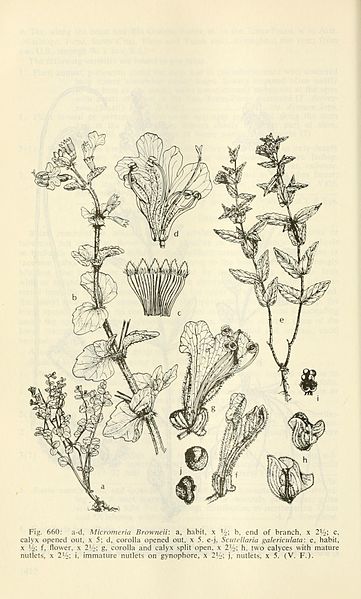
Yet another plant commonly referred to as creeping charlie is Micromeria brownei, synonymously referred to as Clinopodium brownei. It is also used in some teas, but as mentioned above, pregnant women in particular should steer away from consuming it. Apart from the term creeping charlie, a few more common names for this plant include Browne’s savory and mint charlie. Like Glechoma hederacea, Browne’s savory is considered a mint. It produces flowers that are white with hints of purple on the petals and in the throat. This species is quite common in the state of Florida and in parts of Central America; although plants in this genus grow around the world.

Like Pilea nummularifolia, this species loves a good source of water. Its thirst for moisture is so strong, that it can actually adapt itself to an aquatic lifestyle, that is, one which occurs in water and not in dry soil. Many aquarists, people who enjoy keeping aquatic life, love this plant. It can also be trimmed with practically no damage to the plant. It is extremely durable and quite capable of adapting to different circumstances. For instance, Micromeria brownei can be situated midground inside a fish tank. The creeping charlie is perfectly at home totally submerged under water. If a plant floats to the surface then it should typically produce flowers. This adds a new dimension to some of the generic aquatic flora which is often used in many tank displays.

creeping charlie (Micromeria brownei synClinopodium brownei) via wikimedia commons

There you have it. Three different types of plants that have different uses and dangers, and they are all called creeping charlie. Be advised when you’re talking about true creeping charlie – Glechoma hederacea: the invasive weed with the purple flower – that you remember to specify, because “creeping charlie” could mean one plant to you and some plant from an entirely different family to another.

———————

John Tuttle is a Catholic guy with a passion for the media and creativity. Everything about science and health interests him. He’s a writer for publications such as ZME Science and Towards Data Science. John has started his own blog as well called Of Intellect and Interest. He’s also a published ebook author and the 1st place winner of the youth category of the 2017 Skeena Wild Film Fest. You can follow him on Facebook here, and he can be reached anytime at jptuttleb9@gmail.com.

The Seed Salting Experiments of Charles Darwin

In the second chapter of his book, The Diversity of Life, Edward O. Wilson describes the massive volcano that sunk a large portion of the island Krakatau in the summer of 1883. Rakata, the remnant that remained, was now “a sterile island” covered in ash. But it didn’t remain sterile for long. This natural disaster offered biologists the opportunity to watch as a fragment of earth, suddenly stripped of life, turned green again.

Life returned pretty quickly, too. In less than 50 years, nearly 300 species of plants had recolonized the charred landscape. Much of this rebirth was thanks to “aeolian plankton” – tiny wind-borne lifeforms that Wilson describes as “a rain of planktonic bacteria, fungus spores, small seeds, insects, spiders, and other small creatures” that fall “continuously on most parts of the earth’s land surface.” The seeds of some plants likely floated or “rafted” over, and still others may have arrived in the stomachs of birds “to be deposited later in their feces.”

Wind, water, and wing. It is well-accepted today that these are natural means by which the seeds of plants make their way to remote islands. However, in Charles Darwin’s day, things were not so settled. Decades before we understood things like plate tectonics and continental drift, there was ongoing debate about how the flora and fauna residing on islands got there. Were there multiple creation events or were there a series of land bridges and continental extensions now sunken in the sea? Unconvinced of one and skeptical of the other, Darwin embarked on a series of experiments to determine the possibility of an alternate hypothesis: long-distance dispersal.

Darwin wasn’t completely opposed to the idea that some species may have reached remote islands by land bridges of some sort; however, as James T. Costa writes in Darwin’s Backyard, his “imagination [ran] wild with scenarios for long-distance transport by floods and currents, whirlwinds and hurricanes, dispersal by birds, rafting quadrupeds carrying seeds in their stomachs or adhering to their fur, floating trees with seeds wedged in root masses, insects with seeds or eggs stuck to their legs, icebergs, and more.” He was convinced, “improbable as it was that, aided by wing or wave, propagules from a mainland could make it to distant islands.” After all, the vastness of geological time allows for chance events despite how improbable they may be. Even more, such events are “testable.”

So test them, he did. Among a series of experiments regarding long-distance dispersal were Darwin’s extensive seed salting trials. He began by using common vegetable seeds: broccoli, cabbage, oats, radish, lettuce, flax, and many others. He placed seeds in small bottles containing 2-3 ounces of salt water. Some bottles were placed outside in the shade where the air temperature varied throughout the day; other bottles were kept in his cellar where the temperature was more stable. He also placed seeds in a tank of salt water made with melted snow. The water in some of the jars, particularly those with brassica and onion seeds, turned foul, and as Darwin writes, “smelt offensive to a quite surprising degree;” however, “neither the putridity of the water nor the changing temperature had any marked effect on their vitality.”

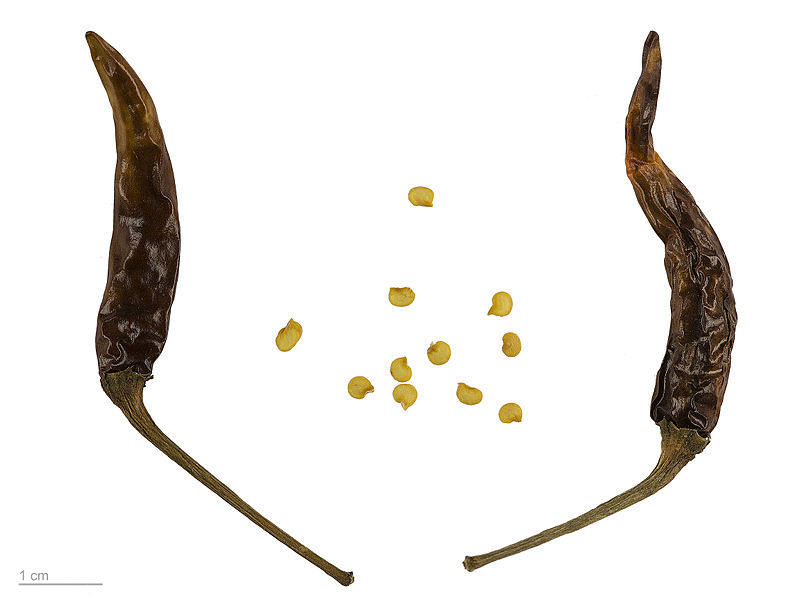
In fact, while a few did quite poorly, the majority of the seeds that Darwin tested germinated just fine after soaking in salt water. At least for a short period anyway. Germination rates tended to decrease dramatically the longer seeds were soaked. For example, “fresh seed of the wild cabbage from Tenby germinated excellently after 50 days, very well after 110 days, and two seeds out of some hundreds germinated after 133 days immersion.” Darwin found that capsicum (i.e. peppers) “endured the trial best, for 30 out of 56 seeds germinated well after 137 days immersion.”

The seeds and dried fruit of Capsicum annuum (via wikimidia commons)

Darwin’s seed salting experiments seemed to be going well until his friend and colleague, Joseph Hooker, pointed out that seeds often sink when placed in water. Darwin wondered if he had been “taking all this trouble in salting the ungrateful rascals for nothing.” Despite the setback, he began another series of tests to determine which seeds sink, which float, and how long they float before they ultimately sink. The results weren’t as bad as expected. A number of species floated for several days, including the seeds of asparagus which were found to float for about 23 days if the seeds were fresh and up to 86 days if they were dried. By his calculations then, ocean currents could carry asparagus seeds over 2800 miles.

While soaking seeds in salt water, Darwin was engaged in a number of other seed dispersal studies, some quite bizarre. In one, he attempted to get goldfish to take mouthfuls of seeds, the idea being that if a fish having recently swallowed seeds was eaten by a seabird which then deposited the undigested seeds on a distant island, those seeds could germinate and establish themselves in a new environment. Unfortunately, Darwin’s subjects wouldn’t oblige: “the fish ejected vehemently, and with disgust equal to my own, all the seeds from their mouths.”

Despite a few botched experiments, Darwin turned out to be correct – long-distance dispersal explains much of the geographical distribution of species. Those who favored ideas of sunken land-bridges and continental extensions weren’t altogether wrong either. Costa writes: “Ironically, there is a kernel of truth behind the old idea of continental extensionism: rearranged and sometime contiguous continents…explain the distribution of some groups. But chance long-distance dispersal has never gone away. Improbable and rare as such events are, they are far from mysterious, and certainly not miraculous.”

Want to carry out your own seed salting experiments?

Darwin’s Backyard by James T. Costa includes detailed instructions, along with instructions for Darwin’s duck feet experiment [Do ducks transport snails, seeds, or other things that get attached to their feet?] and many others. Darwin Correspondence Project is a great resource as well.

Highlights from the Western Society of Weed Science Annual Meeting

Earlier this month, I went to Garden Grove, California to attend the 71st annual meeting of the Western Society of Weed Science. My trip was funded by an Education and Enrichment Award presented by the Pahove Chapter of the Idaho Native Plant Society. It was a great opportunity for a weeds-obsessed plant geek like myself to hang out with a bunch of weed scientists and learn about their latest research. What follows are a few highlights and takeaways from the meeting.

General Session

Apart from opening remarks and news/business-y stuff, the general session featured two invited speakers: soil ecologist Lydia Jennings and historian David Marley. Lydia’s talk was titled “Land Acknowledgement and Indigenous Knowledge in Science.” She started by sharing a website called Native Land, which features an image of the Earth overlayed with known “borders” of indigenous territories. By entering your address, you can see a list of the tribes that historically used the land you now inhabit. It is important for us to consider the history of the land we currently live and work on. Lydia then compared aspects of western science and indigenous science, pointing out ways they differ as well as ways they can be used in tandem. By collaborating with tribal nations, weed scientists can benefit from traditional ecological knowledge. Such knowledge, which has historically gone largely unrecognized in the scientific community, should receive more attention and acknowledgement.

David Marley was the comic relief. Well-versed in the history of Disneyland, he humorously presented a series of stories involving its creation. Little of what he had to say related to weed science, which he openly admitted along the way; however, one weeds related story stood out. Due to a lack of funds, the early years of Tomorrowland featured few landscape plants. To make up for that, Walt Disney had signs with fake Latin names created for some of the weeds.

Weeds of Range and Natural Areas

I spent the last half of the first day in the “Weeds of Range and Natural Areas” session where I learned about herbicide ballistic technology (i.e. killing plants from a helicopter with a paintball gun loaded with herbicide). This is one of the ways that Miconia calvescens invasions in Hawaii are being addressed. I also learned about research involving plant debris left over after logging. When heavy amounts of debris are left in place, scotch broom (Cytisus scoparius) infestations are thwarted. There was also a talk about controlling escaped garden loosestrife (Lysimachia punctata) populations in the Seattle area, as well as a few talks about efforts to control annual grasses like cheatgrass (Bromus tectorum) in sagebrush steppes. Clearly there are lots of weed issues in natural areas, as that only covers about half the talks.

Basic Biology and Ecology

On the morning of the second day, the “Basic Biology and Ecology” session held a discussion about weeds and climate change. As climate changes, weeds will adapt and find new locations to invade. Perhaps some weeds won’t be as problematic in certain areas, but other species are sure to take their place. Understanding the changes that are afoot and the ways that weeds will respond to them is paramount to successful weed management. This means documenting the traits of every weed species, including variations between and among populations of each species, so that predictions can be made about their behavior. It also means anticipating new weed species and determining ways in which weeds might exploit new conditions.

No doubt there is much to learn in order to adequately manage weeds in a changing climate. An idea brought up during the discussion that I was particularly intrigued by was using citizen scientists to help gather data about weeds. Similar to other organizations that collect phenological data from the public on a variety of species, a website could be set up for citizen scientists to report information about weeds in their area, perhaps something like this project in New Zealand. Of course, there are already a series of apps available in North America for citizen scientists to report invasive species sightings, so it seems this is already happening to some degree.

Teaching and Technology Transfer

A highlight of the afternoon’s “Teaching and Technology Transfer” session was learning about the Wyoming Restoration Challenge hosted by University of Wyoming Extension. This was a three year long contest in which thirteen teams were given a quarter-acre plot dominated by cheatgrass with the challenge to restore the plant community to a more productive and diverse state. Each team developed and carried out their own strategy and in the end were judged on a series of criteria including cheatgrass and other weed control, plant diversity, forage production, education and outreach, and scalability. Preliminary results can be seen here; read more about the challenge here and here.

And so much more…

Because multiple sessions were held simultaneously, I was unable to attend every talk. I also had to leave early on the third day, so I missed those talks as well. However, I did get a chance to sit in on a discussion about an increasingly troubling topic, herbicide-resistant weeds, which included a summary of regional listening sessions that have been taking place in order to bring more attention to the subject and establish a dialog with those most affected by it.

One final highlight was getting to meet up with Heather Olsen and talk to her briefly about her work in updating the Noxious Weed Field Guide for Utah. This work was aided by the Invasive Plant Inventory and Early Detection Prioritization Tool, which is something I hope to explore further.

If you are at all interested in weeds of the western states, the Western Society of Weed Science is a group you should meet. They are fun and friendly people who really know their weeds.

See Also: Highlights from the Alaska Invasive Species Workshop