Tea Time: Self-heal

Prunella vulgaris can be found all over the place. It has also been used to treat just about everything. What else would you expect from a plant known commonly as self-heal, heal-all, all-heal, and woundwort? The medicinal value of this plant has been appreciated for centuries across its expansive range, and studies evaluating its medicinal use continue today. Being such a ubiquitous species – both as a garden plant and a native plant (and also a common weed) – and because it has so much clout in the world of herbal medicine, it’s an obvious candidate for Tea Time.

Self-heal is a member of the mint family (Lamiaceae), easily distinguished by its square stems, opposite leaves, and bilabiate and bilaterally symmetrical (or zygomorphic) flowers. One surprise is that, unlike the many aromatic members of this family, the foliage of self-heal lacks a strong scent. P. vulgaris occurs naturally across Asia, throughout Europe, and in parts of northern Africa. It is also widely distributed across North America. Apart from that, it has been introduced to many regions in the southern hemisphere and has also been frequently moved around throughout its native range. Eurasian varieties now intermingle with North American varieties, which can make it difficult to determine a native individual from an introduced one.

self-heal (Prunella vulgaris)

Self-heal is an adaptable plant that tends to prefer shady, moist locations, but can also be found in open, dry, sunny sites. Find it along forest edges, roadsides, ditches, and trails, as well as on the banks of streams, lakes, and reservoirs. It occurs in gardens, both intentionally planted and as a weed, and can escape into lawns, vacant lots, and open fields, as well as into nearby natural areas.

P. vulgaris is an evergreen that grows both prostrate and upright, sometimes reaching 1 foot tall or more (but is often much shorter). It has shallow, fibrous roots, and its stems root adventitiously as they sprawl across the ground, frequently forming an extensive mat or groundcover. Its leaves are oval to lance-shaped and measure about one inch long. Lower leaves have petioles, while upper leaves may become stalkless. Leaf margins are entire or can be slightly toothed. As plants age, they can develop a coppery or purple-bronze color.

the leaves of self-heal

The flowers of self-heal are generally a shade of purple, but can also be white, pink, or blue. They bloom irregularly in a spike measuring up to two inches long. Flower spikes are thick, dense, cylindrical, and made up of whorls of sharp-pointed bracts. Flowers bloom irregularly along the spike and occur from late spring/early summer into the fall. Each flower produces four nutlets, which sit within a cup-shaped, purple calyx.

As a medicinal herb, self-heal has been used both internally and externally to treat a long list of ailments. These include sore throats, diarrhea, fevers, intestinal infections, liver problems, migraines, heart issues, dermatitis, goiter, and thyroid disfunction, just to name a few. It has been used topically to treat skin irritations, bites, stings, and minor cuts and scrapes. This is thanks to its antimicrobial properties and its ability to stop bleeding. A report in the journal Pharmaceuticals (2023) calls P. vulgaris an “important medicinal plant” due to its “rich chemical composition” and its “pharmacological action.” Chemical analyses find the plant to be a valuable source of phenolic compounds, flavonoids, rosmarinic acid, and ursolic acid, among numerous other compounds. If you are curious to learn more detailed information regarding this plant’s medicinal value, you can refer to the above report, as well as one found in Frontiers in Pharmacology (2022).

self-heal tea

P. vulgaris is an edible plant, and its young leaves can be eaten raw or cooked. The leaves together with the flowers can also be dried and used to make a tea. This is how I had it. I used about two teaspoons of dried leaves to one cup of water. Feel free to use more if you would like. I thought the tea was pretty mild. It had a slight sweetness to it and a hint of mint flavor. It has been described as bitter, but I didn’t find it to be overly so (although I may have a higher tolerance for bitterness). Sierra tried it and said that it tasted like “water left over from something else.” That might be because it was more diluted than she would have preferred. Overall, I thought it was a pleasant experience and would be happy to drink it again.

More Tea Time Posts on Awkward Botany:

Garden Plants Gone Wild: The Periwinkles

In a garden setting, a successful groundcover is a plant that is durable and adaptable, spreads readily, and fills in space thouroughly. The point of planting a groundcover is to cover exposed soil and create a sort of living mulch. In fact, groundcovers provide similar benefits to mulch. They prevent erosion, help retain soil moisture, and prevent weeds. It should come as no surprise then, that a plant that fulfills all of these requirements has the potential to become a weed, especially if given the opportunity to escape and establish itself outside of its intended location.

This isn’t a hypothetical. This exact scenario has played out numerous times. A good example of this are the periwinkles: Vinca major and Vinca minor. Both have been popular garden plants for centuries. Their introduction to U.S. gardens came as early as the 1700’s. Today, both species (including cultivars of each) can be found for sale in nurseries throughout the country, even while escaped periwinkles proceed to spread across natural areas and uncultivated spaces. Even in gardens where periwinkles have been intentionally planted, they can be deemed no longer welcome due to their aggressive nature. Eliminating them, however, is a formidable task.
greater periwinkle (Vinca major)

Periwinkles are relatively easy to identify, yet telling the two apart can sometimes pose a challenge. Knowing what to look for can make this a fairly simple task. Vinca major (greater periwinkle) is the larger of the two. Its stems are tough and sprawl up to 5 feet long, rooting adventitiously when in contact with the ground. Vegetative spread also occurs via stolons and rhizomes, modified stems that spread horizontally both above and below ground and whose main purpose is to produce new roots along their length. This extensive rooting creates dense mats of stems and foliage, precisely what you’d want from an effective groundcover. Leaves are arranged oppositely and are semi-evergreen with fine hairs along their margins. They are thick, glossy, simple, dark green, and ovate to ovate-lanceolate in shape. They have a relatively long petiole, and some leaves can even appear heart-shaped.

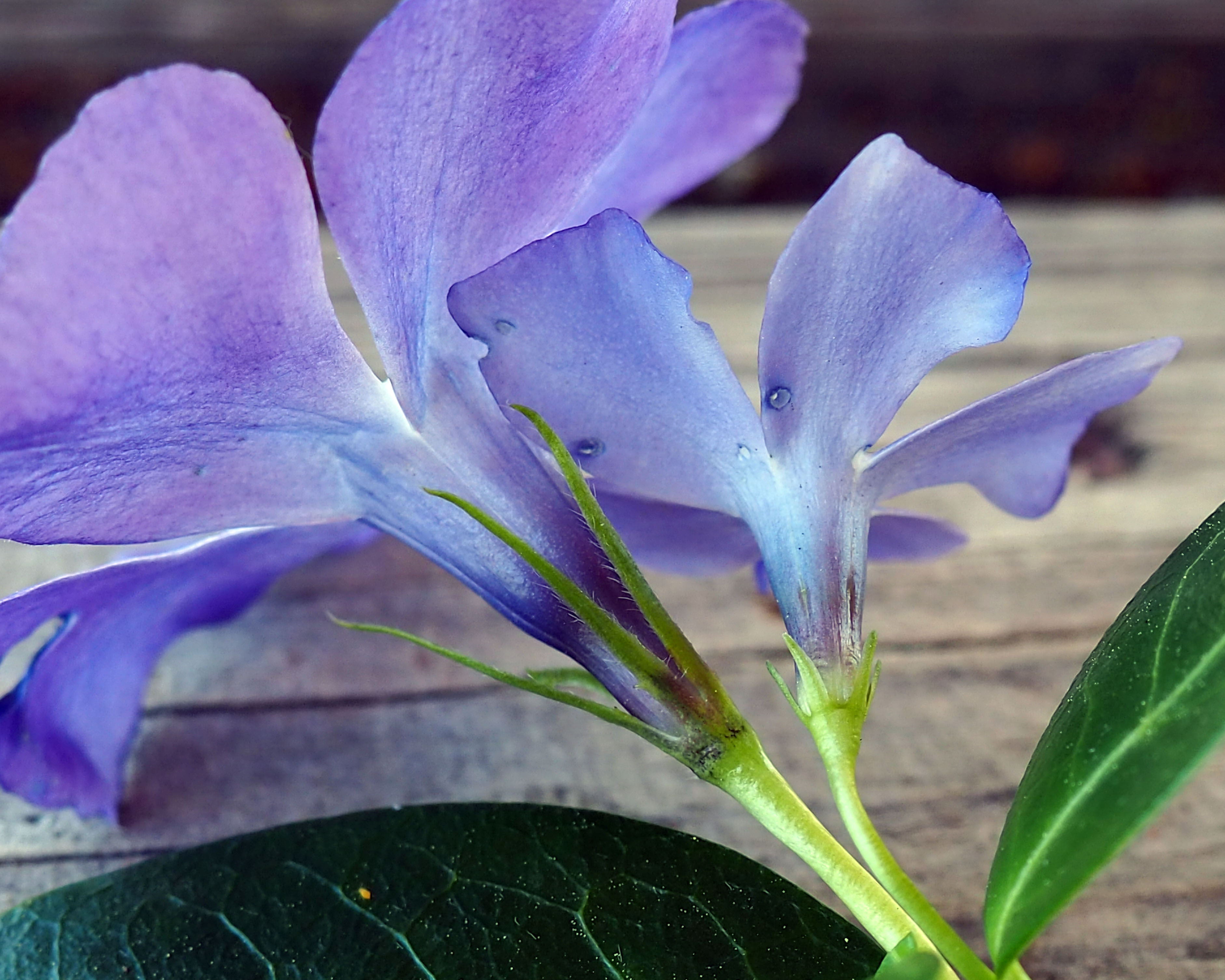
The flowers of V. major are blue to purple and fused at the base to form a tube, separating into five distinct lobes and creating a shape similar to a pinwheel. They are borne on a long stalk in the axils of leaves and measure about two inches wide. Their sepals are long, slender, pointed, and lined with bristly hairs. Fruits rarely form, but when they do, they are narrow follicles.

comparing the petals and sepals of Vinca major (left) and Vinca minor (right)

Vinca minor (lesser periwinkle) is a slightly smaller plant with a similar habit, spreading vegetatively in all the same ways as V. major. Stems are slender and smooth and leaves are evergreen. Compared to V. major, the leaves of V. minor are smaller, narrower, and have hairless margins and short petioles, otherwise they are very similar. Same goes for the flowers, which look identical on both species, except that those of V. minor are slightly smaller (about one inch wide) and borne on shorter stalks. Sepals are shorter, broader, more rounded at the tips, and lack the bristly hairs of V. major.

Because periwinkles only rarely produce seed, their main method of getting around is vegetatively. Fragments of roots or rhizomes hide in soil and are moved from one location to another inadvertently. Periwinkles are often used in hanging baskets and containers, and when these things are cast aside at the end of a season, the perennial roots of periwinkles may continue to grow, spreading out beyond the potting mix and into the soil.

Dump soil, yard waste, and improperly disposed of containers are the main ways that periwinkles find their way into natural areas. Both species can be found in the understories and edge habitats of woodlands, as well as along roadsides and pathways, and in vacant lots and old homesites. They can also be found in riparian areas, where waterways can carry fragments of plants to new locations. The Invasive Plant Atlas compiles reports of both V. major and V. minor growing outside of cultivation and tracks them on a map. They also track which states include them in noxious weeds lists or laws.

lesser periwinkle (Vinca minor)

The best way to keep periwinkles from continuing to spread outside of cultivation is to refrain from growing them. If you choose to have them in your yard, dispose of plant parts properly. If you keep them in containers, send those containers to the landfill when you are done with them. If your property is adjacent to natural areas, the risk may be too great and you may want to consider a different groundcover. Depending on where you live, alternatives vary. In the Intermountain West, potential substitutes include wild strawberry (Fragaria virginiana), woodland strawberry (F. vesca), kinnikinnik (Arctostaphylos uva-ursi), and wild ginger (Asarum caudatum). Each of these are low growing, evergreen to semi-evergreen, spreading plants that do well in shade and can handle some degree of drought.

Book Review: Wild Wasatch Front

If it isn’t clear by now from my Weeds of Boise series and countless other posts, I happen to be interested in the flora and fauna of urban areas. Urban ecology is a fascinating field of study, and I’m not sure that it gets the attention it deserves. Nature is not some far away place, and you shouldn’t have to leave city limits to go in search of it. Remarkably, nature exists right outside your front door, even if you live in the middle of a massive city. It may be a different sort of nature than the one you might find in a national forest or a state park, and it may be composed of species introduced from all corners of the world, but it is still a collection of living organisms interacting with each other and the surrounding environment in unique and important ways. The question is, can you grow to appreciate nearby nature and recognize that the ecological interactions that exist within the context of a city are just as valid as those you’ll find outside of our built environments?

Luckily, there are resources that can help you with that, including a recent book compiled by Lisa Thompson and others at the Natural History Museum of Utah (NHMU). It’s called Wild Wasatch Front, and it’s of particular interest to me because it covers a region that’s relatively close by, and our two locations share a number of similarities. Plus, I played a small role in reviewing some of the plants (specifically the weeds) that ended up in the book (Sierra would insist that I mention this, so there you go). Similar books exist for other regions across North America and elsewhere, so I encourage you to seek out a book that applies to your hometown.

The Wasatch Front is a metropolitan region in north-central Utah that spans the western side of the Wasatch Mountains and includes a long string of cities and towns extending for many miles in all directions. Included in that list of cities is Salt Lake City, the state’s capitol and largest city in the state. The idea for a book about urban nature in the Wasatch Front was inspired by an exhibit at NHMU called “Nature All Around Us.” The exhibit and resulting book offer a new perspective for those insisting that “nature and cities cannot coexist” or that the nature found in cities is influenced by humans and therefore shouldn’t be considered “real.” Hundreds of organisms making a life for themselves within the boundaries of our cities might argue otherwise.

Wild Wasatch Front is divided into three main sections, with each section being worth the price of the book on its own. First there are a series of essays about urban nature and ecology. Names you might recognize, including Emma Marris and Riley Black, contributed to the book, as well as several other people that live and work in the western U.S. and have an interest in nature and environmental issues, especially as they relate to cities. Novel ecosystems is a reoccurring theme, not just in the essays but throughout the book. In her essay, Sarah Jack Hinners writes, “urban nature is a mixture of the intentional and the unintentional,” adding that “for every tree or rosebush or lawn that we plant and carefully nurture, there are multitudes of other plants and animals that grow and thrive uninvited and unnurtured by us.”

The largest section in the book is a field guide, profiling 127 plus species that call the Wasatch Front home, some native and some transplants. This section is divided into subsections that include birds, invertebrates, fungi and lichen, mammals, reptiles and amphibians, street trees, and wild plants. The entry for each species includes a brief description, a few interesting facts, and details on how and where to find them, accompanied by images. With the variety of creatures covered, you are sure to find something that interests you and a reason to go out looking for your favorites. You may even learn something new about a species you’ve been seeing for years, such as house finches. It turns out that the colorful patches on a male house finch are the result of the plants they eat. These patches can be red, orange, or yellow. The redder the better though, because female house finches seek out mates with this coloration.

Naturally, my focus was mainly aimed at the plants covered in this section. I appreciated the mixture of native and introduced plants, even the inclusion of plants considered to be invasive. Instead of vilifying these species, there is an attempt to understand them and find value in them, even in spite of the concerns and negative opinions held about them. Box elder (Acer negundo) is an example of a plant that has both native and introduced populations. Once widely planted in yards and on farms, this tree has “fallen out of favor.” Its weak wood (a result of growing so quickly), can result in a messy, unattractive tree, making it a poor choice for a street tree. However, it propagates itself readily and shows up in vacant lots and other urban locations that receive minimal management and human attention. In the Wasatch Front, you can find box elders that are native, naturalized, and cultivated, an unlikely scenario unique to urban areas.

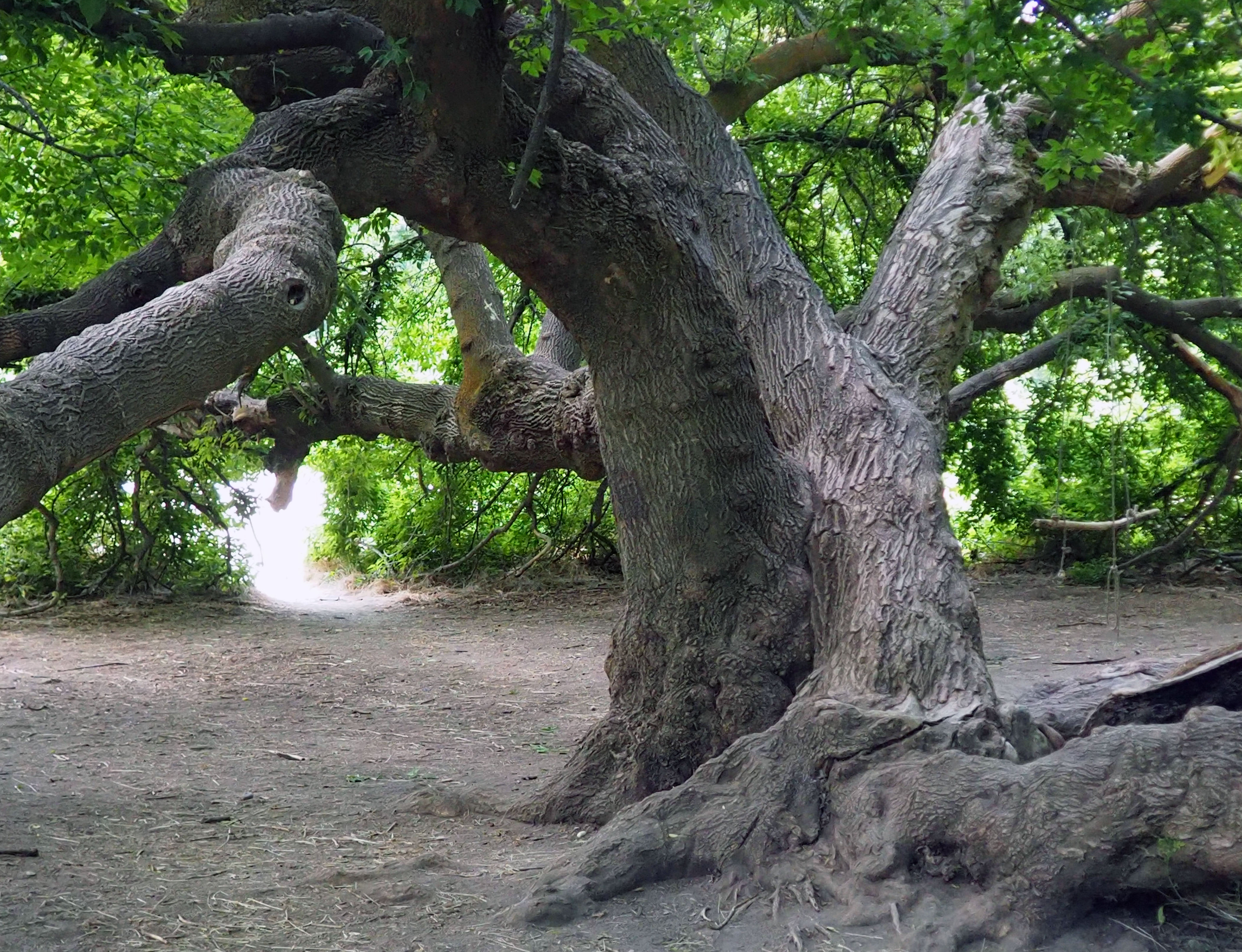
massive box elder (Acer negundo) in Boise, Idaho

The third and final section of the book is a guide to 21 different hikes and field trips in and around the Wasatch Front. Each field trip features a hand-drawn map and some basic notes about the hike. Details about what can be seen along the way are included in the descriptions, which are sure to entice you into visiting. Whether or not you think you’ll ever make it out to any of these spots, this section is still worth reading if only for the ongoing discussions about urban ecology. For example, in the entry for Gib’s Loop, abrupt changes in land ownership and land use (a common experience when hiking in urban areas) is addressed: “Human impacts in the foothills…don’t end at backyard fences, and many animals use resources in both habitats. It’s more interesting to think of cities and the surrounding foothills as part of an interconnected system rather than separate and distinct.”

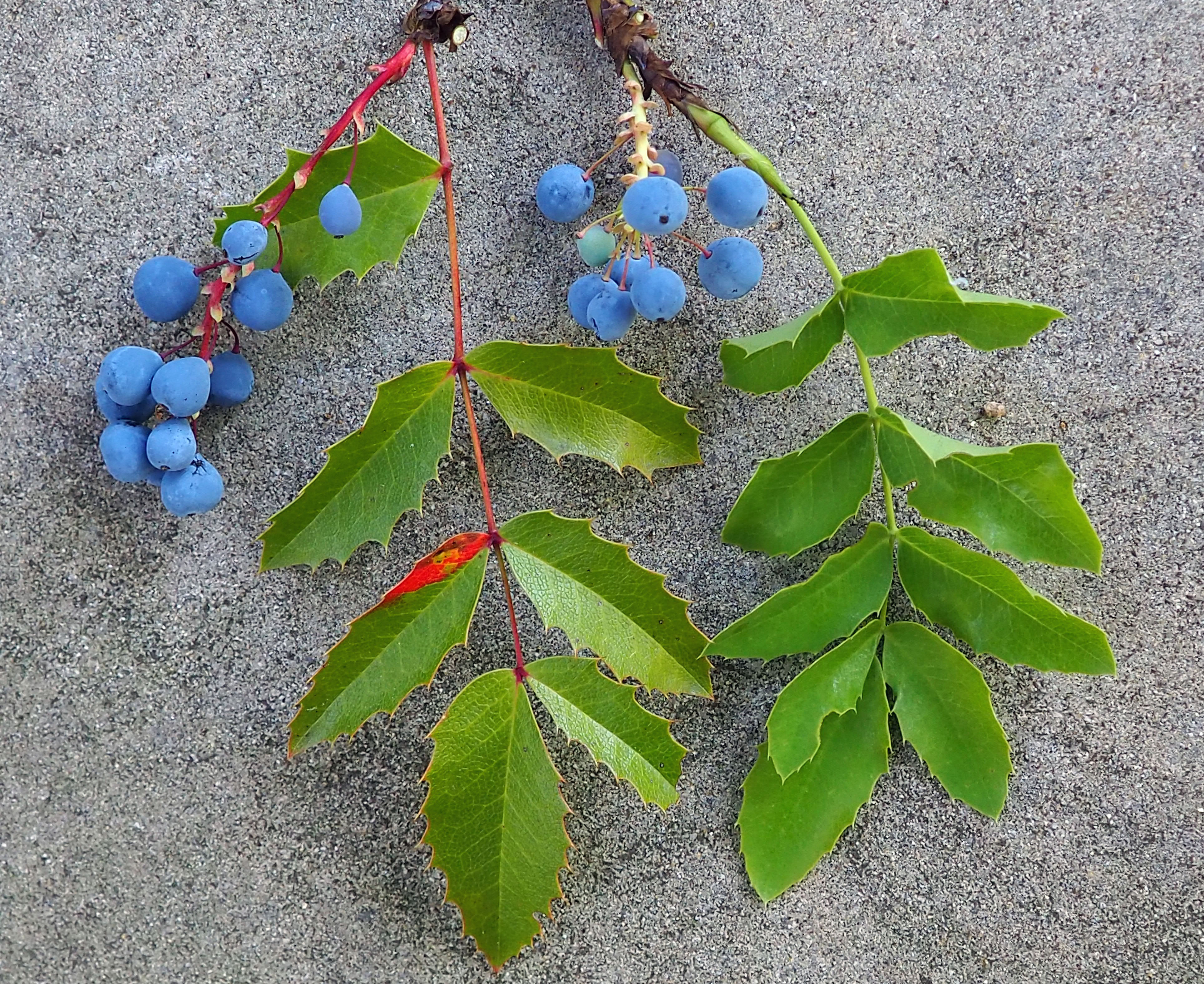
The field trip section is also used as a teaching opportunity to describe more of the species you’ll find in the Wasatch Front. In the entry for Creekside Park, learn how to identify creeping mahonia (Berberis repens), with its low growing habit and matte leaves, and compare it to Oregon grape (B. aquifolium), with its more upright habit and shinier leaves.

Berberis aquifolium (on the left) compared to Berberis repens (on the right)

Last year, in anticipation of Wild Wasatch Front, I came across another book with a similar focus. This book was put out by a group called The Urban Field Naturalist Project, headquartered in Australia. Their book, A Guide to the Creatures in Your Neighbourhood, encourages its readers to become urban naturalists and offers resources to help them get started. Just like Wild Wasatch Front, the bulk of the book is a field guide to species found in and around urban areas (in Australia, of course). In place of a guide to hikes and field trips, there are instructions on how to start nature journaling, which is a key component of becoming an urban field naturalist. Getting outside and learning to recognize nearby nature is step one, documenting what you see and sharing those observations with others is step two. Taken together, these two books will help you gain a better appreciation for urban nature and will hopefully inspire you to work to conserve what is there and make room for more.

More Book Reviews:

Winter Trees and Shrubs: Sweetgum

Sweetgum is a distinctive tree at any time of year. It stands out among most other deciduous trees with its excurrent growth habit, which gives it a narrowly conical or pyramidal shape. Only in its advanced age does it begin to develop a more rounded and irregular form. Its leaves are star-shaped with either five or seven lobes and span between four and seven inches. Their glossy green color gives way to a wide range of colors in the fall, including yellow, orange, red, and maroon, remaining on the tree for several weeks depending on weather conditions. The fruits are particularly distinct, especially in the winter after the leaves have dropped. Woody balls made up of a series of capsules with pointed beaks hang from long stalks throughout the winter, windborne seeds having been released from small openings in the fall. Without even bothering to look at the twigs, seeing these durable, spiky balls hanging from branches (or feeling them under your feet) is a quick indication that you are looking at a sweetgum.

one of many fall colors found on sweetgum (Liquidambar styraciflua)

Liquidamabar styraciflua (one of the funnest botanical names to say) was previously placed in the family Hamamelidaceae but is now one of the few members of Altingiaceae. Its natural distribution is broad, covering a large portion of the eastern United States and west into Missouri then down into Texas, Mexico, and much of Central America. Outside of its natural range it has been widely planted as an ornamental, and there are several popular sweetgum cultivars currently in cultivation. Both the common and botanical names for this tree refer to the resin found in its bark, which historically has had many uses.

The winter twigs of sweetgum are stout, round, smooth, and yellow-brown to green or olive-green to brown-purple in color. They can also be glossy and feature a few scattered lenticels. Older twigs (or branchlets) are brown at first and then light grey with dark grey lenticels. They are occasionally adorned with corky wings similar to those of bur oak. Because the wings aren’t always present, it can be a fun thing to encounter when you are out looking at twigs.

corky wings on the branchlets of sweetgum

The winter buds of sweetgum twigs are egg-shaped and made up of bud scales with acute tips and ciliate margins. They are green to orange-brown or reddish in color and occasionally sticky. Lateral buds are alternately arranged, are much smaller than terminal buds, and are stalkless and flattened against the twig. They sit above a slightly raised leaf scar that is half-elliptical to triangular in shape and has three distinct vascular bundle traces. The pith of sweetgum twigs is solid, continuous, brownish, and irregularly shaped.

winter twig of sweetgum tree

Sweetgum bark is light to dark grey and is made up of a series of rough, vertically arranged, scaly ridges that become deeply furrowed with age. The mace-like fruits of sweetgum are about one inch wide and, at a glance, are similar in appearance to the seed balls of sycamore trees; however, sycamore seed balls easily break apart when compressed, while the pointed, woody capsules that make up a sweetgum ball are held firmly together and can hold their shape for long periods of time. When these “gumballs” collect on the ground below, they can become a hazard, especially where there is lots of foot traffic. Speaking from experience, they are also obnoxious when operating a mower. This polarizing feature has resulted in bad opinions of the sweetgum tree. Luckily, some people are out there defending it.

sweetgum bark
the persistent fruits of sweetgum

More Winter Trees and Shrubs:

Tea Time: Fireweed

lf you’ve seen one fireweed, you’ve probably seen several. As an early successional species, growing in large numbers across a vast amount of space is kind of its thing. Any disturbance that leaves bare ground in its wake, such as a wildfire or a windstorm, gives fireweed the opportunity to colonize. It grows quickly and spreads via rhizomes, producing thousands of airborne seeds in the process, sending them off to continue colonization or contribute to soil seed banks in preparation for future disturbances. The role of plants like fireweed is vital – promptly covering bare ground to stave off erosion and acting as a nurse plant to new saplings destined to become the future forest. In a garden setting or in locations where aggressively spreading plants are discouraged, fireweed and its weedy behavior may be unwelcome, but in other contexts, its services are essential.

fireweed (Chamerion angustifolium)

Fireweed (Chamerion angustifolium) is a species in Onagraceae, commonly known as the evening primrose family. It has an impressive distribution, widespread across much of North America and Eurasia. This is owed largely to its adaptability. Deep shade and overly dry soil are two conditions that it does not tolerate well, otherwise it seems to grow in a wide variety of soil types, moisture levels, and sun exposures, particularly in areas where there is regular disturbance. Swaths of towering plants topped with rose-pink flower spikes make fireweed impossible to ignore and a favorite of wildflower enthusiasts.

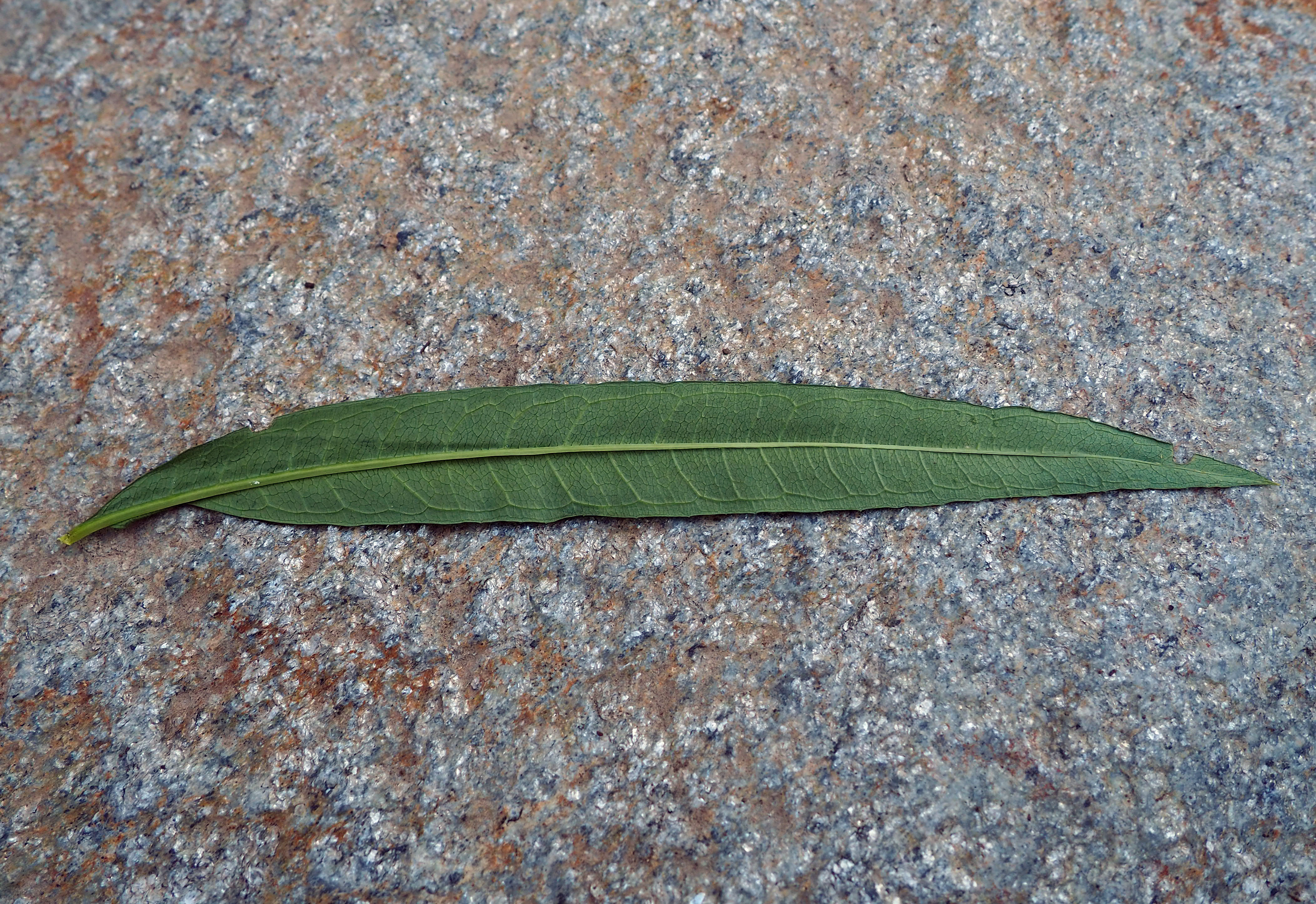
Fireweed stems reach from three to nine feet tall and are rarely branched. Long, narrow, lance-shaped leaves are arranged alternately along the lengths of stems and give the plant a willow-like appearance, which explains another common name, rosebay willowherb. The undersides of leaves have a distinct venation pattern, in which the veins don’t reach the leaf margins, a feature that can help with identification.

distinct leaf veins of fireweed (Chamerion angustifolium)

A series of rose-pink to purple flowers top the stems of fireweed. Each flower has four sepals and four petals with eight stamens and a four-lobed stigma extending prominently from the center. Its long, narrow ovary can be confused for a flower stalk. Rich with nectar, fireweed flowers are a favorite of honeybee keepers. They are also edible, like much of the rest of the plant. Narrow, four-chambered capsules form in place of fertilized flowers and later split open to release abundant, small seeds with a tuft of fluff attached to each one to aid in wind dispersal.

Fireweed has a long history of being used as food and medicine. Stem fibers are also useful for making cord, and seed fluff is useful for weaving and padding. Certainly, fireweed’s abundance and ubiquity contribute to its utility. Having never eaten fireweed before, I decided that a good way to introduce it to my diet would be to make a tea. Fireweed leaves are commonly collected for tea and are said to make an excellent non-caffeinated replacement for black tea.

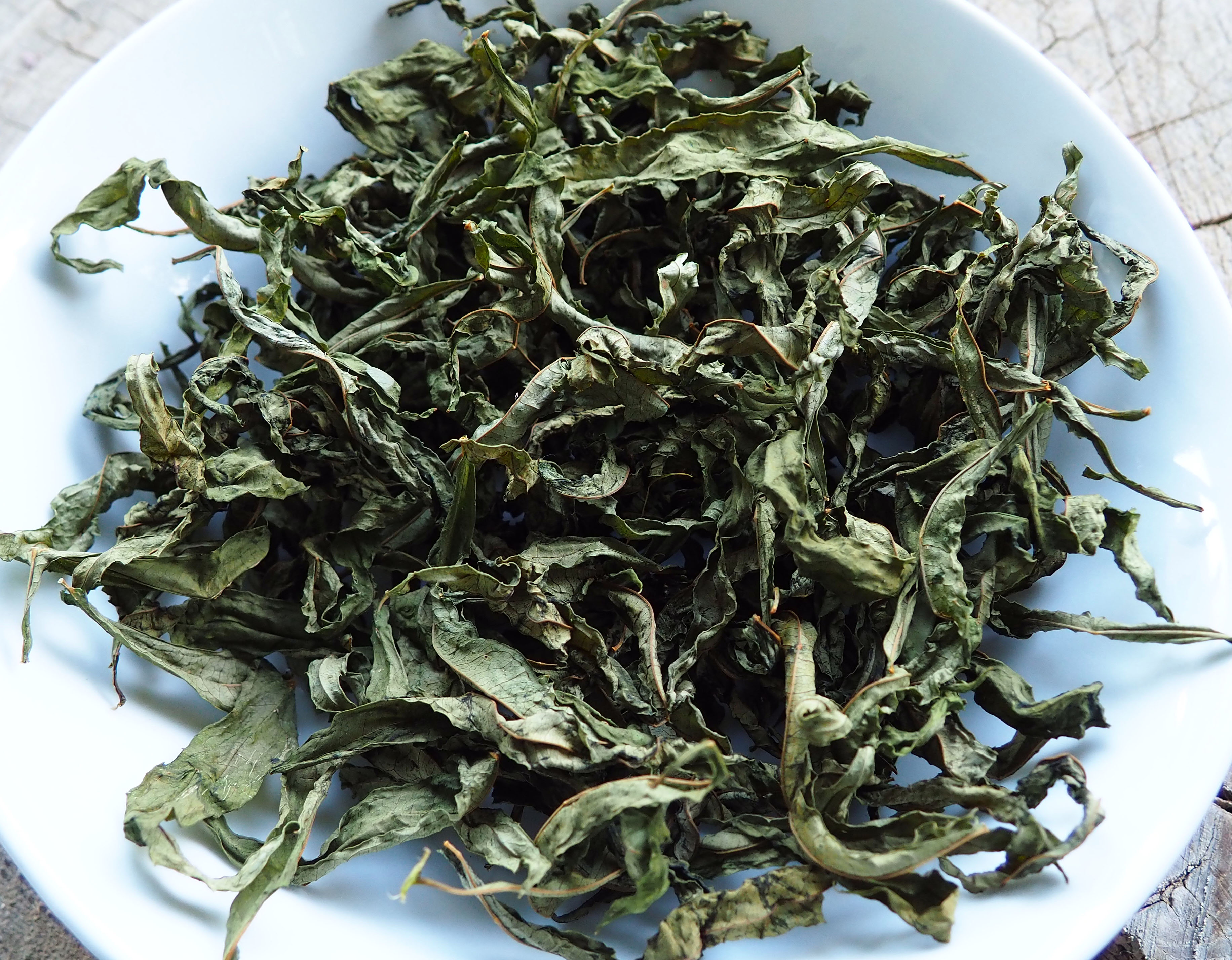
fireweed tea leaves

Making fireweed tea starts by stripping young leaves from fireweed stems. Recipes I encountered all called for fermenting the leaves before drying them. I did this by squeezing handfuls of leaves in my fists just enough to break and bruise them a bit and then packing them into a quart size Mason jar. I closed the lid tight and kept them in the jar for about five days, shaking it up a couple times a day supposedly to help prevent mold issues. After that, I dried the leaves on a baking sheet in the hot sun. From there, they are ready for making tea the same way you would make any other loose leaf tea, chopping the leaves up a bit before immersing them in hot water.

I found the taste of fireweed tea to be mild and pleasant. Despite several sources comparing it to black tea, I thought it was more similar to green tea. Sierra liked the smell more than the taste and wished it had honey in it. Compared to other teas I’ve tried in this short series of posts, this is definitely one of the better ones, and a tea I could see myself making again sometime.

More Tea Time Posts on Awkward Botany:

Getting to Know a Grass – Basic Anatomy and Identification

Have you ever tried to identify a grass? Most of us who like to look at plants and learn their names will probably admit that we often give up on grasses pretty quickly, or just ignore them entirely. They aren’t the easiest plants to identify to species, and there are so many of them. Without close inspection, they can all look pretty similar. Their flowers aren’t particularly showy, and their fruits are fairly forgettable. They are strands or clumps of green that create a backdrop for more intriguing forms of vegetation. Yet, they are among the most ecologically and economically important groups of plants on the planet. And actually, if you can ascend the hurdles that come with getting to know them, they are beautiful organisms and really quite amazing.

Kōura in the Grass

The grass family – Poaceae – consists of nearly 8oo genera and about 12,000 species. Grasses occur in a wide range of habitats across the globe. Wherever you are on land, a grass is likely nearby. Grasses play vital roles in their ecosystems and, from a human perspective, are critical to life as we know it. We grow them for food, use them for building materials and fuel, plant them as ornamentals, and rely on them for erosion control, storm water management, and other ecosystem services. We may not acknowledge their presence most of the time, but we very likely wouldn’t be here without them.

The sheer number of grass species is one thing that makes them so difficult to identify. Key identifying features of grasses and grass-like plants (also known as graminoids) tend to be very small and highly modified compared to similar features on other flowering plants. This requires using a hand lens and learning a whole new vocabulary in order to begin to understand a grass’s anatomy. It’s a time commitment that goes beyond a lot of other basic plant identification, and it’s a learning curve that few dare to follow. However, once you learn the basic features, it becomes clear that grasses are relatively simple organisms, and once you start identifying them, it can actually be an exciting and rewarding experience.

Quackgrass (Elymus repens) and Its Rhizome

Depending on the species, grasses can be annuals – completing their life cycle within a single year – or perennials – coming back year after year for two or more years. Most grasses have a fibrous root system; some are quite shallow and simple while others are extremely deep and extensive. Some species of perennial grasses spread by either rhizomes (underground stems), stolons (horizontal, above ground stems), or both. Some grasses also produce tillers, which are essentially daughter plants that form at the base of the plant. The area where roots, rhizomes, stolons, and tillers meet the shoots and leaves of a grass plant is called the crown. This is an important region of the plant, because it allows for regrowth even after the plant has been browsed by a grazing animal or mown down by a lawn mower.

The stem or shoot of a grass is called a culm. Leaves are formed along the lengths of culms, and culms terminate in inflorescences. Leaves originate at swollen sections of the culm called nodes. They start by wrapping around the culm and forming what is called a leaf sheath. Leaves of grasses are generally long and narrow with parallel venation – a trait typical of monocotyledons. The part of the leaf that extends away from the culm is called the leaf blade or lamina. Leaves are alternatively arranged along the length of the stem and are two-ranked, meaning they form two distinct rows opposite of each other along the stem.

The area where the leaf blade meets the leaf sheath on the culm is called the collar. This collar region is important for identifying grasses. With the help of a hand lens, a closer look reveals the way in which the leaf wraps around the culm (is it open or closed?), whether or not there are hairs present and what they are like, if there are auricles (small flaps of leaf tissue at the top of the collar), and what the ligule is like. The ligule is a thin membrane (sometimes a row of hairs) that forms around the culm where the leaf blade and leaf sheath intersect. The size of the ligule and what its margin is like can be very helpful in identifying grasses.

The last leaf on the culm before the inflorescence is called the flag leaf, and the section of the culm between the flag leaf and the inflorescence is called a peduncle. Like the collar, the flower head of a grass is where you’ll find some of the most important features for identification. Grass flowers are tiny and arranged in small groupings called spikelets. In general, several dozen or hundreds of spikelets make up an inflorescence. They can be non-branching and grouped tightly together at the top of the culm, an inflorescence referred to as a spike, or they can extend from the tip of the culm (or rachis) on small branches called pedicels, an inflorescence referred to as a raceme. They can also be multi-branched, which is the most common form of grass inflorescence and is called a panicle.

Either way, you will want to take an even closer look at the individual spikelets. Two small bracts, called glumes, form the base of the spikelet. Above the glumes are a series of florets, which are enclosed in even smaller bracts – the outer bract being the lemma and the inner bract being the palea. Certain features of the glumes, lemmas, and paleas are specific to a species of grass. This includes the way they are shaped, the presence of hairs, their venation, whether or not awns are present and what the awns are like, etc. If the grass species is cleistogamous – like cheatgrass – and the florets never open, you will not get a look at the grass’s sex parts. However, a close inspection of an open floret is always a delight. A group of stamens protrude from their surrounding bracts bearing pollen, while feathery stigmas reach out to collect the pollen that is carried on the wind. Depending on the species, an individual grass floret can have either only stamens, only pistils (the stigma bearing organs), or both. Fertilized florets form fruits. The fruit of a grass is called a caryopsis (with a few exceptions) and is indistinguishable from the seed. This is because the seed coat is fused to the wall of the ovary, unlike other fruit types in which the two are separate and distinct.

If all this doesn’t make you want to run outside and take a close look at some grasses, I don’t know what will. What grasses can you identify in your part of the world? Let me know in the comment section below or check out the linktree and get in touch by the means that suits you best.

Winter Trees and Shrubs: Kentucky Coffeetree

A few years ago, I was on the hunt for a Kentucky coffeetree. I was aware that a few could be found in some of the parks around Boise, but not being familiar with them, I wasn’t sure where exactly to find one or what I was even looking for. One winter while riding my bike to work, I noticed a tree at the edge of a golf course. No doubt I had passed this tree hundreds (if not thousands) of times. What caught my eye were thick, bean-like pods hanging from the ends of branches. They were unlike any other tree fruits I was familiar with. I stopped and, with a little effort, knocked one of the pods free from the tree. When I split it open, I found three or four large, smooth, black seeds inside. Later, I confirmed that the tree was indeed Kentucky coffeetree. Passing by it during any other time of year, it may have never caught my eye – just another deciduous tree with green leaves that, from a distance at least, looks like so many other deciduous trees. But in winter, with several chunky pods hanging from the tips of its stout branches, it really stood out. This is the joy of looking at trees and shrubs in the winter, where features that may otherwise be obscured, become glaringly obvious against the plainness of a winter backdrop.

fruits of Kentucky coffeetree (Gymnocladus dioicus)

Kentucky coffeetree (Gymnocladus dioicus) is in the bean family (Fabaceae). It occurs in forests across the eastern and central United States and north into southern Ontario, Canada. It is also planted in urban areas both within and outside of its native range. It is a medium to large tree, averaging 60-70 feet (18-21 meters) high and 40-50 feet (12-15 meters) wide. It generally branches out at around 10-15 feet high and forms a narrow, rounded to pyramidal crown. It is a fairly sparsely branched tree compared to other trees its size, which is much easier to observe in the winter after all of its leaves have dropped.

winter twigs of Kentucky coffeetree

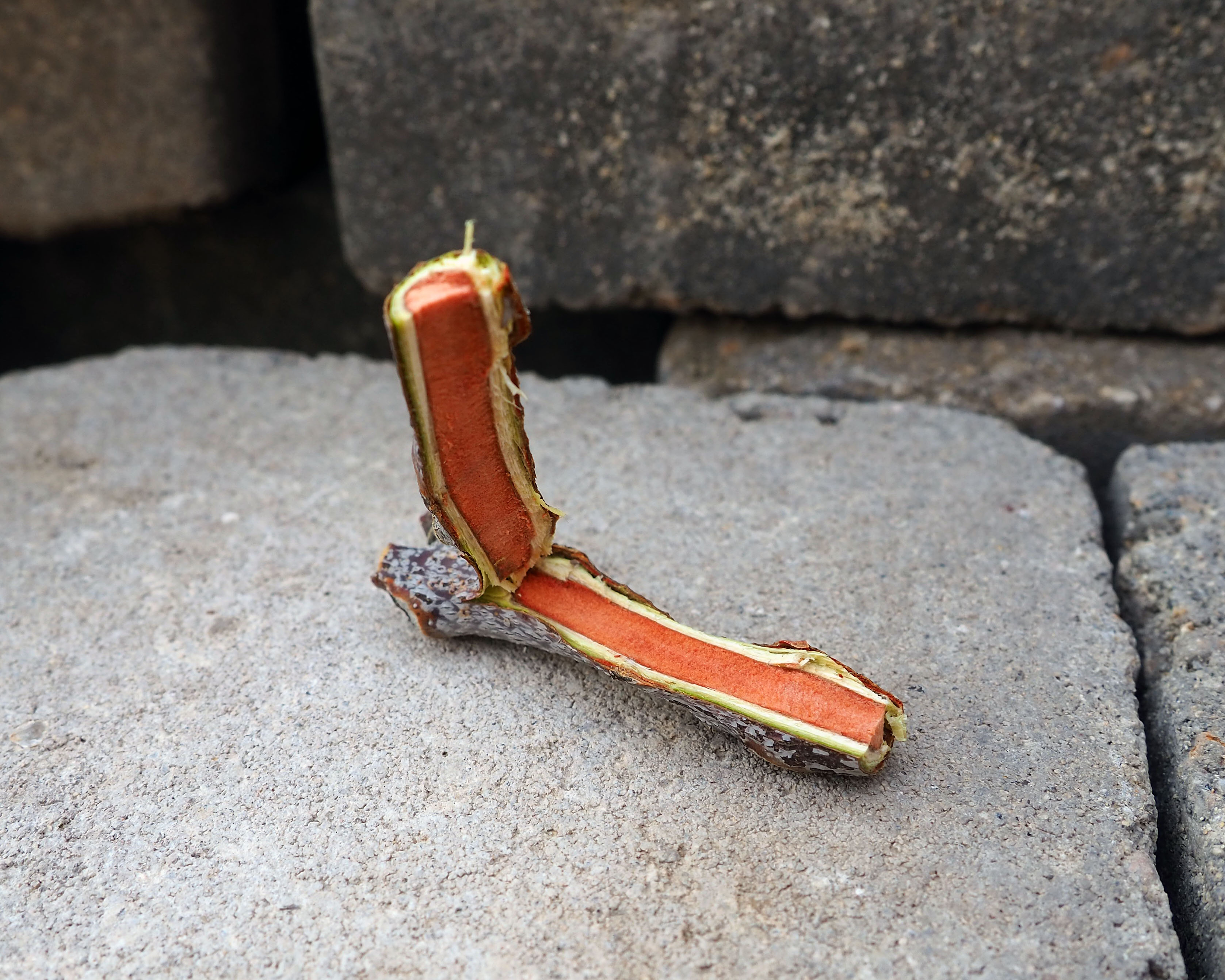
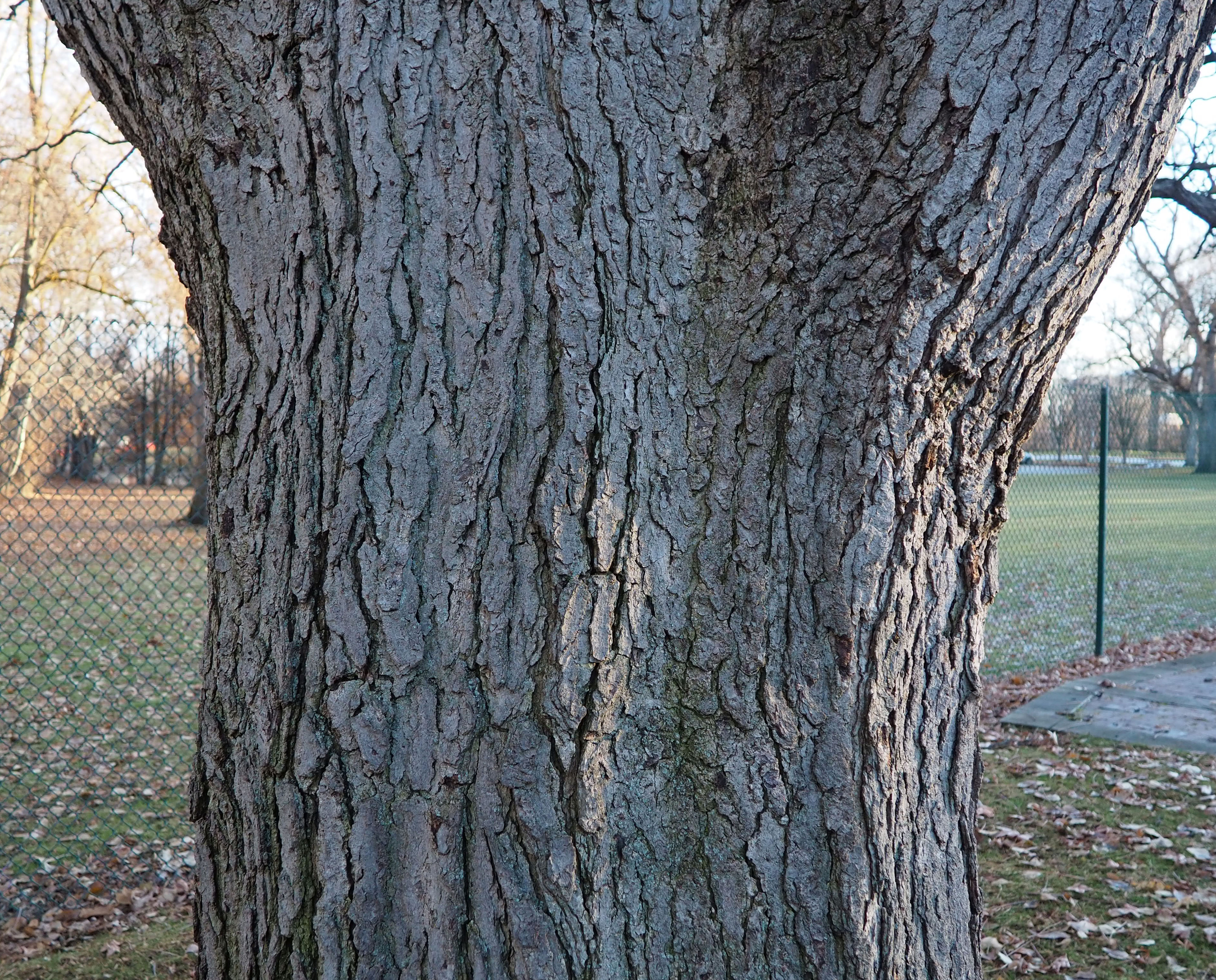
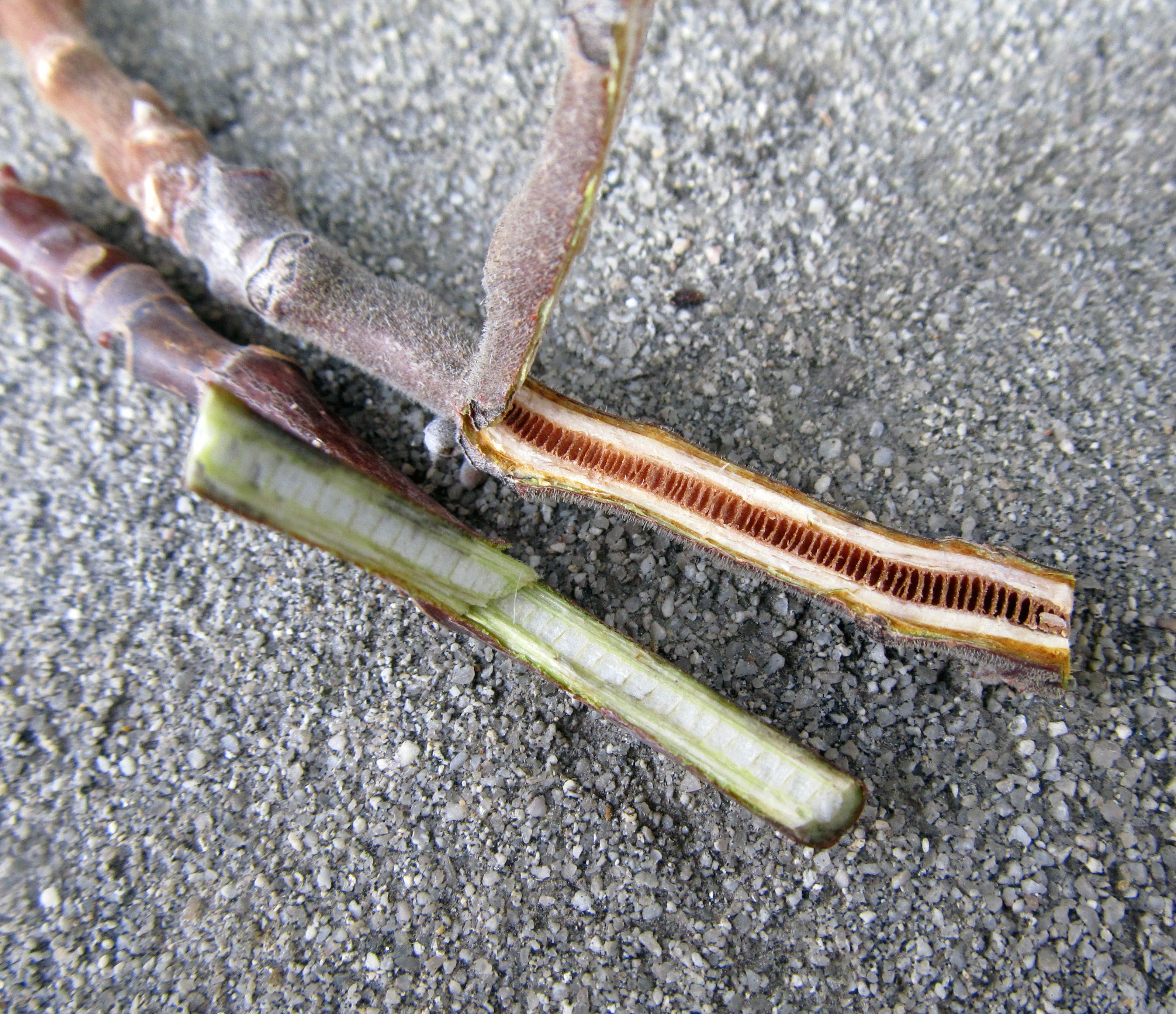
The winter twigs of Kentucky coffeetree are thick and stubby with few hairs and can be greenish, orange, brown, or deep wine-red in color. They have small, scattered lenticels that are either white, orange, or orange-brown. Their leaf scars are alternately arranged and are heart- or sheild-shaped and very large with 3 to 5 distinct bundle traces. It’s pretty obvious from the leaf scars that Kentucky coffeetree bears a sizeable leaf. These massive, bipinnately compound leaves are demonstrated in this Plant Sleuth YouTube video. Leaf buds are tiny and found directly above the leaf scar. There are usually two of them, one of which is sterile and can be difficult to see. They are round, hairy, olive-colored, and sunken like fuzzy, little craters, although you’ll need a hand lens to really see the hairs (which I highly recommend). The twigs lack a terminal leaf bud. Their pith is rounded, thick, and either orange, brown, or salmon colored. The young bark of Kentucky coffeetree is pale gray and fairly smooth. As the tree ages, it breaks into shallow ridges that run the length of the tree. At maturity, the bark is shades of grey and scaly with long, defined, narrow ridges.

pith of Kentucky coffeetree twigs

Kentucky coffeetree is dioecious, meaning that there are “male” trees and “female” trees. The tree that I found on the golf course was a “female” tree because it was bearing fruit, which the “males” and certain cultivars won’t have. If there are no seed pods present, you will have to rely on other features to identify the tree; however, when the pods are present, the tree is unmistakable. Its fruits are thick-walled, flat, oval-shaped, smooth, leathery, and orange-brown to black in color. They measure around 5 to 10 inches long and up to 4 inches wide. They are indehiscent and can persist on the tree for more than a year, and even those that fall to the ground can take months or years to break down enough to release the seeds, which have a hard, dark seed coat. Inside the pod, the seeds are embedded in a thick, gooey, yellow-green pulp, which some descriptions call sweet. However, it doesn’t look appetizing enough to try, and considering that the seeds are toxic, I’d be hesitant to consume any part of the fruit without first verifying its safety with a reputable source. That being said, the seeds can be roasted and used to make a coffee substitute and, as long as it’s done correctly, is safe to drink.

mature bark of Kentucky coffeetree

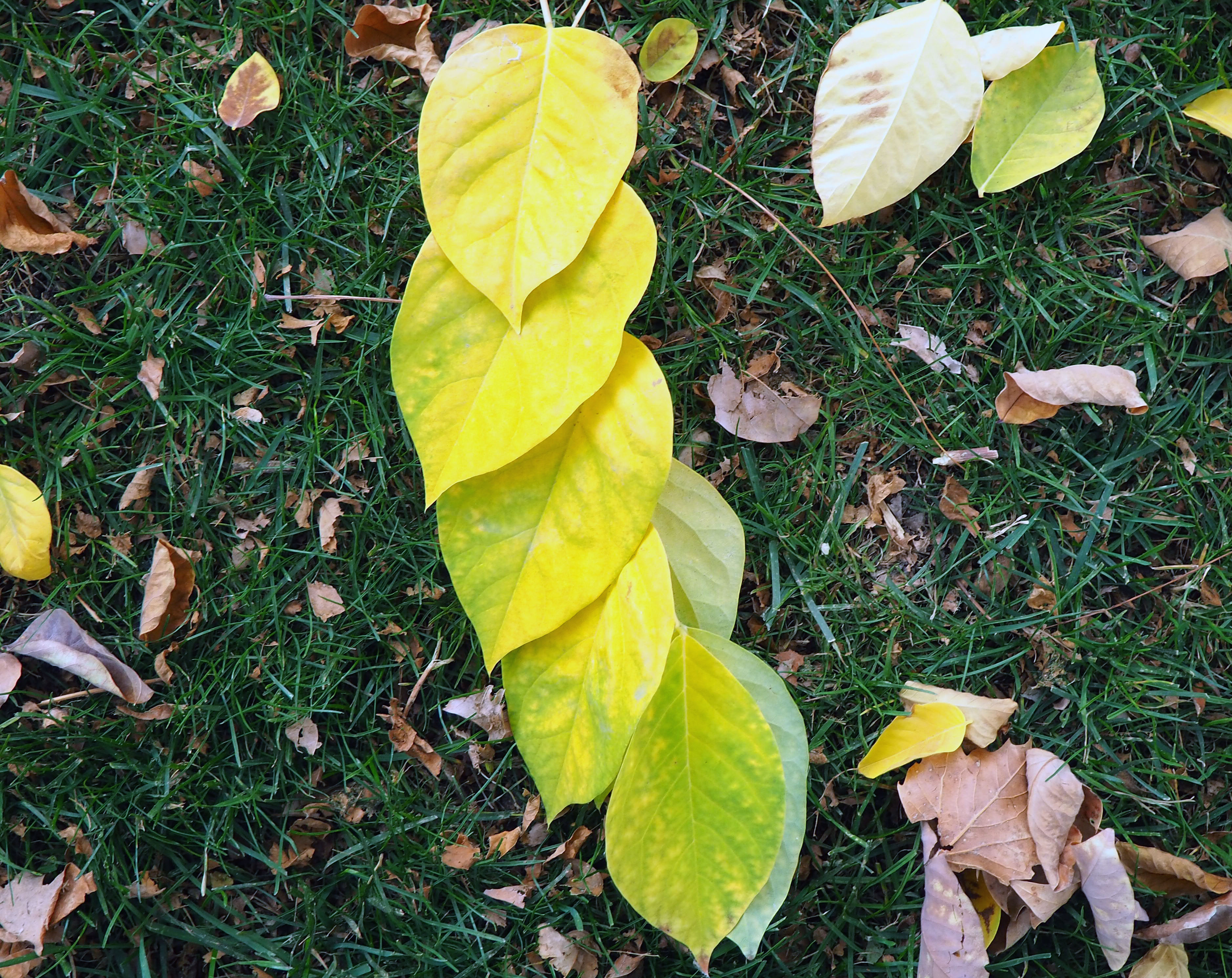
Kentucky coffeetree is one of the last trees to leaf out in the spring and one of the first to drop its leaves in the fall. Flowers appear in mid to late spring. The leaves have a pink to bronze color as they first emerge, and in the fall they turn bright yellow before they drop.

fall foliage of Kentucky coffeetree

More Winter Trees and Shrubs:

Winter Trees and Shrubs: Tulip Tree

At first glance, a tulip and a tulip tree couldn’t be more different. One is a bulb that puts out fleshy, green leaves in the spring, topped with colorful, cup-shaped flowers, barely reaching a foot or so tall. The other is a massive, deciduous tree with a broad, straight trunk that can grow to nearly 200 feet tall. But if you can get a look at the flowers, seed heads, and even the leaves of this enormous tree, you might see a resemblance – at least in the shape of these features – to one of our most popular spring flowering geophytes.

Tulip tree (Liriodendron tulipifera) is distributed across the eastern United States and has been planted widely outside of its native range. Also commonly known as tulip poplar, yellow poplar, and whitewood, it is a member of the magnolia family and is one of two species in its genus (the other being Liriodendron chinense – a tree found mainly in China). Many (if not most) deciduous trees of North America have small, inconspicuous flowers, but tulip trees – like its close relatives, the magnolias – have relatively large, showy flowers. The trouble is actually getting to see them since, at least on mature trees, they are borne in a canopy that is considerably taller than the average human.

Tulip tree flowers are cup-shaped, yellow-green and orange, with a series of prominent stamens surrounding the carpels which are attached to a long, slender receptacle giving it a cone-shaped appearance. As the flower matures into fruits, the tulip shape of the inflorescence is maintained as the seeds with their wing-like appendages form a tight, cone-like cluster that opens as the seeds reach maturity. The wings aid in dispersal as the seeds fall from the “cone” throughout the winter.

seed head of tulip tree (Liriodendron tulipifera)

The four-lobed leaves of tulip trees also form a vague tulip shape. They are alternately arranged, bright green, and up to five or six inches long and wide, turning yellow in the fall. Two prominent, oval-shaped stipules surround the stem at the base of the petiole of each leaf. These stipules come into play when identifying the leafless twigs of tulip trees during the winter months.

leaf of tulip tree (Liriodendron tulipifera) in late summer

The winter twigs of tulip trees are easily recognizable thanks to their duck bill shaped buds which are made up of two wine-red, violet, or greenish bud scales. The terminal buds are considerably larger and longer than the lateral buds, some of which are on little stalks. The twigs are smooth, olive-brown or red-brown, with just a few, scattered, white lenticels. Leaf scars are rounded with a dozen or so bundle scars that are either scattered or form an irregular ellipse. Pronounced stipule scars encircle the twig at the location of each leaf scar. Twigs can be cut lengthwise to reveal pale white pith that is separated by a series of diaphragms.

winter twig of tulip tree (Liriodendron tulipifera)
top right: the chambered pith of black walnut (Juglans nigra); bottom left: diaphragmed pith of tulip tree (Liriodendron tulipifera)

The bark of tulip trees can be easily confused with that of ash trees. Young bark is smooth and ash-gray to grayish green with pale, vertical cracks. As the tree matures, the cracks develop into furrows with flat-topped ridges. The ridges grow taller and more peaked, and the furrows grow deeper as the tree reaches maturity. In the book Winter Botany, William Trelease compares the mature bark of tulip trees to a series of parallel mountain ranges with deep gullies on either side.

maturing bark of tulip tree (Liriodendron tulipifera)

Perhaps even as tulips are blooming, the buds of tulip trees break to reveal their tulip-shaped, stipule bearing leaves. This makes for an interesting show. In The Book of Forest and Thicket, John Eastman describes it this way: “from terminal buds shaped like duck bills, successions of bills within bills uncurl and unfold, revealing a marvel of leaf packaging.”

More Winter Trees and Shrubs:


The photos of tulip tree were taken at Idaho Botanical Garden in Boise, Idaho.

Winter Trees and Shrubs: Northern Catalpa

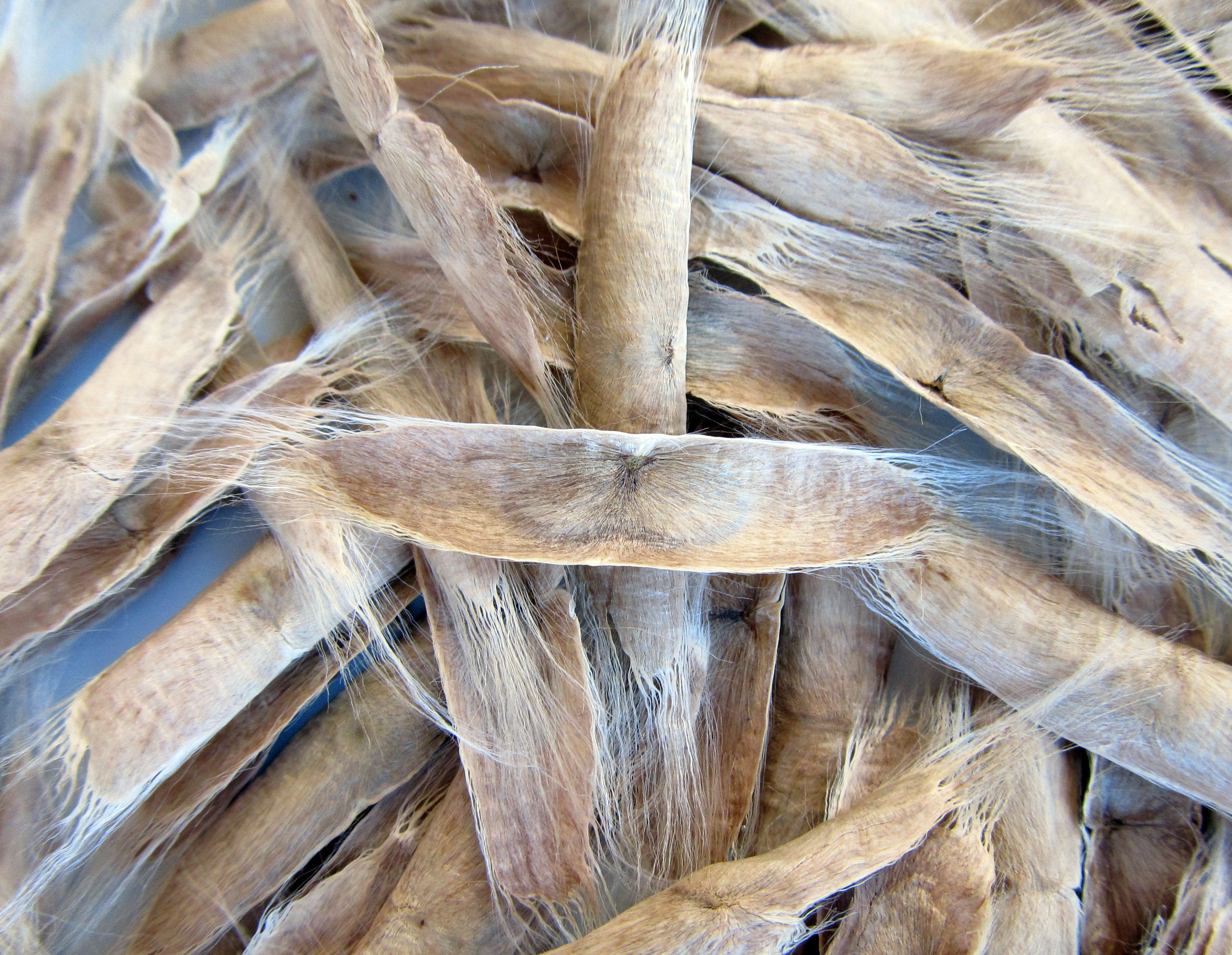
The names of plants often contain clues that can either help with identification or that tell something about the plant’s history or use. The name, catalpa, is said to be derived from the Muscogee word, katałpa, meaning “winged head,” presumably referring to the tree’s winged seeds. Or maybe, as one writer speculates, it refers to the large, heart-shaped, floppy leaves that can make it look like the tree is “ready to take flight.” Or perhaps it’s a reference to the fluted, fused petals of the tree’s large, tubular flowers. I suppose it could mean any number of things, but I’m sticking with its seeds, which are packed by the dozens in the tree’s long, slender, bean-like fruits. The seeds are flat, pale brown, and equipped with paper thin, fringed appendages on either side that assist in wind dispersal – wings, in other words.

winged seeds of northern catalpa (Catalpa speciosa)

Catalpa speciosa, or northern catalpa, is a relatively fast growing, short-lived tree native to the Midwest and one of only two species in the genus Catalpa found in the United States. Its distribution prior to the arrival of Europeans appears to have been restricted to a portion of the central Mississippi River valley, extending west into Arkansas, east into Tennessee, and north into Illinois and Indiana. It has since been widely planted outside of its native range, naturalizing in areas across the Midwest and eastern US. Early colonizers planted northern catalpa for use as fence posts, railroad ties, and firewood. Its popularity as an ornamental tree is not what it once was a century ago, but it is still occasionally planted in urban areas as a shade tree. Its messiness – littering the ground below with large leaves, flowers, and seed capsules – and its tendency to spread outside of cultivation into natural areas are reasons why it has fallen out of favor with some people.

The oval to heart-shaped, 8 to 12 inch long leaves with long petioles rotting on the ground below the tree are one sure sign that you’ve encountered a catalpa in the winter time. The leaves are some of the first to fall at the end of the growing season, briefly turning an unmemorable yellow before dropping.

leaf of northern catalpa (Catalpa speciosa) in the winter with soft hairs on the underside still visible

The leaf arrangement on northern catalpa is whorled and sometimes opposite. The twigs are easy to identify due to several unique features. They are stout, round, and grayish brown with prominent lenticels. The leaf scars are large, rounded, and raised up on the twig, looking a bit like little suction cups. They are arranged in whorls of three, with one scar considerably smaller than the other two. A series of bundle traces inside the scar form an ellipse. The leaf buds are tiny compared to the scar and are protected by loose, pointed, brown bud scales. Northern catalpa twigs lack a terminal bud. In the winter, seed capsules or the stalk of an old inflorescence often remain attached to the terminal end of the twig. The pith inside of the twig is thick, white, and solid.

twig of northern catalpa (Catalpa speciosa)

pith inside twig of northern catalpa (Catalpa speciosa)

Another common name for Catalpa speciosa is cigar tree, a name that comes from its up to 18 inch long, cigar-like seed capsules that hang from the otherwise naked tree throughout the winter. The sturdy, cylindrical pod starts out green in the summer and turns dark brown by late fall. Seed pods that haven’t fallen or already split open will dehisce in the spring time, releasing their papery seeds to the wind.

fruits of northern catalpa (Catalpa speciosa) hanging from the tree in the winter

The young bark of northern catalpa is thin and easily damaged. As it matures, it becomes furrowed with either scaly ridges or blocky plates. Mature trees are generally twisted at the base but otherwise grow straight, reaching 30 to 60 feet tall (sometimes taller) with an open-rounded to narrow-oval crown.

maturing bark of northern catalpa (Catalpa speciosa)

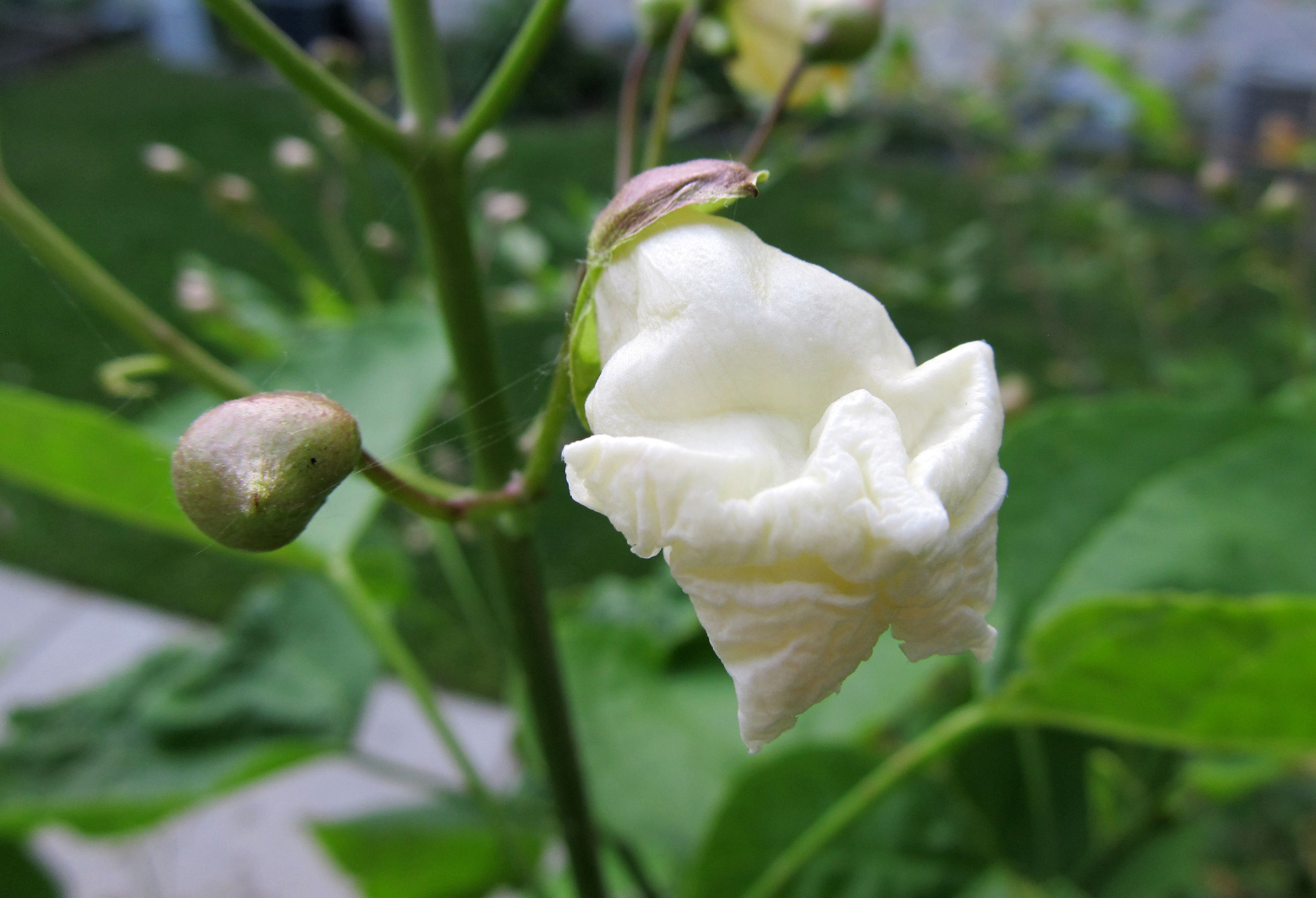
Northern catalpa is one of the last trees to leaf out in the spring. In late spring or early summer, 10 inch long clusters of white, tubular flowers are produced at the tips of stems. Before the flowers open, they look a bit like popped popcorn, reminding me of a song from my childhood (which I will reluctantly leave right here). The margins of its trumpet-shaped petals are ruffled and there is yellow, orange, and/or purple spotting or streaking on the inside of the tubes.

flower of northern catalpa (Catalpa speciosa) just before it opens

More Winter Trees and Shrubs on Awkward Botany:

Winter Trees and Shrubs: Netleaf Hackberry

Boise, Idaho is frequently referred to as the City of Trees despite being located in a semiarid region of the Intermountain West known as the sagebrush steppe where few trees naturally grow. It earns this moniker partly because the name Boise is derived from the river that runs through it (the Boise River), which was named La Rivere Boisse, or The Wooded River, by early French trappers. Although it flows through a largely treeless landscape, The Wooded River was an apt name on account of the wide expanse of cottonwoods and willows that grew along its banks. The fervent efforts of early colonizers to plant trees in large numbers across their new city also helped Boise earn the title, City of Trees. Today, residents continue the legacy of planting trees, ensuring that the city will remain wooded for decades to come.

As is likely the case for most urban areas, the majority of trees being planted in Boise are not native to the region. After all, very few tree species are. However, apart from the trees that flank the Boise River, there is one tree in particular that naturally occurs in the area. Celtis reticulata, commonly known as netleaf hackberry, can be found scattered across the Boise Foothills amongst shrubs, bunchgrasses, and wildflowers, taking advantage of deep pockets of moisture found in rocky outcrops and draws.

The western edge of netleaf hackberry’s range extends to the northwest of Boise into Washington, west into Oregon, and down into California. The majority of its range is found south of Idaho, across the Southwest and into northern Mexico, then east into the prairie regions of Kansas and Oklahoma. Previously placed in the elm family, it is now considered a member of the family Cannabaceae (along with hemp and hops). It’s a relatively small, broad tree (sometimes a shrub) with a semi-rounded crown. It grows slowly, is long-lived, and generally has a gnarled, hardened, twisted look to it. It’s a tough tree that has clearly been through a lot.

The leaves of Celtis reticulata are rough, leathery, and oval to lance shaped with serrate or entire leaf margins. Their undersides have a distinct net-like pattern that gives the tree its common name. A very small insect called a hackberry psyllid lays its eggs inside the leaf buds of netleaf hackberries in the spring. Its larvae develop inside the leaf, feeding on the sugars produced during photosynthesis, and causing nipple galls to form in the leaves. It’s not uncommon to see a netleaf hackberry with warty-looking galls on just about every leaf. Luckily, the tree doesn’t seem to be bothered by this.

fallen leaves of netleaf hackberry (Celtis reticulata) with nipple galls

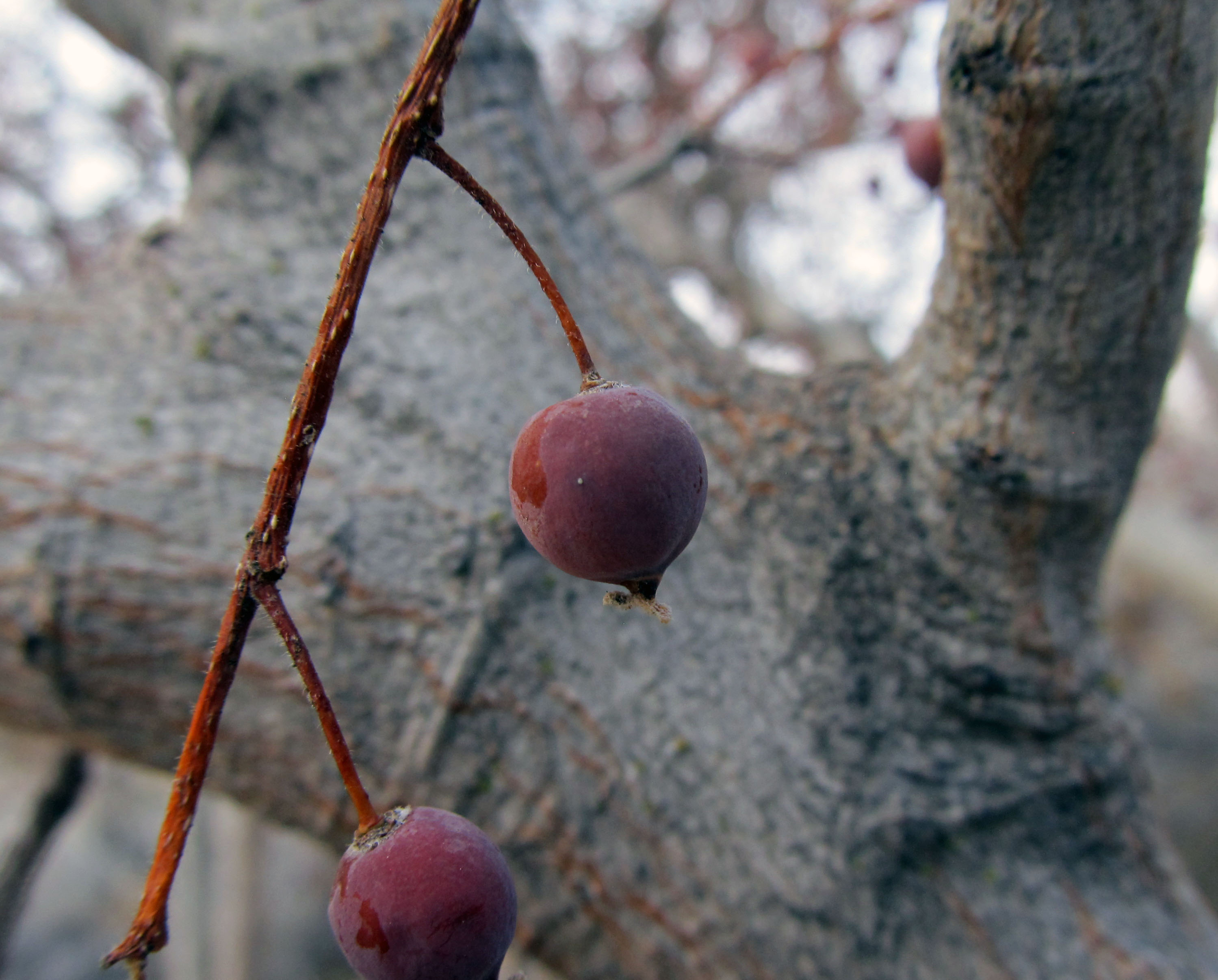
The fruit of netleaf hackberry is a pea-sized drupe that hangs at the end of a pedicel that is 1/4 to 1/2 inch long. Its skin is red-orange to purple-brown, and its flesh is thin with a large seed in the center. The fruits, along with a few random leaves, persist on the tree throughout the winter and provide food for dozens of species of birds and a variety of mammals.

persistent fruit of netleaf hackberry (Celtis reticulata)

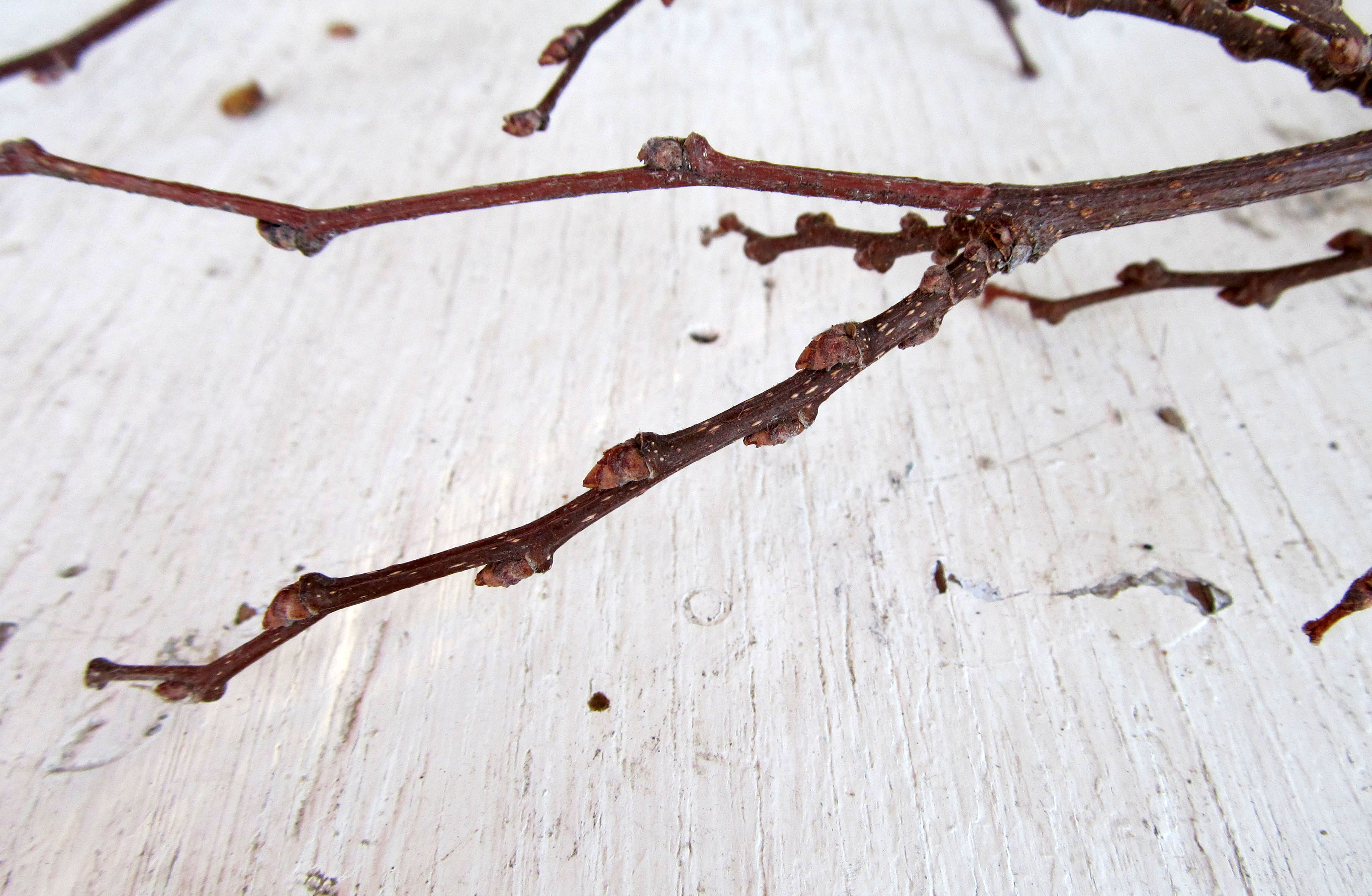
Celtis reticulata is alternately branched. Its twigs are slender, zig-zagging, and often curved back towards the trunk. They are reddish-brown with several pale lenticels and have sparse, fine, short hairs that are hard to see without a hand lens. The leaf scars are small, half-round, and raised up from the twig. They have three bundle scars that form a triangle. The buds are triangle-shaped with fuzzy bud scales that are slightly lighter in color than the twig. The twigs are topped with a subterminal bud, and the pith (the inner portion of the twig) is either chambered or diaphragmed and difficult to see clearly without a hand lens. 

twigs of netleaf hackberry (Celtis reticulata)

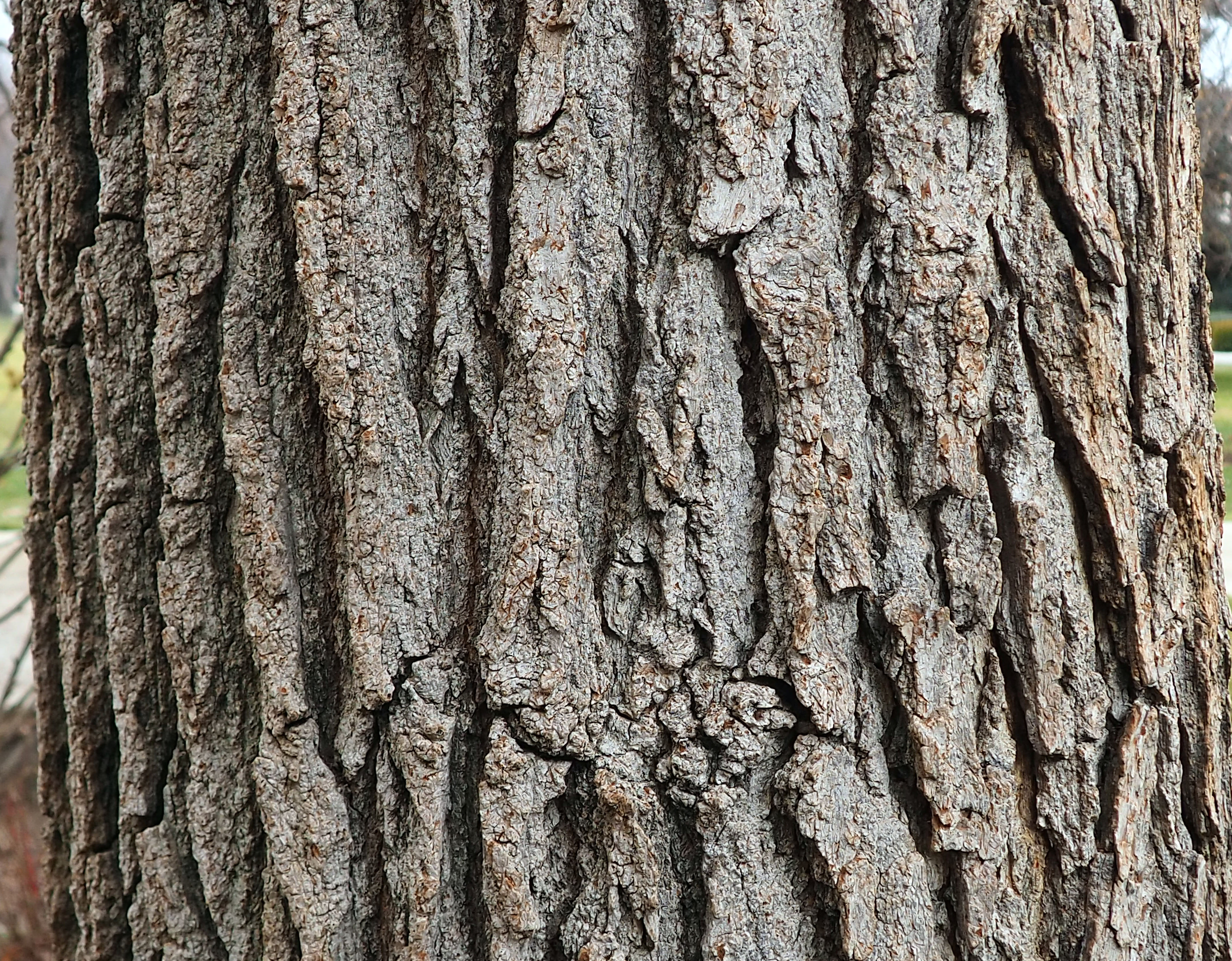
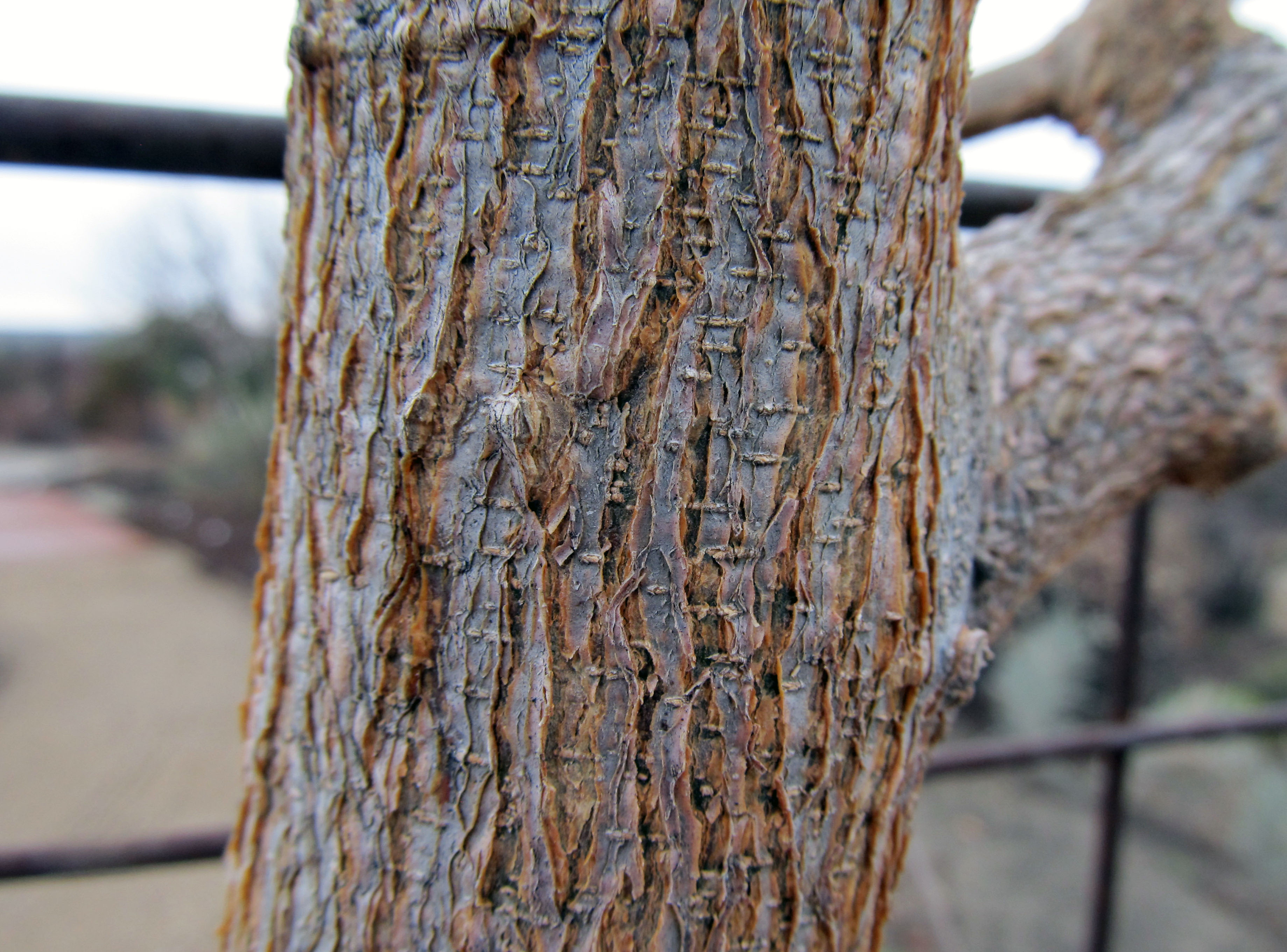
The young bark of netleaf hackberry is generally smooth and grey, developing shallow, orange-tinged furrows as it gets older. Mature bark is warty like its cousin, Celtis occidentals, and develops thick, grey, corky ridges. Due to its slow growth, the bark can be retained long enough that it becomes habitat for extensive lichen colonies.

bark of young netleaf hackberry (Celtis reticulata)

bark of mature netleaf hackberry (Celtis reticulata)

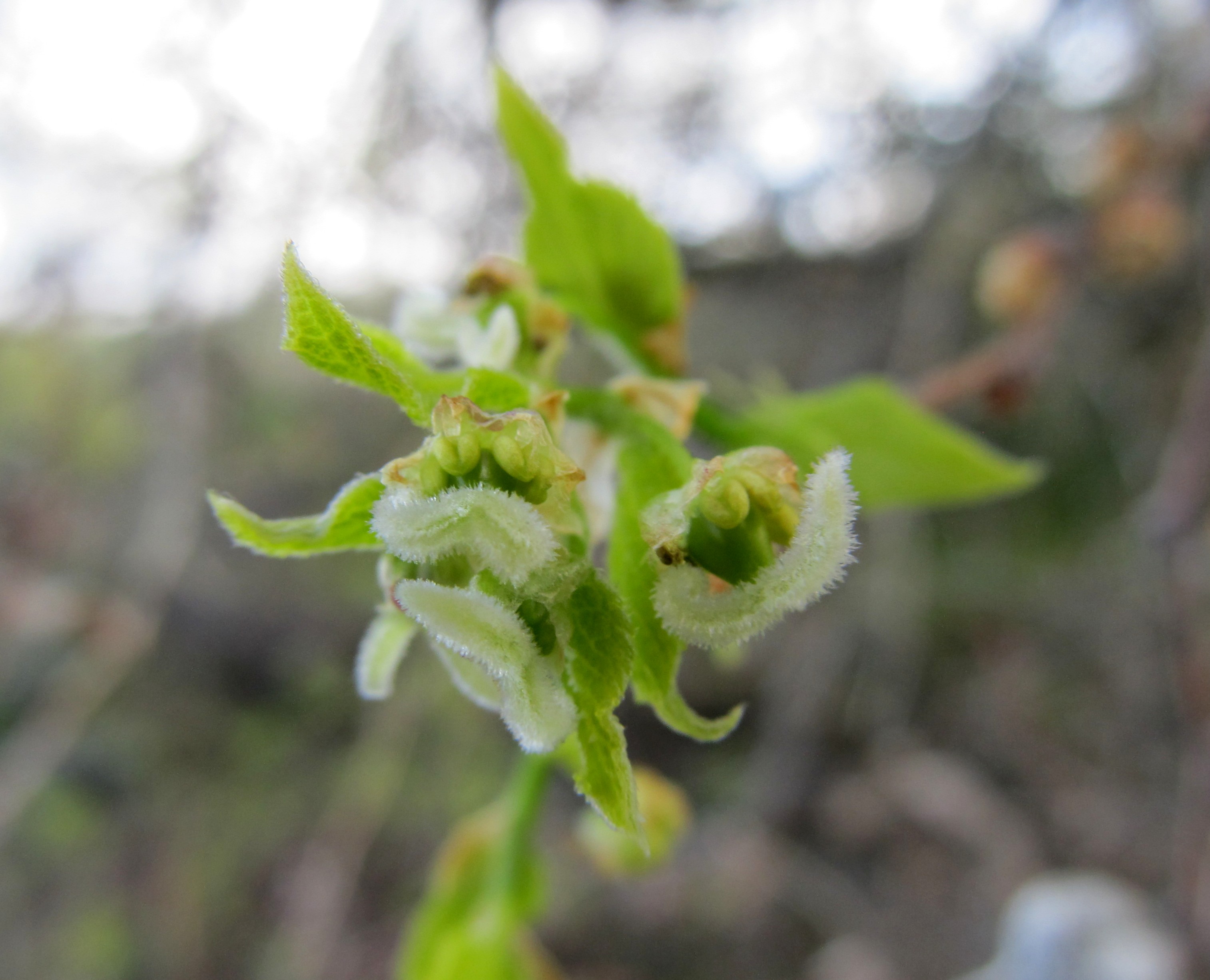
Netleaf hackberry is one of the last trees to leaf out in the spring, presumably preserving as much moisture as possible as it prepares to enter another scorching hot, bone-dry summer typical of the western states. Its flowers open around the same time and are miniscule and without petals. Their oversized mustache-shaped, fuzzy, white stigmas provide some entertainment for those of us who take the time to lean in for a closer look.

spring flowers of netleaf hackberry (Celtis reticulata)

More Winter Trees and Shrubs on Awkward Botany:

———————

Photos of netleaf hackberry taken at Idaho Botanical Garden in Boise, Idaho.