What Do Desert Tortoises Eat?

Desert conditions are not intuitively conducive to life. In many regards they are extreme. Blistering, bleak, dry, and barren. The desert is a place unsuited for the faint of heart and the ill-equipped. Broadly speaking, life in the desert is reliant on one of two things: technology or evolutionary adaptation. Like many species native to desert environments, the desert tortoise employs the latter. It is at home in the desert because it evolved there. That is not to say that life is always easy for the desert tortoise and species like it, but it is possible, thanks to hundreds of thousands of years of making it work. As John Alcock puts it in, Sonoran Desert Spring, “the tortoise will deal with its environment through evolved design rather than seek to deny the desert its due.”

Perhaps it is because the desert is such a harsh environment, requiring finely tuned adaptations for survival, that sweeping changes can put resident species in peril – threatening their long-term existence. The desert tortoise is an example of this. Since 1990, Gopherus agassizii has found itself listed as threatened under the U.S. Endangered Species Act [it is categorized as vulnerable by the IUCN] due to significant population declines and loss of habitat. Getting there did not happen overnight, and it is impossible to pinpoint a sole cause of the tortoise’s decline. Instead, a suite of things have conspired against it, making it difficult to decide on the best route towards conservation.

In an October 2012 issue of BioScience, Averill-Murray, et al. enumerate some of the human-medaited threats that act both simultaneously and synergistically against desert tortoise populations:

Habitat conversion occurs as a result of urban development, mining, waste disposal, energy development, and road construction. Habitat modification is caused by military training, off-highway vehicle use, utility corridors, livestock grazing, and the proliferation of invasive plants. … Direct losses of tortoises also occur through predation, disease, collection from the wild, and recreational killing.

Apart from climate change, which is projected to substantially reduce the historical range of the desert tortoise in the coming years, the proliferation of introduced grasses is particularly disconcerting. Such grasses tend to increase wildfire frequency in areas where wildfire is historically rare and the native flora is ill-adapted to frequent fire. This can alter plant communities in a way that favors introduced plants over plants native to the region.

Desert Tortoise (Gopherus agassizii) - photo credit: wikimedia commons

Desert Tortoise (Gopherus agassizii) – photo credit: wikimedia commons

The desert tortoise is the largest terrestrial turtle in the United States, measuring up to 15 inches long and weighing up to 15 pounds. Their carapaces are generally dull brown or gray, although those of young tortoises may have orange markings. Their limbs are stocky and elephantine, and their front legs are shovel-like and equipped with claws for digging. They reach sexual maturity between ages 15-20, generally living for at least 35 years and as many as 50-100 years.

Desert tortoises are distributed throughout the Mohave and Sonoran Deserts of southeastern United States and into the Sonaron Desert and Sinaloan foothills of northwestern Mexico. Their habitat varies widely across their range. In general, tortoises prefer sites where the soil is loamy and easy to dig as they spend much of their time in underground dens; however, they also occur in rocky foothills where shelter can be found among the rocks. In the Mohave Desert, they are commonly found in plant communities that are dominated by creosote bush (Larrea tridentata), which they use for shade and an occasional food source.
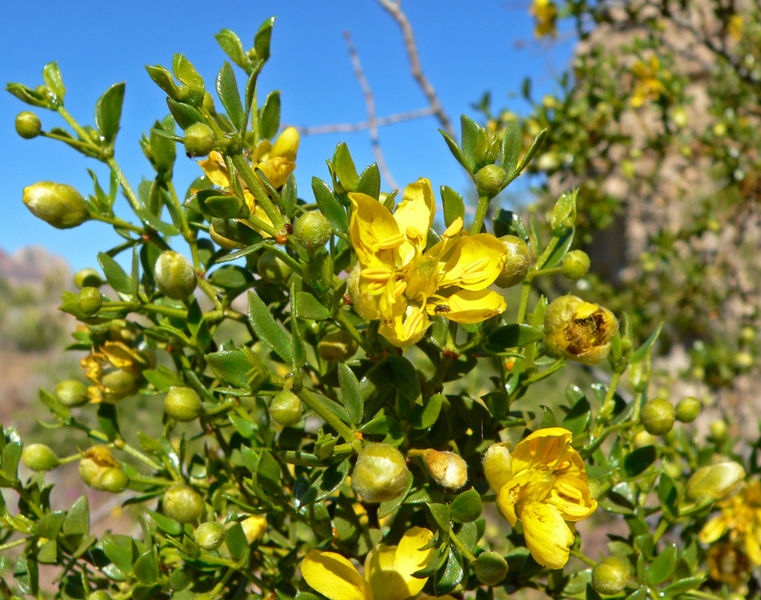
Creasote Bush (Larrea tridentata) - photo credit: wikimedia commons

Creosote Bush (Larrea tridentata) – photo credit: wikimedia commons

Recently the species known as Gopherus agassizii was determined to consist of at least two (possibly four) distinct species. Desert tortoises that occur north and west of the Colorado River have retained the scientific name G. agassizii and are commonly referred to as Agassiz’s desert tortoise. Desert tortoises occurring east of the Colorado river have been given the name G. morafkai, commonly known as Morafka’s desert tortoise. In light of this, G. agassizii may find itself uplisted to endangered, as its range has been reduced to about 30% of its former self and its southern cousins can no longer be considered a genetic reservoir.

Seeing that desert tortoises have plenty of the right foods to eat ensures their immediate survival and holds them back from the precipice of extinction. The question, “What does a desert tortoise eat?,” was what peaked my curiosity in this subject to begin with. I knew they were herbivores (for the most part), so I assumed they must have a favorite food – something that composed the majority of their diet. Finding an answer to this question led me down a rabbit hole [or should I say a tortoise hole? Some tortoise dens can extend 30 feet or more into the banks of desert dry washes.] that led me to discover the complexity of these creatures. It turns out, there is no easy answer to my initial question. What a desert tortoise eats depends on where in its expansive range it resides, what time of year it is, what plants are available in a particular year, whether or not it’s a drought year, etc.

The desert tortoise is “one of the most studied reptiles in the world,” so hundreds of observations have been made, leading to dozens of reports and studies that examine the diet of the desert tortoise; however, the results are highly variable. Due to such variability, this fact sheet from the San Diego Zoo states matter-of-factly, “an ‘average’ tortoise diet [is] hard to characterize.” But let’s try.

The desert tortoise emerges from its winter den in early spring. At the same time, annual wildflowers are also emerging, taking advantage of warming temperatures and rare soil moisture accumulated during winter precipitation. This is the desert tortoise’s preferred banquet. Because there will be little water available the rest of the year, desert tortoises hydrate themselves mainly through the plants they eat. The lush stems, leaves, and flowers of annual wildflowers provide both nutrients and the water necessary to sustain themselves throughout much of the year and aid in their growth and reproduction.

As spring turns to summer, the tortoises switch to eating herbaceous perennials and grasses. By this point, both introduced annual grasses and native perennial bunchgrasses are drying up, but tortoises are still able to extract some nutrients and moisture by eating their dry stems and leaves. Cactus pads and fruits (particularly those in the genus Opuntia) as well as young leaves of shrubs also help tortoises subsist through the long, hot summers, which are mostly spent deep in their dens away from predators and the blistering heat.

A paper published in a March 1986 issue of Herpetologica follows a group of tortoises over the period of a year and makes a number of lifestyle observations, including their diet. The authors noted that much of their diet consisted of two annual wildflowers (Camissonia munzii and Langloisia setosissima), a perennial bunchgrass (Achnatherum hymenoides), and a non-native annual grass (Bromus rubens). A paper published in a 2010 issue of Journal of Herpetology compared the nutritional quality of four plant species commonly consumed by desert tortoises: a native and non-native grass (Achnatherum hymenoides and Schismus barbatus) and a native and non-native annual forb (Malacothrix glabrata and Erodium cicutarium). They found little difference between the native and non-native species in either catagory, but determined that the forbs were significantly more nutritious than the grasses, which lead them to recommend managament practices that would increase the availability of forbs (regardless of provenance) in tortoise habitat. Numerous studies have documented the frequent consumption of introduced plant species by desert tortoises.
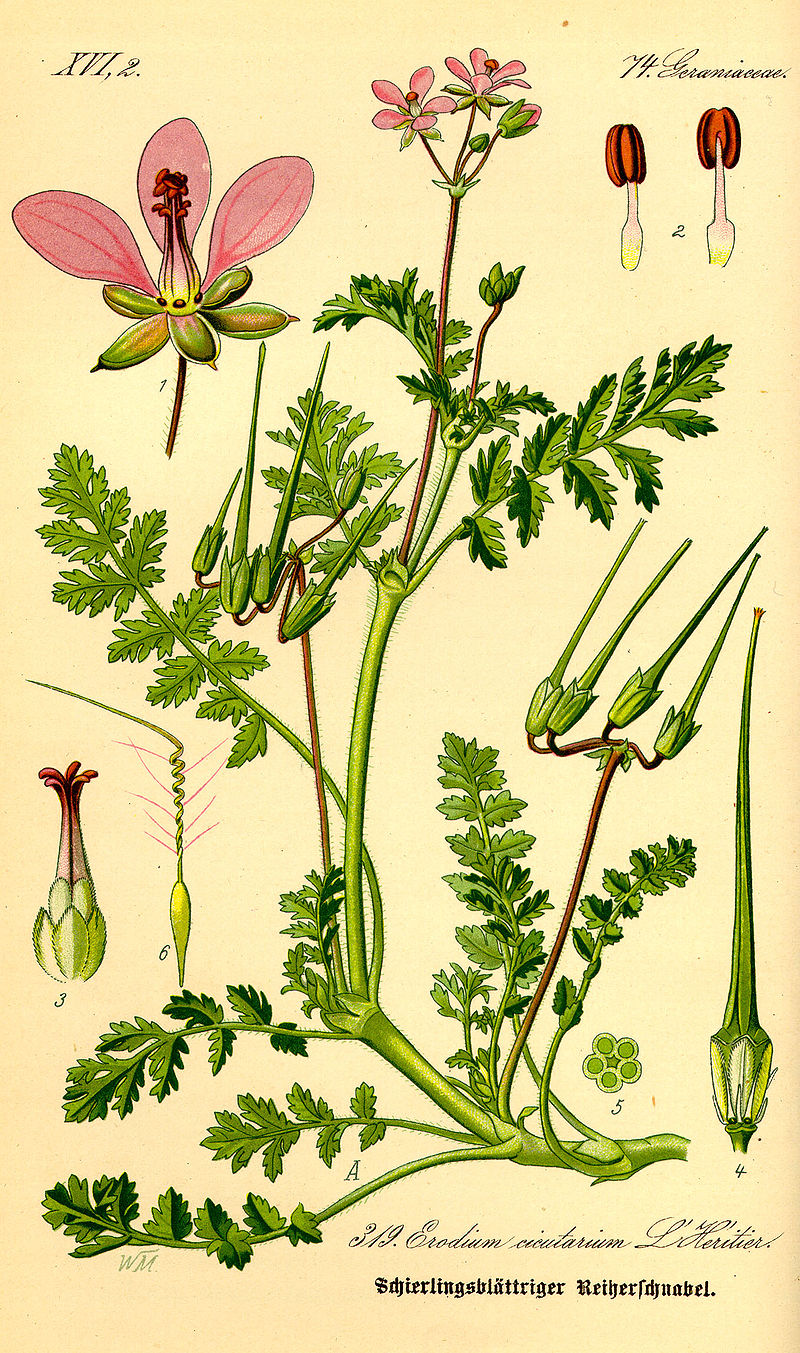
Redstem stork's bill (Erodium cicutarium) is an introduced species commonly consumed by desert tortoises - image credit: wikimedia commons

Redstem stork’s bill (Erodium cicutarium) is an introduced species commonly consumed by desert tortoises – image credit: wikimedia commons

For me, one of the most interesting things to learn was the variety of “non-food” items that tortoises may consume. Tortoises are often observed eating soil and rocks, and are also known to eat bones, arthropods, feces, feathers, hair, and egg shells. The rocks are thought to act as a gastrolith, aiding in digestion. The other items may help supplement minerals and nutrients the tortoises are lacking in their plant-based diet, particularly calcium which is greatly needed for growth and reproduction. Shockingly, a report that appeared in a 2007 issue of The Southern Naturalist details incidences of tortoises eating the skeletal remains of other tortoises.

Desert tortoises are an engrossing subject of study, and so much more could be said about them. For now, I leave you with this passage from Alcock’s book:

To see a tortoise with wrinkled neck and solemn eyes, moving like an animated rock, is an essential part of the experience of the desert. The removal of even a single adult extinguishes a presence that was meant to persist for years to come and snuffs out a prehistoric spark of life in a spartan environment where life, so hard-won, should be celebrated.
Additional Resources:

The Nippleworts of Camassia Natural Area

This is a guest post. Words and illustration by Mesquite Cervino.

At the end of a residential neighborhood that is barely off the 205 in the hills of West Linn, Oregon is a small, 26 acre preserve called the Camassia Natural Area. The defining features of the landscape were caused by the Missoula Floods (aka the Spokane or Bretz floods) at the end of the last ice age (12 to 19 thousand years ago) which swept away the already established soil and in their place deposited glacial erratics from other far-away places, some even coming all the way from Canada. The flood reached eastern Oregon and the Willamette via the Columbia River Gorge and created the green and rocky plateau that is now Camassia.

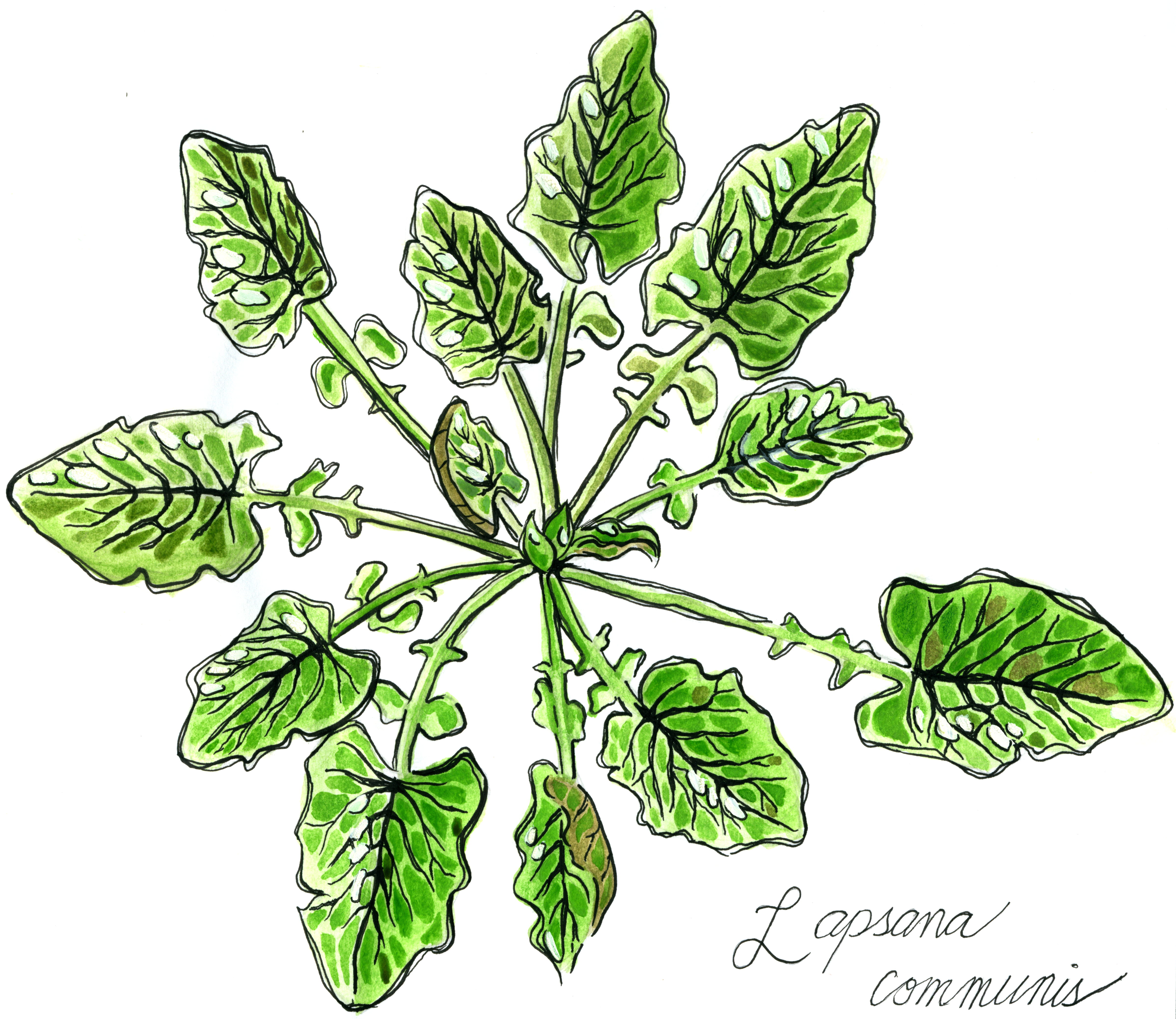
While the reserve is named after a widespread plant in the park, which is a common camas (Camassia quamash) that blooms in April and early May, the park has over 300 different species overall. However, one species in particular has kicked in the door and far overstayed its welcome in the park, becoming a highly invasive weed in the area. This plant is known as Lapsana communis or nipplewort. It is an annual dicot that is native to Europe and Asia, but is considered invasive in Canada and the United States. In the U.S., the weed is most common west of the Cascades in the Pacific Northwest. It is in the Asteraceae family (aka the aster, daisy, or sunflower family), and like dandelions or common groundsel, nipplewort is part of the weedy side of the family.

nicole illustration_cropped

The name itself has an interesting history that originated around 350 years ago when an Englishman by the name of John Parkinson named the plant after he heard that it was useful for topical treatment of ulcers for women on certain areas of their bodies. It was also an herbal treatment for nursing mothers, and was used to aid cows and goats that were having trouble being milked. Another source of the name is said to have come from the shape of the basal lobes and their resembling features. Because nipplewort is edible, its leaves can be cooked like spinach or served raw in only the most hipster of salads.

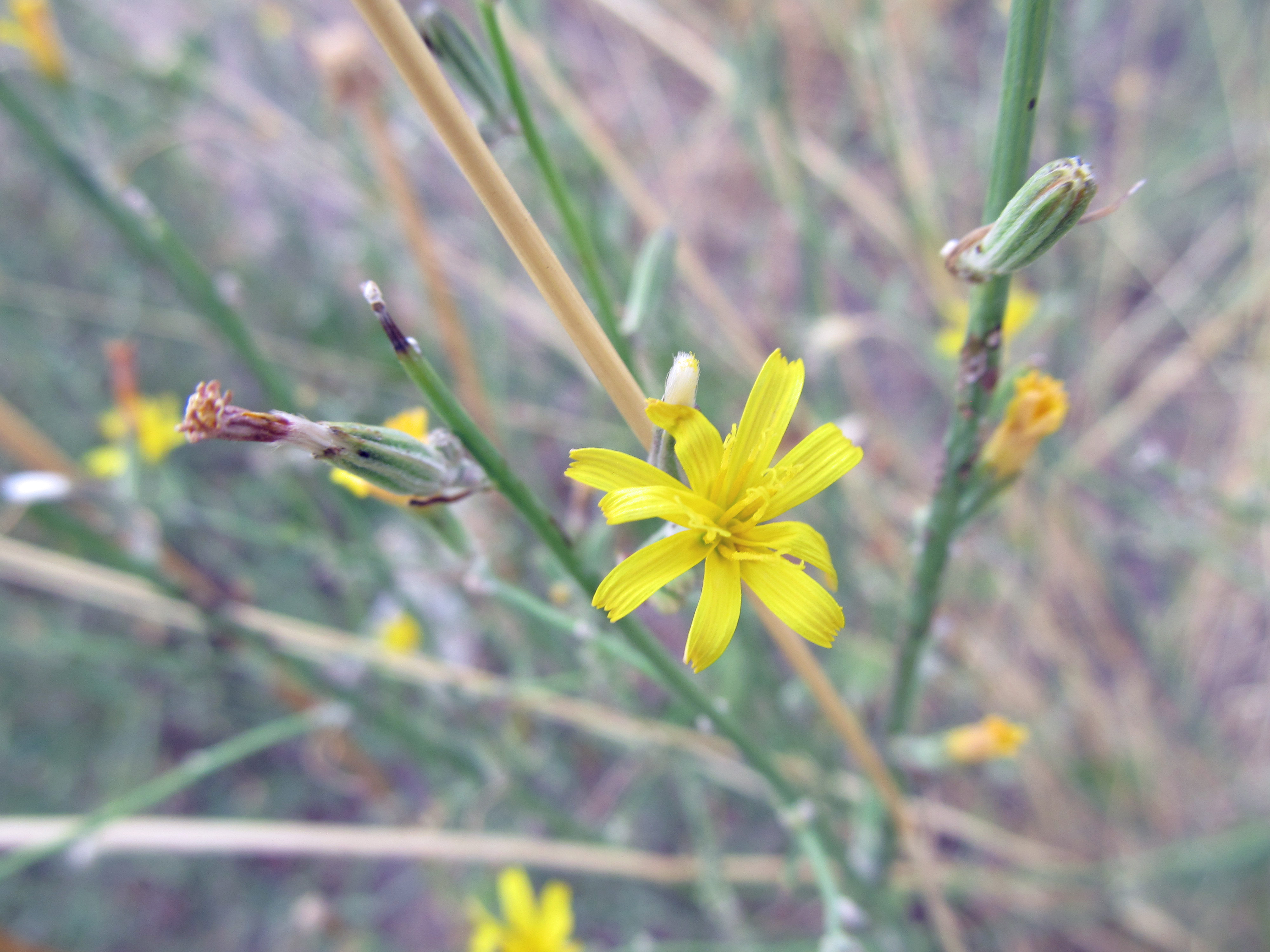
In terms of its anatomy, nipplewort is about one to three and a half inches in height, has alternate, ovular, lobed, rich green leaves, and composite yellow flowers with about 13 petals similar in resemblance to a dandelion. They flower from June to September and are pollinated by various insects. Seed set occurs in July to October. The plant then spreads through reseeding, and one plant can produce 400 to 1,000 seeds that put out shoots in fall and spring.

Consult a fellow botanist to find out more about Lapsana communis, especially if you are curious to know if it has invaded your territory. If it has, consider entertaining dinner guests with this unusual plant.

Additional Resources:

Field Trip: Bruneau Dunes State Park

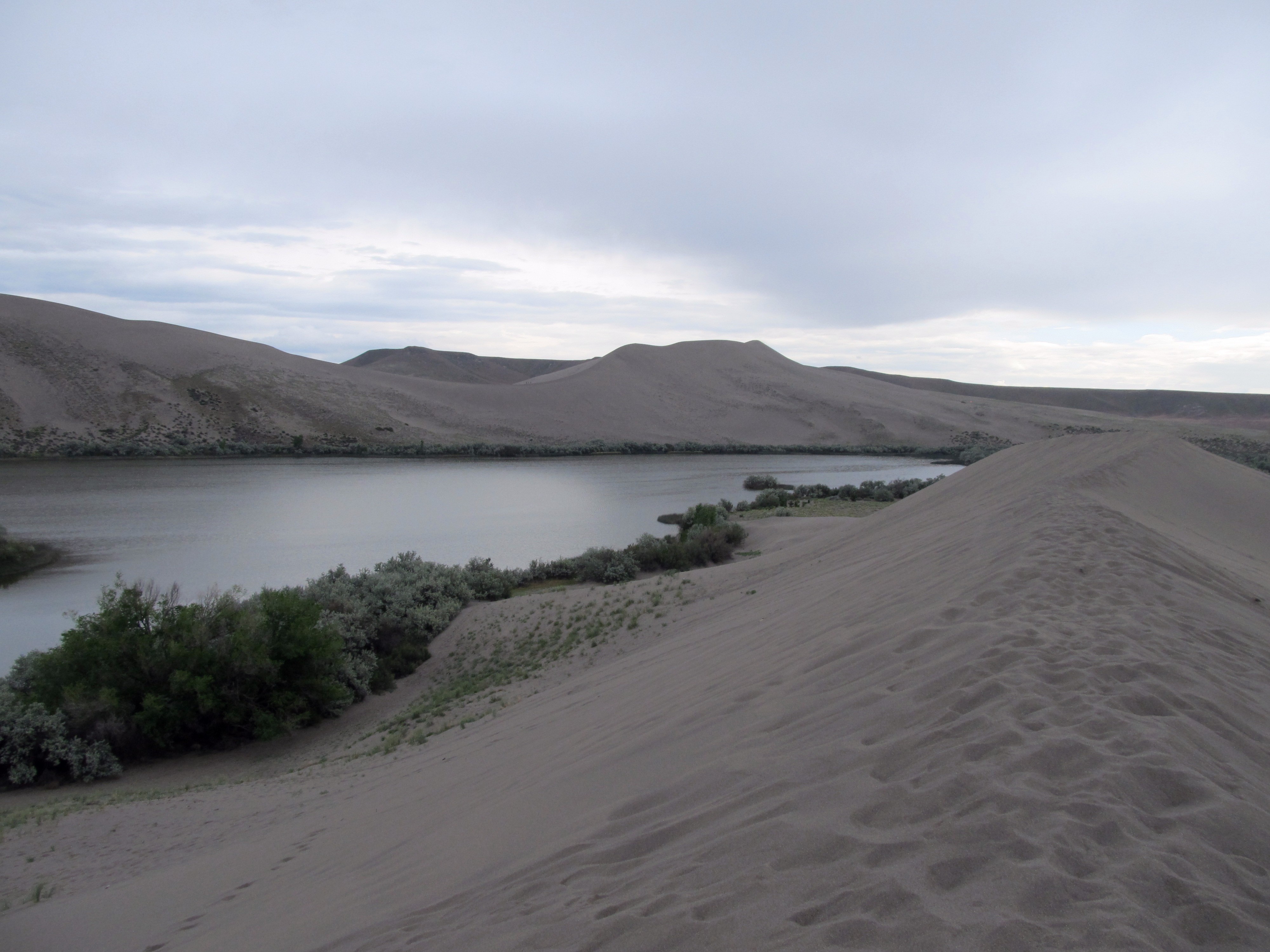
One of the aims of American Wetlands Month is to encourage people to get out and visit nearby wetlands. I accepted this challenge by visiting the small lakes and marshes of Bruneau Dunes State Park which is located about 20 miles south of Mountain Home, Idaho (or, 70 miles from my house).

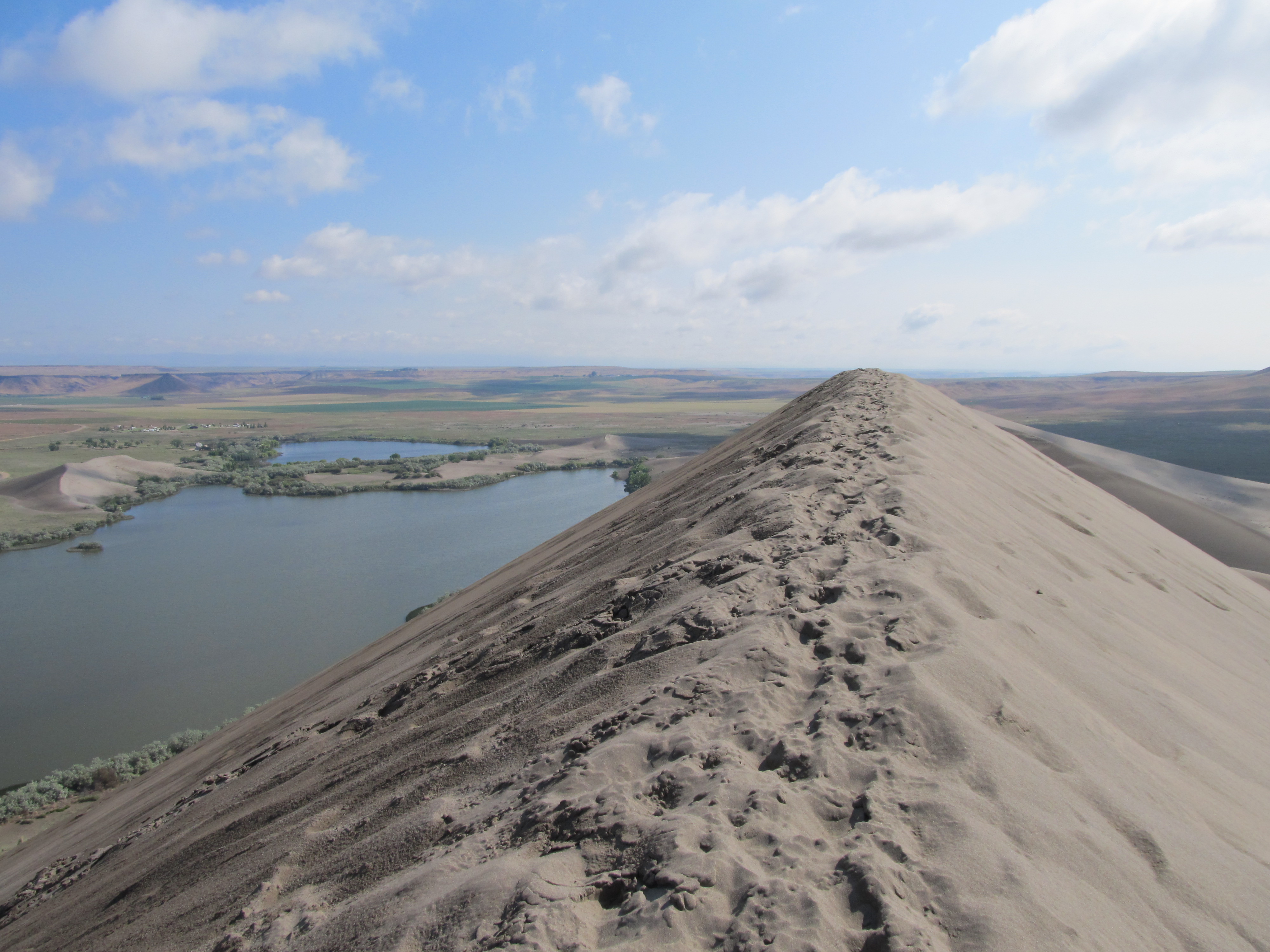
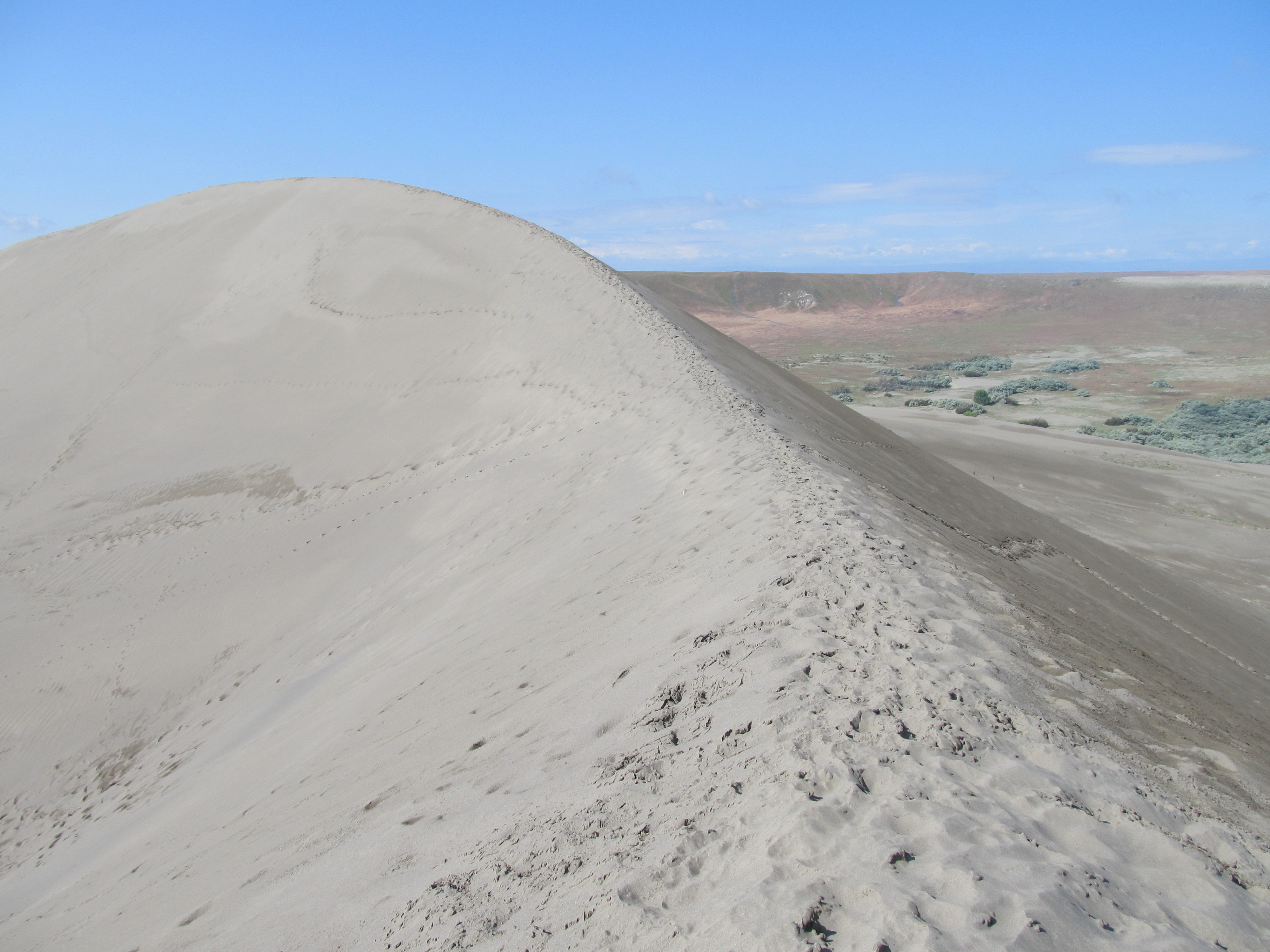
The park is known for its enormous sand dunes, claiming the tallest single-structured sand dune in North America which measures about 470 feet. The dunes began forming about 15,000 years ago during the Bonneville Flood. After the flood receded, the dunes continued to grow due to their unique location – a basin in which strong winds approach from both the northwest and the southeast, carrying sand from the surrounding steppes and keeping the dunes in place.

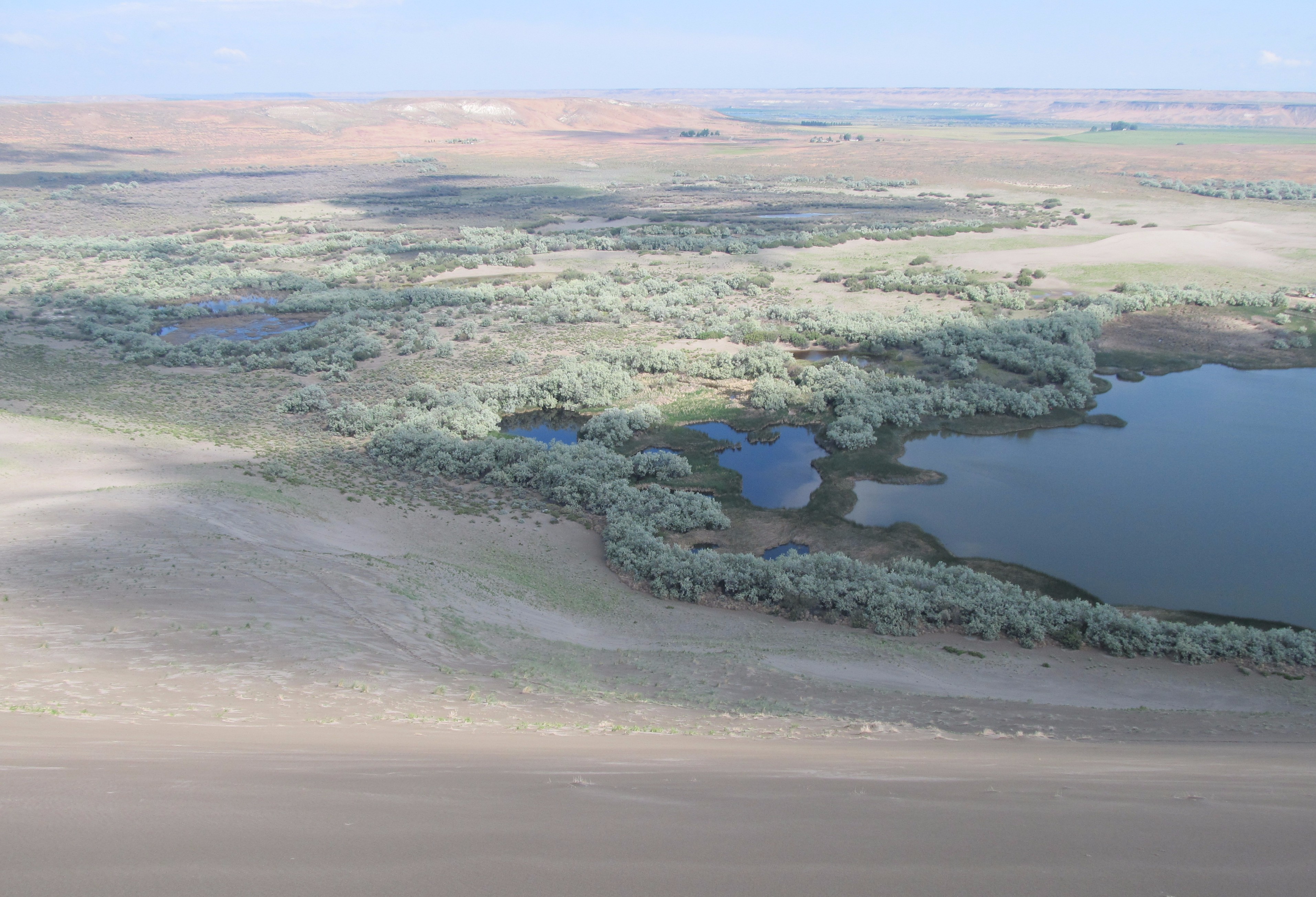
Two small lakes and a marsh are found nestled among the dunes, and the Snake River flows just north of the park. Apart from the dunes and the wetlands, the park also includes desert and prairie habitats and is situated in an extensive conservation area called Morley Nelson Snake River Birds of Prey. If that’s not enough, Bruneau Dunes State Park is home to a public observatory, where visitors can view the night sky and learn more about the stars and our place in the universe.

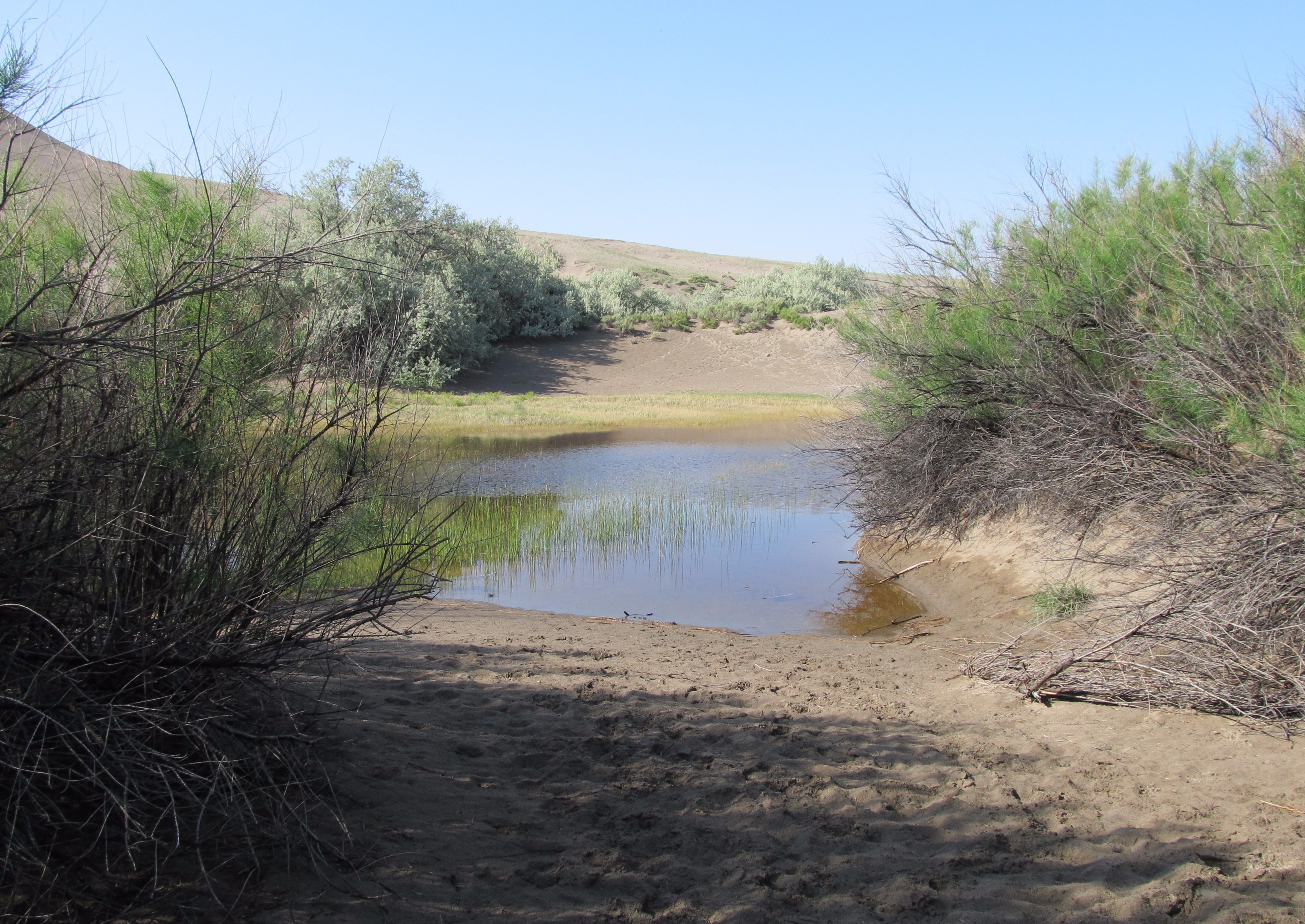
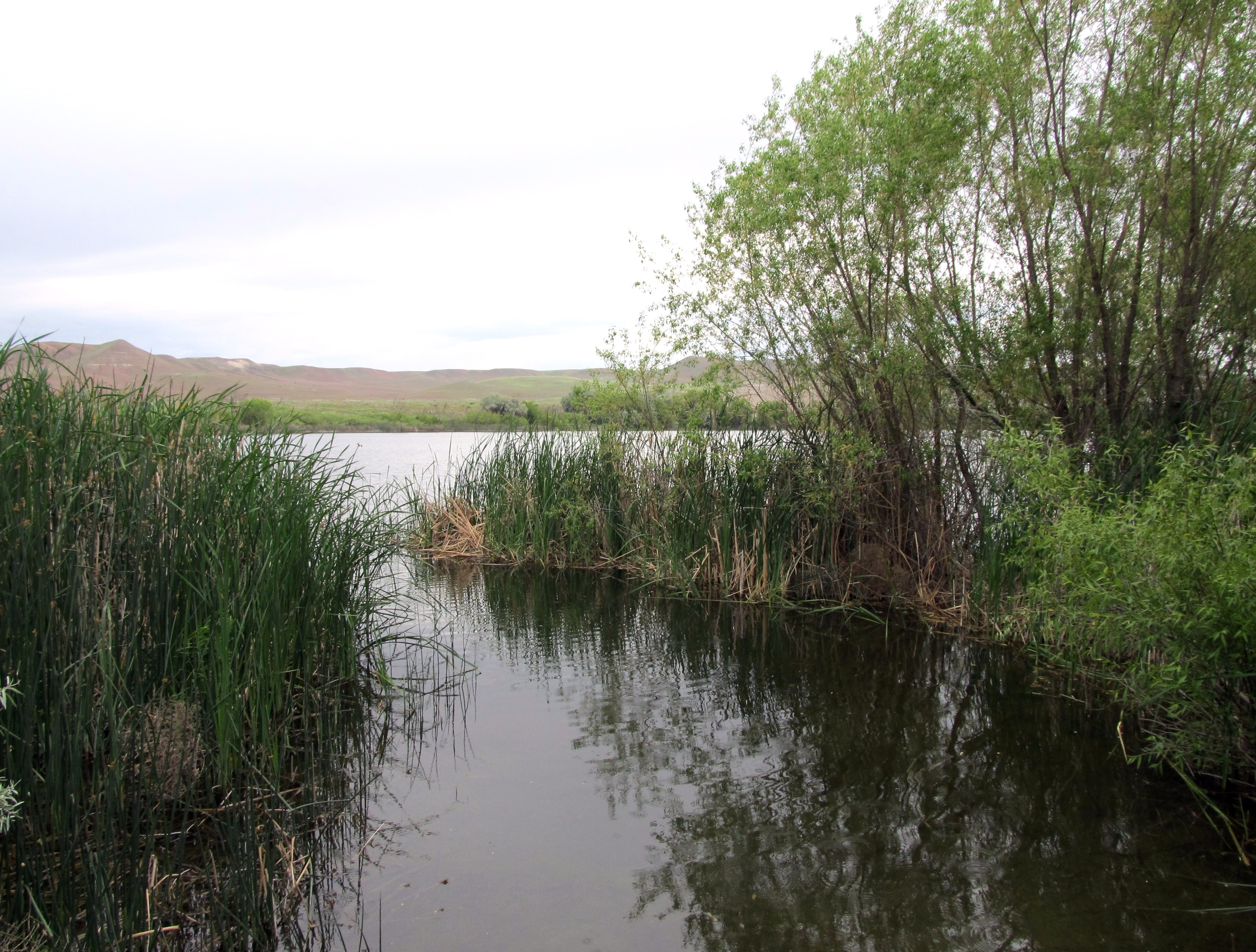
A marshy entrance to Dunes Lake

A marshy entrance to Dunes Lake

Climbing the sand dunes (and, if you’re up for it, sledding down them) is understandably a popular activity at the park. I spent a decent amount of time on top of the dunes, partly because the view was great and because the mosquitoes seemed to be absent up there. Yes, when visiting a wetland, you are advised to carry mosquito repellent, otherwise the cloud of mosquitoes that will undoubtedly surround you will make for an unpleasant experience. They will also make it difficult to stand still long enough to take a decent picture.

On top of a small dune looking across lake to large dune.

On top of small dune looking across lake to large dune

On top of large dune looking across lake to small dune.

On top of large dune looking across lake to small dune

Traversing the spine of a brontosauras (aka sand dune).

Traversing the spine of a brontosaurus (a.k.a. sand dune)

On top of the sand dune looking down at the lake and marsh.

On top of sand dune looking down at the lake and marsh

The marshes and shores around the lakes were populated with numerous wetland plants, including swamp milkweed (Aesclepias incarnata), duckweed (Lemna minuta), cattails (Typha sp.), and various rushes, sedges, and grasses. Native shrubs were also present, however the dominant woody plants were (unfortunately) introduced species: Russian olive (Elaeagnus angustifolia) and saltcedar (Tamarix chinenesis).

An entrance to the marsh

An entrance to the marsh

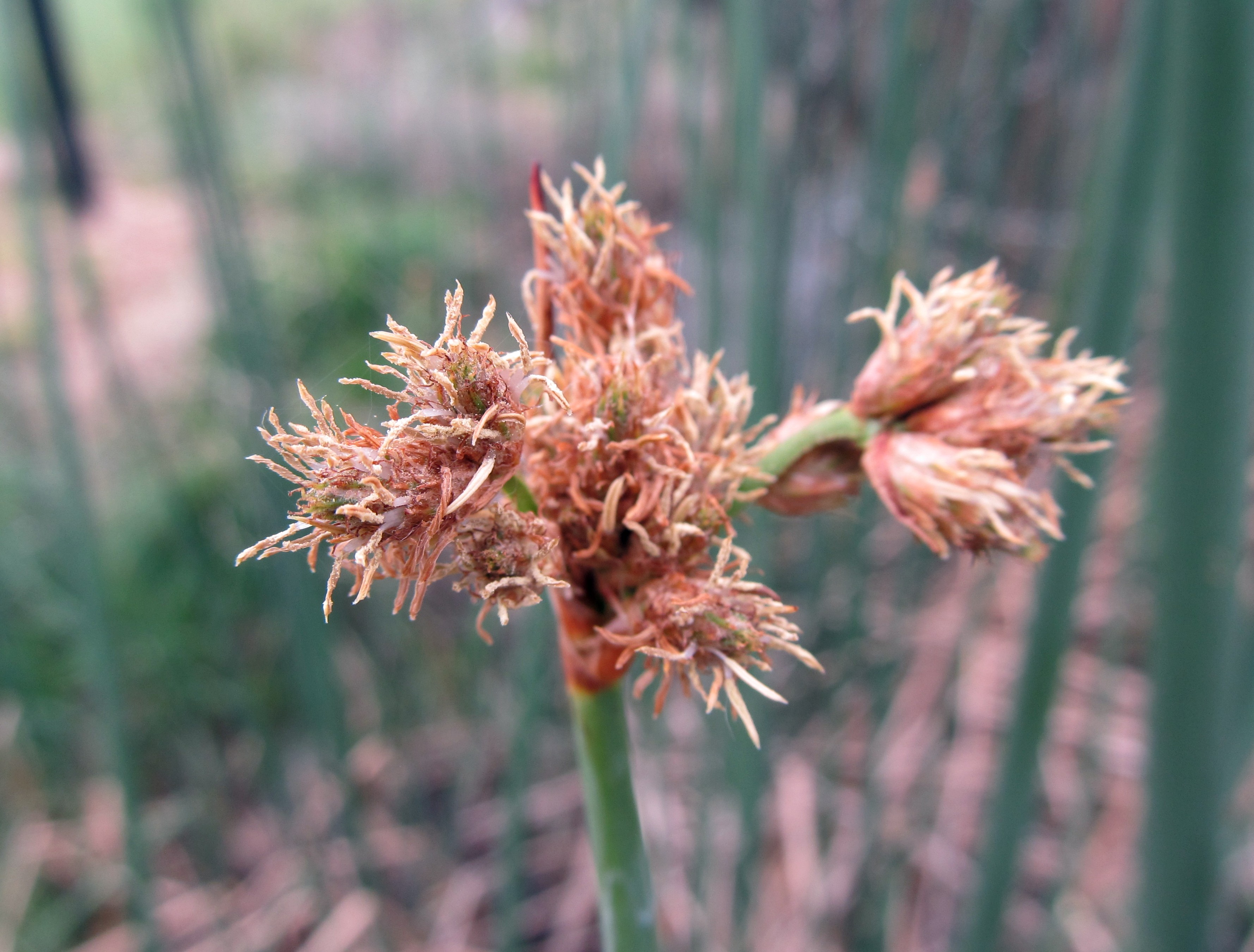
Flowers of bullrush (Schoenoplectus sp.)

Flowers of bulrush (Schoenoplectus sp.)

Russian olive (Eleagnus angustifolia)

Russian olive (Elaeagnus angustifolia)

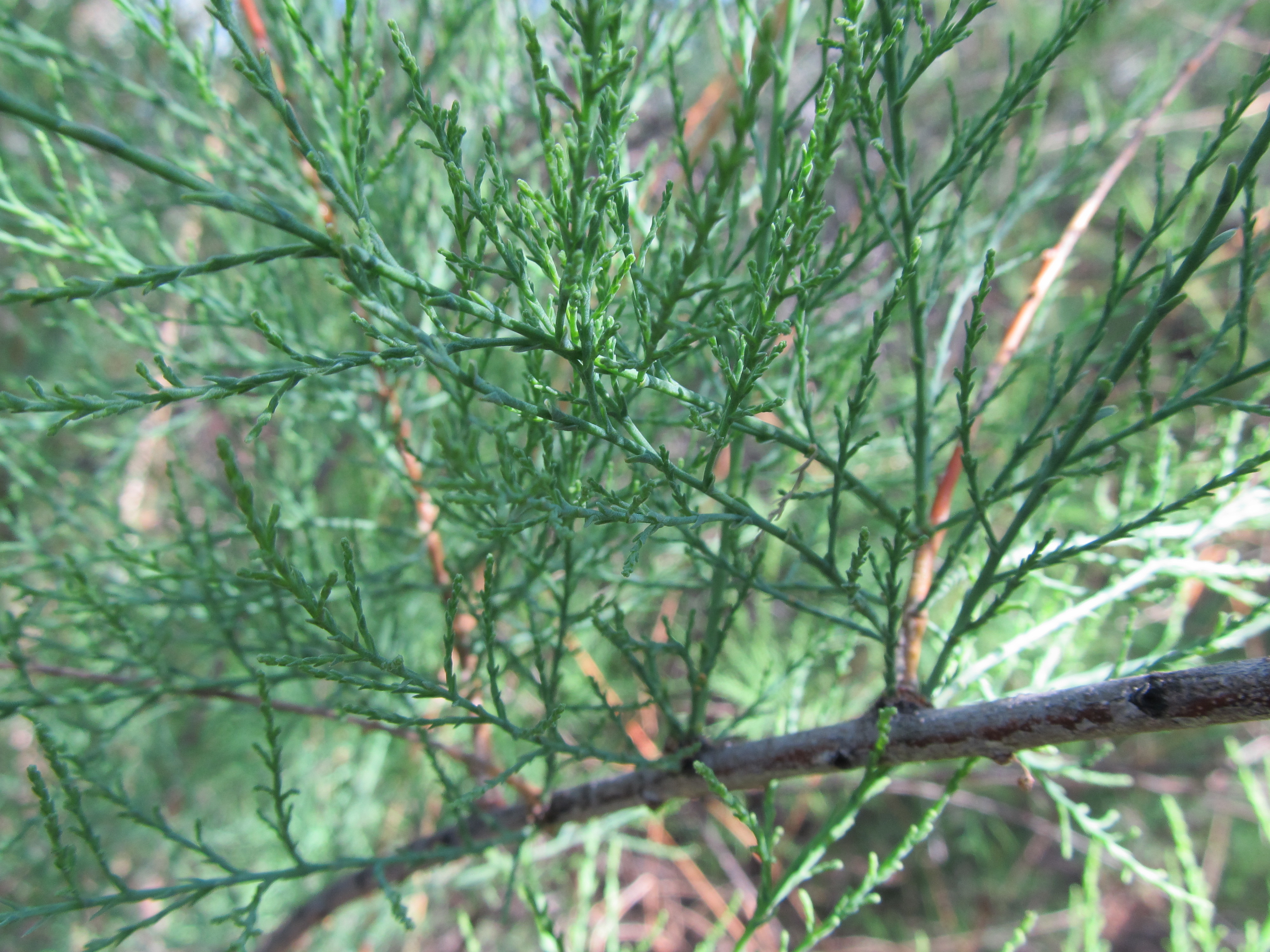
Saltcedar (Tamarix chinensis)

Saltcedar (Tamarix chinensis)

Despite being there to explore and celebrate the wetland, the plants in the adjacent area (which appeared to be growing in almost 100% sand) continued to draw me away. Some I recognized easily, while others I could only identify to genus or couldn’t identify at all. Some notable observations included low lupine (Lupinus pusillus), sand-dune penstemon (Penstemon acuminatus), pale evening primrose (Oenothera pallida), and species in the genera Astragalus, Erigeron, and Eriogonum. Two bunchgrasses were particularly common throughout the area: Indian ricegrass (Achnatherum hymenoides) and needle and thread grass (Hesperostipa comata).

All of these plants are worthy of being photographed; however, the wind makes that difficult to do. Idaho is a windy state, and an area composed of wind-formed sand dunes is particularly windy. Between swarms of mosquitoes and consistent wind, capturing decent photos was a challenge. Aside from those minor nuissances, I had a very enjoyable time and hope to visit again soon.

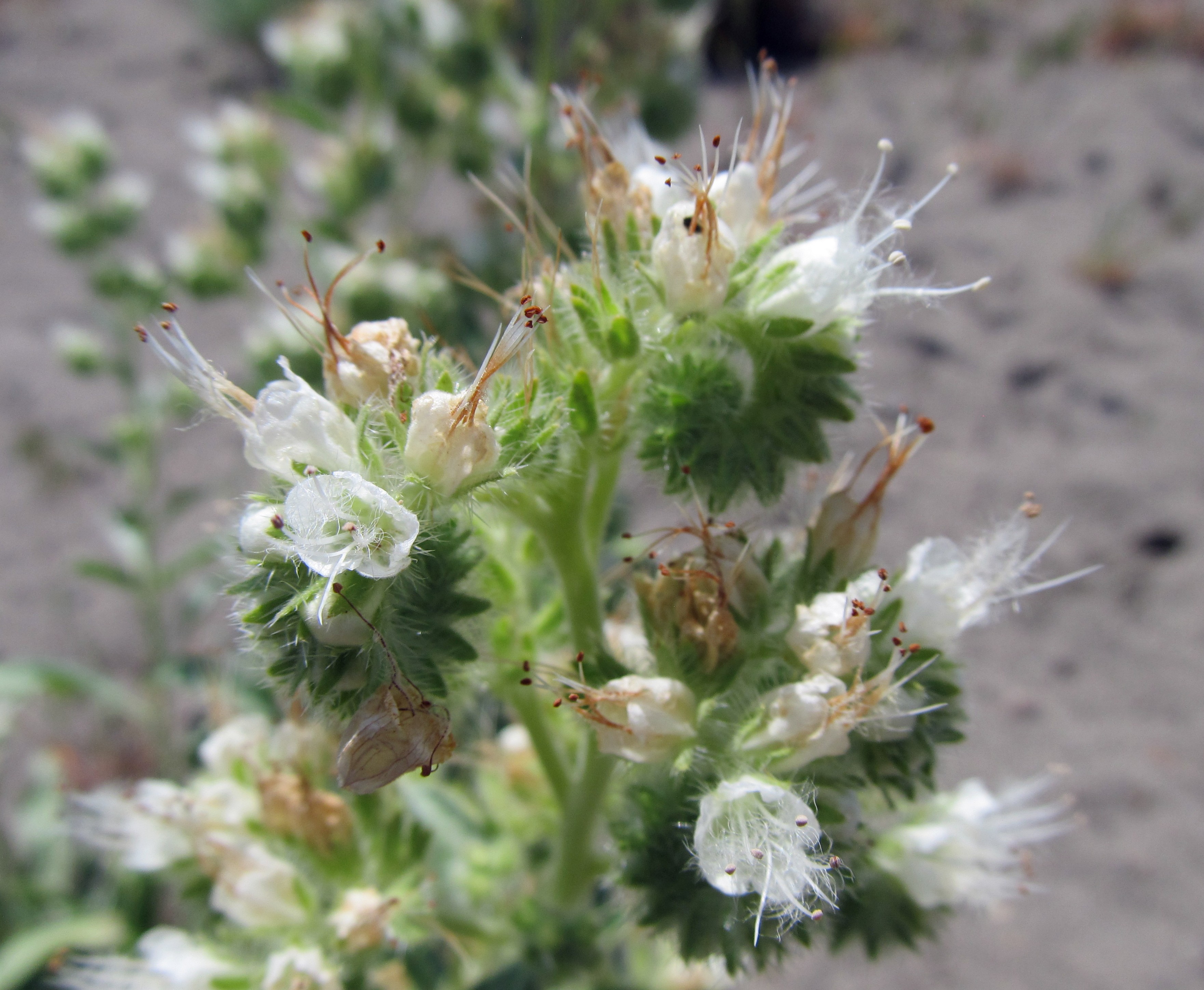
Phacelia (Phacelia hastata)

Silverleaf phacelia (Phacelia hastata)

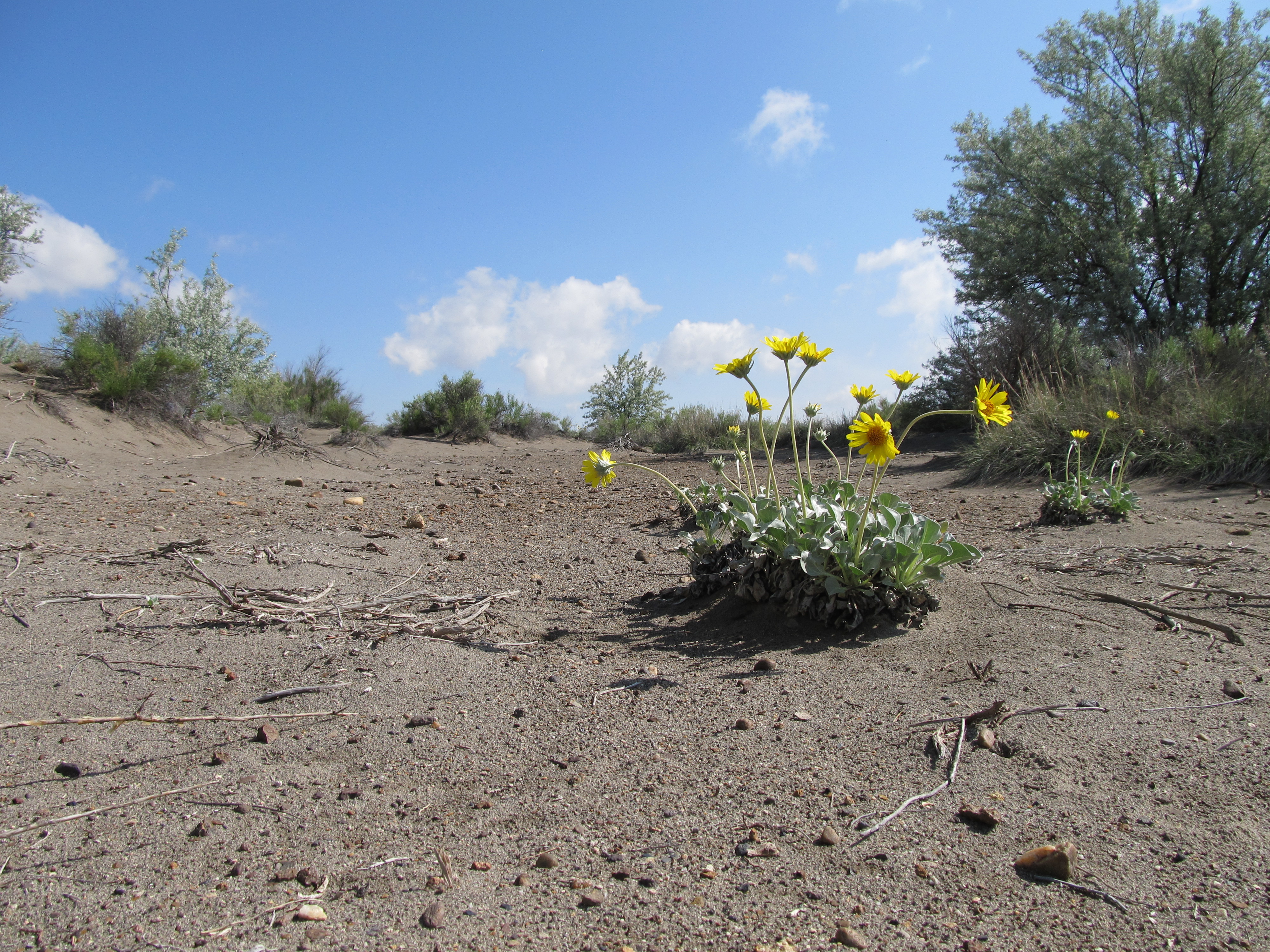
Nakedstem sunray (Enceliopsis nudicaulis)

Nakedstem sunray (Enceliopsis nudicaulis)

Have you visited a wetland this month? Or do you plan to? Share your adventures in the comments section below.

Biodiversity Dips When Japanese Rice Paddies Go Fallow

Large-scale farms that generally grow a single crop at a time and are managed conventionally are, by design, lacking in biodiversity. Abandoning such farms and allowing nature to take its course should, not surprisingly, result in a dramatic uptick in biodiversity. Plant colonization of abandoned farmland (also referred to as old field succession) is well studied and is regularly used as an example of secondary succession in ecology textbooks. The scenario seems obvious: cease agriculture operations, relinquish the land back to nature, and given enough time it will be transformed into a thriving natural community replete with diverse forms of plants and animals. This is an oversimplification, of course, and results will vary with each abandoned piece of land depending on the circumstances, but it generally seems to be the story. So what about when it isn’t?

Rice farming in Japan began at least 2400 years ago. Rice had been domesticated in China long before that, and when it eventually arrived in Japan it shaped the culture dramatically. For hundreds of years rice was farmed in small, terraced paddies in the mountains of Japan. Dennis Normile writes about these traditional, rice paddies in a recent issue of Science. He describes how they were found in villages “nestled in a forested valley” accompanied by vegetable plots, orchards, and pasture. Today, farms like these are “endangered,” and as they have become increasingly abandoned, plants, insects, and other wildlife that have historically thrived there are suffering.

Since the 1960’s, a combination of factors has resulted in the decline of traditional rice farming in Japan. For one, large scale farming has led to the consolidation of paddies, which are farmed more intensively. Diets in Japan have also shifted, resulting in a preference for bread and pasta over rice. Additionally, Japan’s population is shrinking, and residents of rural areas are migrating to cities. Traditional rice farmers are aging, and younger generations are showing little interest in pursuing this career.

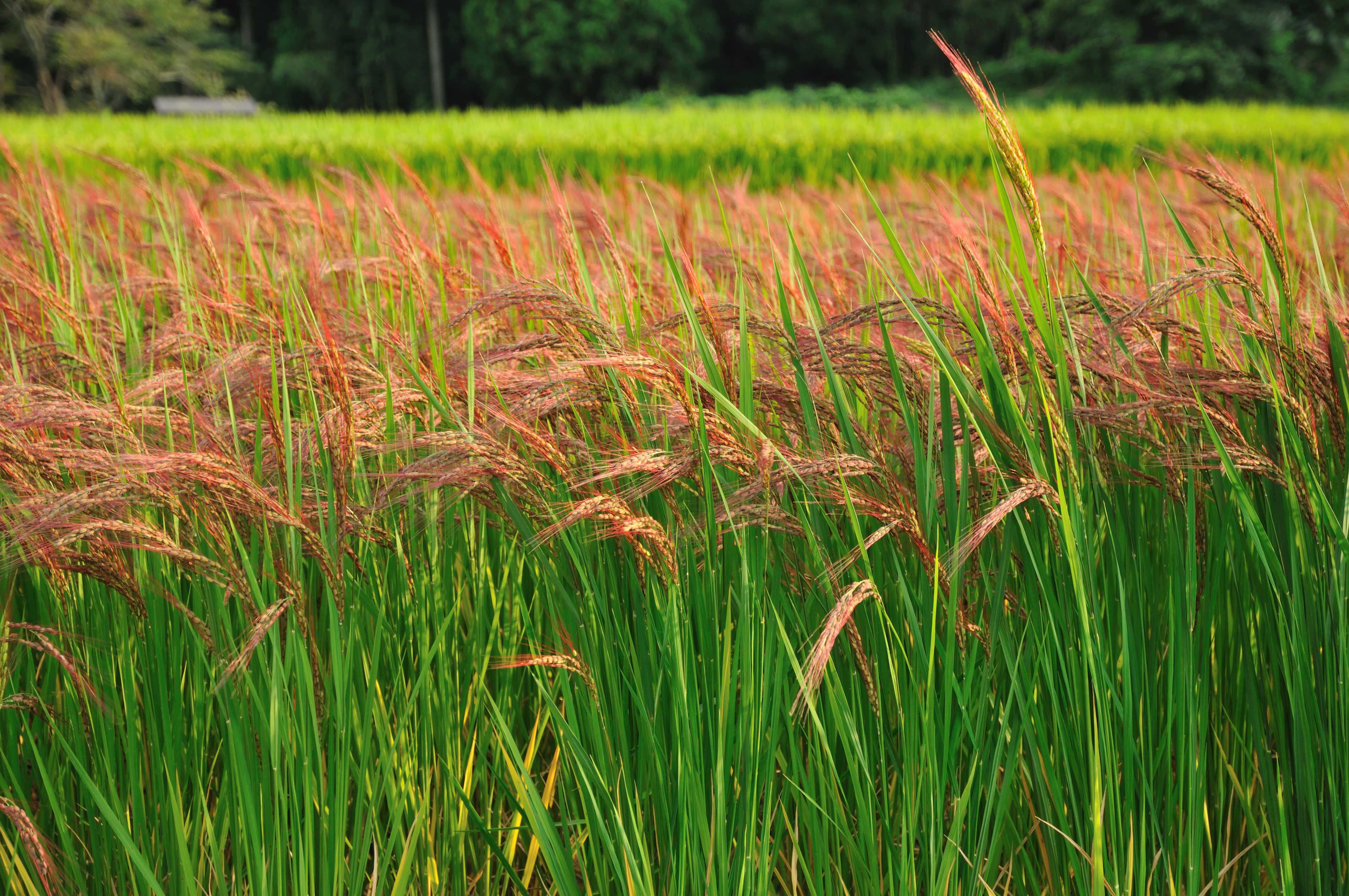
Red rice paddy in Japan - photo credit: wikimedia commons

Red rice paddy in Japan – photo credit: wikimedia commons

Demographic and dietary concerns aside, why in this case is the abandonment of agriculture imperiling species? The answer appears to be in both the way that the rice paddies have been historically managed and the length of time that they have been managed that way. Agriculture, by its very nature, creates novel ecosystems, and if the practice continues long enough, surrounding flora and fauna could theoretically coevolve along with the practice. When the practice is discontinued, species that have come to rely on it become threatened.

Traditional rice paddies are, as Normile describes, “rimmed by banks so that they can be flooded and drained.” Farmers “encouraged wild grassland plants to grow on the banks because the roots stabilize the soil.” The banks are mowed at least twice a year, which helps keep woody shrubs and trees from establishing on the banks. In some areas, rice farming began where primitive people of Japan were burning frequently to encourage grassland habitat. Maintaining grassland species around rice paddies perpetuated the grassland habitat engineered by primitive cultures.

As rice paddies are abandoned and the surrounding grasslands are no longer maintained, invasive species like kudzu and a North American species of goldenrod have been moving in and dominating the landscape resulting in the decline of native plants and insects. Normile reports that the abandoned grasslands are not expected to return to native forests either since “surrounding forests…are a shadow of their old selves.”

Additionally, like most other parts of the world, Japan has lost much of its natural wetland habitat to development. Rice paddies provide habitat for wetland bird species. On paddies that have been abandoned or consolidated, researchers are finding fewer wetland bird species compared to paddies that are managed traditionally.

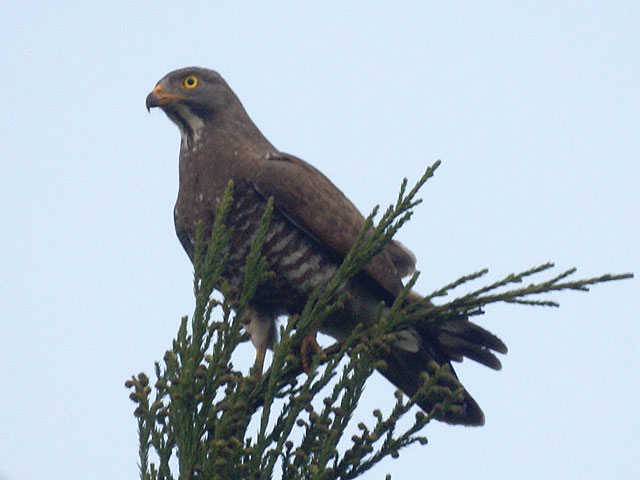
The gray-faced buzzard (Butastur indicus) is listed as vulnerable in Japan. It nests in forests and preys on insects, frogs, and other animals found in grasslands and rice paddies. It's decline has been linked to the abandonment and development of traditionally farmed rice paddies. (photo credit: wikimedia commons)

The gray-faced buzzard (Butastur indicus) is listed as vulnerable in Japan. It nests in forests and preys on insects, frogs, and other animals found in grasslands and rice paddies. Its decline has been linked to the abandonment and development of traditionally farmed rice paddies. (photo credit: wikimedia commons)

All of this adds fodder to an ongoing debate: “whether allowing farmland to revert to nature is a boon to biodiversity or actually harms it.” Where agriculture is a relatively new practice or where conventional practices dominate, abandoning agriculture would be expected to preserve and promote biodiversity. However, where certain agricultural practices have persisted for millenia, abandoning agriculture or converting  to modern day practices could result in endangerment and even extinction of some species. In the latter case, “rewilding” would require thoughtful consideration.

The thing that fascinates me the most about this report is just how intertwined humans are in the ecology of this planet. In many ways humans have done great harm to our environment and to the myriad other species that share it. We are a force to be reckoned with. Yet, the popular view that we are separate, above, apart, or even dominant over nature is an absurd one. For someone who cares deeply about the environment, this view has too often been accompanied by a sort of self-flagellation, cursing myself and my species for what we have done and continue to do to our home planet. Stories like this, however, offer an alternative perspective.

Humans are components of the natural world. We evolved just like every other living thing here, and so our actions as well as the actions of other species have helped shape the way the world looks. If our species had met its demise early in its evolutionary trajectory, the world would look very different. But we persisted, and as it turns out, despite the destruction we have caused and the species we have eliminated, we have simultaneously played a role in the evolution and persistence of many other species as well. We must learn to tread lightly – for the sake of our own species as well as others – but we should also quit considering ourselves “other than” nature, and we should stop beating ourselves up for our collective “mistakes.” It seems that when we come to recognize how connected we are to nature we will have greater motivation to protect it.

Additional Resources:

Book Review: Jade Pearls and Alien Eyeballs

The spring season for plant-obsessed gardeners is a time to prepare to grow something new and different – something you’ve never tried growing before. Sure, standards and favorites will make an appearance, but when you love plants for plant’s sake you’ve got to try them all, especially the rare and unusual ones – the ones no one else is growing. Even if it ultimately turns out to be a disaster or a dud, at least you tried and can say you did.

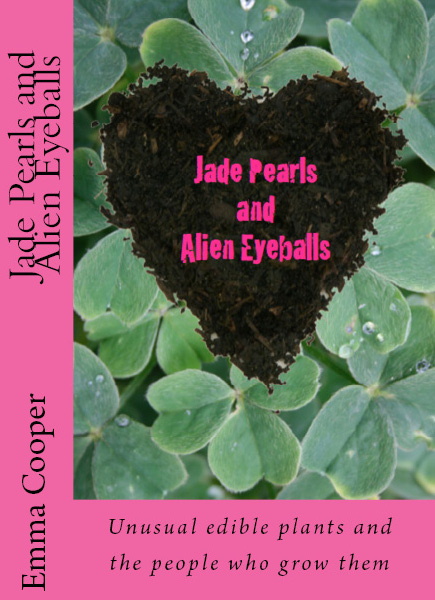
That seems to be the spirit behind Jade Pearls and Alien Eyeballs by Emma Cooper. Subtitled, “Unusual Edible Plants and the People Who Grow Them,” Cooper’s book is all about trying new plants, both in the garden and on your plate. While its focus is on the rare and unusual, it is not a comprehensive guide to such plants – a book like that would require several volumes – rather it is a treatise about trying something different along with a few recommendations to get you started.

jadepearls_cover

Cooper starts out by explaining what she means by “unusual edible” – “exotic, old-fashioned, wild, or just plain weird.” Her definition includes plants that may be commonly grown agriculturally but may not make regular appearances in home gardens. She goes on to give a brief overview of plant exploration throughout history, highlighting the interest that humans have had for centuries – millennia even – in seeking out new plants to grow. She acknowledges that, in modern times, plant explorations have shifted from simply finding exotic species to bring home and exploit to cataloging species and advocating for their conservation in the wild. Of course, many of these explorations are still interested in finding species that are useful to humans or finding crop wild relatives that have something to offer genetically.

Cooper then includes more than 2o short interviews of people who are growers and promoters of lesser known edible plants. The people interviewed have much to offer in the way of plant suggestions and resource recommendations; however, this part of the book was a bit dull. Cooper includes several pages of resources at the end of the book, and many of the interviewees suggest the same plants and resources, so this section seemed redundant. That being said, there are some great responses to Cooper’s questions, including Owen Smith’s argument for “citizen-led research and breeding projects” and James Wong’s advise to seek out edible houseplants.

The remainder of the book is essentially a list of the plants that Cooper suggests trying. Again, it is not a comprehensive list of the unusual plants one could try, nor it is a full list of the plants that Cooper would recommend, but it is a good starting point. Cooper offers a description of each plant and an explanation for why it is included. The list is separated into seven categories: Heritage and Heirloom Plant Varieties, Forgotten Vegetables, The Lost Crops of the Incas, Oriental Vegetables, Perennial Pleasures, Unusual Herbs, and Weeds and Wildings.

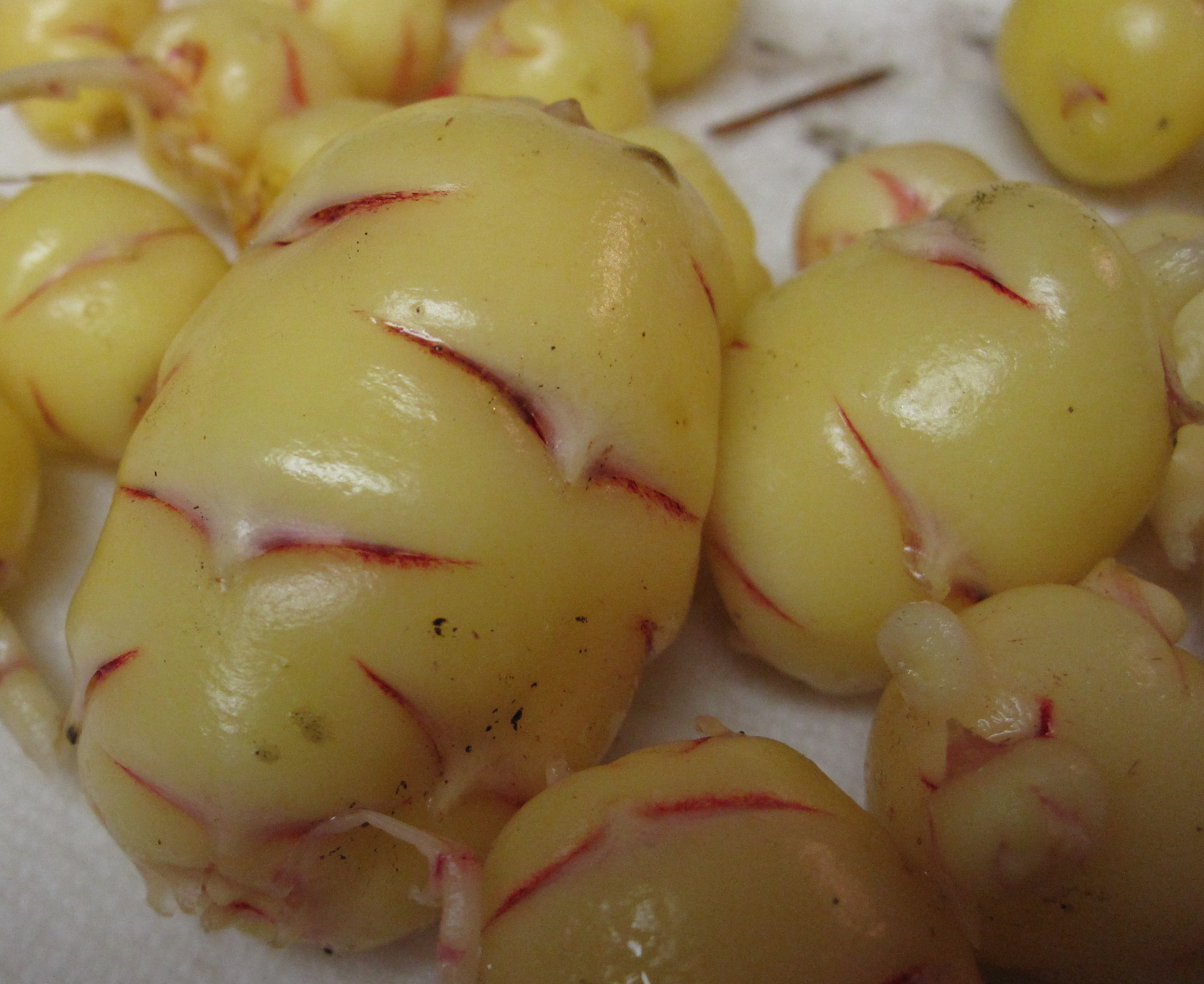
This is the portion of the book that plant geeks are likely to find the most compelling. It is also where the reader learns where the title of the book comes from – “jade pearls” is another common name for Chinese artichoke (Stachys affinis), and “alien eyeballs” is Cooper’s name for toothache plant (Acmella oleracea). I have tried a few of the plants that Cooper includes, and I was intrigued by many others, but for whatever reason the two that stood out to me as the ones I should try this year were Hamburg parsley (Petroselinum crispum var. tuberosum) and oca (Oxalis tuberosa).

Tubers of oca (Oxalis tuberosa) - photo credit: wikimedia commons

Tubers of oca (Oxalis tuberosa) – photo credit: wikimedia commons

In the final chapter, Cooper offers – among other things – warnings about invasive species (“our responsibility is to ensure that the plants we encourage in our gardens stay in our gardens and are not allowed to escape into our local environment”), import restrictions (“be a good citizen and know what is allowed in your country [and I would add state/province], what isn’t, and why”), and wild harvesting (“act sustainably when foraging”). She then includes several pages of books and websites regarding unusual edibles and a long list of suppliers where seeds and plants can be acquired. Cooper is based in the U.K., so her list of suppliers is centered in that region, but a little bit of searching on the internet and asking around in various social media, etc. should help you develop a decent list for your region. International trades or purchases are an option, but as Cooper advises, follow the rules that are in place for moving plant material around.

Bottom line: find some interesting things to grow this year, experiment with things you’ve never tried – even things that aren’t said to grow well in your area – and if you’re having trouble deciding what to try or you just want to learn more about some interesting plants, check out Emma Cooper’s book.

Also, check out Emma Cooper’s blog and now defunct podcast (the last few episodes of which explore the content of this book).

Are you interested in writing a book review for Awkward Botany or helping out in some other way? If so, go here.

In Defense of Plants – A Podcast Review

I’m an avid podcast listener; however, the majority of the podcasts I listen to, while satisfying many of my varied interests, don’t speak to my interests in plants and plant science. Recently, when I went searching for such a podcast, I happened upon In Defense of Plants. Alas, my podcast queue felt complete.

indefenseofplants

In Defense of Plants began as a blog authored by a guy named Matt. The podcast emerged about 3 years later, and in the first episode (which was posted in January 2015), Matt explains why he started the blog. While searching the internet in an effort to learn more about plants, he discovered that people weren’t writing the stories that he really wanted to read – stories that went beyond mainly talking about the anthropogenic uses of plants. Rather, Matt was interested in the stories of the plants themselves, their biological and evolutionary histories and how they fit in with the ecological world around them. Unable to find such a blog, he decided to start one himself.

His passion for plants for plant’s sake continues in his podcast. It’s evidenced both in the topics he covers as well as in the way he speaks enthusiastically and affectionately about the plants involved in the stories he tells and their habitats. He finds people to interview that are as excited about plants as he is – some are friends, some are research scientists, and some are people otherwise involved in botany or horticulture. All have interesting things to say about the world of plants and plant ecology.

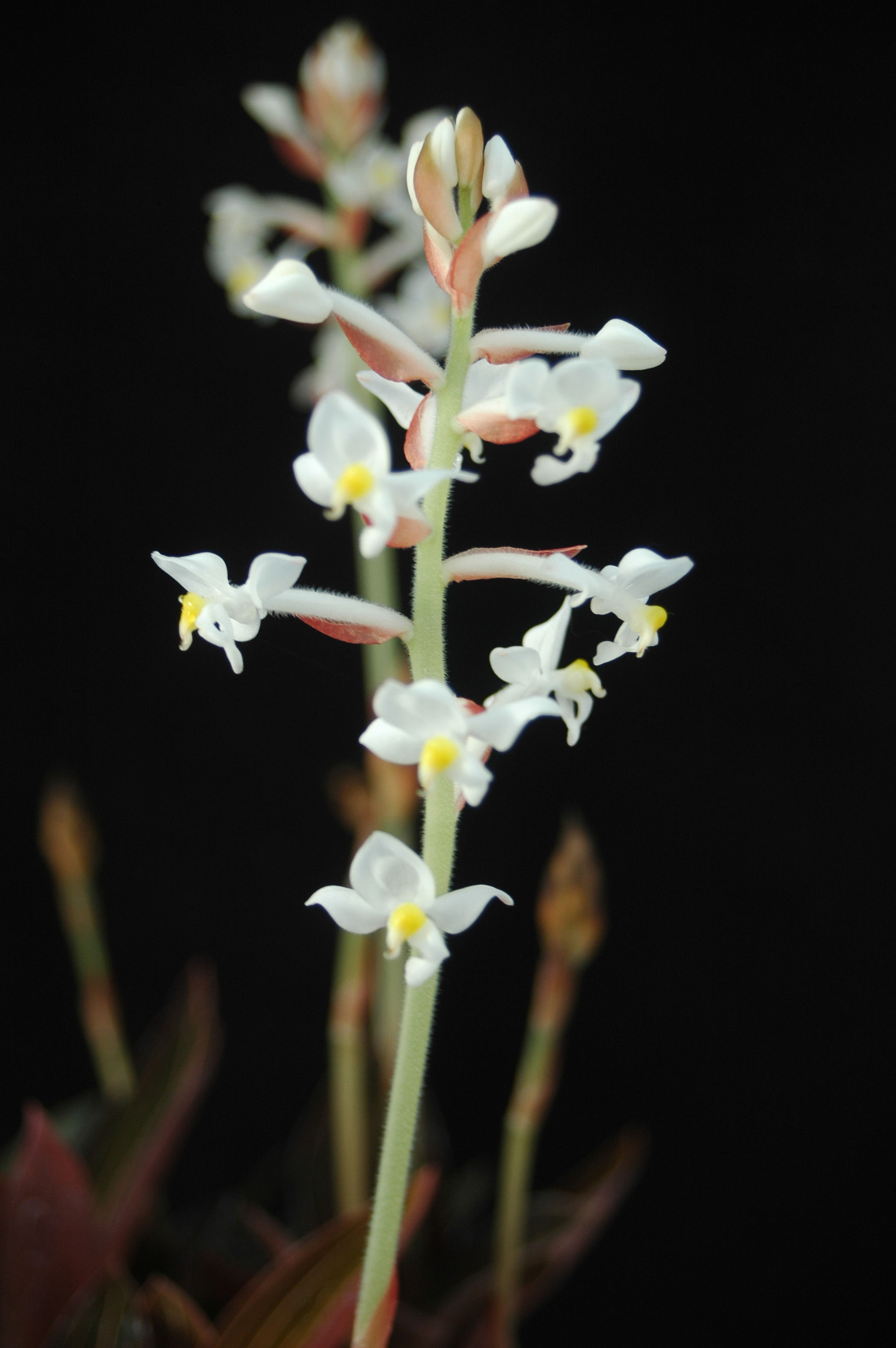
Ludisia discolor - the plant that inspired Matt to start the blog

Ludisia discolor – the plant that inspired Matt to start the blog (photo credit: www.eol.org)

Over the mere nine months that the podcast has been in existence, Matt has shared some of his personal botanical explorations. When he started the podcast he was living in Buffalo, NY. He completed a Master’s degree program there and has since moved to Illinois to pursue a PhD. His most recent episodes find him exploring the tallgrass prairie of the Midwest. He’s got my attention, since this is one of my favorite ecosystems in North America.

Standout episodes to me so far have been the two part episode with Russel Funderburk as they walk through the grounds of the Highlands Biological Station, the discussion with Dave Spiering about urban ecology, and the interview with Dr. Robert Warren about invasive species (“a refreshing take”). The episode about pack rat middens and the candid discussion with Matt’s friend Steve about why they botanize are also great. Matt and Steve also do an episode about plant poaching, a topic that deserves much more attention than it gets.

The love Matt has for plants is infectious, and it is hard not to feel his excitement as he helps tell their stories. So, if you find that your podcast queue is lacking something purely plant related, In Defense of Plants is a podcast you should definitely be following.

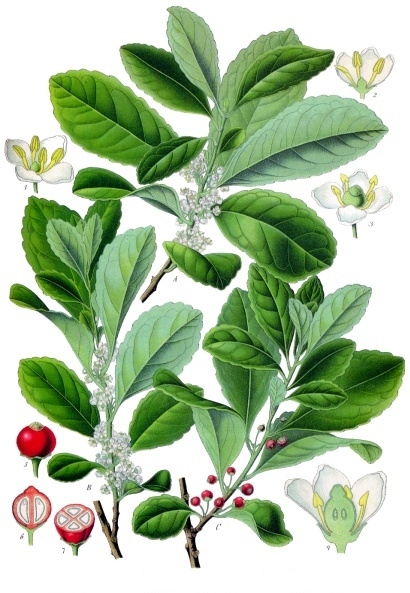
Yerba Mate (Ilex paraguariensis)

Yerba Mate (Ilex paraguariensis) is featured in two episodes of In Defense of Plants. Listen to part one and part two. (photo credit: wikimedia commons)


In Defense of Weeds – A Book Review

Weeds have been with us since the beginning of human civilization. We created them, really. We settled down, started growing food, urbanized, and in doing so we invited opportunistic plant species to join us – we created spaces for them to flourish and provided room for them to spread out and settle in. During our history together, our attitudes about weeds have swung dramatically from simply living with and accepting them, recognizing their usefulness, incorporating them into our religious myths and cultural traditions, to developing feelings of disgust and disdain and ultimately declaring outright war against them. In a sense, weeds are simultaneously as wild and as domestic as a thing can be. They remind us of ourselves perhaps, and so our feelings are mixed.

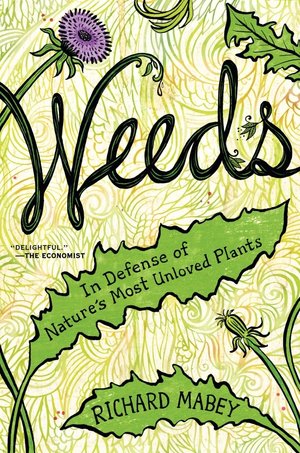
Considering our combined history and the fact that weeds have stuck with us all along, perhaps it’s time we give them a little respect. This seems to be the objective of Richard Mabey’s book, Weeds: In Defense of Nature’s Most Unloved Plants. In Mabey’s own words, “this book is a case for the defense, an argued suggestion that we look more dispassionately at these outlaw plants, at what they are, how they grow, and the reasons we regard them as trouble.” Additionally, we should recognize that we wrote the definition for weeds: “plants become weeds because people label them as such.” We introduce them, create conditions in which they can thrive, and then turn around and despise them for doing what they do best. “In a radical shift of perspective we now blame the weeds, rather than ourselves;” however, as Mabey ultimately concludes, “we get the weeds we deserve.”

weeds book

But before he arrives at that conclusion – and certainly Mabey has more to say than that pithy remark – Mabey takes readers on a remarkable journey. Starting with the origins of agriculture – and the origins of weeds – he recounts the story of how weeds followed civilization as it spread across the globe. He describes our diverse reactions to weeds, how we have dealt with them, and how they have infiltrated our myths, art, cultures, food, medicine, rituals, philosophies, and stories. Along the way, certain weeds are profiled using Mabey’s unique prose. Each weed has a story to tell – some more sordid than others.

Mabey is a British author, and so the book has a strong Anglocentric slant. But this seems fitting considering that the explorations and migrations of early Europeans are probably responsible for moving more plant species around than any other group in history – at least up until the modern era. Mabey describes the myriad ways these plants were introduced: “Some simply rode piggy-back on crop and garden plants…others were welcomed as food plants or glamorous ornaments, but escaped or were thrown out and became weeds as a consequence of unforeseen bad behavior.” The seeds of many species hitched rides with numerous agricultural and industrial products, while others attached themselves to clothing, shoes, and animal fur. Everywhere humans traveled, weeds followed.

Weeds are one of the great legacies Europeans brought with them as they settled the American continent. A veritable wave of new plant species entered the Americas as the Europeans trickled in, some were purposeful introductions and some accidental. Ever the opportunists, Europe’s weeds traversed across the continent as settlers tilled and altered the land. Mabey details the introduction of “invasive European weeds” to the western United States, claiming that “by the twentieth century two-thirds of the vegetation of the western grasslands was composed of introduced species, mostly European.

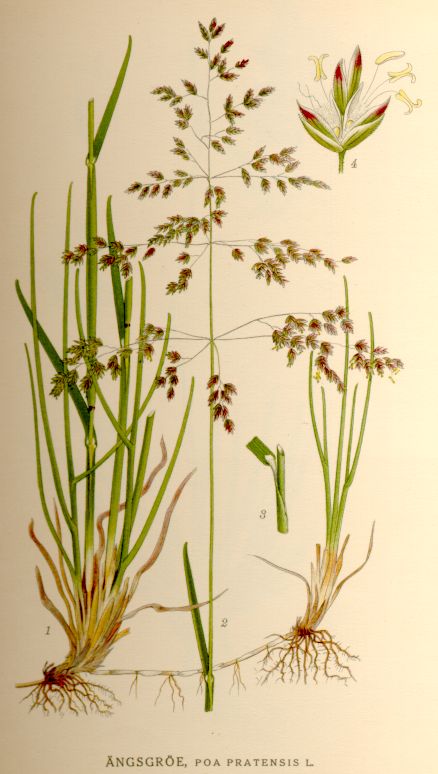
One of these European species in particular has been wholeheartedly embraced by American culture; it was even given an American name. Kentucky bluegrass, Poa pratensis, “is a common, widespread but unexceptional species of grassy places in Europe…but in uncontested new grazing lands of North America it could color whole sweeps of grassland.” It has since become a preferred turfgrass species, and it’s innate ability to thrive here makes it partly responsible for Americans’ obsession with the perfect lawn. Oddly, other European invaders infiltrating a pristine, green lawn are unwelcome and derided as “weeds.” In actuality, considering its relentless, expansive, and spreading nature and its reliance on humans to perpetuate its behavior, turfgrass is much more fit for the label “weed” than any other species that invades it. As Mabey asserts, “a lawn dictates its own standards…the demands made by its singular, unblemished identity, its mute insistence that if you do not help it to continue along the velvet path you have established for it, you are guilty of a kind of betrayal.”

Kentucky bluegrass (Poa pratensis) also known as smooth meadow-grass - photo credit: wikimedia commons

Kentucky bluegrass (Poa pratensis), also known as smooth meadow-grass – photo credit: wikimedia commons

Reading along it becomes clear that Mabey is infatuated with weeds. You can see it in sentences like, “the outlandish enterprise of weeds – such sharp and fast indices of change – can truly lift your heart.” This doesn’t mean that in his own garden he doesn’t “hoick them up when they get in [his] way.” It just means that his “capricious assault” is “tinged with respect and often deflected by a romantic mood.” Does Mabey wish his readers to swoon the way he does over these enterprising and opportunistic aliens? Perhaps. More than that he seems to want to instill an awe and admiration for what they can do. In many cases they serve important ecological functions, including being a sort of “first responder” after a disturbance due to their fast acting and ephemeral nature. In this way, weeds “give something back” by “holding the bruised parts of the planet from falling apart.” They also “insinuate the idea of wild nature into places otherwise quite shorn of it,” and so despite their dependence on human activities, they could be considered “the very essence of wildness.”

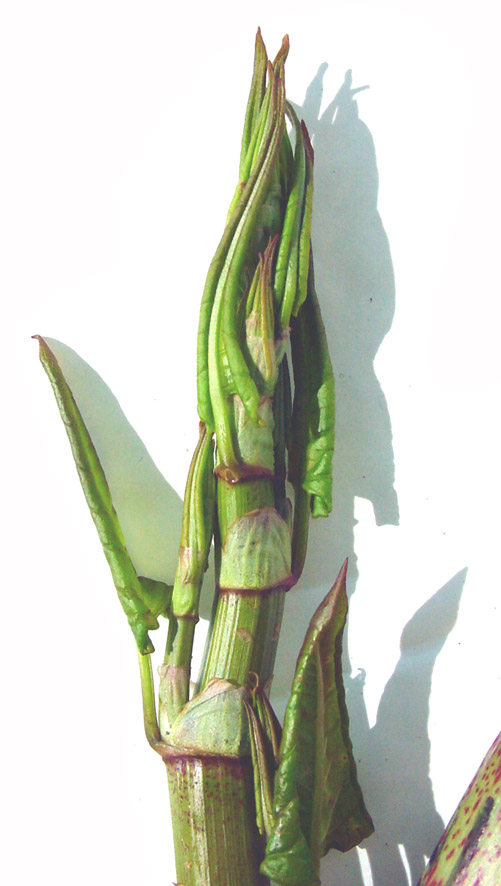
For all the love Mabey has for weeds, he remains convinced that some absolutely need to be kept in check. He calls out Japanese knotweed specifically – an “invader with which a truly serious reckoning has to be made.” In speaking of naturalized plant species – introduced species that propagate themselves and “spread without deliberate human assistance” – he makes the comparison to humans becoming naturalized citizens in countries where they were not born. In this sense he argues for more acceptance of such species, while simultaneously warning that “there are invasive species that ought never to get their naturalization papers.”

Japanese knotweed (Fallopia japonica) is listed as one the 100 Worst Invasive Species - photo credit: wikimedia commons

Japanese knotweed (Fallopia japonica) is listed as one the 100 Worst Invasive Species – photo credit: wikimedia commons

This is an engrossing read, and regardless of how you feel about weeds going in, Mabey will – if nothing else – instill in you a sort of reverence for them. You may still want to reach for the hoe or the herbicide at the sight of them – and you may be justified in doing that – but perhaps you’ll do so with a little more understanding. After all, humans and weeds are kindred species.

As a type they are mobile, prolific, genetically diverse. They are unfussy about where they live, adapt quickly to environmental stress, use multiple strategies for getting their own way. It’s curious that it took so long to realize that the species they most resemble is us.

Listen to Mabey talk about his book and his interest in weeds on these past episodes of Science Friday and All Things Considered.

What Shall We Do About Invasive Species?

I think about invasive species a lot. This blog doesn’t really reflect that though. I have been avoiding a deep dive into the subject mainly because there is so much to say about it and I don’t really want this to become “the invasive species blog.” Admittedly, I’m also trying to avoid controversy. Some people have very strong opinions about invasive species, and I don’t always agree. But then an article entitled Taking the long view on the ecological effects of plant invasions appeared in the June 2015 issue of American Journal of Botany. Intrigued by the idea of “taking the long view,” I read the article and decided that now is as good a time as any to start exploring this topic in greater depth.

However, before getting into the article, we should define our terms. “Invasive species” is often used inappropriately to refer to any species that is found outside of its historic native range (i.e. the area in which it evolved to its present form). More appropriate terms for such species are “introduced,” “alien,” “exotic,” “non-native,” and “nonindigenous.” The legal definition of an invasive species (according to the US government) is “an alien species that does or is likely to cause economic or environmental harm or harm to human health.” Even though this definition specifically refers to “alien species,” it is possible for native species to behave invasively.

These terms refer not just to plants but to all living organisms. The term “noxious weed,” on the other hand, is specific to plants. A noxious weed is a plant species that has been designated by a Federal, State, or county government as “injurious to public health, agriculture, recreation, wildlife, or property.” A “weed” is simply a plant that, from a human perspective, is growing in the wrong place, and any plant at any point could be determined to be a weed if a human says so. (I’ll have more to say about human arrogance later in the post.)

Rush skeletonweed (Chondrilla juncea) - labeled a noxious weed in Idaho

Rush skeletonweed (Chondrilla juncea) – labeled a noxious weed in Idaho

The authors of the AJB article (S. Luke Flory and Carla M. D’Antonio) begin by clarifying that “most introduced species are not problematic.” Those that are, however, can “cause significant ecological and economic damage.” This damage is well documented, and it is the reason why billions of dollars are spent every year in the battle against invasive species. But there is a dearth in our research: “less is known about how ecological effects of invasions change over time.” The effects of invasive species could “increase, decrease, or be maintained over decades,” and “multiple community and ecosystem factors” will determine this. For this reason, the authors are calling for “concentrated efforts to quantify the ecological effects of plant invasions over time and the mechanisms that underlie shifting dynamics and impacts.” Armed with this kind of information, managers can better direct their efforts towards invasive species determined to be “the most problematic.”

The authors go on to briefly explain with examples why an invasive species population may decline or be maintained over time, highlighting selected research that demonstrates these phenomena. Research must continue with the aim of improving our understanding of the long term effects of plant invasions. The authors acknowledge that this “will require carefully designed experiments,” “patient and persistent research efforts,” and significant amounts of money. However, they are convinced that through a widespread collaborative effort it can be done. They encourage researchers to deposit data obtained from their research in open source online repositories so that future meta-analyses can be conducted. The information available in these online repositories can be used to develop management plans and help predict “future problematic invasions.”

Considering the amount of time and resources currently spent on confronting invasive species, the approach proposed by the authors of this article is quite reasonable. It seems absurd to continue to battle a problematic species that will ultimately be brought down to more manageable levels by natural causes. It also seems absurd to battle against a species that is essentially here to stay.

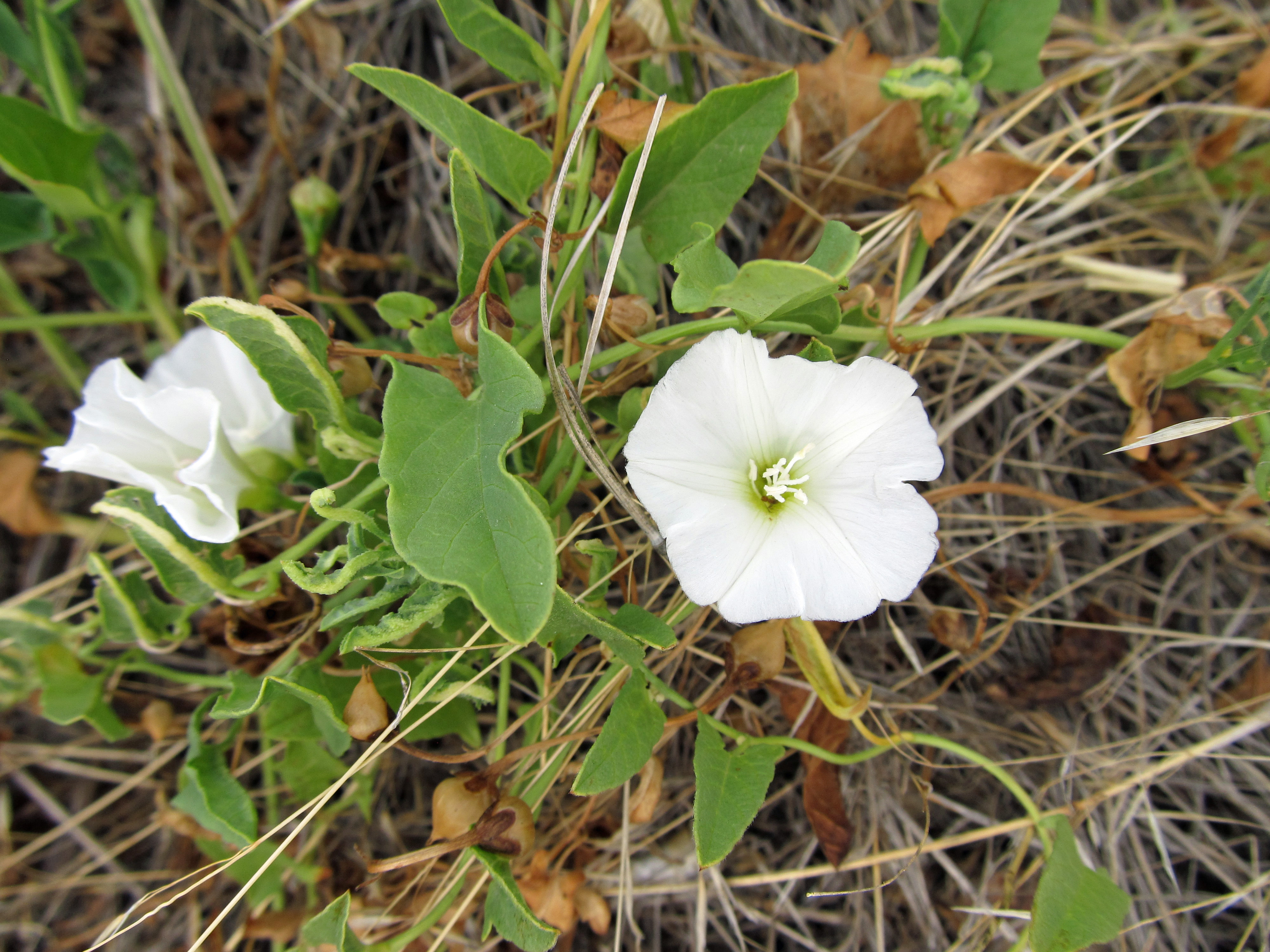
Field bindweed (Convulvulus arvensis) - labeled a noxious weed in Idaho

Field bindweed (Convulvulus arvensis) – labeled a noxious weed in Idaho

And that brings me to the point in which I make enemies. Take a look at the terms defined earlier. When we talk about introduced species, we are referring to introductions by humans, whether purposeful or accidental. An “alien” species introduced to a new location by wind, water, or animal (other than human) would be considered a natural introduction, right? If that species becomes established in its new location, it would simply be expanding its range. If a human brought it there, again whether purposefully or accidentally, it would be considered an exotic indefinitely.

Humans have been moving species around since long before we became the humans we are today in the same way that a migratory bird might move a species from one continent to another. At what point during our evolution did our act of moving species around become such a terrible thing?

I will concede that our species has become an incredibly widespread species, able to move about the planet in ways that no other species can. We also have technological advances that no other species comes close to matching. In the time that our species has become truly cosmopolitan, the amount of species introductions that we have participated in has increased exponentially. Leaving ecological destruction in our wake is kind of our modus operandi. I don’t want to make excuses for that, but I also don’t see it unfolding any other way. Give any other species the opportunities we had, and they probably would have proceeded in the same manner. Just consider any of the most notorious invasive species today – “opportunist” is their middle name.

More and more, as we are able to see what we have done, we are making efforts to “fix it.” But how de we rewind time? And if we could, when do we rewind back to? And how do we not “ruin it” again? The earth does not have a set baseline or a condition that it is supposed to be in at any given time. The earth just is. It is operating in a state of randomness, just like everything else in the universe. Any idea of how the earth must look at any given time is purely philosophical – conceived of by humans. I’m not saying that we shouldn’t try to repair the damage, but we should acknowledge that the repairs we’re trying to make are largely for the perpetuation of our own species. Yeah, we’ve developed a soft spot for other species along the way (thankfully), but ultimately we’re just trying to maintain. The earth, on the other hand, would be fine without us.

So, what shall we do about invasive species? I’m not entirely sure. The only thing I’m certain of is that I will continue to ruminate on them and potentially bore you with more blog posts in the future. Until next time…

Puncturevine (Tribulus terrestris) - labeled a noxious weed in Idaho

Puncturevine (Tribulus terrestris) – labeled a noxious weed in Idaho

Poisonous Plants: Castor Bean

A series of posts about poisonous plants should not get too far along without discussing what may be the most poisonous plant in the world – one involved in high and low profile murders and attempted murders, used in suicides and attempted suicides, a cause of numerous accidental deaths and near deaths, developed for use in biological warfare by a number of countries (including the United States), and used in bioterrorism attacks (both historically and presently). Certainly, a plant with a reputation like that is under tight control, right? Not so. Rather, it is widely cultivated and distributed far beyond its native range – grown intentionally and used in the production of a plethora of products. In fact, products derived from this plant may be sitting on a shelf in your house right now.

Ricinus communis, known commonly as castor bean or castor oil plant, is a perennial shrub or small tree in the spurge family (Euphorbiaceae) and the only species in its genus. It is native to eastern Africa and parts of western Asia but has since been spread throughout the world. It has naturalized in tropical and subtropical areas such as Hawaii, southern California, Texas, Florida, and the Atlantic Coast. It is not cold hardy, but is commonly grown as an ornamental annual in cold climates. It is also grown agriculturally in many countries, with India, China, and Mozambique among the top producers.

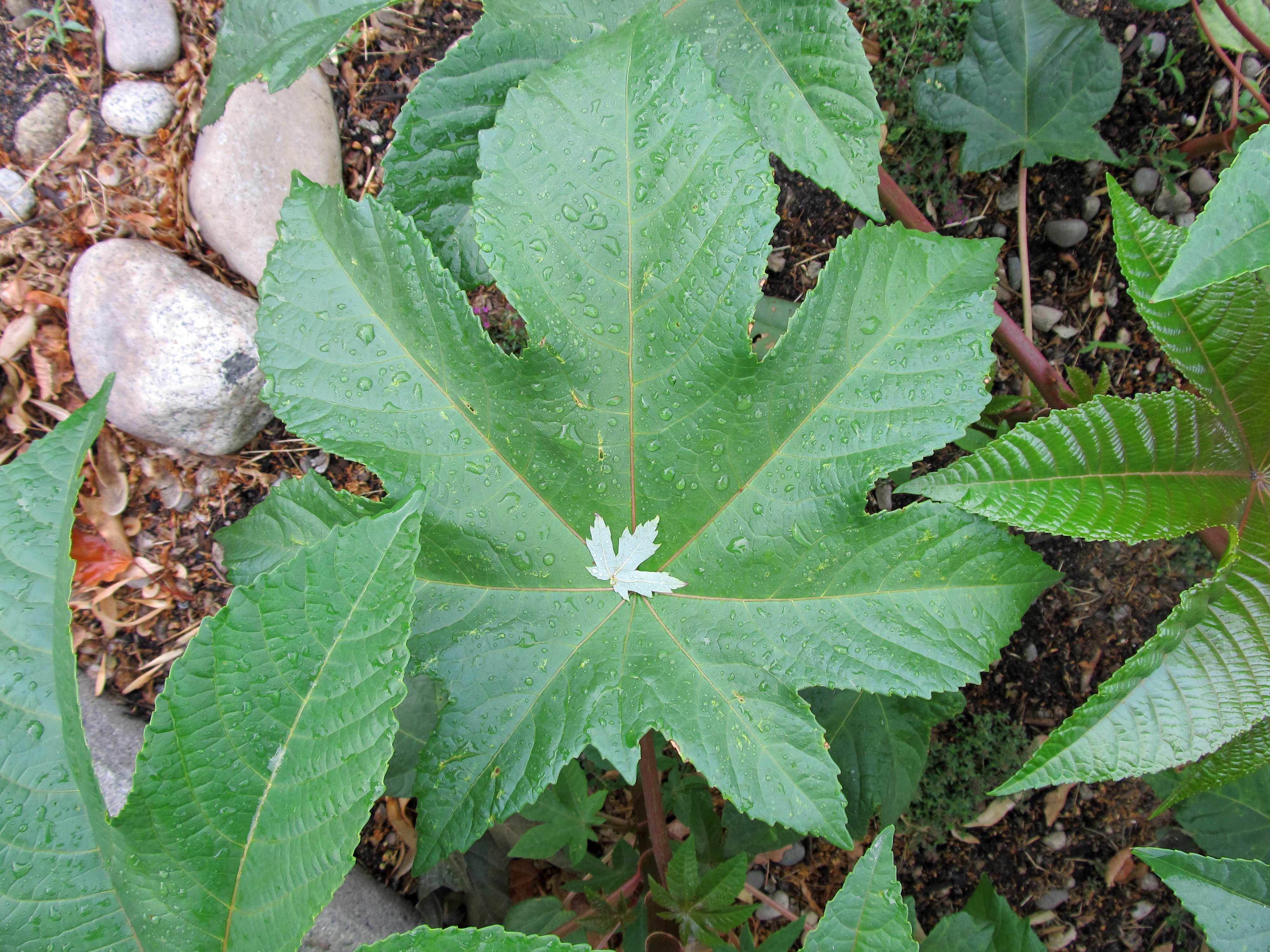
Silver maple leaf nestled in the center of a castor bean leaf.

Silver maple leaf nestled in the center of a castor bean leaf.

Castor bean has large palmately lobed leaves with margins that are sharply toothed. Leaves are deep green (sometimes tinged with reds or purples) with a red or purple petiole and can reach up to 80 centimeters (more than 30 inches) across. Castor bean can reach a height of 4 meters (more than 12 feet) in a year; in areas where it is a perennial, it can get much taller. Flowers appear in clusters on a large, terminal spike, with male flowers at the bottom and female flowers at the top. All flowers are without petals. Male flowers are yellow-green with cream-colored or yellow stamens. Female flowers have dark red styles and stigmas. The flowers are primarily wind pollinated and occasionally insect pollinated. The fruits are round, spiky capsules that start out green often with a red-purple tinge and mature to a brown color, at which point they dehisce and eject three seeds each. The seeds are large, glossy, bean-like, and black, brown, white, or often a mottled mixture. They have the appearance of an engorged tick. There is a small bump called a caruncle at one end of the seed that attracts ants, recruiting them to aid in seed dispersal.
Female flowers and fruits forming on castor bean.

Female flowers and fruits forming on castor bean.

All parts of the plant are toxic, but the highest concentration of toxic compounds is found in the seeds. The main toxin is ricin, a carbohydrate-binding protein that inhibits protein synthesis. The seeds need to be chewed or crushed in order to release the toxin, so swallowing a seed whole is not likely to result in poisoning. However, if seeds are chewed and consumed, 1-3 of them can kill a child and 2-6 of them can kill an adult. It takes several hours (perhaps several days) before symptoms begin to occur. Symptoms include nausea, vomiting, severe stomach pain, diarrhea, headaches, dizziness, thirst, impaired vision, lethargy, and convulsions, among other things. Symptoms can go on for several days, with death due to kidney failure (or multisystem organ failure) occurring as few as 3 and as many as 12 days later. Death isn’t imminent though, and many people recover after a few days. Taking activated charcoal can help if the ingestion is recent. In any case, consult a doctor or the Poison Control Center for information about treatments.

The seeds of castor bean are occasionally used to make jewelry. This is not recommended. In The North American Guide to Common Poisonous Plants and Mushrooms, the authors warn that “drilling holes in the seeds makes them much more deadly because it exposes the toxin.” Wearing such jewelry can result in skin irritation and worse. The authors go on to say that “more than one parent has allowed their baby to suck on a necklace of castor beans.” I doubt such parents were pleased with the outcome.

castor bean seeds

Castor beans are grown agriculturally for the oil that can be extracted from their seeds. Due to the way its processed, castor oil does not contain ricin. The leftover meal can be fed to animals after it has been detoxified. Castor oil has been used for thousands of years, dating as far back as 5000 BC when Egyptians were using it as a fuel for lamps and a body ointment, among other things. Over the centuries it has had many uses – medicinal, industrial, and otherwise. It makes an excellent lubricant, is used in cosmetics and in the production of biofuel, and has even been used to make ink for typewriters. One of its more popular and conventional uses is as a laxative, and in her book, Wicked Plants, Amy Stewart describes how this trait has been used as a form of torture: “In the 1920’s, Mussolini’s thugs used to round up dissidents and pour castor oil down their throats, inflicting a nasty case of diarrhea on them.”

A couple of years ago, I grew a small stand of castor beans outside my front door. I was impressed by their rapid growth and gigantic leaves. I also enjoyed watching the fruits form. By the end of the summer, they were easily taller than me (> 6 feet). I collected all of the seeds and still have them today. I knew they were poisonous at the time, but after doing the research for this post, I’m a little wary. With a great collection of castor bean seeds comes great responsibility.

The castor beans that once grew outside my front door.

The castor beans that once grew outside my front door.

There is quite a bit of information out there about castor beans and ricin. If you are interested in exploring this topic further, I recommend this free PubMed article, this Wikipedia page about incidents involving ricin, this article in Nature, and this entry in the Global Invasive Species Database. Also check out Chapter 11 (“Death by Umbrella”) in Thor Hanson’s book, The Triumph of Seeds.

Weeds and Wildflowers of the Boise Foothills: June 2015

Boise, Idaho is a beautiful city for many reasons. One feature that makes it particularly attractive are the foothills that flank the city from the southeast to the northwest. The foothills are a transition zone to the mountains that lie to the northeast. Large sections of the foothills have been converted to housing, but much of the area remains as wide open space. There are around 150 miles of trails winding through the foothills that can be accessed from the Boise area. These trails are used frequently by hikers, mountain bikers, dog walkers, bird watchers, trail runners, and horseback riders. The foothills, along with so many other nearby attractions, explains why Boise is such an excellent city for those who love outdoor recreation.

boise foothills trail

I feel embarrassed to say that I had not yet made it into the foothills this year until about a couple weeks ago. I had intended to go for more frequent hikes this year, but life has been in the way. What I was especially curious to see was how the plant life in the foothills changes throughout the year. Because Boise is located in a high desert and receives very little precipitation (especially during the summer months), many of the local wildflowers show themselves in the spring when there is moisture in the soil, after which they wither up and go dormant for the rest of the year.

But there is still lots to see in June. However, it should be noted that when you are hiking in the foothills you must develop an appreciation for weeds, as many of the plants you will see are not native to this area and, in many cases, are in much greater abundance than the plants that are. Species brought in from Europe and Asia have become well established in the Boise Foothills, significantly altering the area’s ecology. One of the major changes has been wildfire frequency. Before weeds like cheatgrass – an annual, shallow-rooted grass imported from Europe – became so prolific in the area, fires were rare, slow moving, and isolated. The continuous, quick burning fuel source provided by dead cheatgrass heightens the risk of more frequent, faster moving, widespread fires, especially in the hot, dry summer months. This threatens plant species that are not adapted to frequent fires.
But this post isn’t about the ecology of the foothills. We can save that for another time. For now, I just wanted to share some of the plants I saw – both native and non-native – on my short walk through a very tiny corner of the Boise Foothills earlier this month.

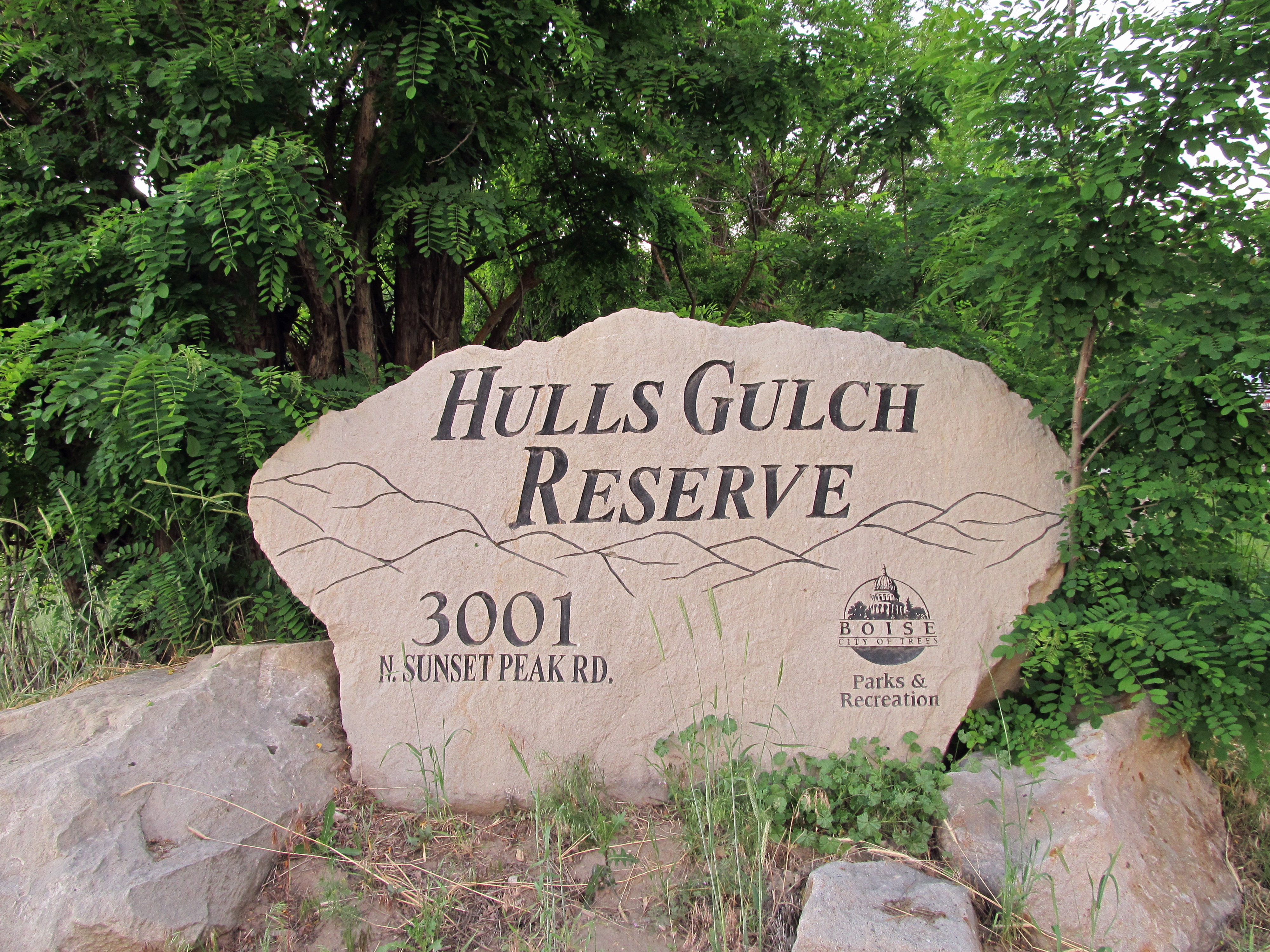
The trail that I hiked is one of several trails in an area of the Boise Foothills called Hulls Gulch Reserve.

The trail that I hiked is one of several trails in an area of the Boise Foothills called Hulls Gulch Reserve.


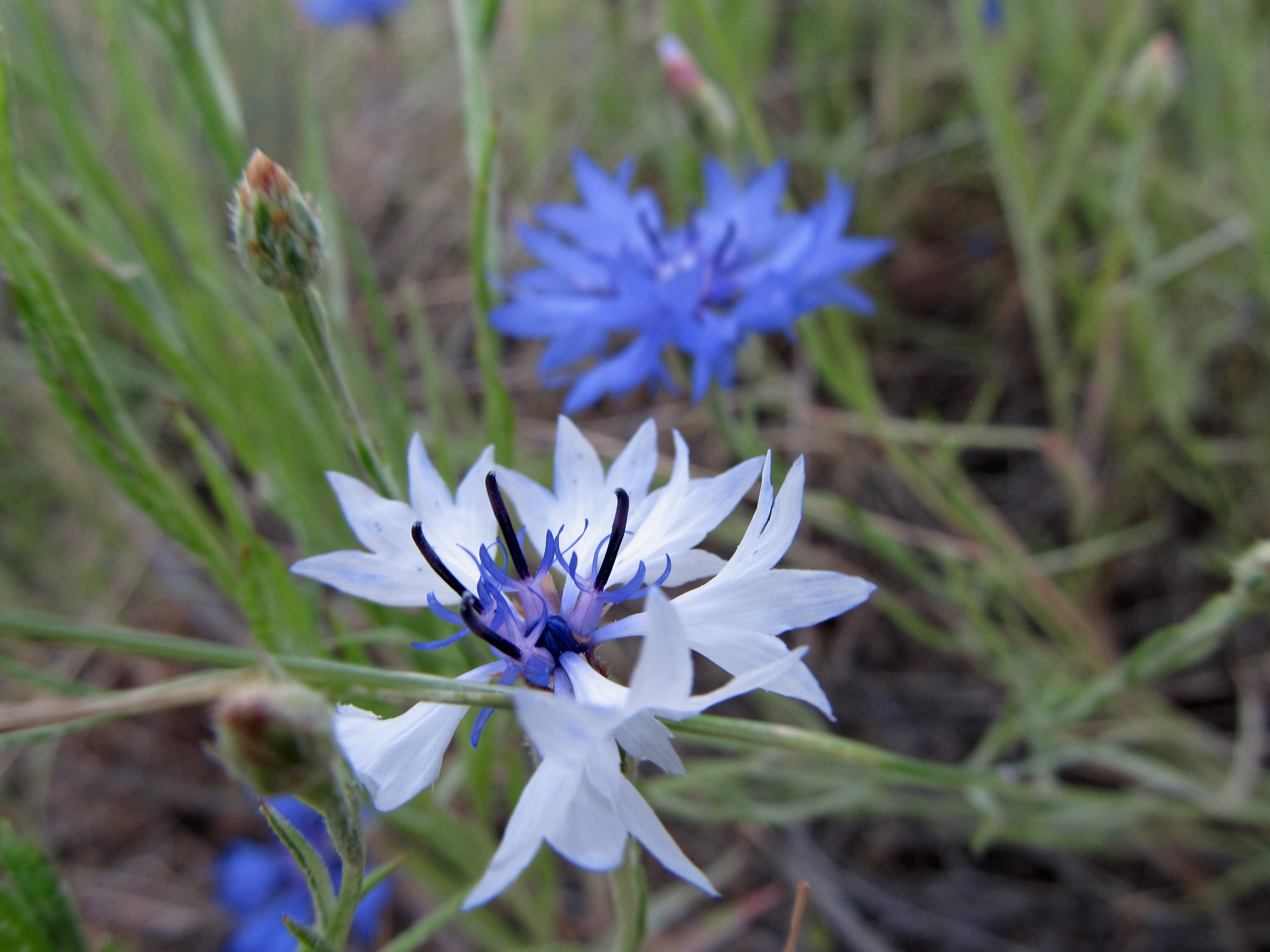
Bachelor's Buttons (Centaurea cyanus) are native to Europe. They are a common cultivated flower and have escaped from yards into the foothills. They are quite attractive and popular among pollinators. Their flowers and stems are edible so perhaps we should all take to eating them.

Bachelor’s buttons (Centaurea cyanus) are native to Europe. They are a common cultivated flower and have escaped from yards into the foothills. They are quite attractive and popular among pollinators. Their flowers and stems are edible, so perhaps we should all take to eating them.


Silverleaf phacelia (Phacelia hastate) - a foothills native that is also a pollinator favorite.

Silverleaf phacelia (Phacelia hastata) – a foothills native and a pollinator favorite.


Pale evening primrose (Oenothera pallida) - a foothills native pollinated by nocturnal moths.

Pale evening primrose (Oenothera pallida) – a foothills native pollinated by nocturnal moths.


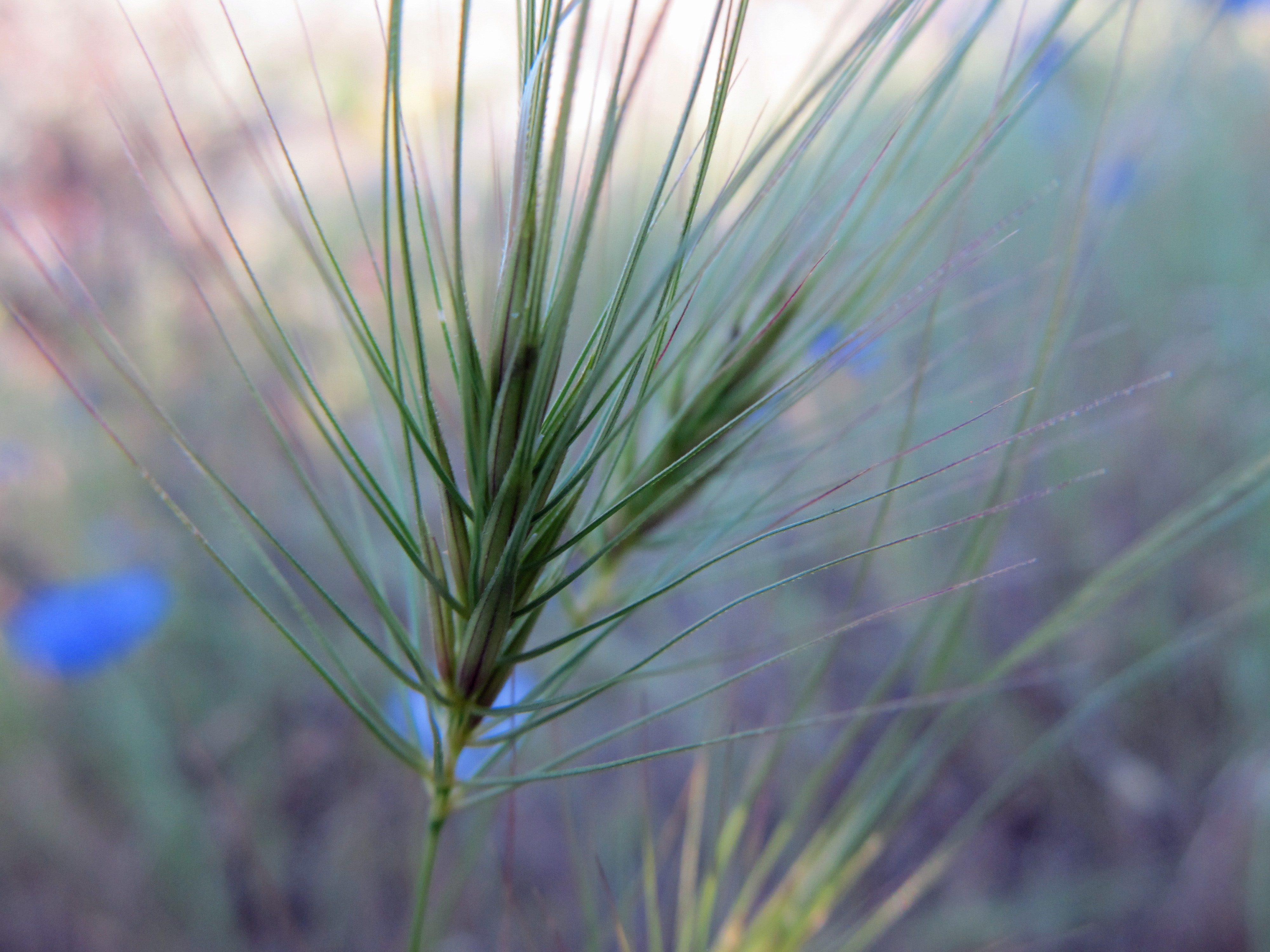
Medusahead (Taeniatherum caput-medusa) is an invasive annual grass from Eurasia. It has an ecological impact similar to cheatgrass (Bromus tectorum).

Medusahead (Taeniatherum caput-medusae) is an invasive annual grass from Eurasia. It has an ecological impact similar to cheatgrass (Bromus tectorum).


The fruits of nineleaf biscuitroot (Lomatium triternatum), a spring flowering plant in the carrot family (Apiaceae).

The fruits of nineleaf biscuitroot (Lomatium triternatum), a native spring wildflower in the carrot family (Apiaceae).


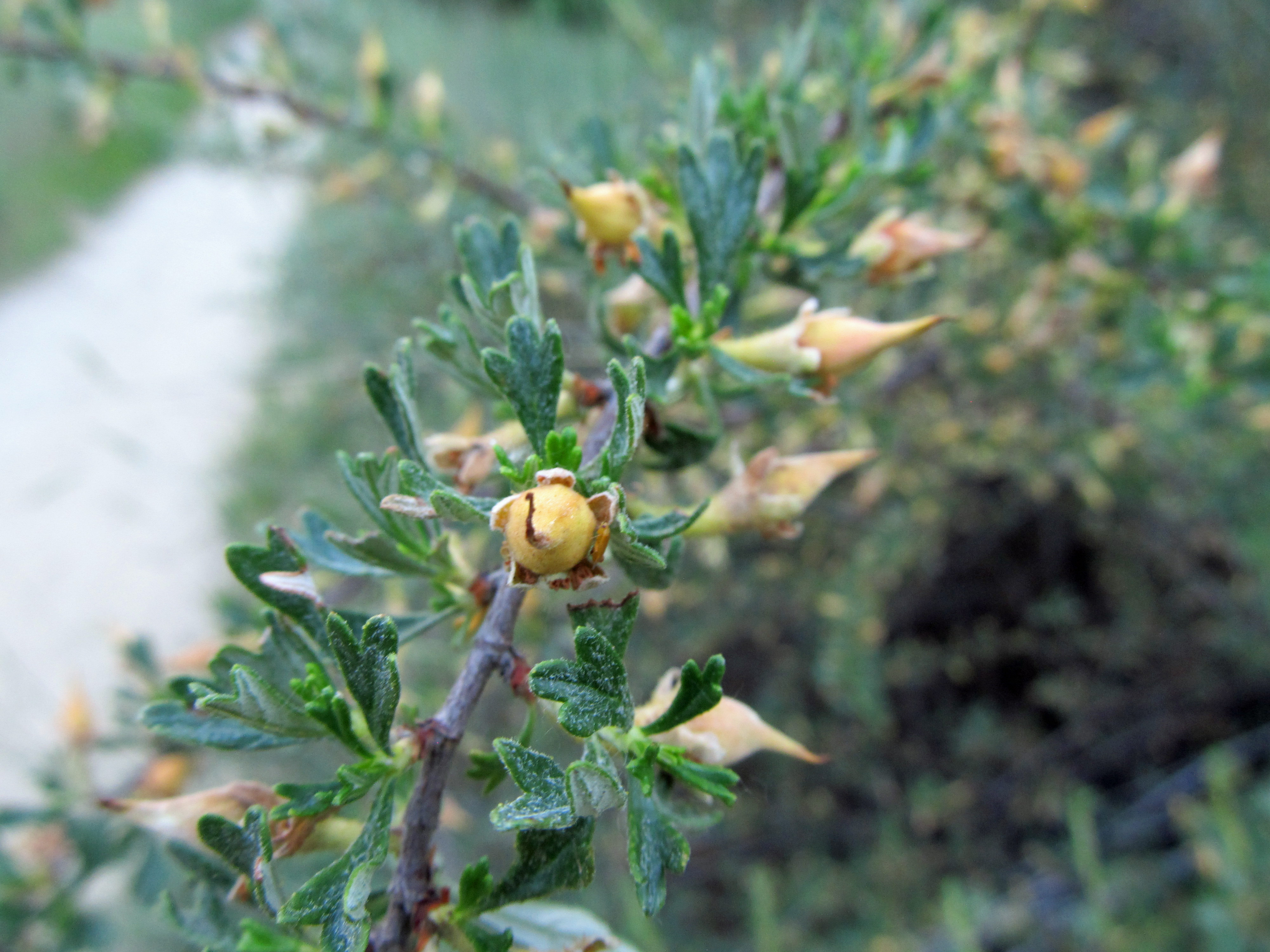
Fruits forming on antelope bitterbrush (Purshia tridentata), one of several shrubs native to the Boise Foothills.

Fruits forming on antelope bitterbrush (Purshia tridentata), one of several shrubs native to the Boise Foothills.


Rubber rabbitbrush (Ericameria nauseosa), a native shrub that flowers in late summer.

Rubber rabbitbrush (Ericameria nauseosa), a native shrub that flowers in late summer.


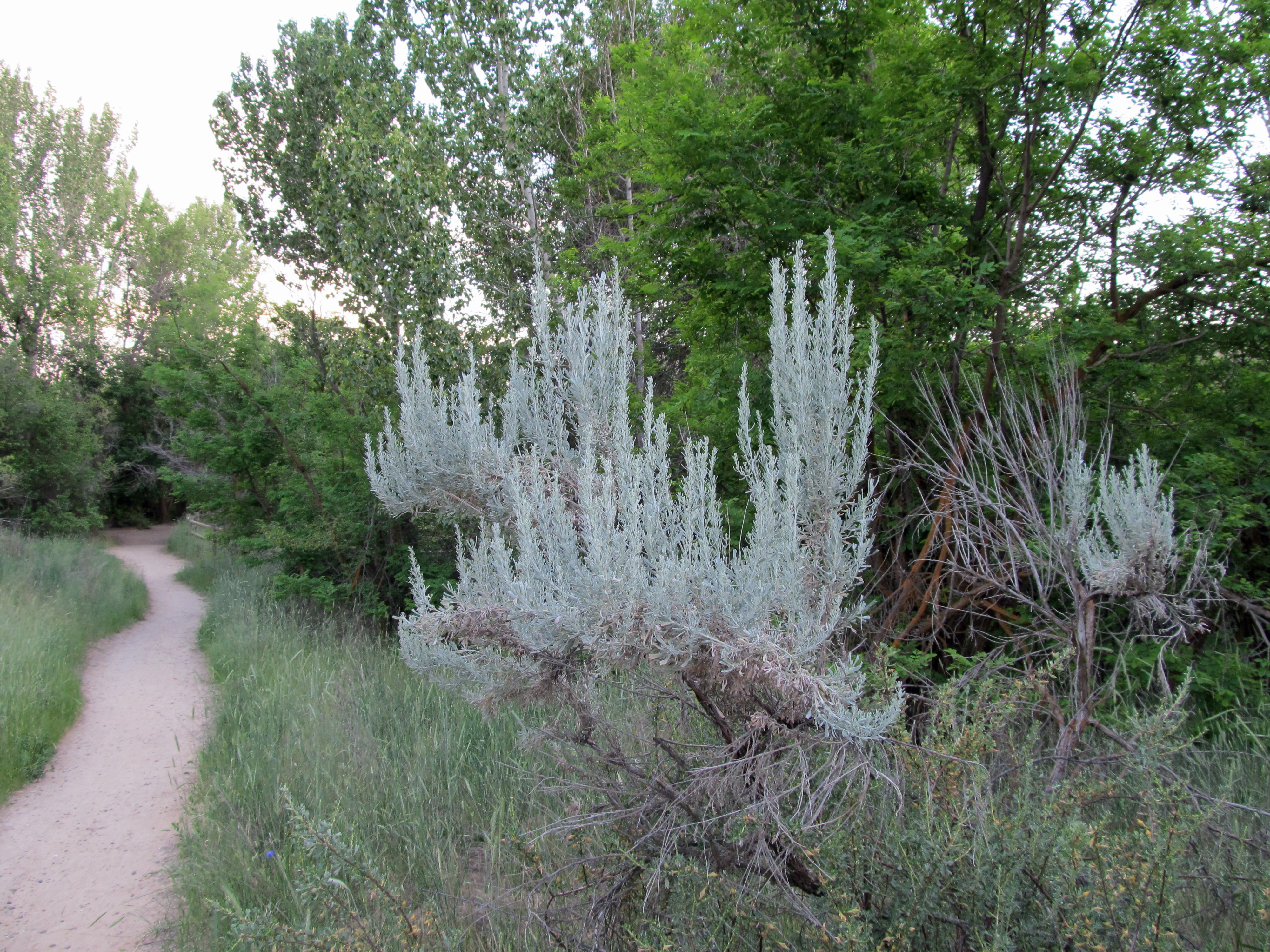
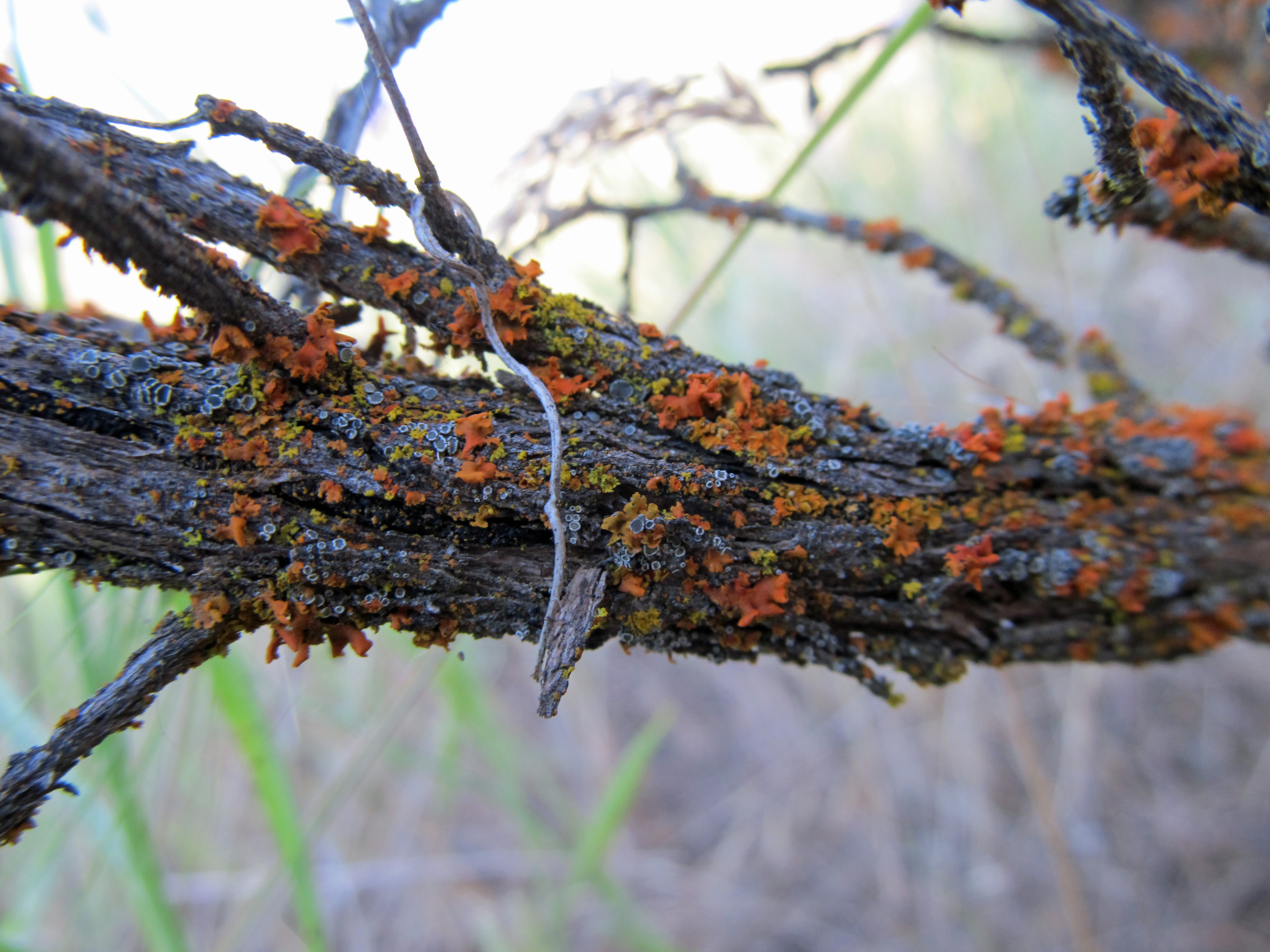
Lichens on the branch of basin big sagebrush (Artemisia tirdentata sbsp. tridentata) another common native shrub.

Lichens on the branches of basin big sagebrush (Artemisia tridentata subsp. tridentata), another common native shrub.


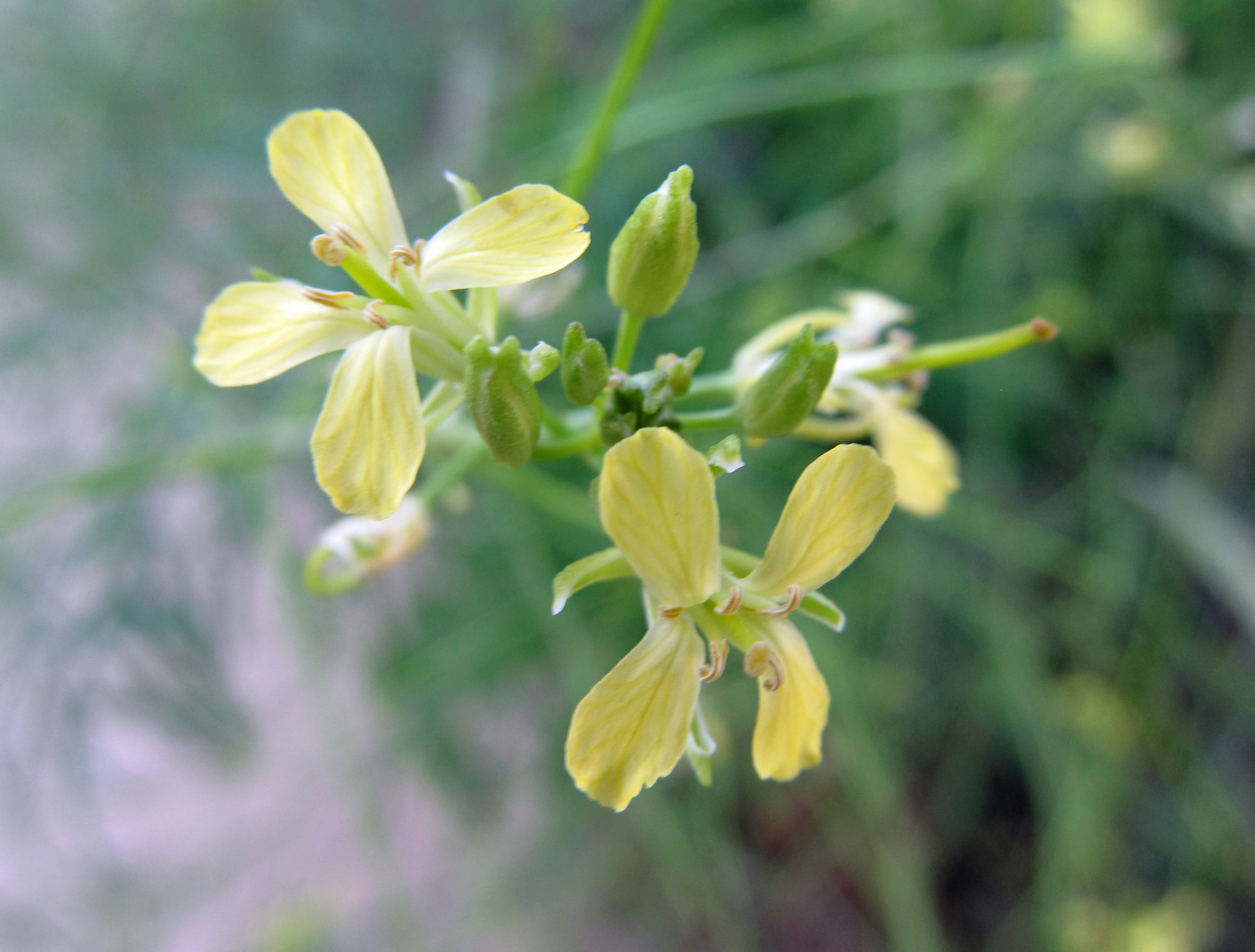
Tall tumblemustard (Sisymbrium altissimum) an introduced species and one of many tumbleweed species in the western states.

Tall tumblemustard (Sisymbrium altissimum) – an introduced species and one of many tumbleweed species in the western states.


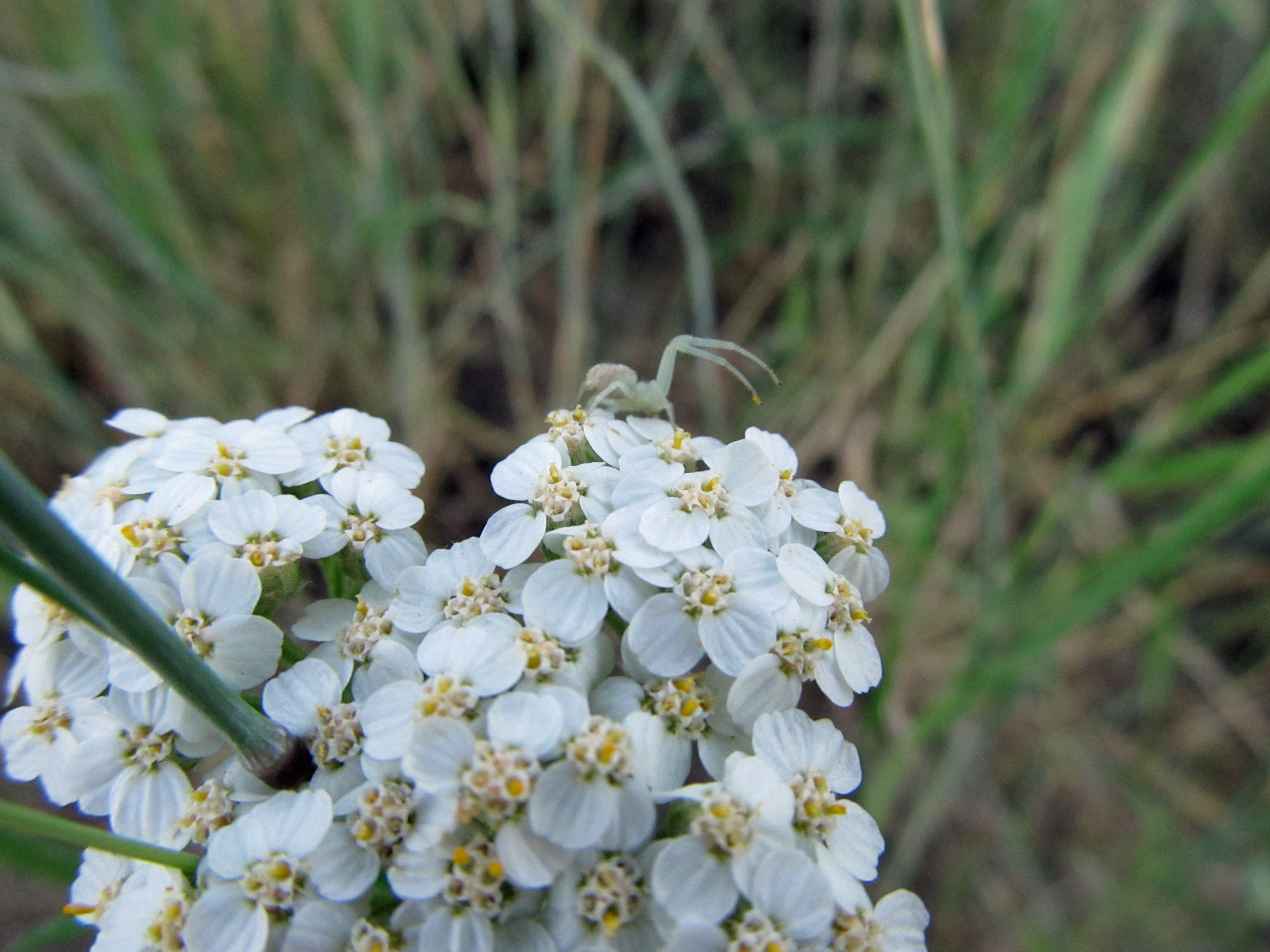
Little spider atop the flowers of western yarrow (Achilea millefolium), a foothills native.

A little spider atop flowers of western yarrow (Achilea millefolium var. occidentalis), a foothills native.

Learn more about the Boise Foothills here and here.

Where have you been hiking lately?