Party Time for Puncture Vine at Boise Goathead Fest

When the Goathead Monster revealed itself before the big bike parade at the first annual Boise Goathead Fest, it was worried that the thousands of people it saw gathered before it were there out of hatred. After all, “rides have been ruined, tires have been trashed, and punctures have permeated” the “pedal-powered lives” of pretty much everyone in attendance, and the Goathead Monster was to blame. For that reason, hundreds (perhaps thousands) of pounds of puncture vine had been pulled around Boise throughout the month of July, all in preparation for this inaugural event.

Certainly, those of us who ride bikes regularly have a sore spot for this problematic plant. Yet, we weren’t there in anger. We were there to celebrate bicycles, community, friendship, and summer, and even if it took a villain like the Goathead Monster to bring us all together, how could we be mad?
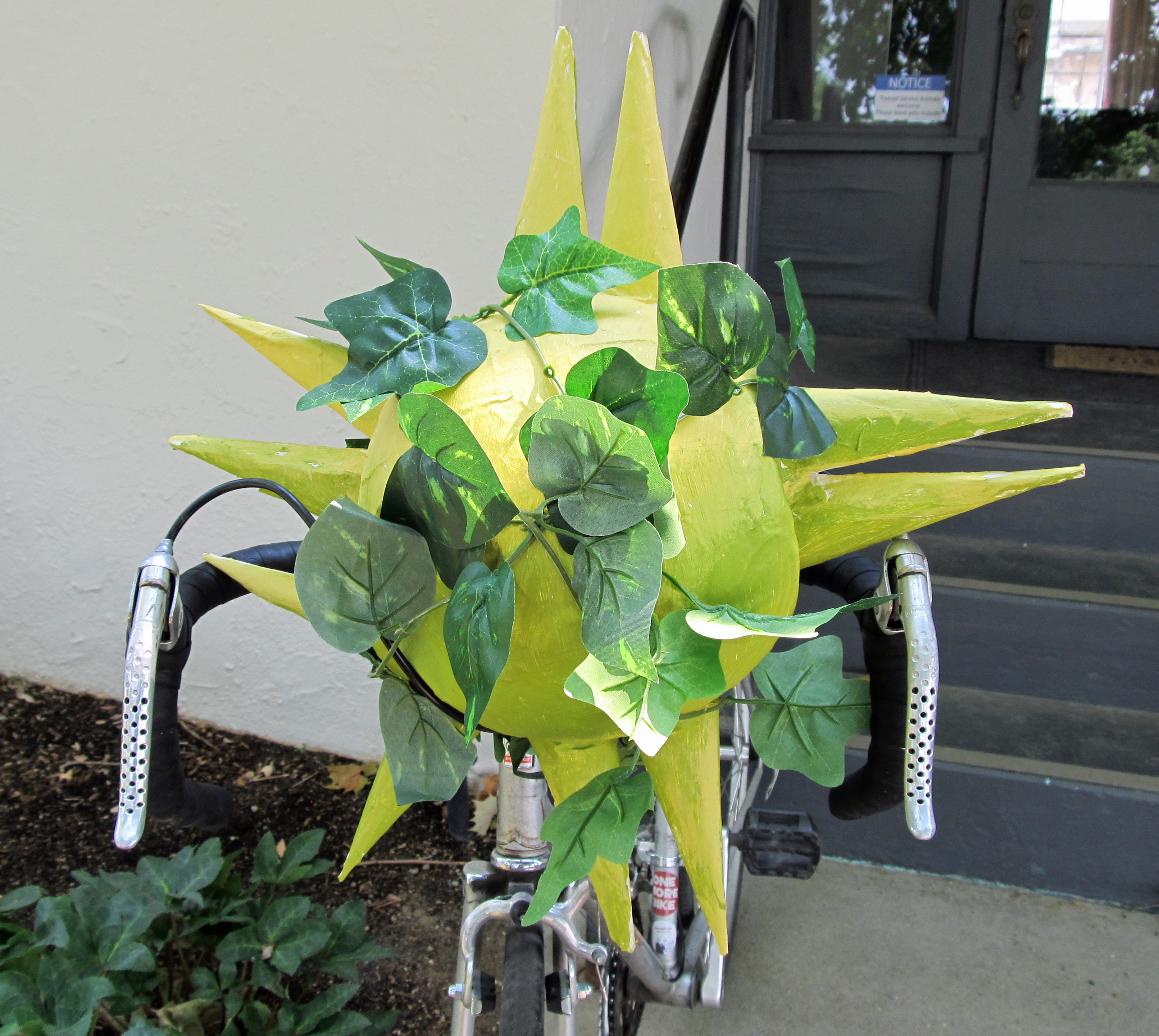
My bike decorated with a papiermâchée goathead.

Bicycle events like this one have been a feature of summers in Boise, Idaho for years now. For over a decade, Tour de Fat was the main event, but after dropping Boise from its tour schedule starting this year, Boise (with New Belgium Brewing‘s continued support) was left to create its own thing. Boise Bicycle Project, along with the help of several other bike-centric and bike-friendly organizations, put together Boise Goathead Fest. The trappings are similar to Tour de Fat – a bike parade, along with music, food, drinks, costumes, games, and weirdness. The main difference is that this event is “bona fide Boise” … and goathead themed.

As a bicycle enthusiast, this is already my kind of event. As a plant nerd – and even more so, as a weeds-obsessed plant nerd – a noxious weed-themed festival is about as on the nose as you can get. Where else are you going to see people dressing up their bikes and themselves like a noxious weed? And where else are you going to find people who, despite their disdain for this plant (or perhaps because of it), decide to come together and celebrate? In a way, it makes me wish we could throw a party for all vilified plants, each one getting a chance to tell its story, and each one getting some time under the spotlight, in spite of the negative feelings we may have towards them.
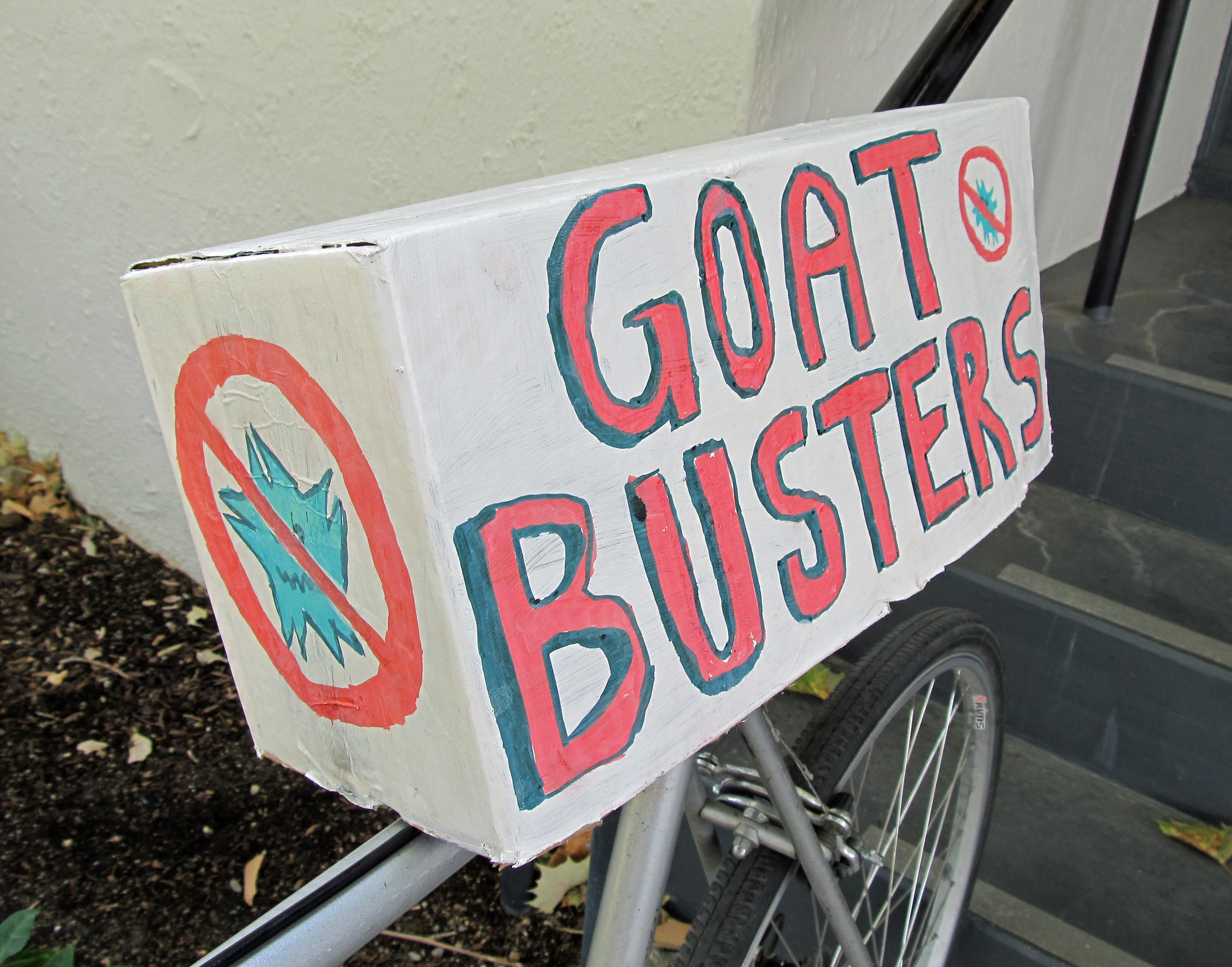
Sierra rode in the parade dressed up as a Goat Buster.

Goathead is an easy plant to rally around. As executive director of Boise Bicycle Project said on Idaho Matters, goatheads are a “bane of bicycling, and they don’t discriminate. It doesn’t matter who you are, where you’re from, what sort of bicycle you’re riding … you’re going to get a flat tire from these things.” Perhaps other noxious weeds don’t quite have the charisma that puncture vine does – the ability to “unify everyone together” – but that’s okay. I’ll just have to find a way to celebrate each of them some other way. As it is, we now have Boise Goathead Fest, and if that means that every summer for years to come people will be donning goathead costumes and coming together to party in a positive way, what more can we ask for?
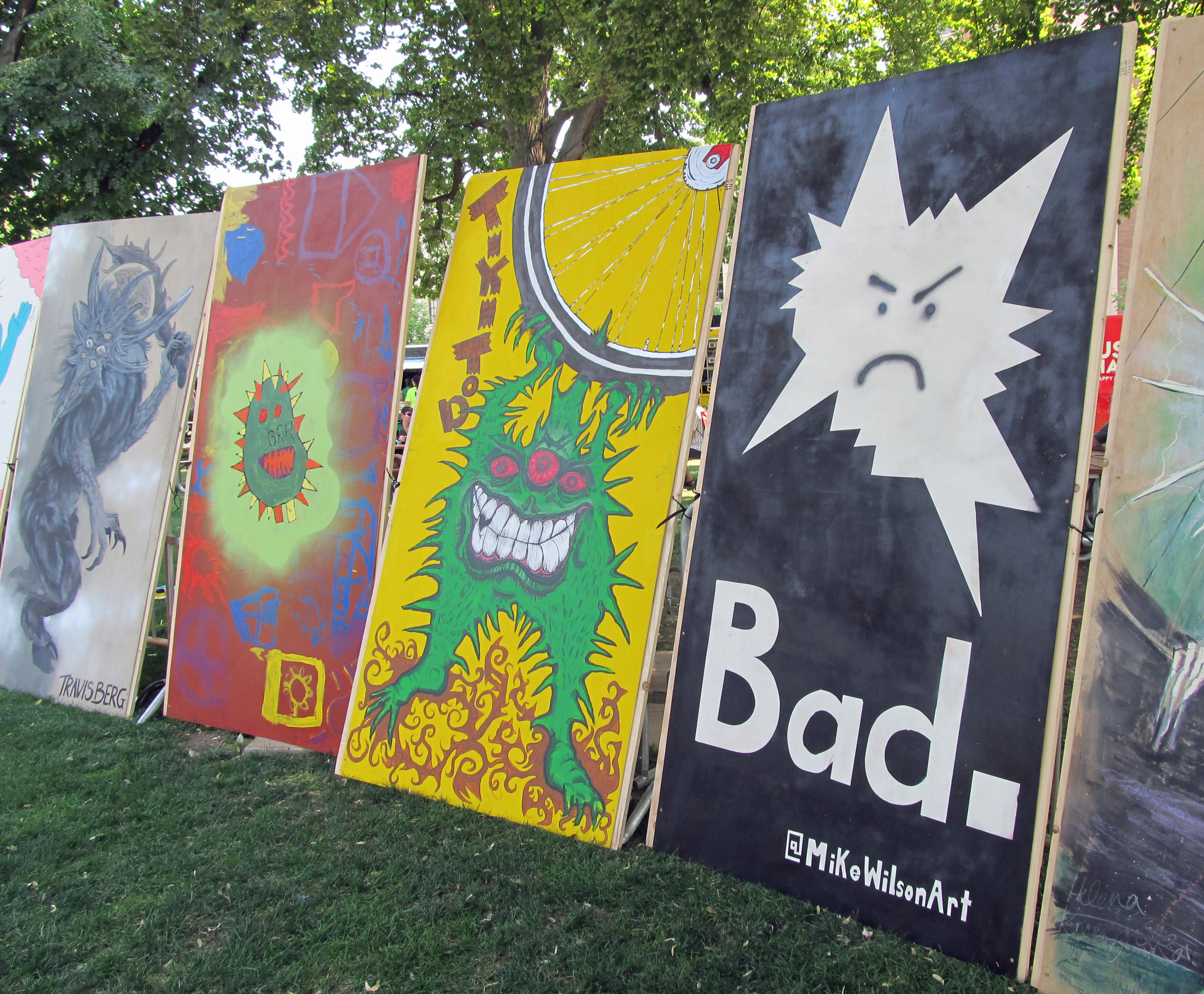
goathead art
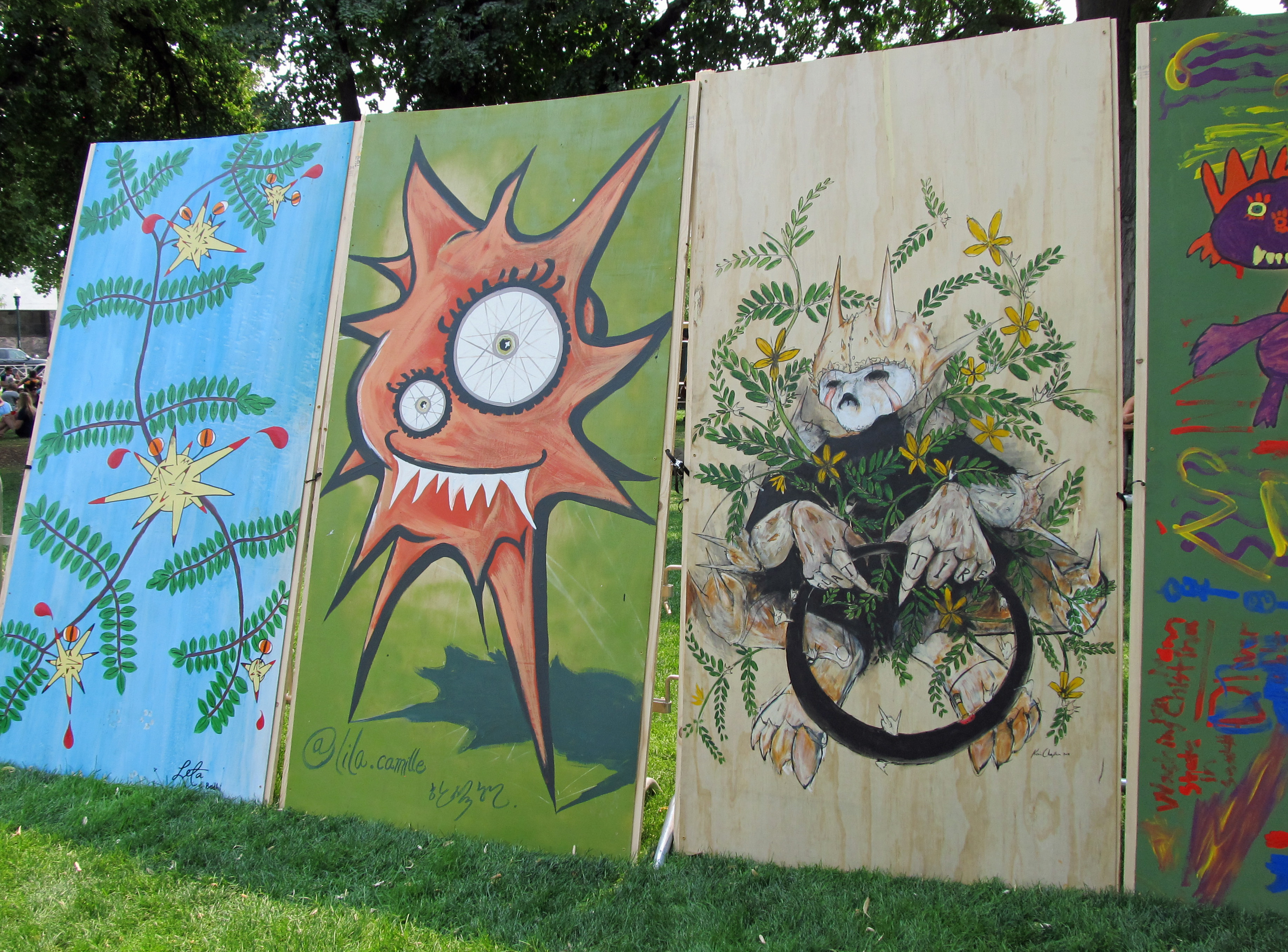
more goathead art
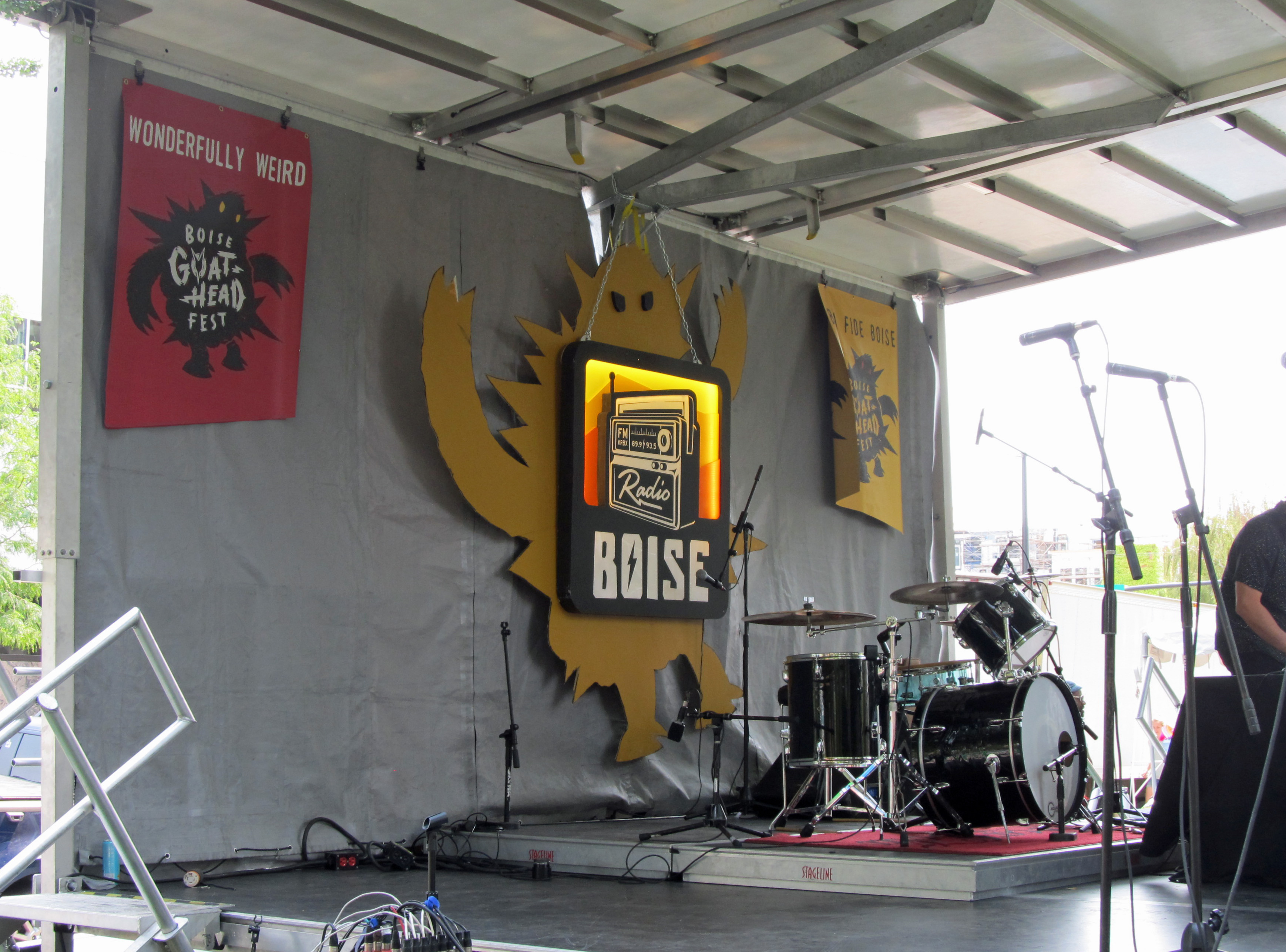
The goathead monster is center stage.
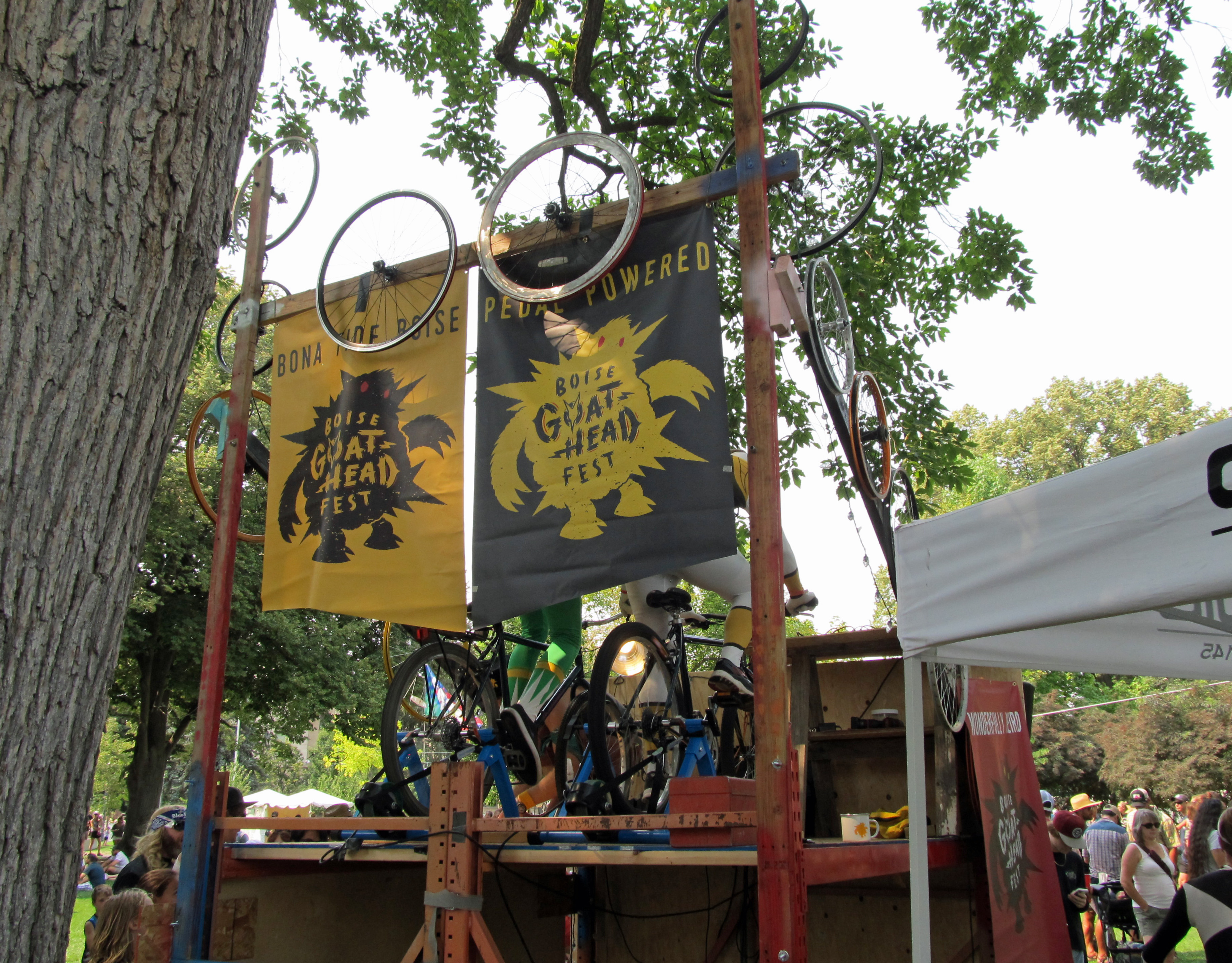
bicycle-powered stage
See Also: How to Identify Puncture Vine (a.k.a. the Goathead Monster)

Eating Weeds: Burdock

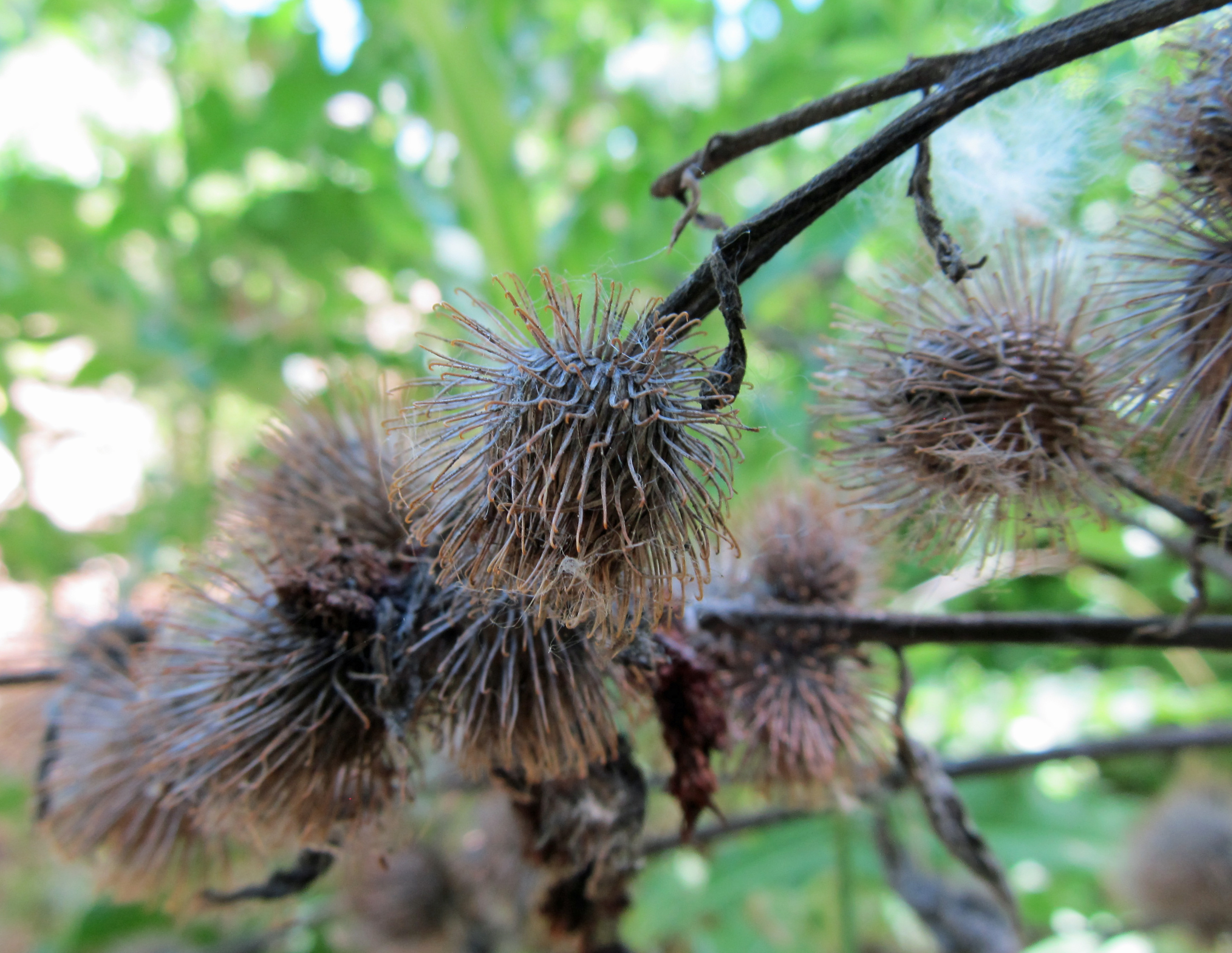
If we agree that weeds can be famous while simultaneously being infamous, a list of famous weeds must include burdock. Its fame largely comes from being an inspiration for the hook-and-loop fastener, Velcro. The idea for this revolutionary product came when Swiss inventor, George de Mestral, was removing burs – the dried inflorescences of burdock – from his dog in the early 1940’s. Most of us have experienced this, pulling out burs from animal hair or our own clothing, but few have felt inspired to develop a new product. Infamy reigns supreme.

But burdock’s fame isn’t tied to Velcro. Its tenacious, sticky burs, which house the seeds, have been attaching themselves to humans and other animals for centuries, frustrating those who have to remove them but finding new places to grow in the process. And what better way to pay tribute to this phenomenon than to dress oneself in hundreds of burs and parade around town calling yourself the Burry Man? Lest you think I’m crazy, just such a thing has been part of an annual celebration for over 300 years in a town outside of Edinburgh, Scotland.

burs of common burdock (Arctium minus)

Of course, burdock is more than its burs. Other, perhaps less celebrated features, are its edible roots and shoots. Its leaves are also edible, but most people find them too bitter to bother. Green Deane suggests wrapping the leaves around food to cook on a campfire. Both the roots and shoots can be eaten raw or cooked, and the fermented roots along with dandelion roots are traditional ingredients in the British beverage, dandelion and burdock. The roots, shoots, and leaves of burdock have also had a wide variety of medicinal uses.

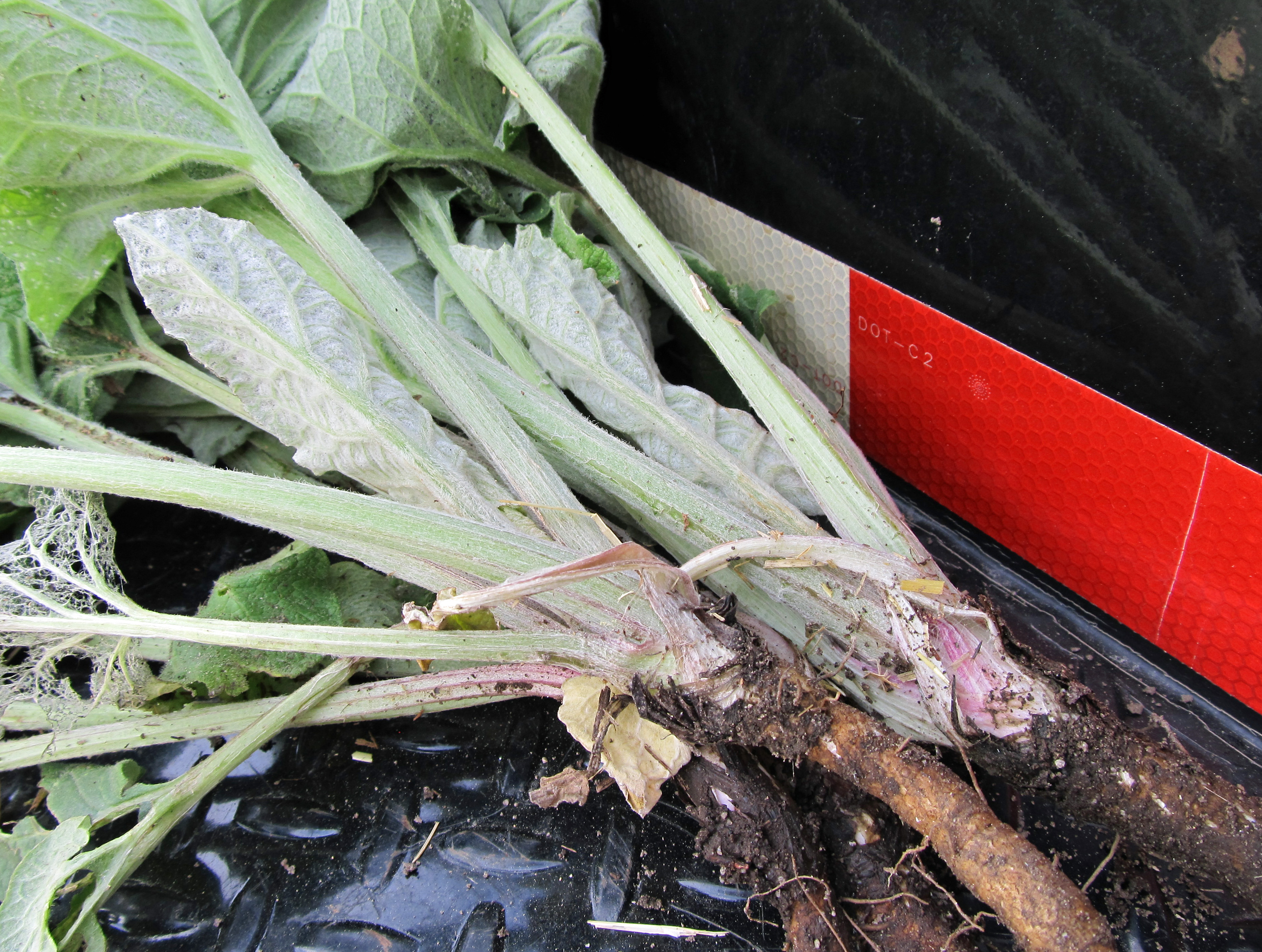
Two species of burdock have become naturalized in North America – Arctium minus and Arctium lappa. Both species are biennials or short-lived perennials. They start out as rosettes of large leaves with woolly undersides. The leaves grow to a foot or more long and wide. At this stage burdock is similar in appearance to rhubarb. Burdock has a large taproot, which can extend down to three feet in the ground. The taproot continues to grow as the rosette expands. When the plant has reached a certain size it begins to put up a branching flower stalk. It is in the rosette stage, before the plant bolts, that the taproot should be harvested.

As the flower stalk grows, the plant takes on a pyramidal shape, with the leaves along the stalk getting increasingly smaller with height. The plant can reach several feet tall, with one source describing them as towering up to ten feet. The stalks should be harvested before the plants start flowering. Multiple flower heads are produced at the ends of the branching stalk. The inflorescences are composed of purple, tubular, disc florets that are encased and encircled in a series of hooked bracts. The flower heads resemble thistle flowers, but the plant is easy to distinguish from thistles due to its large, soft leaves. Speaking of the leaves, one photographer found them alluring enough to compile a series of photos of them.

Common burdock (Arctium minus): the woolly undersides of the leaves and the tops of the taproots

While burdock can be nuisance plant, it is not particularly noxious. In The Book of Field and Roadside, John Eastman writes, “Burdock cannot be labeled a truly invasive weed, for it rarely intrudes into cultivated fields. Tilling usually controls and eradicates burdock populations. Its favored havens are the disturbed soils of roadsides, railroads, fence rows, vacant lots, and around sheds and old buildings.” In Wild Urban Plants of the Northeast, Peter Del Tredici also comments on burdock’s preference for minimally maintained locations including “vacant lots and rubble dump sites; the edges of emergent woodlands; the sunny borders of freshwater wetlands, ponds, and streams; and on unmowed highway banks and median strips with frequent salt applications.”

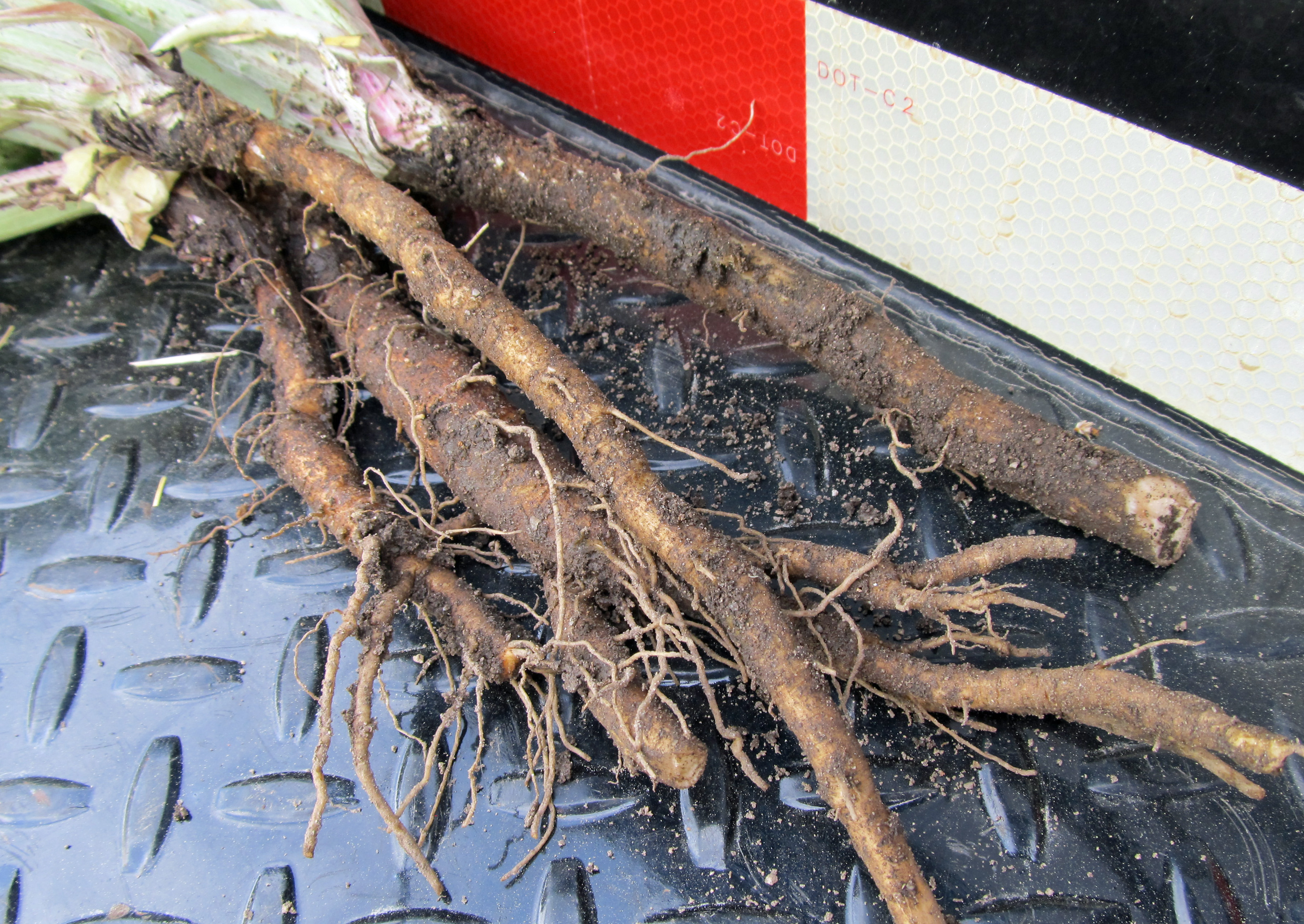
I harvested my burdock roots along an unmaintained fence line surrounding a series of raised flower beds. I chose a simple recipe for making burdock chips that involved peeling the roots, cutting them into thin slices, dressing them with olive oil and salt, and baking them in the oven. Since the author of this recipe mentioned buying burdock from a store, they were probably using Arctium lappa, or greater burdock, which is commonly cultivated, especially in Asian countries. Both species can be prepared in similar ways.

burdock roots

The burdock chips had a pleasant nutty flavor, but they were also a little stringy and tough to chew. If I were to do it again, I would probably use a recipe like this one that involves parboiling and then frying. Sierra suggested grating the roots and frying them in bacon grease, which would probably do the trick. There are also recipes for pickled burdock roots, which would be fun to try.

Because the plants I harvested were still in their rosette stage and there weren’t any other plants in the area that were bolting, I didn’t try the shoots. But I’ll keep my eye out, and when I find some I may have to write a part two.

Eating Weeds: Pineapple Weed

When I wrote about pineapple weed (Matricaria discoidea) last year during the Summer of Weeds, I knew that it was edible but I didn’t bother trying it. Pineapple weed is one of my favorite native weeds (yes, it happens to be a native of northwestern North America). I enjoy its sweet fragrance, its frilly leaves, its “petal”-less flowers, and its diminutive size. I also appreciate its tough nature. Now that I have tried pineapple weed tea, I have another thing to add to this list of pros.

pineapple weed (Matricaria discoidea)

One thing about pineapple weed that always impresses me is its ability to grow in the most compacted soils. It actually seems to prefer them. It is consistently found in abundance in highly trafficked areas, like driveways, parking lots, and pathways, seemingly unfazed by regular trampling. Referring to pineapple weed in one of his books about wildflowers, botanist John Hutchinson wrote, “the more it is trodden on the better it seems to thrive.” This is not something you can say about too many other plants.

Both the leaves and flowers of pineapple weed are edible. The flowers seem to be the more common of the two to consume, generally in tea form. In his book Wild Edible and Useful Plants of Idaho, Ray Vizgirdas writes, “A delicious tea can be made from the dried flowers of the plant. The leaves are edible, but bitter. The medicinal uses of pineapple weed are identical to that of chamomile (Anthemis). Used as a tea it is a carminative, antispasmodic, and mild sedative.” In Wild Urban Plants of the Northeast, Peter Del Tredici writes, “A tea made from the leaves has been used in traditional medicine for stomachaches and colds.”

I harvested my pineapple weed at the end of a dirt parking lot and in an adjacent driveway/pathway. I noted how the pineapple weed’s presence waned as I reached the edges of the parking lot and pathway where, presumably, the ground was less compact. Maybe it has more to compete with there – other weeds – and so it shows up less, or maybe its roots simply “prefer” compact soils. Perhaps a little of both. Once I got my harvest home, I rinsed it off and left it to dry. Later, I snipped off the flower heads and made a tea.

I probably used more water than I needed to, so it was a bit diluted, but it was still delicious. It smelled and tasted a lot like chamomile. Sierra agreed. With a little honey added, it was especially nice. Sierra agreed again. The flowers of pineapple weed can be used fresh or dried. They can also be mixed with other ingredients to make a more interesting tea, like the recipe found here.

If you are hesitant to take the leap into eating weeds, a tea may be the simplest thing you can try. Pineapple weed tea is a great way to ease yourself into it. Apart from maybe having to harvest it from strange places, it probably isn’t much different from other teas you have tried, and, from my experience, it’s delightful.

Book Review: A Feast of Weeds

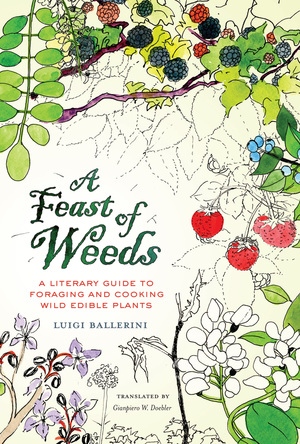
Since I am planning on eating more weeds, it seems appropriate that I review this book. Not to be confused with Feast of Weeds, a series of apocalyptic novels about a world-ending plague, A Feast of Weeds, by Luigi Ballerini is tangentially about foraging and cooking wild, edible plants. I say “tangentially” because it’s not like other foraging guides. This is a “literary guide,” as the subtitle states, so in the place of plant descriptions and harvesting tips, etc. are verbose and erudite essays summarizing the various literary references that each of the species profiled has accumulated from antiquity to the modern era. Apart from dozens of recipes, the information presented in this book is more entertaining than it is practical; however, when telling the stories of plants, the human element is an important facet – particularly in the stories of edible and medicinal plants – and it is the human element that this book is concerned with.

Ballerini is an Italian poet, a cooking historian, and a professor of Italian literature at UCLA. The 31 plant species he chose to profile can all be foraged in Italy (most of them in one specific region), and all except for maybe capers can be found somewhere in the United States. The majority of the plants in this book are commonly cultivated as crops, ornamentals, or landscape plants – few are truly weeds – but all of them can be found growing wild somewhere. And that’s one of Ballerini’s main points – wild food and the act of foraging is a very different experience from farmed food and the act of buying it at the grocery store. Take arugula for example:

Try making a salad with arugula that you have gathered yourself in a field and compare its taste with what you have made a hundred times with pre-washed and sterilized arugula bought at the supermarket or even at a farmers’ market. It’s easy to predict the comment that will immediately come to your lips: ‘There’s no comparison.’

A selection of recipes accompanies each of the plants that Ballerini writes about. These recipes were “invented or elaborated” by Ada De Santis, who lives on a farm in the “heel of Italy” and who “enthusiastically agreed to divulge the secrets of her kitchen.” Ballerini partnered with De Santis because of her Italian ancestry and her vast experience with both wild and cultivated plants.

Each chapter in the book follows the same basic format: a discussion of the myriad references a certain plant has received in various writings throughout human history, an overview of the (often bizarre) medicinal uses the plant has had throughout the centuries, and a brief statement on when to harvest the plant. References include plays, poems, songs, myths, fiction and non-fiction, religious and sacred texts, medicinal plant guides, and even artwork. Reading through the book, my interest and attention waned often, partly due to Ballerini’s way of writing and also due to my lack of familiarity (and lack of interest, frankly) with the references. But there were enough interesting bits here and there that made it worth the effort.

common mallow (Malva neglecta )

Of course, my interest was mainly held by the chapters about the weeds. Apparently, mallow (Malva spp.) has been written about prolifically, leading Ballerini to write, “the history of mallow is complex and contradictory, rich in illustrious testimony but, given its effects, not always very noble.” Like other plants in the book, the medicinal uses for mallow have been so numerous that it could be considered “a true cure-all,” if in fact it truly treated all the things it has been claimed to treat. On a humorous note, Ballerini writes in the chapter on wild fennel (Foeniculum vulgare), “we have come to understand … if a plant is good for you, it is good for nearly everything – but particularly for snakebite.”

Ballerini especially enjoys sharing odd medical claims, like in the chapter about sow thistle (Sonchus oleraceus), in which Nicholas Culpepper promoted some interesting uses for its juice. Purportedly, bringing it to a boil or “warming it in some bitter almond oil inside the skin of a pomegranate is a sure remedy for deafness and tinnitus.” The medicinal uses of wild chicory (Cichorium intybus) are “as old as the hills,” with a medical papyri from ancient Egypt (circa 1550 B.C.) referencing its medicinal uses among “magic formulas and spells for driving away evil-intentioned demons.”

sow thistle (Sonchus sp.)

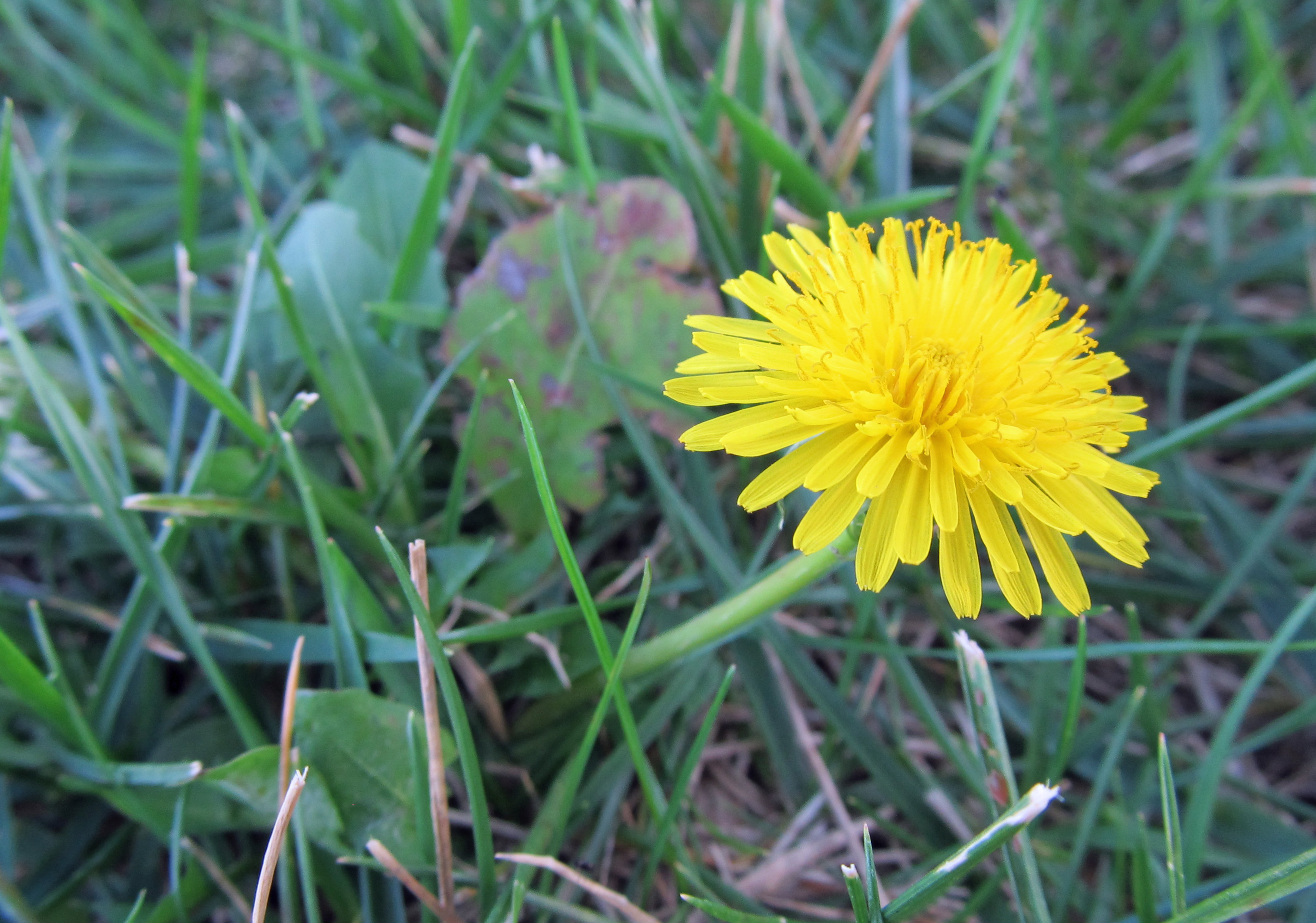
A couple of paragraphs about dandelion (Taraxacum officinale) find their way into the chapter about wild chicory. The rosettes of these two plants look similar, and the roots of both, when “roasted and ground, can be used as a substitute for coffee.” Dandelion is also known to be a diuretic, and is thus referred to as pisciailetto in Italy, pissenlit in France, and piss-a-beds in England.

Speaking of the names of things, how things came to be called what they are is a topic that Ballerini addresses frequently throughout the book. However, such origins aren’t always clear. In the chapter on wild raspberries (Rubus idaeus), Ballerini reflects on the “general uncertainty regarding the origin of the English term raspberry.” Does it originate from the Old French word rasper, the Spanish word raspar, and the Italian word raspare, all of which mean to rasp or to scrape? Ballerini laments, “this introduces very unpleasant connotations for such a delicate fruit (yet there are those who, when faced with roses always think of thorns).”

While the bulk of this book is of little use to me – I guess I’m just not that interested in classic literature or mythology – it’s worth keeping around for the recipes alone, several of which I am anxious to try. If the idea of an unconventional field guide appeals to you, this book might be up your alley, just as it apparently was for this reviewer.

Additional Book Reviews on Awkward Botany:

Eating Weeds: Lambsquarters

Last year during the Summer of Weeds I inadvertently wrote about several edible weeds, one of which I even ate. It’s not surprising that so many weeds are edible; there are plenty of plants out there – both native and introduced – that are, despite the fact that most of us stick with whatever is made available at the grocery store. Some edible weeds, dandelion included, were once commonly grown for food, while other weeds are close relatives of present day agricultural crops. The more I read about these things and the more my weeds obsession grows, the more I feel compelled to eat them (the edible ones, at least). Hence, a new series of posts: Eating Weeds.

I might as well start with an easy one. Chenopodium album, or lambsquarters, which I wrote about last summer, is a close relative of a number of common crops and a spitting image of quinoa. It happily grows alongside other plants in our vegetable gardens without even being asked to. It is highly nutritious and palatable – particularly the young leaves – and can be eaten raw or cooked. It is often compared to spinach and can be prepared and used in similar ways.

lambsquarters seedling (Chenopodium album)

For the purposes of this post, I decided to try lambsquarters pesto. While pesto is traditionally made using basil leaves, all kinds of other leaves – or combinations thereof – can be substituted. I have made pesto with parsley, which was interesting, as well as watercress, which was delicious. The possibilities are endless. So, why not lambsquarters?

Making pesto is incredibly simple. Blend together a combination of leaves, garlic, nuts or seeds, Parmesan cheese (or something similar), olive oil, salt, and pepper. Pine nuts are traditionally used to make pesto, but like the leaf component, a number of different nuts or seeds can be substituted. I rarely make pesto with pine nuts because, despite being delicious, they are pricey.

lambsquarters pesto

I made two batches of lambsquarters pesto. For the first I used walnuts, and for the second I used sunflower seeds. Both batches were delicious. How could they not be with all of that garlic and cheese in there? Lambsquarters is not a very bitter or strong-tasting green, so lambsquarters pesto might be perfect for anyone who is otherwise not fond of pesto (although that is a stance that I personally cannot fathom).

This is definitely something I will make again. I understand the frustration people have with lambsquarters. It can be prolific and hard to eliminate from a garden. Luckily, it makes an excellent pesto.

Resources:

———————

This series of posts was inspired in part by the book Dandelion Hunter, in which the author, Rebecca Lerner, attempts to go a full week eating only things she is able to forage in her hometown of Portland, Oregon. As you might imagine, many of the plants she forages are weeds.  

Highlights from the Western Society of Weed Science Annual Meeting

Earlier this month, I went to Garden Grove, California to attend the 71st annual meeting of the Western Society of Weed Science. My trip was funded by an Education and Enrichment Award presented by the Pahove Chapter of the Idaho Native Plant Society. It was a great opportunity for a weeds-obsessed plant geek like myself to hang out with a bunch of weed scientists and learn about their latest research. What follows are a few highlights and takeaways from the meeting.

General Session

Apart from opening remarks and news/business-y stuff, the general session featured two invited speakers: soil ecologist Lydia Jennings and historian David Marley. Lydia’s talk was titled “Land Acknowledgement and Indigenous Knowledge in Science.” She started by sharing a website called Native Land, which features an image of the Earth overlayed with known “borders” of indigenous territories. By entering your address, you can see a list of the tribes that historically used the land you now inhabit. It is important for us to consider the history of the land we currently live and work on. Lydia then compared aspects of western science and indigenous science, pointing out ways they differ as well as ways they can be used in tandem. By collaborating with tribal nations, weed scientists can benefit from traditional ecological knowledge. Such knowledge, which has historically gone largely unrecognized in the scientific community, should receive more attention and acknowledgement.

David Marley was the comic relief. Well-versed in the history of Disneyland, he humorously presented a series of stories involving its creation. Little of what he had to say related to weed science, which he openly admitted along the way; however, one weeds related story stood out. Due to a lack of funds, the early years of Tomorrowland featured few landscape plants. To make up for that, Walt Disney had signs with fake Latin names created for some of the weeds.

Weeds of Range and Natural Areas

I spent the last half of the first day in the “Weeds of Range and Natural Areas” session where I learned about herbicide ballistic technology (i.e. killing plants from a helicopter with a paintball gun loaded with herbicide). This is one of the ways that Miconia calvescens invasions in Hawaii are being addressed. I also learned about research involving plant debris left over after logging. When heavy amounts of debris are left in place, scotch broom (Cytisus scoparius) infestations are thwarted. There was also a talk about controlling escaped garden loosestrife (Lysimachia punctata) populations in the Seattle area, as well as a few talks about efforts to control annual grasses like cheatgrass (Bromus tectorum) in sagebrush steppes. Clearly there are lots of weed issues in natural areas, as that only covers about half the talks.

Basic Biology and Ecology

On the morning of the second day, the “Basic Biology and Ecology” session held a discussion about weeds and climate change. As climate changes, weeds will adapt and find new locations to invade. Perhaps some weeds won’t be as problematic in certain areas, but other species are sure to take their place. Understanding the changes that are afoot and the ways that weeds will respond to them is paramount to successful weed management. This means documenting the traits of every weed species, including variations between and among populations of each species, so that predictions can be made about their behavior. It also means anticipating new weed species and determining ways in which weeds might exploit new conditions.

No doubt there is much to learn in order to adequately manage weeds in a changing climate. An idea brought up during the discussion that I was particularly intrigued by was using citizen scientists to help gather data about weeds. Similar to other organizations that collect phenological data from the public on a variety of species, a website could be set up for citizen scientists to report information about weeds in their area, perhaps something like this project in New Zealand. Of course, there are already a series of apps available in North America for citizen scientists to report invasive species sightings, so it seems this is already happening to some degree.

Teaching and Technology Transfer

A highlight of the afternoon’s “Teaching and Technology Transfer” session was learning about the Wyoming Restoration Challenge hosted by University of Wyoming Extension. This was a three year long contest in which thirteen teams were given a quarter-acre plot dominated by cheatgrass with the challenge to restore the plant community to a more productive and diverse state. Each team developed and carried out their own strategy and in the end were judged on a series of criteria including cheatgrass and other weed control, plant diversity, forage production, education and outreach, and scalability. Preliminary results can be seen here; read more about the challenge here and here.

And so much more…

Because multiple sessions were held simultaneously, I was unable to attend every talk. I also had to leave early on the third day, so I missed those talks as well. However, I did get a chance to sit in on a discussion about an increasingly troubling topic, herbicide-resistant weeds, which included a summary of regional listening sessions that have been taking place in order to bring more attention to the subject and establish a dialog with those most affected by it.

One final highlight was getting to meet up with Heather Olsen and talk to her briefly about her work in updating the Noxious Weed Field Guide for Utah. This work was aided by the Invasive Plant Inventory and Early Detection Prioritization Tool, which is something I hope to explore further.

If you are at all interested in weeds of the western states, the Western Society of Weed Science is a group you should meet. They are fun and friendly people who really know their weeds.

See Also: Highlights from the Alaska Invasive Species Workshop 

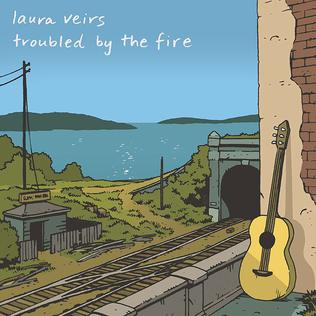
Botany in Popular Culture: Laura Veirs

I love music for its ability to conjure up emotions, create a mood, and inspire action. The music of Laura Veirs has always inspired me to get out into nature and be more observant of the wild things around me. Her music is rich with emotions, and I feel those, too. However, when I think of her music, I can’t escape images of the natural world and the creatures that inhabit it.

Found within her nature-centric lyrics are, of course, numerous botanical references. After all, plants and their actions make excellent subject matter for all types of art. And with that in mind, Veirs asks rhetorically in the song Rapture, “Doesn’t the tree write great poetry?”

When it comes to botanical references, the song that jumps first to mind is Lonely Angel Dust, starting off right away with these lyrics: “The rose is not afraid to blossom / though it knows its petals must fall / and with its petals fall seeds into soil / Why toil to contain it all? / Why toil at all?” Plants produce seeds in abundance, as mentioned in Shadow Blues: “Thousand seeds from a flower blowing through the night.” And, as in Where Are You Driving?, they’re seeking a suitable spot to plant themselves: “Through clouds of dandelions / seeds sailing out on the wind / hoping you’ll be the one to plant yourself on in.”


Flowers come up often in the songs of Laura Veirs. In White Cherry, “cherry trees take to bloom.” In Nightingale, “her heart a field in bloom.” In Make Something Good, “an organ pipe in a cathedral / that stays in tune through a thousand blooms.” In Sun is King, “innocent as a summer flower.” In Cast a Hook, “with watery cheeks down flowered lanes.” In Life Is Good Blues, “Messages you sent to Mars came from a crown of flowers.” Grass and weeds get a few mentions, too. In Summer Is the Champion, “let’s get dizzy in the grass.” In Life Is Good Blues, “tender green like the shoots of spring / unfurling on the lawn.”

Trees are the real stars, though. Veirs makes frequent references to trees and their various parts. This makes sense, as trees are real forces of nature. So much happens in, on, and around them, and images of the natural world can feel barren without them. First there is their enormousness, as in Black Butterfly, “evergreen boughs above me tower / were singing quiet stories about forgiveness, ” and Don’t Lose Yourself, “we slept in the shadow of a cedar tree.” Then there is their old age, as in Where Are You Driving?, “tangled up in the gnarled tree,” and When You Give Your Heart, “falling through the old oak tree.” There is also their utility, mentioned in Make Something Good, “I wanted to make something sweet / the blood inside a maple tree / the sunlight trapped inside the wood / make something good.” And then, of course, there is the fruit they bear, as in July Flame, “sweet summer peach / high up in the branch / just out of my reach,” and then in Wandering Kind, “a strange July / a storm came down / from the North and pulled out the salt / and it tore out the leaves from the pear tree / my canopy.”

Many of Veirs songs create scenes and tell stories of being in the wilderness among rivers, lakes, mountains, and caves. Chimney Sweeping Man, for example, is a “forest resident” who “walks[s] quiet through the forest like a tiny, quiet forest mouse.” In Snow Camping, Veirs tells a story about sleeping in a snow cave in the forest, where “a thousand snowflakes hovered,” “a distant songbird [was] singing,” and “the weighted trees” were her “only home.” But sometimes those forests burn, which is captured in Drink Deep: “Now the raging of the forest fires end / and all the mammals fled / I smell in the charred darkness / a little green / a little red.” Later in the song: “the fire closed his eyes / tipped his flame hat and slipped through the dire rye / we wandered romantic / we scattered dark branches / with singing green stars as our guide.”

Nature can also be empowering, and Veirs often refers to things in the natural world as metaphors or similes for the human experience. In Cast a Hook, Veirs adamantly asserts, “I’m not dead, not numb, not withering / like a fallen leaf who keeps her green.” This line comes up again in Saltbreakers: “You cannot burn me up / I’m a fallen leaf who keeps her green.” In Lake Swimming, Veirs addresses change and how some of life’s changes may wound us but we can still shine – “shucking free our deadened selves / like snakes and corn do / … / Old butterfly / I’ll dance with you / though our wings may crumble / we can float like ash / broken but the edges still shine.”


The botanical references Veirs makes in her songs are not the only things that excite me. Birds, insects, mammals, fish, and worms all find a place in Veirs’ lyrics. This is why, after more than a decade of listening to her songs, I find myself coming back to them again and again. There is a sort of kinship we feel for each other when we share in common a love of the natural world. I find that in the music of Laura Veirs.

More Botany in Popular Culture Posts:

Book Review: Good Weed Bad Weed

Distinguishing weeds from desirable plants is a skill that takes years of experience. If you’re not an avid gardener or a practiced naturalist, the distinction between the two groups may be blurry. There are weed identification guides aplenty, but even those aren’t always the most user-friendly and can often leave a person with more questions than answers. One of those questions may be, “Why is this plant considered a weed and not that one?” Through her book, Good Weed Bad Weed, Nancy Gift attempts to answer that question, offering much needed nuance to a regularly vilified group of plants.

In the introduction, Gift acknowledges that the term “good weed” sounds like an oxymoron. A weed, by definition, is an unwanted plant, an interloper and a troublemaker, without value or merit. What could be good about that? Gift, on the other hand, asserts that “it is a weakness of the English language that weeds are universally unwanted.” We need a word that describes plants that may have weedy characteristics but some redeeming qualities as well. For now, Gift uses “volunteer” – “a plant that comes up without being planted or encouraged” – suspending judgement until its performance can be fairly assessed.

Good Weed Bad Weed is a weed identification guide designed for beginners, for those wondering if their yard is “infested or blessed.” It is specifically concerned with weeds commonly found in lawns and garden beds, and “not meant to apply to farm fields or any other landscape.” It sets itself apart from other identification guides by organizing weeds into three categories: Bad Weeds, Not-So-Bad Weeds, and Good Weeds. Each plant profile includes a description, notes about benefits as well as problems, and some recommendations for control. Assigning good/bad designations to these plants is bound to cause some heated debate and outright disagreement, and Gift acknowledges that; however, we all have our “unique judgement” about the plants we encounter in our landscapes, so as “weed-lovers-in-training,” Gift hopes that we can “make a few new friends in the plant kingdom” and, perhaps, a few less enemies.

For the ten plants that make the Bad Weeds list, the reasoning is pretty clear. They are highly competitive and difficult to control [foxtail (Setaria spp.), garlic mustard (Alliaria petiolata), and Canada thistle (Cirsium arvense)], they are poisonous to humans despite being beneficial to wildlife [poison ivy (Toxicodendron radicans ) and poison hemlock (Conium maculatum)], they are known allergens and otherwise unattractive [common ragweed (Ambrosia artemisiifolia)], or, like Japanese knotweed (Fallopia japonica), they are on the list of top 100 worst invasive species.

The other two categories are where more personal judgement comes into play. The twelve plants considered Not-So-Bad Weeds are said to have “admirable qualities despite some negatives.” Prostrate knotweed (Polygonum aviculare) provides excellent erosion control. Orange hawkweed (Hieracium aurantiacum), bull thistle (Cirsium vulgare), and musk thistle (Carduus nutans) are quite beautiful and highly beneficial to pollinators and other wildlife. Nutsedge (Cyperus spp.) is edible and easy to keep in check if you stay on top of it. Bindweeds (Convolvulus arvensis and Calystegia sepium) avoid the Bad Weeds list because their flowers are so appealing. Aesthetics really matter to Gift, which is made clear with the entry for common fleabane (Erigeron philadelphicus), which could have made the Good Weeds list were it not for its disappointing and forgettable floral display.

field bindweed (Convolvulus arvensis)

As for the Goods Weeds list, more plant species find themselves in this category than the other two categories combined. That being said, those who have strong, negative opinions about weeds should probably avoid this section of the book, lest they experience an unsafe rise in blood pressure upon reading it. But be advised that making the Good Weeds list doesn’t mean that there are no negatives associated with having these plants in your yard; it’s just that the positive qualities tend to overshadow the negatives.

Positive qualities include edible, medicinal, low growing, slow growing, easy to control, beneficial to wildlife, not a bully, hardly noticeable, uncommon, and soil building. Certain weeds are desirable in lawns because they are soft to walk on, like ground ivy (Glechoma hederacea), yarrow (Achillea millefolium), and moss. Other weeds, like self-heal (Prunella vulgaris), stay green year-round and don’t leave ugly, brown patches when they die or go dormant. Still others, like bird’s-foot trefoil (Lotus corniculatus), black medic (Medicago lupulina), and clovers (Trifolium spp.) fix nitrogen, providing free fertilizer. Gift notes that, for those who keep chickens, weeds like common sorrel (Rumex acetosa) and cuckooflower (Cardamine pratensis) are great chicken feed.

Speaking of eating weeds, Gift concludes her book with four pages of recipes. The “Weedy Foxtail Tabouli” is particularly intriguing to me. Reading this book definitely requires an open mind, and some people simply won’t agree that any weed should ever be called “good.” Gift seems okay with that. She calls herself a “heretical weed scientist,” insisting that “a weed is in the eye of the beholder.” As “beholders,” I hope we can all be a little more like Nancy Gift.

A weedy lawn (photo credit: wikimedia commons)

More Book Reviews on Awkward Botany:

2017: Year in Review

Awkward Botany turns 5 years old this month! 

In the five years since I first introduced myself I have had the pleasure of sharing my writing and photos with thousands of people. Together we have formed a tiny community of nature lovers, botany nerds, and phytocurious folks. It has been fun seeing the audience grow and our interactions increase. The World Wide Web is a crowded and chaotic place, and you can never be sure what will come of the pieces of you that you throw at it. Luckily, my little project has not gone completely unnoticed. The crowd that enjoys it may be small, but it is composed of a solid group of people. Thank you for being one of those people.

If you were following along in 2017, you are well aware that weeds and invasive species have been regular themes. Both of these topics are still obsessions of mine, so while I don’t have plans to continue to saturate the blog with such posts, I will still be writing about them. I’m actually working on a larger project involving weeds, which you can read more about here.

Speaking of which, I have threatened a couple of times now to interrupt my weekly posting schedule in order to make time for other projects. So far that hasn’t really happened, but this year I am fairly certain that it will. It’s the only way that I am going to be able get around to working on things I have been meaning to work on for years. There are also some new things in the works. I think these things will interest you, and I am excited to share them with you as they develop. Once you see them for yourself, I’m sure you’ll forgive the reduced posting schedule.

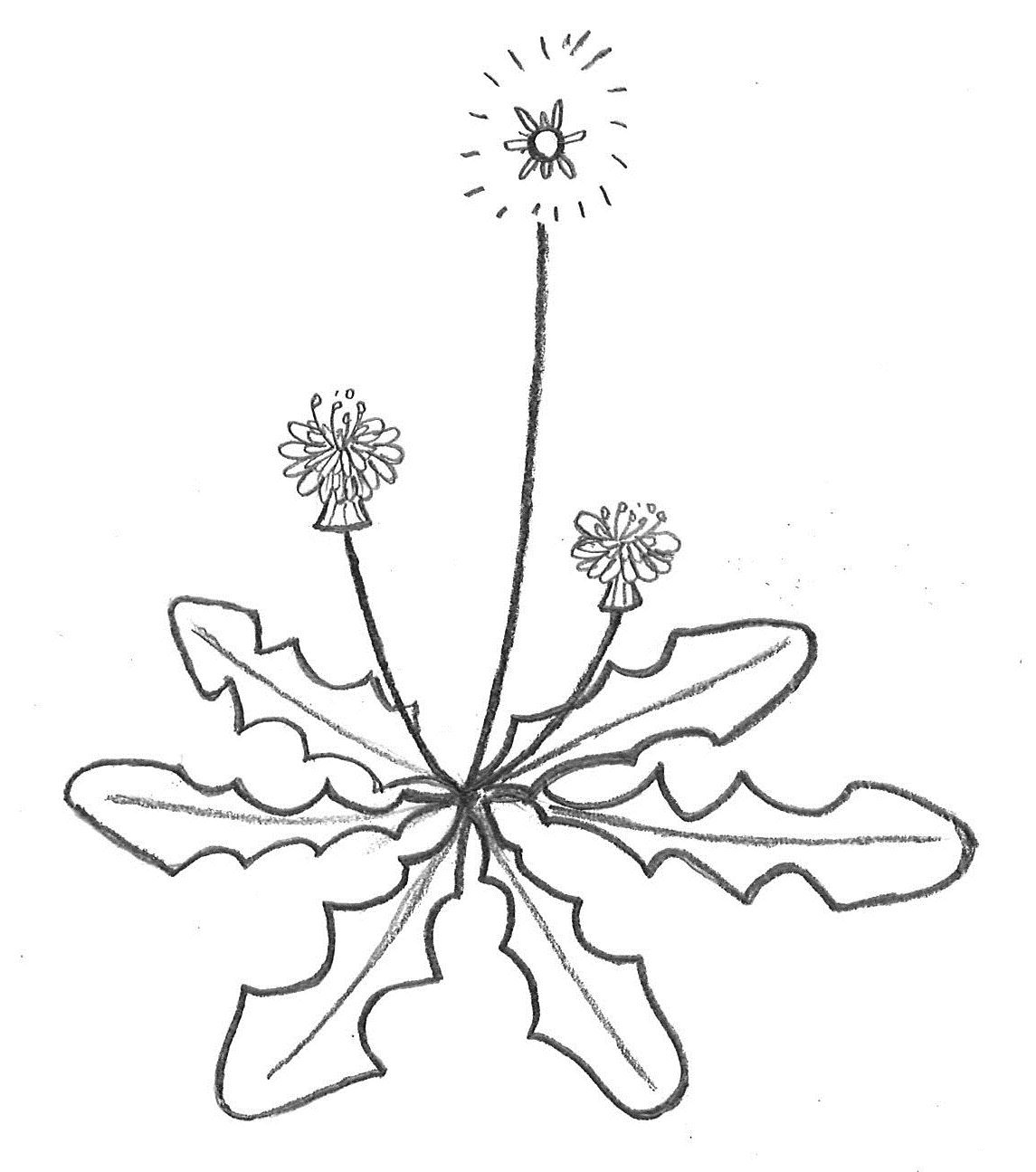
One thing I have resolved to do this year is learn to draw. I love botanical illustrations, and I have always been envious of the artistic abilities of others. My drawing skills are seriously lacking, but a little practice might help improve that. While it is bound to be a source of embarrassment for me, I have decided to post my progress along the way. So even if you have less to read here, you will at least get to check out some of my dumb drawings. Like this one:

Drawing of a dandelion with help from Illustration School: Let’s Draw Plants and Small Creatures by Sachiko Umoto

One of my favorite things this year has been Awkward Botany’s new Facebook page. With Sierra’s help, we have finally joined that world. Sierra has been managing the page and is the author of most of the posts, and she is doing an incredible job. So if you haven’t visited, liked, and followed, please do. And of course, the invitation still stands for the twitter and tumblr pages, as well.

Lastly, as I have done in the past I am including links to posts from 2017 that were part of ongoing series. These and all other posts can be found in the Archives widget on the right side of the screen. During the summer I did a long series about weeds called Summer of Weeds, the conclusion of which has a list of all the posts that were part of that series. Thank you again for reading and following along. Happy botanizing and nature walking in 2018. I hope you all have a plant filled year.

Book Reviews:

Podcast Review:

Poisonous Plants: 

Drought Tolerant Plants:

Field Trips:

Guest Posts:

Book Review: Grow Curious

In the early 2000’s when I was really getting excited about learning how to garden, one of the first resources I turned to was a website called You Grow Girl by Gayla Trail. I probably saw it mentioned in a zine about gardening. Something about it felt very punk rock. Trail’s site was different than other resources, and it spoke to the anti-authoritarian, non-conformist in me. Reading through the About page today, Trail’s punk rock spirit hasn’t waned, and I can see why her site appealed to me.

Now with well over two decades of gardening experience to draw from, Trail continues to run her site, has written five books (including one called You Grow Girl), and her “contemporary, laid-back approach” to gardening remains essentially the same. In her words, she “places equal importance on environmentalism, style, affordability, art, and humour.” Her “aim has always been to promote exploration, excitement, and a d.i.y approach to growing plants without the restrictions of traditional ideas about gardening.” We share these sentiments, which is why when I learned of her most recent book, Grow Curious, I knew I needed to read it.

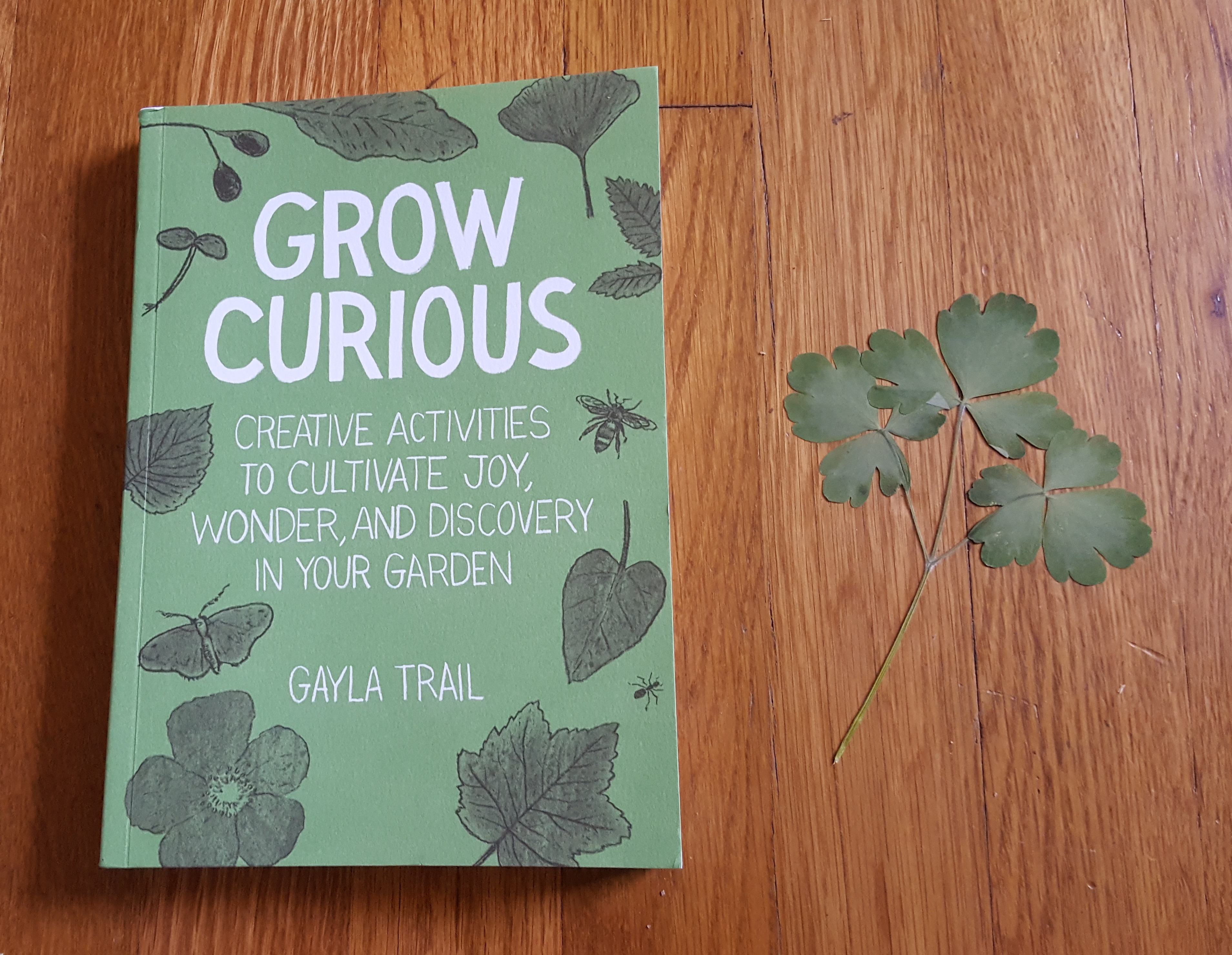
Grow Curious by Gayla Trail accompanied by a pressed leaf from Trail’s garden.

Grow Curious is an activity book for gardeners of all ages, backgrounds, and skill levels. It diverges from most books about gardening in that it is not a how-to or a what-to-plant-where guide. It is instructional, but only in ways that are less about getting our chores done and more about helping us explore our gardens in order to see them in a new light and open our eyes to the remarkable world that is right outside our door – a world often overlooked because we have work to do. Trail’s book is also meant to reinvigorate any of us that may be a bit disillusioned by the act of gardening – having misplaced our spark along the way, lost in the drudgery of it all. It’s about stopping for a minute, looking around, and seeing things we maybe haven’t noticed before but that have been there all along.

Because Grow Curious is a compilation of garden activities (“an invitation to play”) interspersed with prose, there is no need to consume it chronologically. Activities can be done in order or chosen at random. They can be skipped altogether or done at different times of the year. The book, however, is organized by season, starting in spring and ending in winter. In this way, the story of the birth and death of the garden is told, a polarity that Trail reflects on throughout the book. In the introduction to “Fall,” she writes of the growing season coming to a close and the garden becoming “a scene of decay.” The garden’s death can help us come to terms with other deaths, including our own. On a brighter side, the return of spring can bring a newfound sense of “hope, transformation, and optimism;” along with “the energy of renewal.”

Botanical rubbings – one of dozens of creative, garden activities found in Grow Curious by Gayla Trail

The bulk of this book is a series of activities that are meant to, as the subtitle proclaims, “cultivate joy, wonder, and discovery in your garden.” In general, the instructions are minimal – a short paragraph or two; a single sentence followed by a list of things to observe or do. In this way, you have the freedom to explore and make things up as you go, without worrying about rules or whether or not you are doing it right. Activities include touching an insect, observing the shapes of leaves and stems, smelling soil, taking pictures from new and unusual angles, visiting your garden in the dead of night, et cetera. Some activities are more involved, like raising a caterpillar or researching something to death. Other activities require little effort, like pulling up some plants to see what color their roots are or tasting an edible plant part that you have never tasted before. To facilitate advanced exploration, many of the activities include ideas or ways to “Go Further.”

Among the pages of activities are Trail’s musings on gardening and life (as it relates to gardening), and I found these to be equally intriguing.  Like her thoughts on fear and insecurity: “I was inexperienced and uncertain, full of my own fears and excuses.” And her “balanced” view on pests in the garden: “Since our insect partners often depend on the so-called bad guys, it turns out that a balanced garden needs both.” Her encouragement to observe the differences between wild plants and weeds that grow within and beyond the borders of our gardens, and her plea for us to “invite wildness” in, noting the “knotty labyrinth” that exists between “wild” and “cultivated” – “social constructs that we place in opposition to each other.”

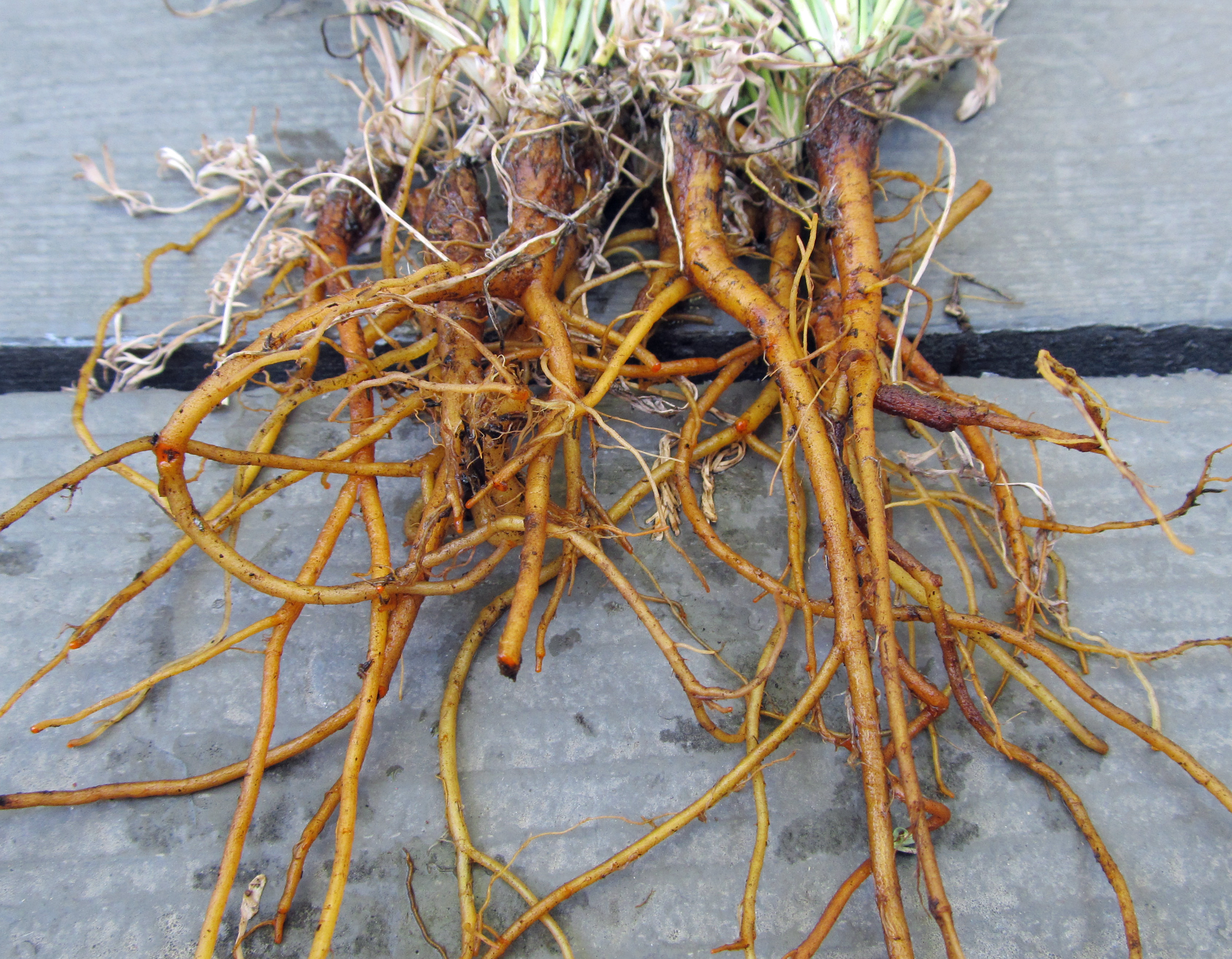
Orange roots of California poppy (Eschscholzia californica). “As you’re digging up, moving around, and planting out new crops, trees, bushes, and perennials this fall, take note of plants that have colourful roots.” — Gayla Trail

If you have been following Awkward Botany for a while, you can probably see why this book is right up my alley. If you enjoy reading Awkward Botany, this book should be right up your alley, too.