
To understand the current state of rangeland wildfires in the Intermountain West, you must first familiarize yourself with a plant commonly referred to as cheatgrass. This annual grass moved into the region over a century ago, and its spread has had a massive impact on the environment, as well as the economy and our way of life. Just the very mention of cheatgrass in the West will get some people’s blood boiling. It’s a menace, a scourge, a pest, and yet it’s here to stay. It’s a result of us being here, yet somehow it’s the invader. Its success is largely due to the way we’ve chosen to operate in this region, yet it’s the one to blame for our troubles. When you really start to learn about this plant, it’s hard not to develop an appreciation for it, despite the tragic ways in which it has shaped our region for the worse. It’s not a plant that is showy or grandiose in any significant way. Everything about its appearance screams for it to be dismissed and overlooked, yet it’s story – at least here in the American West – is larger than life.

Bromus tectorum goes by more than a dozen common names, but the ones you tend to hear most often are downy brome and cheatgrass. Downy because of how fuzzy its leaf blades can be and cheat because its presence on wheat farms cheats farmers of their yield. It is distributed widely across Europe, eastern Asia, and northern Africa where it originates, and was introduced to North America in the mid-19th century. How and why it got here isn’t totally clear. It likely had multiple introductions, both as a contaminant in seeds and attached to fur, clothing, packaging materials, etc., as well as intentionally as a forage crop for livestock. Regardless, it managed to establish readily in the east and then quickly spread across the country, spanning the continent by the early 20th century. It found the Great Basin particularly habitable due to its hot, dry summers and cold, wet winters and largely treeless landscape.
Apart from the climate, a significant factor behind cheatgrass’s establishment in the Intermountain West are all the cows. For a number of reasons, the Great Basin isn’t really suitable for largescale farming operations, but livestock grazing is another story. Many of the animals native to the region are grazing animals after all, so why not graze cattle and sheep? But there is a limit. Too many animals stuck in one spot for too long leads to overgrazing, and overgrazed sites take time for the native vegetation to recover. Cheatgrass exploits this opportunity by establishing itself quickly in disturbed and overgrazed locations and begins the process of outcompeting nearby plants for limited water and nutrients. Once it begins to dominate these sites, it has another trick up its sleeve.
Cheatgrass actually makes good forage for livestock early in the spring when it’s green and tender, but that quickly changes as the plants start to dry out and go to seed. By early summer, cheatgrass has completed its lifecycle and what’s left is a dried-up plant that, due to the silica in its cells, does not break down readily. Where cheatgrass is abundant, this means large swaths of standing brown grass as far as the eye can see. What’s more, this dead vegetation is highly flammable, and the slightest spark can set off a roaring blaze that moves quickly across the landscape, igniting everything in its path. In a region where fires once occurred decades apart, they now occur on a nearly annual basis. And because fire had been historically infrequent, the native vegetation is not adapted to regular fire and can take years to recover, whereas cheatgrass bounces right back, again exploiting the void left by the decimation of native plants and is flowering again the following spring. It’s a self-perpetuating cycle, and cheatgrass excels at it.

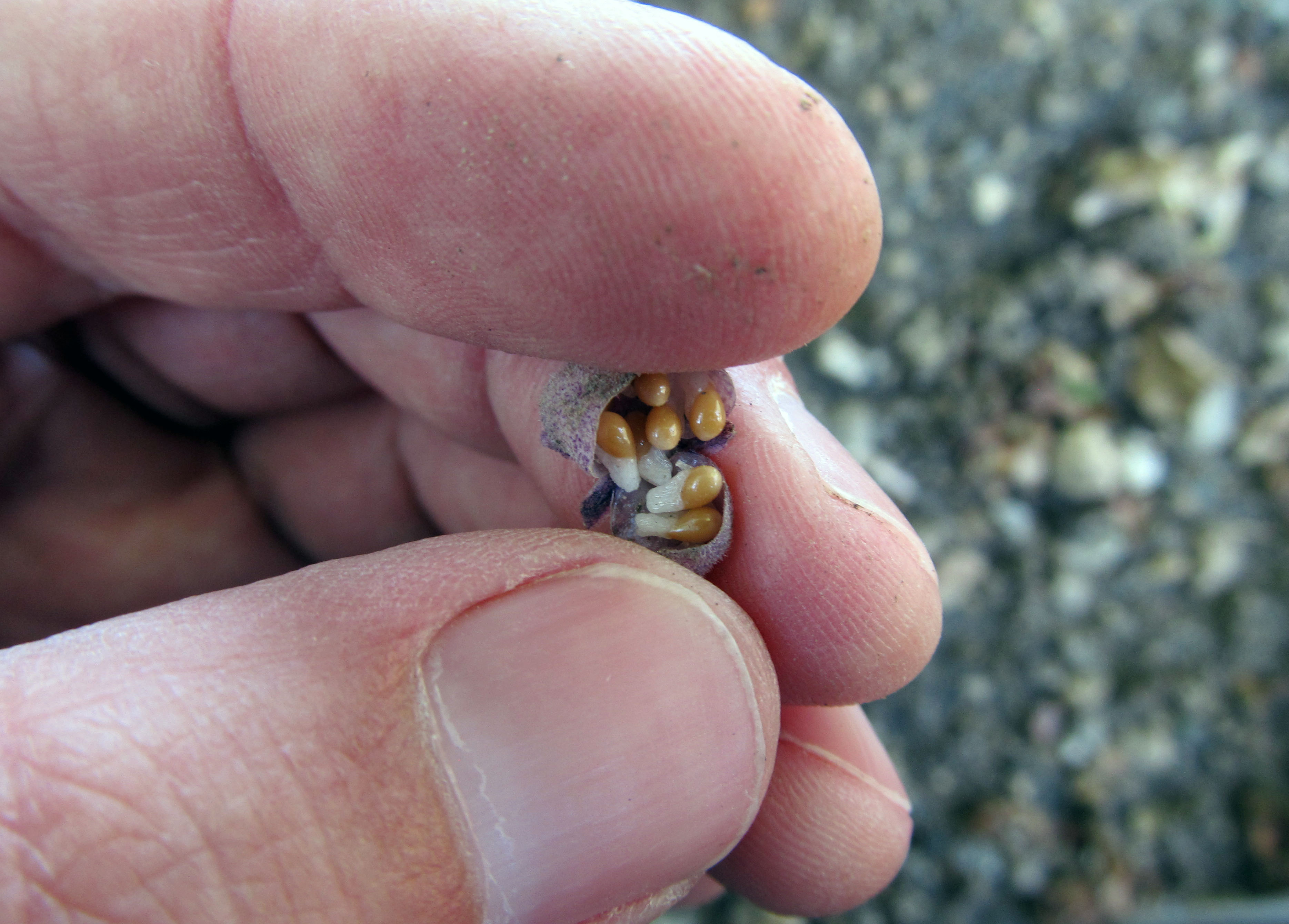
Cheatgrass is a winter annual, meaning that it germinates in the fall as soon as moisture becomes available. It then lies mostly dormant, its shallow, fibrous roots still growing as long as the ground isn’t frozen. Employing this strategy means cheatgrass is ready to resume growth at a quick pace as soon as the weather warms in the spring. Its roots spread horizontally in the soil and essentially rob water from nearby, more deeply rooted native vegetation. Its deep green, hairy leaves form a little tuft or rosette and provide early spring forage for livestock, gamebirds, and other grazing animals. As the spring progresses flower stalks form and the plants reach heights of around 2 feet (60 centimeters). Their inflorescence is a prominently drooping, open panicle and each spikelet has between 4-8 florets, each with a single, straight awn. The flowers of cheatgrass are cleistogamous, which means they don’t ever open. Self-pollination occurs inside the closed floret, and viable seeds soon develop. As the plant matures, it takes on a purple-reddish hue, after which it turns crispy and light brown as the seeds disperse.
The stiff awns remain on the seeds and aid in dispersal. They also cause injury to animals that dare consume them, poking into the soft tissues of their mouths. Passing animals are also injured when the awns work their way into their feet, ears, and other vulnerable body parts. The ability of the awns to attach so easily to fur and clothing is one of the reasons why cheatgrass spreads so readily. Wind also helps distribute the seed. A single plant can produce hundreds, if not thousands, of seeds, which are ready to germinate upon dispersal. They remain viable in the soil for only a few short years, but since they germinate so easily and are produced so abundantly, their short lifespan isn’t much of a downside.
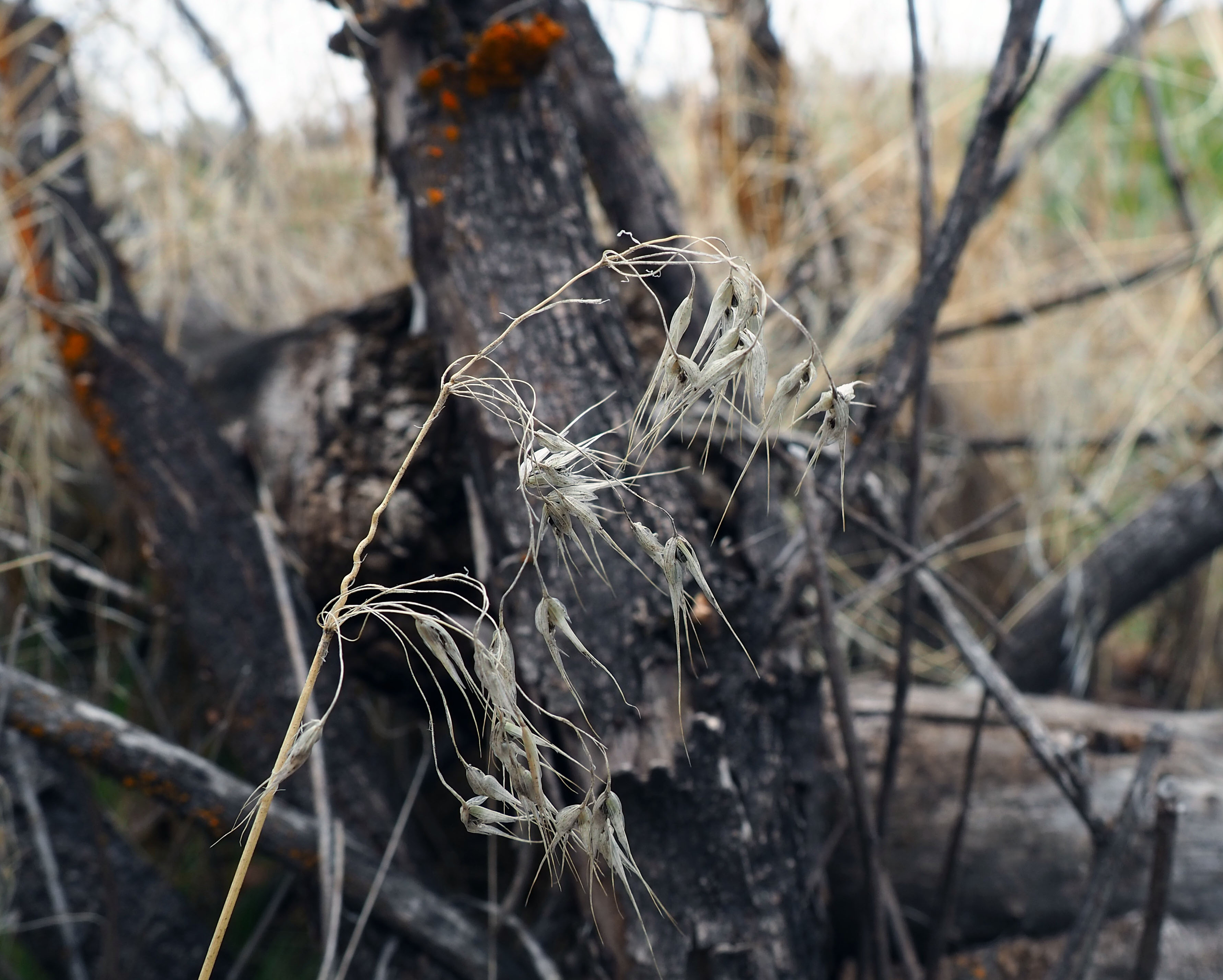
In many ways, cheatgrass is the perfect weed. It is able to grow under a broad range of conditions. Its seeds germinate readily, and the plant grows during a time when most other plants have gone dormant. It excels at capturing water and nutrients. It self-pollinates and produces abundant viable seed, which are reliably and readily dispersed thanks to persistent awns. Disturbed areas are ripe for a plant like cheatgrass, but even nearby undisturbed areas can be invaded as seeds are dispersed there. With the help of fire, cheatgrass also creates its own disturbance, which it capitalizes on by then growing even thicker, more abundant stands with now even less competition from native vegetation. And because it is available so early in the season and is readily consumed by livestock and gamebirds, what motivation is there for humans to totally replace it with something else? As James Young and Charlie Clements ask in their book, Cheatgrass, “How can we come to grips with the ecological and economic consequences of this invasive alien species that can adapt to such a vast range of environmental conditions?” In another section they lament, “cheatgrass represents a stage in transition toward an environment dominated by exotic weeds growing on eroded landscapes.”
The topic of cheatgrass and other introduced annual grasses, as well as the even broader topic of rangeland wildfires, is monstrous, but it is one that I hope to continue to cover in a series of posts over the coming months and years. It’s not an easy (or necessarily fun) thing to tackle, but it’s an important one, especially for those of us who call the cheatgrass sea our home.
Check out the linktree for various ways to follow and support Awkward Botany.

 awkward botany