Winter Trees and Shrubs: Sweetgum

Sweetgum is a distinctive tree at any time of year. It stands out among most other deciduous trees with its excurrent growth habit, which gives it a narrowly conical or pyramidal shape. Only in its advanced age does it begin to develop a more rounded and irregular form. Its leaves are star-shaped with either five or seven lobes and span between four and seven inches. Their glossy green color gives way to a wide range of colors in the fall, including yellow, orange, red, and maroon, remaining on the tree for several weeks depending on weather conditions. The fruits are particularly distinct, especially in the winter after the leaves have dropped. Woody balls made up of a series of capsules with pointed beaks hang from long stalks throughout the winter, windborne seeds having been released from small openings in the fall. Without even bothering to look at the twigs, seeing these durable, spiky balls hanging from branches (or feeling them under your feet) is a quick indication that you are looking at a sweetgum.

one of many fall colors found on sweetgum (Liquidambar styraciflua)

Liquidamabar styraciflua (one of the funnest botanical names to say) was previously placed in the family Hamamelidaceae but is now one of the few members of Altingiaceae. Its natural distribution is broad, covering a large portion of the eastern United States and west into Missouri then down into Texas, Mexico, and much of Central America. Outside of its natural range it has been widely planted as an ornamental, and there are several popular sweetgum cultivars currently in cultivation. Both the common and botanical names for this tree refer to the resin found in its bark, which historically has had many uses.

The winter twigs of sweetgum are stout, round, smooth, and yellow-brown to green or olive-green to brown-purple in color. They can also be glossy and feature a few scattered lenticels. Older twigs (or branchlets) are brown at first and then light grey with dark grey lenticels. They are occasionally adorned with corky wings similar to those of bur oak. Because the wings aren’t always present, it can be a fun thing to encounter when you are out looking at twigs.

corky wings on the branchlets of sweetgum

The winter buds of sweetgum twigs are egg-shaped and made up of bud scales with acute tips and ciliate margins. They are green to orange-brown or reddish in color and occasionally sticky. Lateral buds are alternately arranged, are much smaller than terminal buds, and are stalkless and flattened against the twig. They sit above a slightly raised leaf scar that is half-elliptical to triangular in shape and has three distinct vascular bundle traces. The pith of sweetgum twigs is solid, continuous, brownish, and irregularly shaped.

winter twig of sweetgum tree

Sweetgum bark is light to dark grey and is made up of a series of rough, vertically arranged, scaly ridges that become deeply furrowed with age. The mace-like fruits of sweetgum are about one inch wide and, at a glance, are similar in appearance to the seed balls of sycamore trees; however, sycamore seed balls easily break apart when compressed, while the pointed, woody capsules that make up a sweetgum ball are held firmly together and can hold their shape for long periods of time. When these “gumballs” collect on the ground below, they can become a hazard, especially where there is lots of foot traffic. Speaking from experience, they are also obnoxious when operating a mower. This polarizing feature has resulted in bad opinions of the sweetgum tree. Luckily, some people are out there defending it.
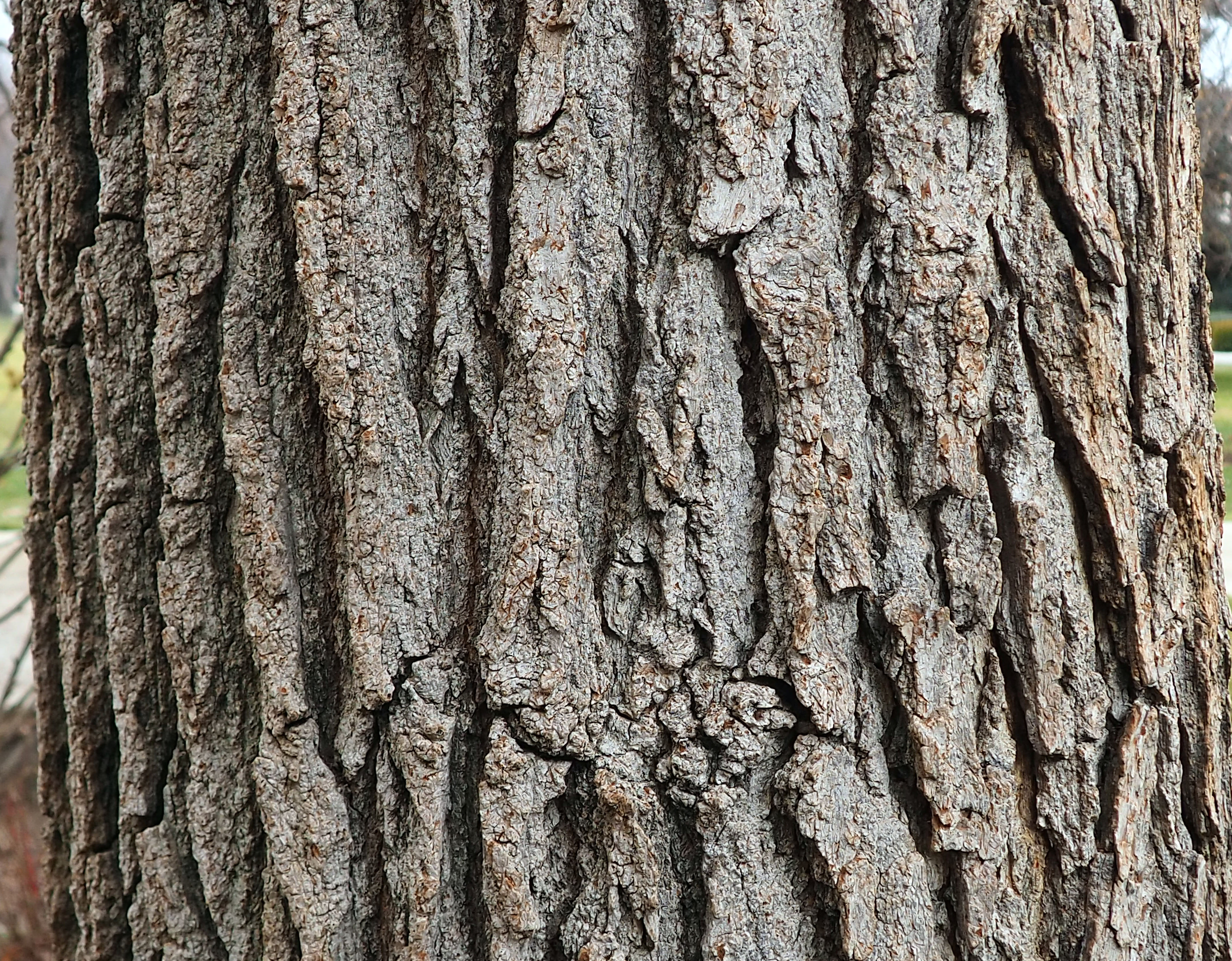
sweetgum bark
the persistent fruits of sweetgum

More Winter Trees and Shrubs:

Winter Trees and Shrubs: Northern Catalpa

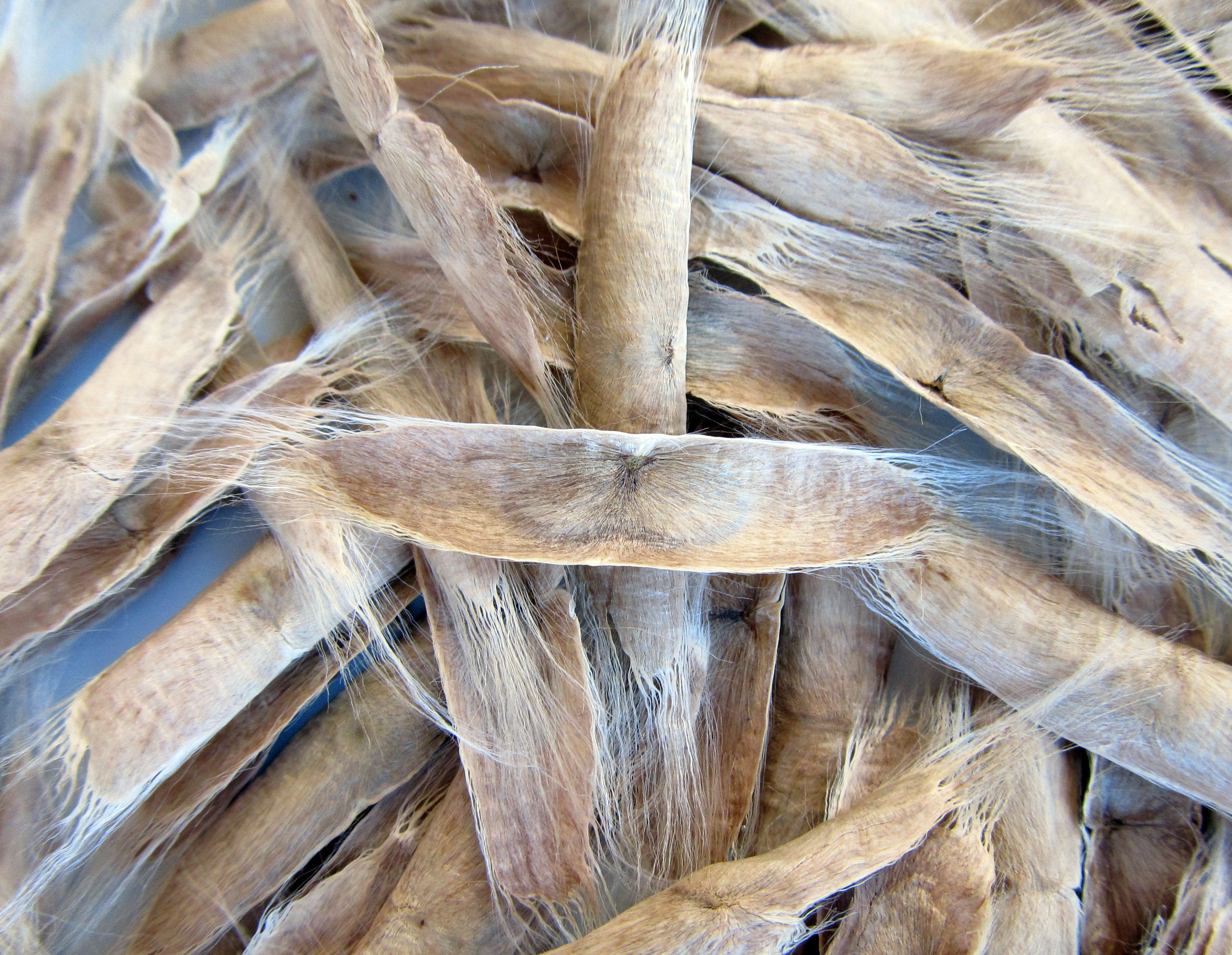
The names of plants often contain clues that can either help with identification or that tell something about the plant’s history or use. The name, catalpa, is said to be derived from the Muscogee word, katałpa, meaning “winged head,” presumably referring to the tree’s winged seeds. Or maybe, as one writer speculates, it refers to the large, heart-shaped, floppy leaves that can make it look like the tree is “ready to take flight.” Or perhaps it’s a reference to the fluted, fused petals of the tree’s large, tubular flowers. I suppose it could mean any number of things, but I’m sticking with its seeds, which are packed by the dozens in the tree’s long, slender, bean-like fruits. The seeds are flat, pale brown, and equipped with paper thin, fringed appendages on either side that assist in wind dispersal – wings, in other words.

winged seeds of northern catalpa (Catalpa speciosa)

Catalpa speciosa, or northern catalpa, is a relatively fast growing, short-lived tree native to the Midwest and one of only two species in the genus Catalpa found in the United States. Its distribution prior to the arrival of Europeans appears to have been restricted to a portion of the central Mississippi River valley, extending west into Arkansas, east into Tennessee, and north into Illinois and Indiana. It has since been widely planted outside of its native range, naturalizing in areas across the Midwest and eastern US. Early colonizers planted northern catalpa for use as fence posts, railroad ties, and firewood. Its popularity as an ornamental tree is not what it once was a century ago, but it is still occasionally planted in urban areas as a shade tree. Its messiness – littering the ground below with large leaves, flowers, and seed capsules – and its tendency to spread outside of cultivation into natural areas are reasons why it has fallen out of favor with some people.

The oval to heart-shaped, 8 to 12 inch long leaves with long petioles rotting on the ground below the tree are one sure sign that you’ve encountered a catalpa in the winter time. The leaves are some of the first to fall at the end of the growing season, briefly turning an unmemorable yellow before dropping.

leaf of northern catalpa (Catalpa speciosa) in the winter with soft hairs on the underside still visible

The leaf arrangement on northern catalpa is whorled and sometimes opposite. The twigs are easy to identify due to several unique features. They are stout, round, and grayish brown with prominent lenticels. The leaf scars are large, rounded, and raised up on the twig, looking a bit like little suction cups. They are arranged in whorls of three, with one scar considerably smaller than the other two. A series of bundle traces inside the scar form an ellipse. The leaf buds are tiny compared to the scar and are protected by loose, pointed, brown bud scales. Northern catalpa twigs lack a terminal bud. In the winter, seed capsules or the stalk of an old inflorescence often remain attached to the terminal end of the twig. The pith inside of the twig is thick, white, and solid.

twig of northern catalpa (Catalpa speciosa)

pith inside twig of northern catalpa (Catalpa speciosa)

Another common name for Catalpa speciosa is cigar tree, a name that comes from its up to 18 inch long, cigar-like seed capsules that hang from the otherwise naked tree throughout the winter. The sturdy, cylindrical pod starts out green in the summer and turns dark brown by late fall. Seed pods that haven’t fallen or already split open will dehisce in the spring time, releasing their papery seeds to the wind.

fruits of northern catalpa (Catalpa speciosa) hanging from the tree in the winter

The young bark of northern catalpa is thin and easily damaged. As it matures, it becomes furrowed with either scaly ridges or blocky plates. Mature trees are generally twisted at the base but otherwise grow straight, reaching 30 to 60 feet tall (sometimes taller) with an open-rounded to narrow-oval crown.

maturing bark of northern catalpa (Catalpa speciosa)

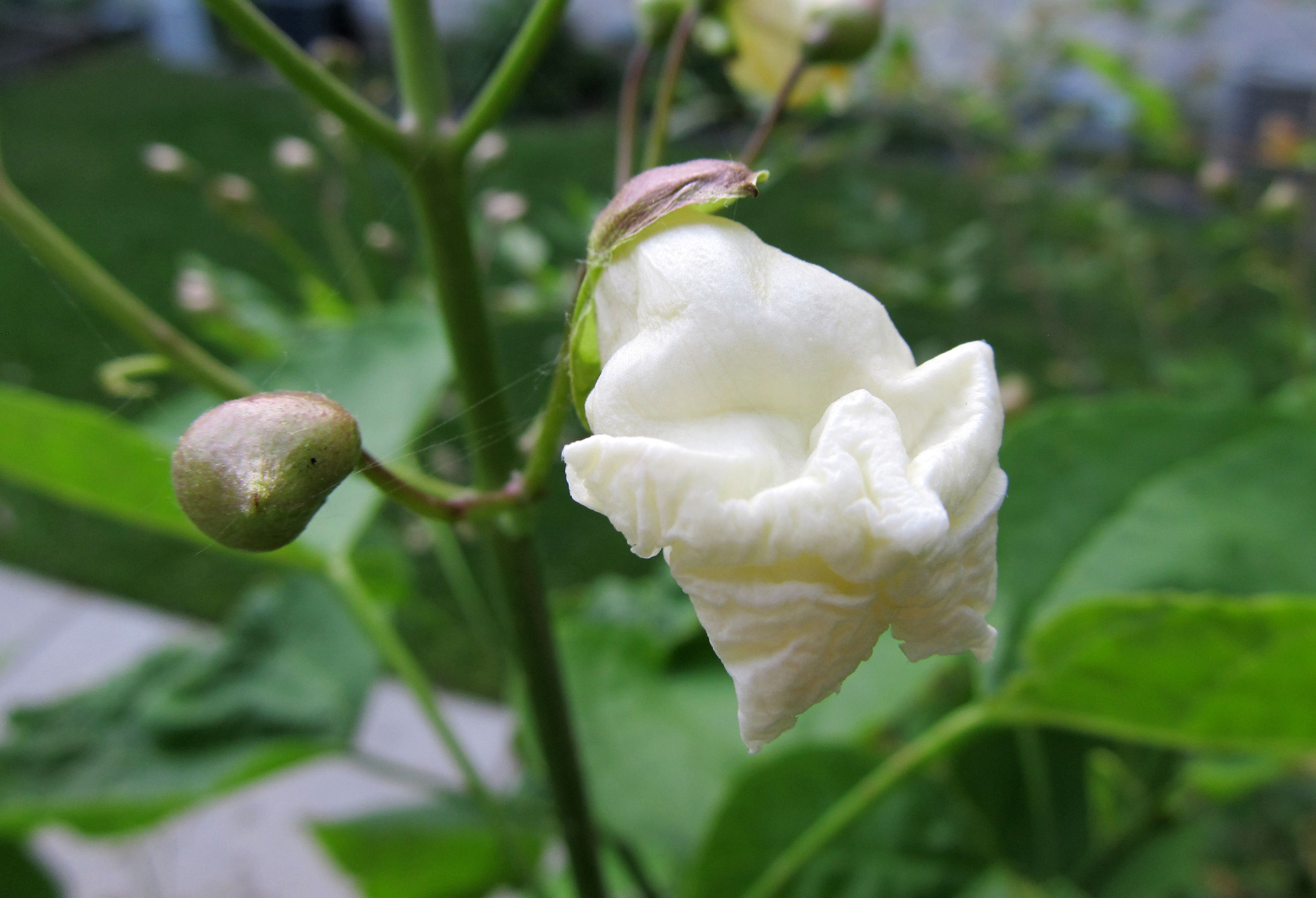
Northern catalpa is one of the last trees to leaf out in the spring. In late spring or early summer, 10 inch long clusters of white, tubular flowers are produced at the tips of stems. Before the flowers open, they look a bit like popped popcorn, reminding me of a song from my childhood (which I will reluctantly leave right here). The margins of its trumpet-shaped petals are ruffled and there is yellow, orange, and/or purple spotting or streaking on the inside of the tubes.

flower of northern catalpa (Catalpa speciosa) just before it opens

More Winter Trees and Shrubs on Awkward Botany: