Garden Plants Gone Wild: The Periwinkles

In a garden setting, a successful groundcover is a plant that is durable and adaptable, spreads readily, and fills in space thouroughly. The point of planting a groundcover is to cover exposed soil and create a sort of living mulch. In fact, groundcovers provide similar benefits to mulch. They prevent erosion, help retain soil moisture, and prevent weeds. It should come as no surprise then, that a plant that fulfills all of these requirements has the potential to become a weed, especially if given the opportunity to escape and establish itself outside of its intended location.

This isn’t a hypothetical. This exact scenario has played out numerous times. A good example of this are the periwinkles: Vinca major and Vinca minor. Both have been popular garden plants for centuries. Their introduction to U.S. gardens came as early as the 1700’s. Today, both species (including cultivars of each) can be found for sale in nurseries throughout the country, even while escaped periwinkles proceed to spread across natural areas and uncultivated spaces. Even in gardens where periwinkles have been intentionally planted, they can be deemed no longer welcome due to their aggressive nature. Eliminating them, however, is a formidable task.

greater periwinkle (Vinca major)

Periwinkles are relatively easy to identify, yet telling the two apart can sometimes pose a challenge. Knowing what to look for can make this a fairly simple task. Vinca major (greater periwinkle) is the larger of the two. Its stems are tough and sprawl up to 5 feet long, rooting adventitiously when in contact with the ground. Vegetative spread also occurs via stolons and rhizomes, modified stems that spread horizontally both above and below ground and whose main purpose is to produce new roots along their length. This extensive rooting creates dense mats of stems and foliage, precisely what you’d want from an effective groundcover. Leaves are arranged oppositely and are semi-evergreen with fine hairs along their margins. They are thick, glossy, simple, dark green, and ovate to ovate-lanceolate in shape. They have a relatively long petiole, and some leaves can even appear heart-shaped.

The flowers of V. major are blue to purple and fused at the base to form a tube, separating into five distinct lobes and creating a shape similar to a pinwheel. They are borne on a long stalk in the axils of leaves and measure about two inches wide. Their sepals are long, slender, pointed, and lined with bristly hairs. Fruits rarely form, but when they do, they are narrow follicles.
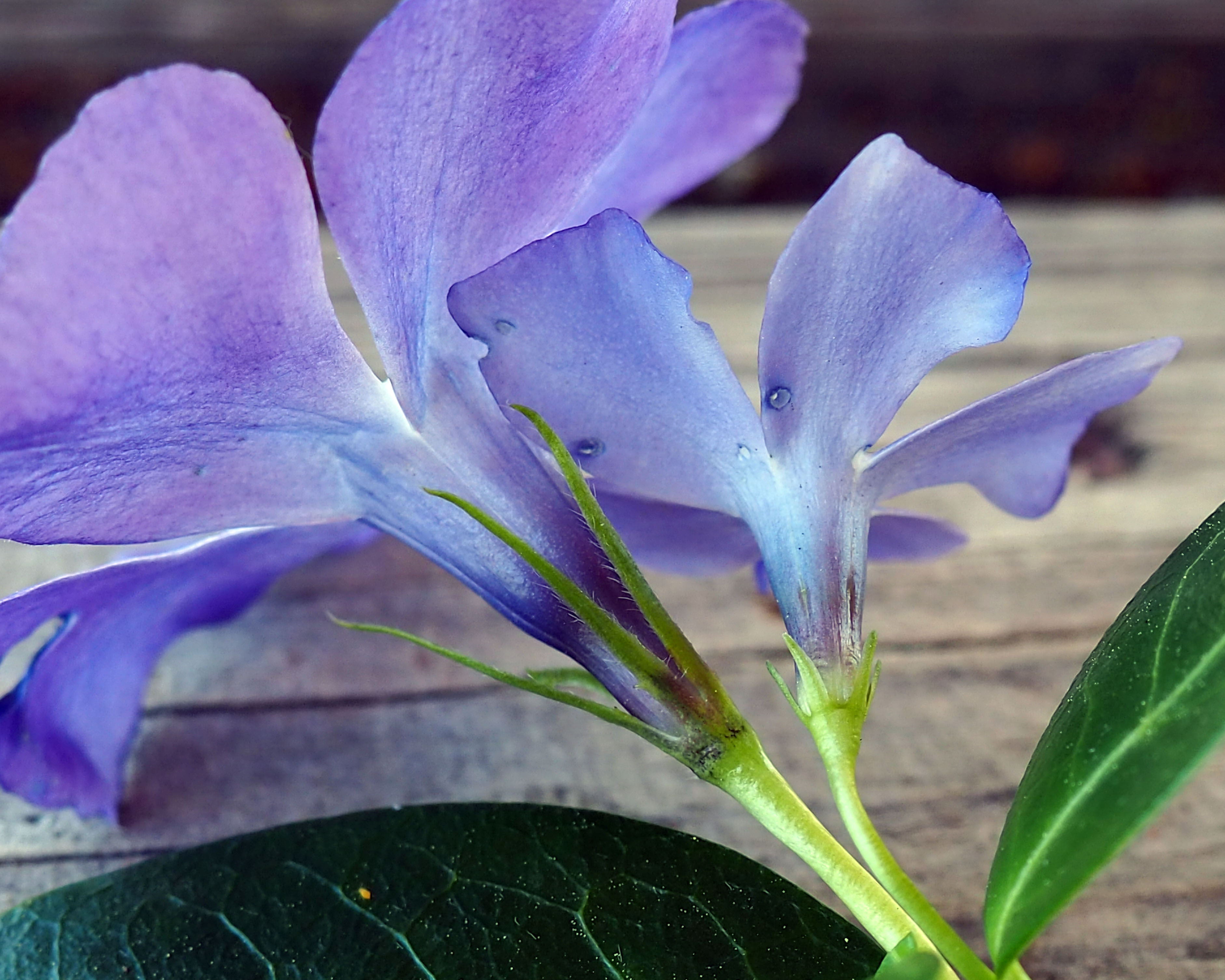
comparing the petals and sepals of Vinca major (left) and Vinca minor (right)

Vinca minor (lesser periwinkle) is a slightly smaller plant with a similar habit, spreading vegetatively in all the same ways as V. major. Stems are slender and smooth and leaves are evergreen. Compared to V. major, the leaves of V. minor are smaller, narrower, and have hairless margins and short petioles, otherwise they are very similar. Same goes for the flowers, which look identical on both species, except that those of V. minor are slightly smaller (about one inch wide) and borne on shorter stalks. Sepals are shorter, broader, more rounded at the tips, and lack the bristly hairs of V. major.

Because periwinkles only rarely produce seed, their main method of getting around is vegetatively. Fragments of roots or rhizomes hide in soil and are moved from one location to another inadvertently. Periwinkles are often used in hanging baskets and containers, and when these things are cast aside at the end of a season, the perennial roots of periwinkles may continue to grow, spreading out beyond the potting mix and into the soil.

Dump soil, yard waste, and improperly disposed of containers are the main ways that periwinkles find their way into natural areas. Both species can be found in the understories and edge habitats of woodlands, as well as along roadsides and pathways, and in vacant lots and old homesites. They can also be found in riparian areas, where waterways can carry fragments of plants to new locations. The Invasive Plant Atlas compiles reports of both V. major and V. minor growing outside of cultivation and tracks them on a map. They also track which states include them in noxious weeds lists or laws.

lesser periwinkle (Vinca minor)

The best way to keep periwinkles from continuing to spread outside of cultivation is to refrain from growing them. If you choose to have them in your yard, dispose of plant parts properly. If you keep them in containers, send those containers to the landfill when you are done with them. If your property is adjacent to natural areas, the risk may be too great and you may want to consider a different groundcover. Depending on where you live, alternatives vary. In the Intermountain West, potential substitutes include wild strawberry (Fragaria virginiana), woodland strawberry (F. vesca), kinnikinnik (Arctostaphylos uva-ursi), and wild ginger (Asarum caudatum). Each of these are low growing, evergreen to semi-evergreen, spreading plants that do well in shade and can handle some degree of drought.

Horticulture’s Weedy Introductions in a Changing Climate

In case I need a reminder that the horticulture industry has a history of introducing weedy plants to natural areas, I get one each time I bike to work. Riding along the Boise River Greenbelt, a trail that for much of its length is flanked by cultivated landscapes on one side and a highly modified but largely naturalized river bank on the other, I see a mixture of both native and introduced plants. Of the introduced plants, many are horticultural species that have escaped cultivation and established themselves on the bank of the river. There are catalpa and black locust trees brought in from the other side of the country, St. John’s wort and chicory from Eurasia, honeysuckles primarily from Asia, and a few different cherry species and hybrids with varied provenances. And this is just a small sample of what can be found along my three and a half mile bike ride.

St. John’s wort (Hypericum perforatum) on the banks of the Boise River

This is certainly not a new concern. We have been aware of the role that horticulture plays in introducing invasive species for quite some time now. Several years back, while doing a deep dive into the topic of invasive species, I wrote about this issue right here on this very blog. According to a study published in Frontiers in Ecology and the Environment (2021), out of 1285 plant species identified as invasive, 61% are currently sold in nurseries. If that’s not concern enough, an additional factor to consider is climate change. Plants that were less likely to escape cultivation and head for the wild, may take the opportunity to do so in a changing climate. Plus, horticultural plants that are already problems in certain areas could expand their range as climates become more favorable in new locations, especially if these plants continue to be sold in nearby nurseries.

These concerns and more are the topic of a paper published in BioScience (2023). Evelyn M. Beaury, et al. looked at nurseries across the United States and the plants they sell in order to determine where invasive plants are still being sold in regions where they are invasive. Additionally, they looked at plants known to be invasive but that are not currently invasive in the regions they are being sold. Using climate models, they predicted whether or not these plants could become invasive under changing climates.

Plants are being moved around with a lot more ease than they once were, and the sales of problematic plants are increasingly difficult to regulate. For one thing, plants prohibited for sale in one state can be purchased at nurseries in neighboring states and brought back to be planted in regions where those plants are invasive. And while mail order has existed for a long time, online ordering makes the process even simpler; and many online plant vendors are not liscensed nurseries, making them much more difficult to regulate. But even regulation is typically a response to something that has already become a problem, rather than a proactive measure to prevent plants from escaping into natural areas.

Beaury, et al. identified 672 nurseries across the United States, both online and traditional retailers. Each of these nurseries were selling one or more of the 89 plant species that became the focus of their research. These are plant species that are either on federal or state noxious weed lists or that have been identified as invasive by Invasive Plant Atlas. The reach of each nursery was determined by using customer reviews to compute distances that plants might travel after being purchased at nurseries or from online stores. Obviously, not every customer that purchases a plant leaves a review, but this is a good way to get a general idea how far away customers are from nurseries without having access to more detailed records. These geotagged reviews can also be cross-referenced with known distributions of invasive plants. Using climate models and environmental predictor variables, the researchers determined areas of current and potential invasion for each of the 89 plants.

tansy (Tanacetum vulgare) – one of the 89 plant species looked at in the study

The first question was about proximity to current records of plant invasions. Results showed that “49 of the 89 ornamental invasives were sold within 21 kilometers (13 miles) of an observed record of invasion.” When invasive plants are sold and planted near locations where they are already known to be invasive, it gives them the opportunity to add new plants to existing or developing invasions. In ecology, this is known as propagule pressure. When it comes to current and future climate, most species in the study are being sold by nurseries where the climate is either currently favorable for range expansion or may eventually become favorable. Specifically for future climate, 40 of the 89 plants are being sold in regions that are currently suitable for invasion and will continue to be suitable as the climate changes, and 25 of the 89 plants are being sold in regions where the climate is currently unsuitable but will become suitable as temperatures warm.

Particularly for plants being sold in areas that are not yet suitable for invasion, there is time to educate both the nursery industry and the general public and to look for alternatives to these plants. However, as the researchers point out, their analysis “only examined about 10% of the larger pool of U.S. ornamental plants known to be invasive,” and they “sampled only a subset of the nurseries that could be selling invasive species in the United States.” It is highly likely that the results of this study are an underestimation of the problem. Clearly the work of education and finding alternatives to problematic plants is monumental. The hope is that studies like this can help with education and can assist with working out ways to regulate sales of invasive plants.

coltsfoot (Tussilago farfara) – another one of the 89 plant species looked at in the study

Regulating the sale of plants is beyond most of our control, and how much regulation we should be enforcing on nurseries in the first place is a debate we should be having. Outside of those questions, there is a responsibility that we should take as gardeners and as residents of the planet. If we choose to grow plants, it is crucial that we get to know them. We should be taking the time to observe the degree to which they spread and how they are being dispersed. When they do move around our yards, where are they going, and are they able to grow outside of our care? Are they leaving our properties and coming up elsewhere? If we choose to plant non-native species, we should be mindful of how they might affect nearby, wild landscapes if they were to escape our yards and establish themselves in these locations. We should also be aware of where we live in the city. If our gardens are in the middle of a dense urban landscape, perhaps there is less concern that our plants will move beyond the borders of our gardens. But if we garden near natural areas, we should be significantly more selective about the things we plant, and we ought to be more observant as to what those plants are up to.

Nurseries generally sell the plants that gardeners want to buy, which means we can choose not to buy problematic plants and instead demand alternatives to these plants. Seeking out nurseries that sell the types of plants that are better suited for our regions and do not exhibit invasive behaviors can send a message to other growers that they should phase out certain plants and start growing the plants that gardeners are asking for. This may be a simplistic take, and as with most things, it’s complicated. While one of the goals of this research is to help influence regulators, another goal is simply to “[share] information about high-risk ornamental invaders across states and regions, and [work] with horticulture and community members to reduce the escape of ornamental species into natural areas.” This is precisely the area where gardeners can make a difference.

On that note, I will be starting a new series of posts to discuss some of the ornamental species that have gone weedy. By getting to know the plants that find themselves in this predicament, we can be better situated to make informed decisions about what to do about them.