Some weeds are so noxious, their crimes so heinous, and their control so challenging that desperation leads us to introduce other non-native organisms to contain them. Alien vs. alien duking it out in a novel environment. It seems counterintuitive – if an introduced species has reached the status of invasive, is it worth the risk of bringing in yet another foreign species in attempt to defeat it? We all know what happened to the old lady who swallowed the spider to catch the fly, yet for decades now we have been doing just this. It’s something we call classical biological control – introducing pathogens, insects, or other organisms to help control the spread of problematic ones.
Such attempts mostly fail, but we keep trying. The attempts made on Cirsium arvense exemplify this. The trouble is that even when such efforts fail, they aren’t always benign, as we shall see.
Canada thistle, a misnomer for Cirsium arvense, is a European native that has been acting in the role of noxious weed for centuries, even in its native land. First introduced accidentally to eastern North America sometime in the 1600’s, it has made its way across the continent and has since become one of our worst weeds in both natural and agricultural settings, as well as in our yards and gardens. Its seeds get around, carried by wind and water, attached to animals or deposited in their dung, stowing away as contaminants in crop seed or passengers in the ballast water of ships. But casual dispersal by seed isn’t quite as troubling as what it does once it takes root.
Several related species of thistle are also pesky weeds, but unlike Cirsium arvense, they are mostly annuals or biennials, spreading only by seed. Cirsium arvense is a perennial plant with roots that spread deep and wide. New shoots form readily along the spreading roots, forming a veritable thicket of stems that can be dozens of feet wide and giving the plant a more appropriate common name, creeping thistle.
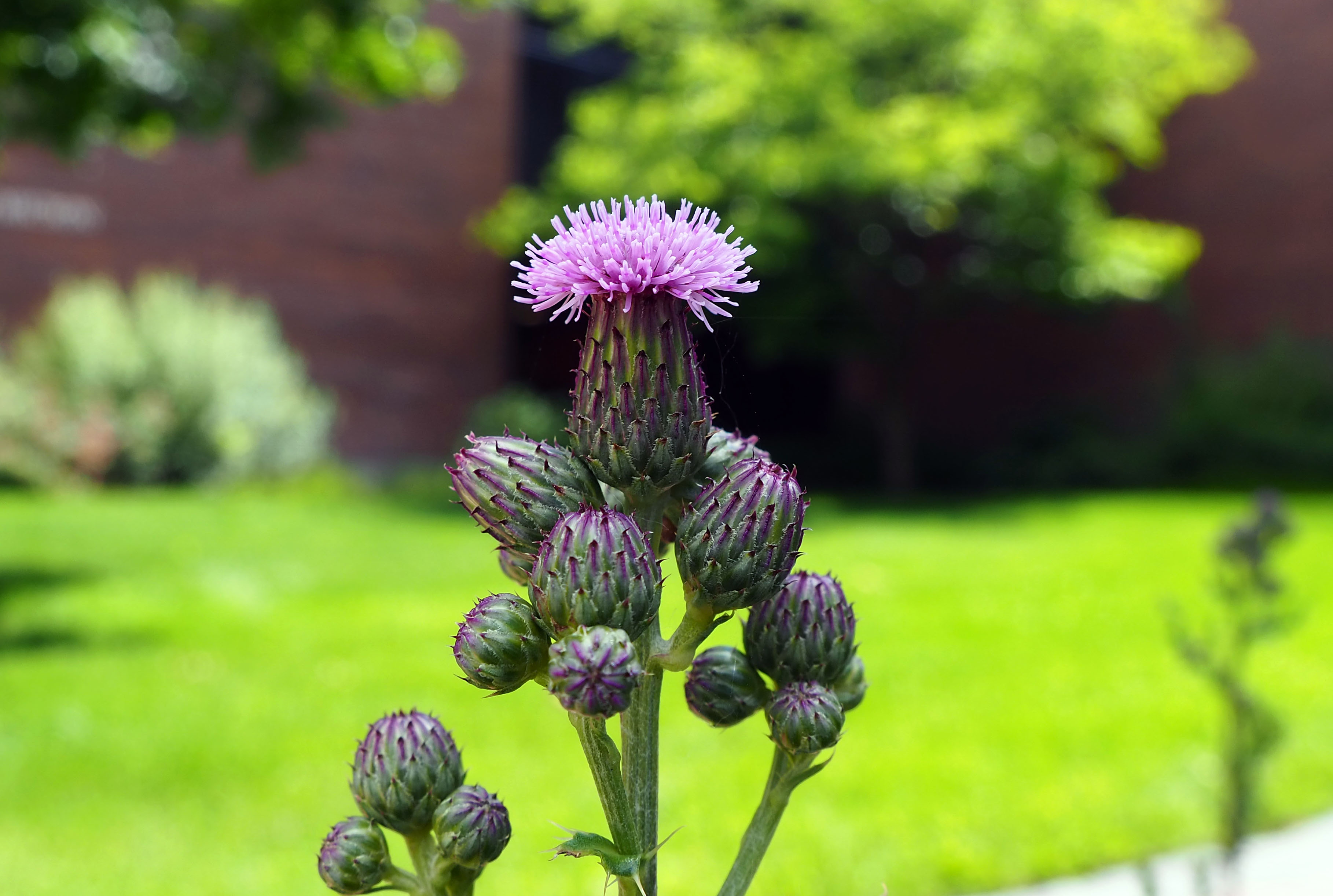
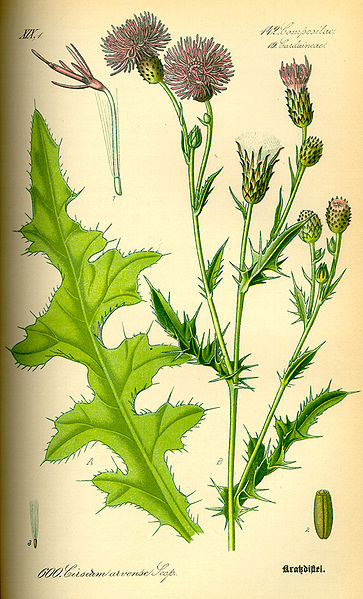
The stems of creeping thistle can grow more than four feet tall and are adorned with alternately arranged, prickly, lobed leaves. Groups of small, urn-shaped flowerheads are born at the tops of stems. Flowers are pink to purple, sweet smelling, and favored by pollinators. Individual plants either produce all male flowers or all female flowers, and since individual plants are actually large colonies, an adjacent colony of the opposite sex is necessary in order for the production of viable seeds. Like other plants in the aster family, the seeds come with a feathery pappus, suggesting wind dispersal. However, the pappus is often weakly attached, sloughing off without seeds in tow, leaving them to the fate of gravity.
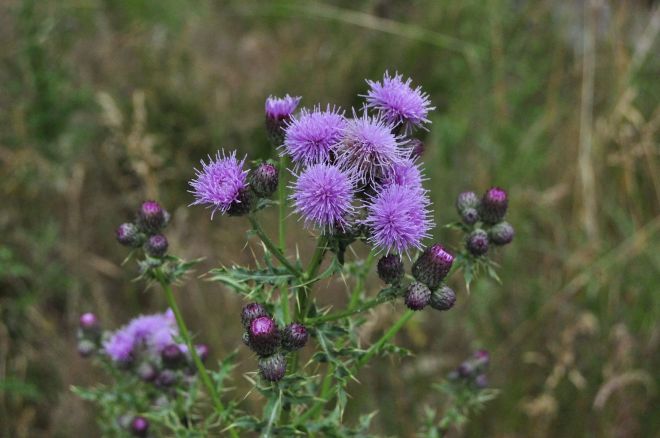
flowers of creeping thistle (Cirsium arvense) via eol
It comes as no surprise that when plants readily spread by root, stolon, or rhizome, they are well suited to become some of our most bothersome weeds. Eliminating their seed heads does little to reduce their spread. Pulling them out of the ground is futile; you will never get all the roots. Tilling them under only aids in their dispersal since chopped up roots and stems now have the chance to produce new plants. Herbicide treatments can set them back, but they must be repeated on a long-term and exacting schedule in order to thoroughly kill the roots. Considering what we’re up against when it comes to plants like creeping thistle, it makes sense why we would introduce foreign fighters to do our bidding, especially if such fighters are enemies of the plant in their native land.
The list of insects that have been employed (or at least considered) in the fight against creeping thistle is extensive. It includes thistle tortoise beetle (Cassida rubiginosa), seedhead weevil (Rhinocyllus conicus), thistle crown weevil (Trichosirocalus horridus), thistle gall fly (Urophora cardui), thistle stem weevil (Ceutorhynchus litura), thistle bud weevil (Larinus planus), seedhead fly (Orellia ruficauda), thistle flea beetle (Altica carduorum), thistle leaf beetle (Lema cyanella), painted lady (Vanessa cardui), and sluggish weevil (Cleonus piger). Unfortunately, and perhaps not surprisingly, as Bugwood reports, “biocontrol currently provides little or no control of Canada thistle populations, although some agents weaken and kill individual plants.” Despite the fact that there are well over 100 known organisms that consume or attack Cirsium arvense, nothing manages to do long-term damage.
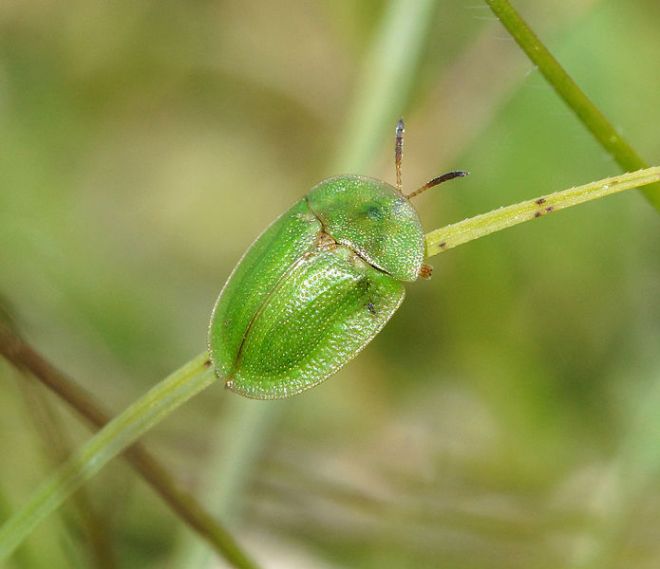
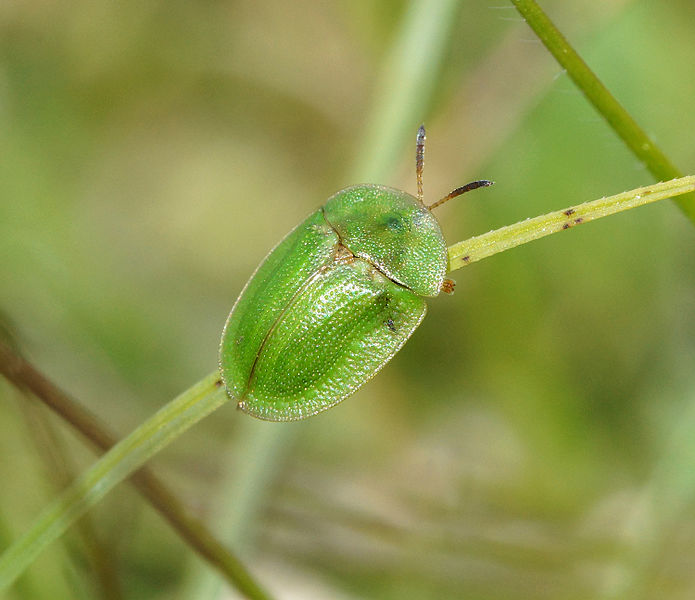
thistle tortoise beetle (Cassida rubiginosa) – a common biocontrol agent of invasive thistle species (via wikimedia commons)
The status of creeping thistle biocontrol efforts on two South Dakota wildlife refuges was reported on in a 2006 issue of Natural Areas Journal. Multiple introductions of at least half a dozen different insect species had occurred beginning in 1986. Nearly 20 years later, they were not found to have had a significant effect on creeping thistle populations. The authors concluded stating they “do not advocate further releases or distribution in the northern Great Plains of the agents” examined in their study. They also advised that “effectiveness be a primary consideration” of any new biocontrol agents and expressed concern that some introduced insects have the potential to attack native thistles.
North America is home to quite a few native thistles, several of which are rare or threatened. A USDA guide to managing creeping thistle in the Southwest highlights the importance of protecting native thistles – “especially rare or endangered species” – from biocontrol agents and gives two examples of endangered thistles in New Mexico that are at risk of such agents.
The federally threatened species, Pitcher’s thistle (Cirsium pitcheri), which is restricted to sand dune shorelines along the upper Great Lakes, has quite a bit working against it. An added blow came a few years ago when it was discovered that the flowerheads of Pitcher’s thistle were being damaged by the thistle bud weevil (Larinus planus), a biocontrol agent employed against creeping thistle in the area. A paper published in Biological Conservation in 2012 examining the extent of weevil damage on the rare thistle cautioned that, “although some biological control agents may benefit some rare plant taxa, the negative impacts of both native insects and introduced herbivores are well documented.”
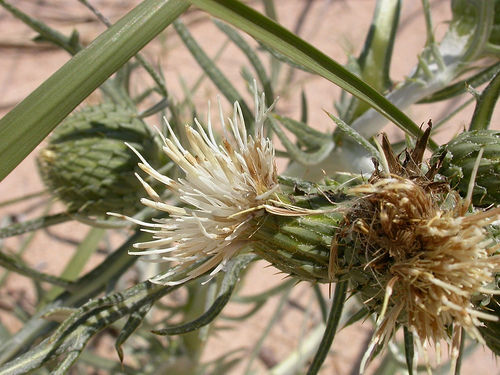
Pitcher’s thistle (Cirsium pitcheri) via eol
Classical biological control, if and when it works, can be quite valuable, especially if it reduces the need for other management inputs like herbicides and cultivation. Unfortunately, it is rarely successful and can have unintended consequences. Goldson et al. report in a 2014 issue of Biological Conservation that the success rate is only around 10% and that even that 10% is at risk of failing at some point. In his book, Where Do Camels Belong?, ecologist Ken Thompson cites that “only about one in three species introduced as biological controls establish at all, and only half of those that do establish (i.e. about 16% of total attempts) control the intended enemy,” adding that “biological control is just another invasion, albeit one we are trying to encourage rather than prevent, and its frequent failure is another example of how poorly we understand the effects of adding new species to ecosystems.”
Still, while some warn against being too optimistic, others argue that it is an essential tool in the war against invasive species and, while acknowledging that a few introductions have gone awry, assert that “significant non-target impacts” are rare. Clearly, this is a rich topic ripe for healthy debate and one that I will continue to explore. If you have thoughts or resources you’d like to share, please do so in the comment section below.
———————
This post was inspired in part by episode six of The Shape of the World podcast. I highly recommend listening to the entire series.



 awkward botany