Rosemary Christmas Tree

In the spirit of the holiday season, consider this fun alternative to a conventional Christmas tree. Rosemary (Rosmarinus officinalis) is an herbaceous, evergreen shrub or subshrub and is commonly found in herb gardens. Its leaves are valued for their myriad culinary and medicinal uses. Futhermore, this plant takes very kindly to pruning and shaping, which makes transforming it into a miniature Christmas tree a very simple task.

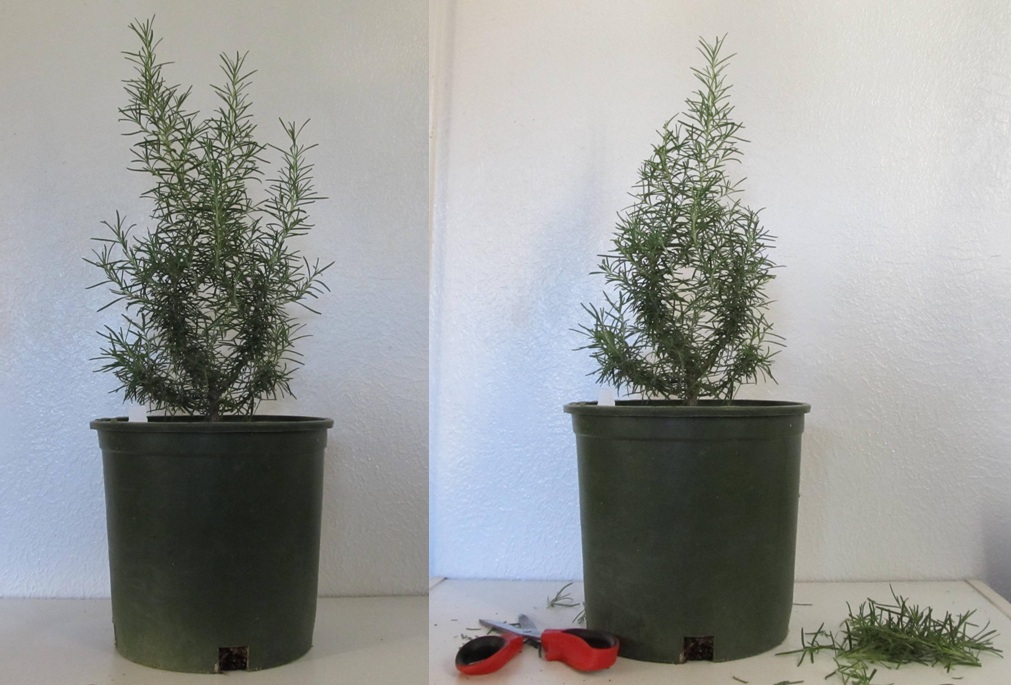
It may be too late to cultivate a “tree” for this year’s holiday season, but perhaps you’d like to try for next year. To do so, find a small rosemary plant at a local garden center or plant sale in the spring. Make a few initial pruning cuts to select a leader or leaders. After about a month or two, start giving it the shape of a Christmas tree. Floral scissors work great for making these cuts, and you don’t have to worry about where on the branches you are cutting – rosemary is very forgiving – just make sure your scissors are sharp. Wait a couple more months and then do more shaping with the pruning scissors. Do some final shaping a month or so later. At this point, you should be entering the holiday season and your rosemary Christmas tree will be ready to display. It’s that simple!

1

Initial pruning: selecting the leaders

2

Second pruning: giving it shape

3

Third pruning: keeping in shape

4

Final pruning: clean it up and present it  

One major downside to growing rosemary if you live in a cold climate is that it is only hardy to about USDA zone 7. However, if you select the right cultivar, place it in a protected location (near the south facing wall of a building perhaps), give it some mulch and maybe a blanket for the winter, you might be able to get it to survive in colder zones. Rosemary can also be difficult to overwinter indoors because the air in homes is typically dry and warm and there is little direct sunlight. If you are determined to keep one alive despite your odds, awaytogarden.com provides an excellent tutorial about overwintering rosemary both indoors and out.

Growing Plants on the Moon

You’ve heard about gardening by the moon – an ancient approach to gardening based in folklore and superstition in which planting times are scheduled according to moon phases and astrological signs. Now, how about gardening on the moon! No pseudoscience necessary here. NASA scientists are currently on a mission to determine what it will take to grow plants on the moon in anticipation of setting up a permanent lunar base. After all, if we plan on sending people to the moon to live for long periods of time, we will need to figure out how to grow some food for them up there, right?

The first phase of the study will examine seed germination in a lunar environment and will observe seedlings during the first week or so of their lives. The seeds of cress, basil, and turnip have been selected as the first to be grown on the moon. However, these seeds will experience an environment that seeds of their kind (or any other kind for that matter) have never experienced before, because, unlike the earth, the moon has no atmosphere. Gravity on the moon is one sixth of what it is on earth; solar radiation is intense and direct; and fluctuations in temperature are extreme to put it lightly (about 150°F during the day to -150°F during the night). Oh, and there is one other important limitation: moon soil is dead. To start with, it’s virtually moisture-free. It also has no organic matter content, and it is void of life (compared to a tablespoon of earth soil, which is said to harbor about 50 billion microbes, many of which help sustain plant life).

NASA scientists have considered these limitations. That is why the first seeds on the moon will be grown in a lunar plant growth chamber. This growth chamber is designed to regulate temperature and light and will contain a filter paper inoculated with plant nutrients. Water will be stored inside the growth chamber and released when the chamber reaches the moon. There will be just enough water to induce germination and allow the plants to grow for 5-10 days. Plant growth will be monitored with an onboard camera and then compared to plants grown in a similar growth chamber on earth. Scientists will be observing how well the seeds germinate and grow in a low gravity, high radiation environment.

The first lunar plant growth chamber is scheduled to head for the moon in late 2015. It will be hitching a ride with the winners of the Google Lunar X-prize competition. Based on the results of the first phase of the experiment, following phases will observe sexual reproduction in a lunar environment. If sexual reproduction occurs, what effect will high levels of radiation have on subsequent generations? Only time will tell, so this will be an exciting project to monitor for years to come.

moon

photo credit: wikimedia commons

Do you want to help design future lunar plant growth chambers? Go here.

Overwintering Carnivorous Plants

I once assumed that all carnivorous plants were tropical. I’m not sure exactly why. Perhaps it’s because they are so bizarre (both in their appearance and behavior), nothing like the plants that I was accustomed to seeing growing up in the Intermountain West. Or maybe it’s because the one carnivorous plant that I was most familiar with, the Venus flytrap, is commonly sold in the houseplant section of department stores. If it’s a houseplant, it must be tropical, right?

Eventually I learned the truth. Much to my surprise, there are numerous carnivorous plants that are native to temperate regions – in fact, carnivorous plants can be found on every continent except Antarctica. Even more surprising, Venus flytraps are temperate plants! It’s true. They are native to a small region in North Carolina, within about a 100-mile radius from Wilmington.

Plant species native to temperate regions require a dormant period. In the winter, the temperature drops, day length decreases, and, in some cases, drought ensues. During this time plants go dormant – they hibernate – and wait for the warmer, brighter days of spring to continue on with their metabolic and reproductive processes. It’s a period of rest.

Carnivorous plants native to temperate regions fall into this category – they require a period of dormancy in order to stay healthy and productive. In his book, The Savage Garden, Peter D’Amato asserts that, “Dormancy in carnivorous plants that require it must be respected and permitted to occur. Otherwise, the plant may die.” He goes on to say that a Venus flytrap grown year-round in a warm environment exposed to grow lights for the majority of the day “will eventually get sickly and die.” In short, these plants need a rest, and so it’s best to grow them outdoors where they will be exposed to the elements, thereby entering a period of dormancy as nature intended.

Venus flytraps (Dionaea spp.), North American pitcher plants (Sarracenia spp.), and serveral species of sundews (Drosera spp.) can all be grown outdoors year-round in temperate climates. In order to ensure their survival, it’s best to give them a little protection during the winter months – especially when temperatures are projected to reach below 20 degrees for several consecutive nights.

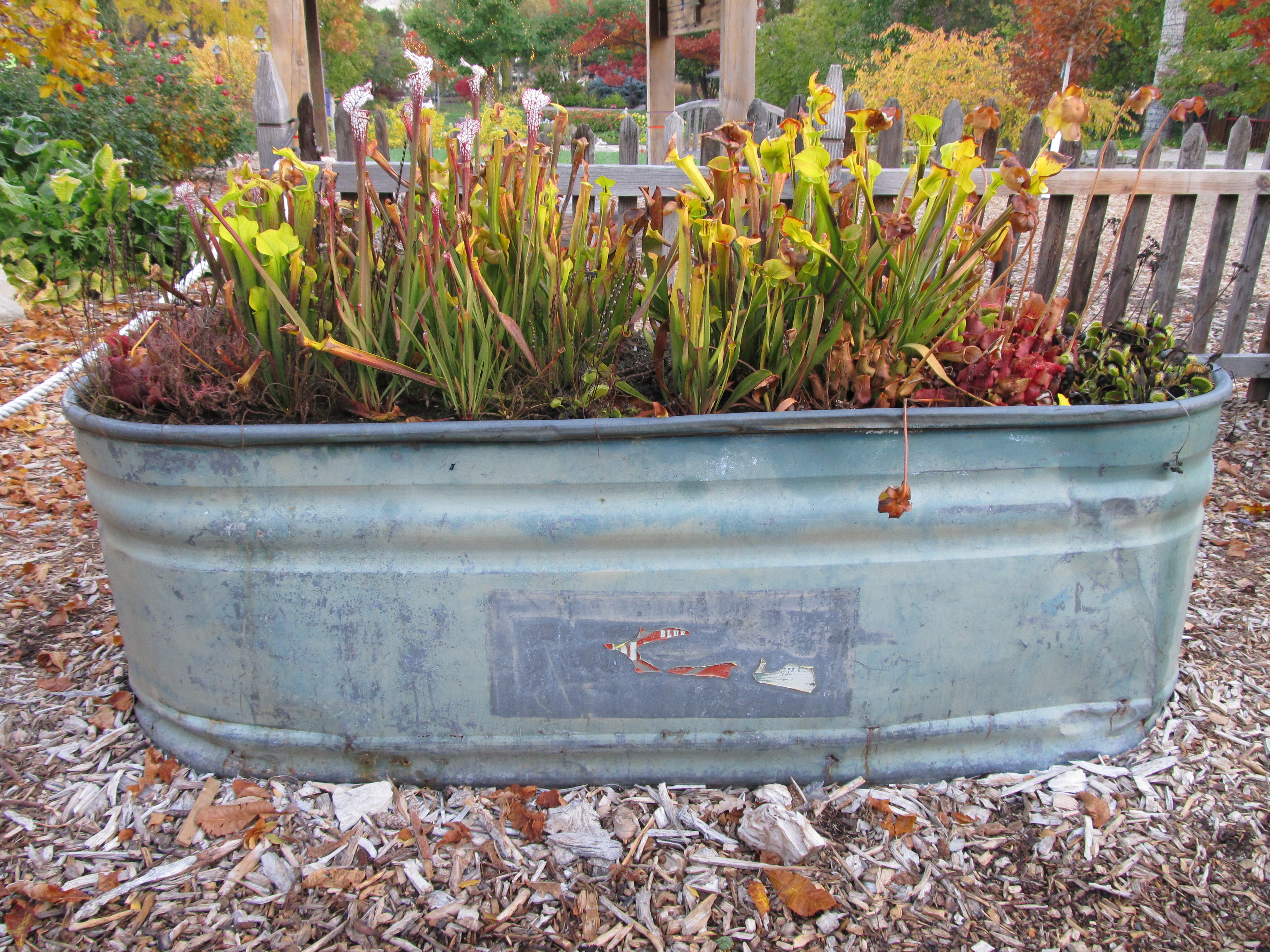
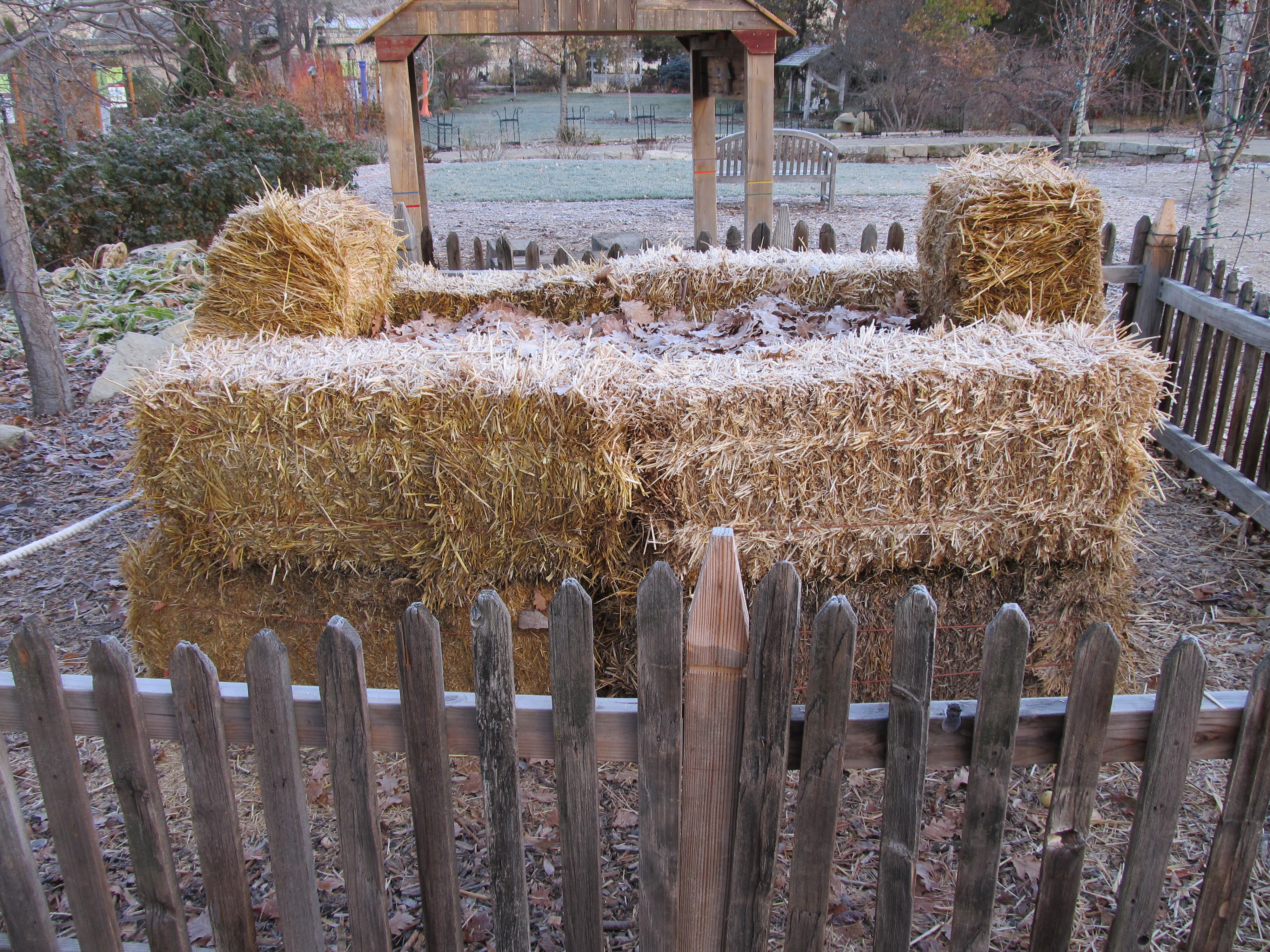
Recently, I helped put the carnivorous plant display at Idaho Botanical Garden to bed for the winter. The carnivorous plants are being grown in an old stock water trough. First we cut back the plants, reducing their size by at least a third and being especially careful to remove dead or rotting plant material. Next, we placed several straw bales around the sides of the trough. Then we covered the plants with three layers of material: black plastic, evergreen boughs, and dead leaves. Dave Nelson, of killergarden.com, suggests a similar winterizing treatment: “the plants can be placed on the ground, covered with a tarp, and then covered with six inches or so of dead leaves, pine needles, straw, or other mulch.”

After the threat of freezing temperatures has passed, the plants can be uncovered. As temperatures continue to warm, the plants will awake from their dormant state and prepare themselves for another spectacular season of devouring bugs and looking awesome.

IBG_carnivorous plants_fall

Carnivorous Plant Display at Idaho Botanical Garden

IBG_carnivorous plants_winter

Winterized Carnivorous Plant Display

A final word from Paul D’Amato: “You should never force a carnivorous plant into growth during a season when it should be resting.”

Excerpt from Amanda Thomsen Interview

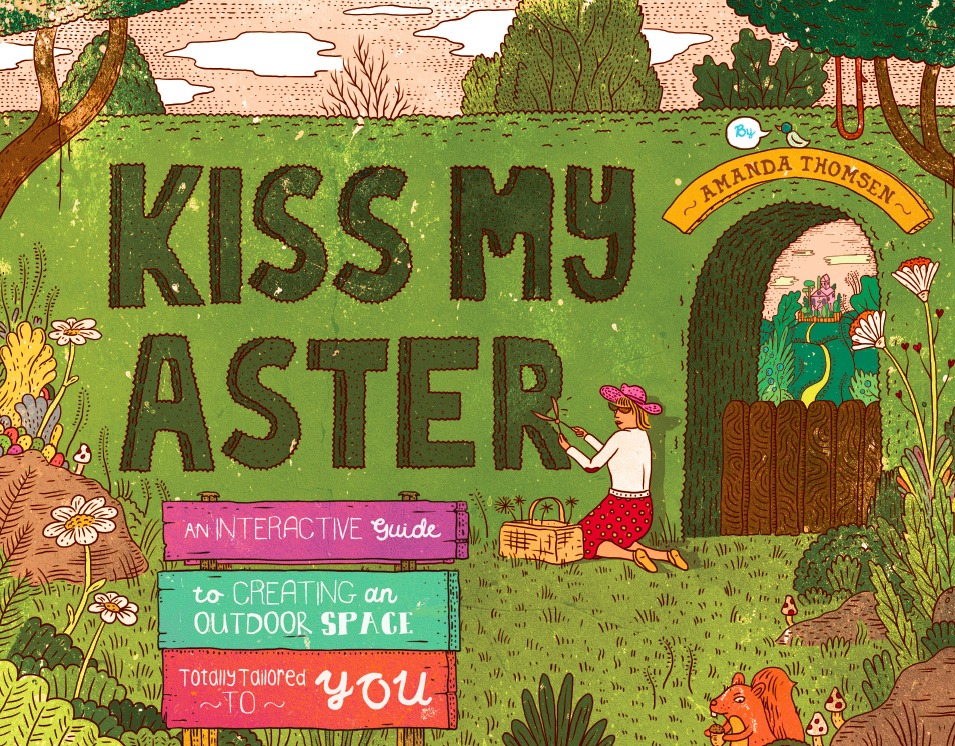
Plenty of books have been written about gardening and landscaping 101, but none are quite like Kiss My Aster by Amanda Thomsen. The title alone should clue you in that Thomsen’s approach is unique. Flipping through the pages it becomes more apparent. It’s a graphic novel. It’s a choose your own adventure book. There is a pink unicorn and a vampire reference, but there is also great information for those interested in gardening. Much of it is geared towards beginners, but seasoned gardeners will find it useful as well. This book is in a league of it’s own…so it’s certainly worth a look.

In the latest issue of Greenwoman Magazine, Sandra Knauf interviews Amanda Thomsen. It’s a lively conversation, in which Thomsen reveals how the book came about, among other things. What follows is an excerpt from that interview. Get your hands on a copy of the magazine for the full conversation.

Knauf: Who or what inspired you to become a gardener? A writer?

Thomsen: When I was little I wanted to do three things when I grew up: 1. Be a writer, 2. Recycle, and 3. Wear red lipstick. Happily, I have achieved these three goals. Although I always wanted to be a writer, I did ABSOLUTELY NOTHING to make that happen growing up. No one pointed me in the right direction. I’ve taken a few writing classes, but overall nothing that was memorable. I have always been super creative and have just looked for ways to demonstrate that!

My parents were the prototypes for yuppies. For some reason, and I think it was my dad’s Indiana upbringing, they were SUPER into Crockett’s Victory Gardening on PBS and did, literally, everything he did. We have a 30′ x 50′ victory garden each summer and I just grew up in it. They had a greenhouse added to the house, canned up everything from applesauce to giardiniera. It was a delicious way to grow up, and I didn’t realize that EVERYBODY didn’t have that until I was, like, 20. Maybe older. I didn’t realize there were jobs in gardening and horticulture.

Knauf: You have this funny, sassy, sexy, free-spirited, curse-word-strewn, delightfully naughty blog for a few years, and you’re a landscaper, and suddenly you’re blogging for Horticulture magazine’s website, and now you blog for Fine Gardening. I don’t want to disrespect these fine publications, but, well, they can be at times just a bit, shall we say, dry. How did you get together with them?

Thomsen: Horticulture asked me to join this contest they were having for a blogger. I did and I won. It was hard on me to blog exclusively for them and not on my personal blog at all – not even about personal stuff – but that was the deal. Fine Gardening has been a great, laid back home for my more horty things to say. I leave the eff-bombs at the door and get my freak on over there and I’ve loved it. AND they’ve given me a chance to write articles, which is seriously one of my happiest achievements in life…

All these magazines KNOW that if they are going to survive, they have to get new, younger readers, and I’m happy as a salami at a mustard party to help do that for them.

Knauf: How did the idea for a book come about?

Thomsen: I was dreaming about how to make books more interactive when I thought of the idea. Originally it was going to be SO comprehensive that I thought I’d need help writing it. You know, a backyard bible of sorts. Then I got this wack-a-doo idea of having a hipster gardening book that was illustrated with, you know those terrible IKEA instructions with no words and very vague symbolism? I wanted to do it like that. Carleen Madigan at Storey literally found me in a dumpster and asked me if I had ideas for books. We met up in Boston while I was there speaking, and I just LOVED her. She was totally the midwife of this book. I literally wrote the whole book for her and if I could make her laugh then I was golden. I wrote the whole book, and then they found the illustrators, which completely adds everything.  The illustrations are way better than the writing!

kissmyaster

Visit Amanda Thomsen’s blog: www.kissmyaster.co

Read the entire interview and more at Flora’s Forum.

An Emerging Botanical Garden in Louisville, Kentucky

There is a new botanical garden being constructed in Louisville, Kentucky. It’s called Waterfront Botanical Gardens, and it is being built on top of an old landfill. The landfill was in use for several decades during the mid-1900’s and officially closed in 1973 when a new landfill site was opened. Recently, there was discussion about what to do with the old landfill site. Botanica, a group of plant lovers and devoted gardeners in Louisville, was able to work out a deal with the city to secure the 23 acre site and is currently moving forward with plans to turn it into a botanical garden.

Botanica’s vision for the garden is broad, but part of that vision includes educating the public about native flora and promoting environmental stewardship. Planning and construction are still at their early stages and there is tons of work ahead, but considering that people in Louisville have been wanting to see a botanical garden in their city for at least 30 years, watching it finally start to happen must be exciting. To celebrate the emergence of Waterfront Botanical Gardens, the Founders’ Garden was constructed and planted this spring. It is located near the site of the future botanical garden and is a small token of things to come. A picture of that garden (taken from the website) can be seen below.

I am excited to watch from afar as this new botanical garden emerges, and I hope to be able to visit someday after the garden has been constructed. To learn more about this garden and to follow its progress, visit their website: www.waterfrontgardens.org

waterfront botanical_founders garden

The Founder’s Garden at Waterfront Botanical Gardens

Louisville, Kentucky

Interview with Peter D’Amato of The Savage Garden

In my last post about sundews, I referenced a book about carnivorous plants called, The Savage Garden, by Peter D’Amato. Earlier this month, a revised edition of The Savage Garden was released by Ten Speed Press. Recently, D’Amato appeared on Real Dirt, a garden podcast hosted by Ken Druse, to tell his story, promote the revised edition of his book, and talk about carnivorous plant cultivation. It’s a fascinating discussion, and I highly recommend checking it out.

real dirt

Also, check out the website for Peter D’Amato’s carnivorous plant nursery, California Carnivores.

The Sundews

Earlier this year, I wrote about northern pitcher plants and how they are helping us to better understand food webs. At that time I promised future posts about carnivorous plants, so I have decided to write about sundews, the only carnivorous plant that I currently have in my collection.

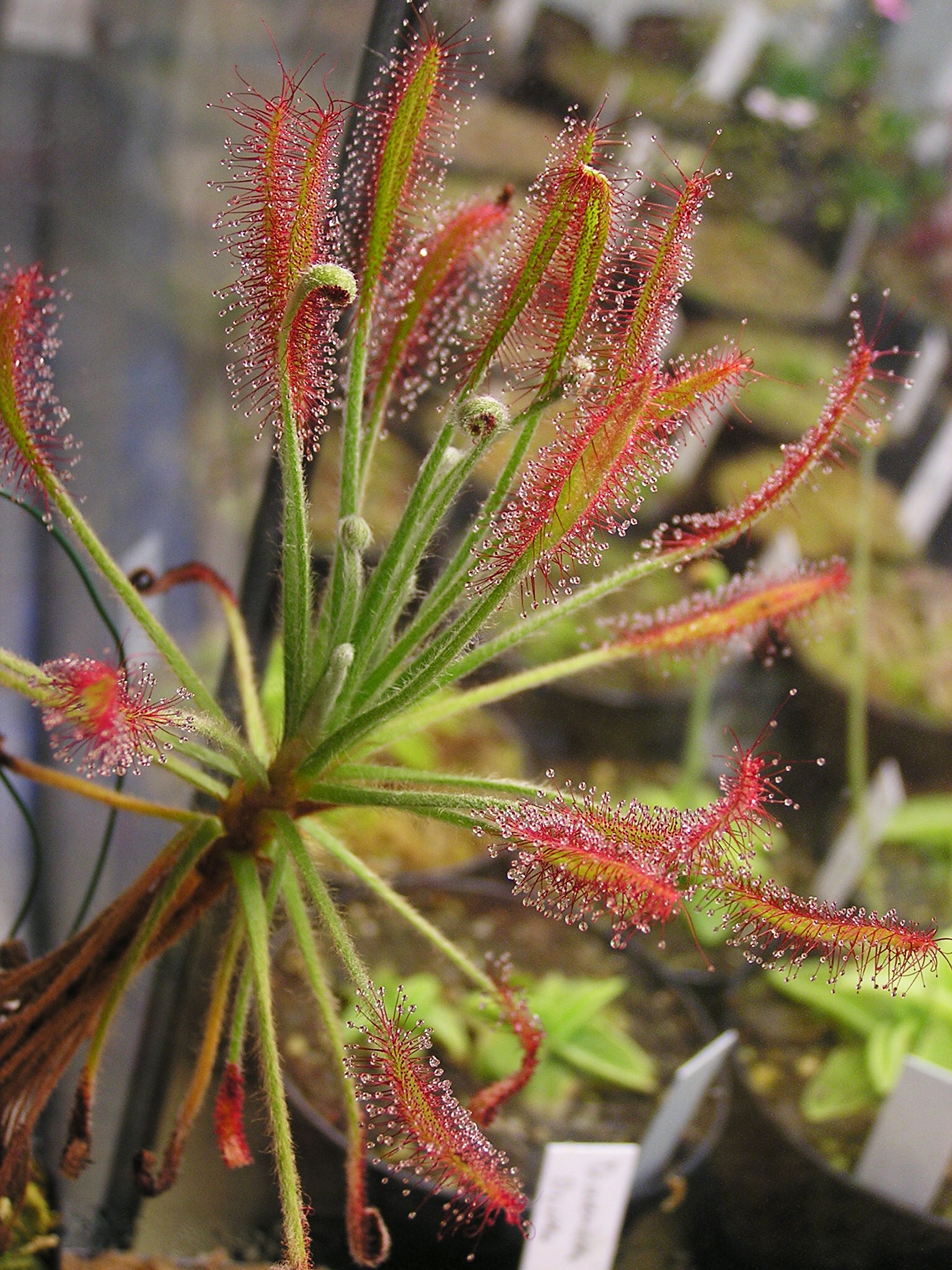
Sundews are members of the genus Drosera and are in the family Droseraceae (the same family as the Venus flytrap). With as many as 194 species, Drosera is one of the largest and most diverse genera of carnivorous plants. Sundews can be found in a wide variety of climates and on nearly every continent, from subarctic Alaska to tropical Brazil. They can be as small as a penny or as big as a small shrub. Their leaves form rosettes and come in numerous shapes and sizes, including circular, wedge-shaped, oval,  forked, fern-like, and grass-like. Drosera flowers are also quite diverse, but typically they are flat, five-petaled, white or pink, and appear in clusters at the top of a tall stalk.

As described so far, you may be thinking that sundews sound quite simple and innocent, but this is certainly not the case. Covering the surfaces of Drosera leaves are dozens of hair-like filaments. At the end of each filament (or tentacle) is a gland, which produces a small drop of clear and very sticky dew. Attracted to the glistening dew and mistaking it for plant nectar, insects fly into it and find themselves instantly stuck. Struggling to get away, an insect may tear off body parts as it flails about, only to fall into other nearby dew droplets, worsening its ensnarement and ensuring its fate.

In his book, The Savage Garden, Peter D’Amato describes it this way:

“Sundews are innocent-looking and pretty, their delicate leaves sparkling with the promise of sweet nectar, but the foolish insect curious enough to give a sundew the slightest touch will suddenly find itself caught in a living nightmare. Doomed to a horrible death, the insect may struggle for a blessed few minutes or suffer for untold hours as it tries to break free of ensnaring, suffocating glue, grasping tentacles, and burning acids and enzymes; meanwhile, its precious bodily fluids are being slowly sucked dry.”

As the sticky dew attracts and then traps the insects, and the tentacles that support the dew help to further ensnare them, imminent death comes in a variety of ways. The most common for small insects is suffocation, as the glue almost immediately covers up the breathing holes on their abdomens. Larger insects that manage to avoid bodily contact with the glue will instead dangle from the plant and die of starvation or exhaustion. Those that break free, losing an appendage or appendages in the process, usually don’t last long after that and are often trapped and killed by spiders who build their webs around sundews in order to take advantage of such occasions. The leaves of some sundews curl up around their prey, not necessarily to further ensnare them, but to surround them with the largest possible number of glands which will help quicken the consumption and digestion process. By now you can see that as innocent and delicate as they may appear, sundews are in fact about as brutal and unforgiving as they come.

If you’d like to learn more about sundews and other carnivorous plants, including information on how to grow them, I highly recommend D’Amato’s book (The Savage Garden). It’s a fascinating and informative read, and the reality of the natural world described therein will astound you.

Drosera chrysolepis

Drosera chrysolepis, photo credit: wikimedia commons

White Rot and the Quarantine Zone

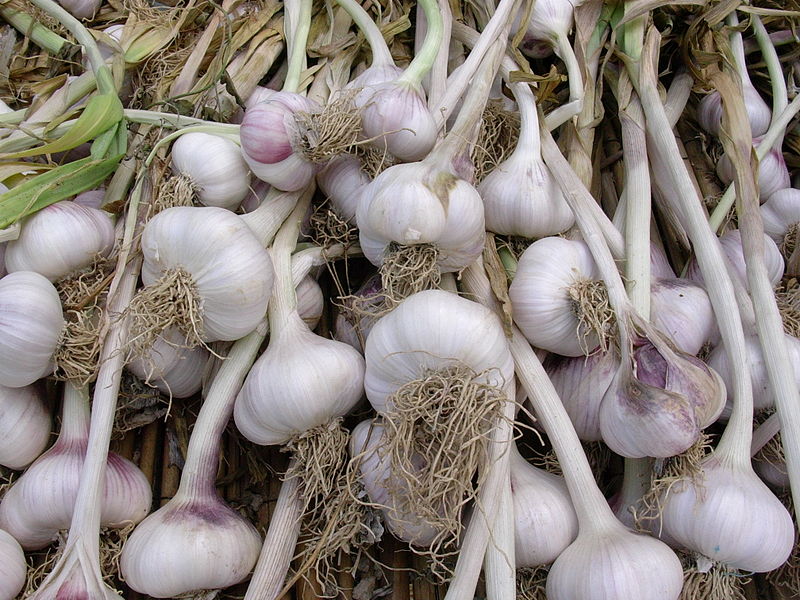
It’s garlic harvesting season in the northern hemisphere, so recently while helping out with the harvest at a local farm, I had the chance to learn about a challenge involving growing garlic in southern Idaho. The challenge stems from a disease called white rot. It’s caused by a fungus (Sclerotium cepivorum), and it affects all alliums, including garlic, onions, chives, and ornamental alliums. This disease causes the leaves of alliums to die back, their bulbs to decay, and their roots to rot, ultimately turning the plants to mush. Sclerotia, the dormant stage of the fungus, are small (about the size of a poppy seed), black, spherical structures that can survive in soil for more than 20 years. They remain dormant until the exudates of allium plants awaken them, at which point they begin to grow, unleashing their destruction. Sclerotia can be moved around by farm equipment, flood and irrigation water, wind, and by attaching themselves to plant material. Once this fungus has established itself in a field, it is extremely difficult to eradicate, making the field virtually unfit for allium crops.

The threat of white rot and the monetary damage that it can cause led to the establishment of a quarantine zone in southern Idaho in order to protect its $55 million dollar a year onion industry. Due to the quarantine zone, all garlic that is grown for seed within the zone must be inspected and certified, and any garlic seed (i.e. garlic cloves) that are brought into the zone must go through a rigorous testing process in order to be certain it is free of the white rot pathogen before it can be planted. Garlic is a specific threat, because while onions in the zone are typically grown from seed and so are largely free from harboring sclerotia, garlic is grown from cloves, which can readily carry sclerotia. This process significantly limits the amount and the variety of garlic that can be grown in the quarantine zone. While the quarantine is essential for warding off the threat of this particular pathogen, it stifles the garlic growing industry and makes it difficult for new garlic growers to establish themselves.

Growing garlic is already an incredibly challenging pursuit due to the amount of time and physical labor that goes into planting, harvesting, drying, grading, etc. The quarantine, while understandable, is yet another added challenge. Learn more about this issue by reading this article found at Northwest Food News.

garlic

photo credit: wikimedia commons

Pac Choy in Bloom

Earlier this year I planted some Shanghai Green Pac Choy (Brassica rapa var. chinensis) seeds in a container outside. I harvested and ate them as they became ready, and they were delicious. However, I was a little slow at harvesting one of them and it began to bolt. I decided to go ahead and let it bloom so that I could admire its flowers and possibly collect its seeds. Unfortunately, seed collecting may be out of the question because, even though the flowers on this species are perfect (having both male and female parts), the plants may be self-sterile, meaning I would need a second plant for cross-pollination in order to get viable seed. We’ll see.

Pac Choy is in the Mustard Family (Brassicaceae), which is a relatively easy family to identify. The flowers have four petals and six stamens, and the four petals form a cross, which explains the old family name, Cruciferae. The inflorescence is a raceme, and the fruits are capsules called siliques or silicles. The walls of the capsules dry and break away to reveal the seeds of the fruit housed in a translucent sheet. There are several species in the mustard family that are common vegetable crops, including radish (Raphnus), turnip (Brassica spp.), horseradish (Armoracia), and cabbage, cauliflower, kohlrabi, Brussels sprouts, broccoli, and kale, which are all cultivars of the same species, Brassica oleracea. There are also several annual and biennial weeds in the mustard family, as well as a very common ornamental flower, sweet alyssum (Lobularia maritima).

Rock Gardens: An Introduction

Recently I helped build and plant a rock garden. It was a first for me, but something I had been wanting to do for a while. Rock gardens consist of plants that grow in rocky environments, such as rock outcrops on mountains or accumulations of rocks at the bases of cliffs or steep slopes. Rock garden plants are commonly called alpine plants – alpine refers to an environment that is very high in elevation or, in other words, in mountains above the tree line. Not all rock garden plants are native to alpine environments; however, in the rock garden community, the term “alpine” often refers to small, hardy plants that are ideal for rock gardens.

A rock garden mimics the environments of alpine plants by incorporating a mixture of large and small rocks placed in an aesthetically pleasing manner. Well-draining soil is brought in to fill the spaces between the rocks, and the plants are planted in these spaces. Rock garden plants are typically small and compact. Cushion plants (Silene acaulis, Saxifraga spp., etc.) are one example of a type of rock garden plant. Other popular rock garden plants include the following genera: Pulsatilla, Viola, SedumDaphne, DelospermaDianthus, Thymus, Primula, and Scutellaria. The list goes on. Many rock garden plants can be found at local garden centers, while others will require some searching, but there should be enough of them available to at least get you started.

A rock garden doesn’t have to mean a scattering of rocks laid out on the ground. They can also be built in raised beds or they can consist of a series of troughs or planters. Rock garden troughs are typically made of tufa or hypertufa. Tufa is a naturally occurring variety of limestone. Hypertufa is a human-made version of tufa that is composed of various aggregates cemented together.

To learn more about rock gardening and to join a community of rock gardeners, check out the North American Rock Garden Society, and stay tuned to Awkward Botany for future posts on rock gardens.

SAMSUNG

Here is an example of a rock garden in a hypertufa trough. You can see this and more like it at Idaho Botanical Garden.

SAMSUNG