Another Year of Pollination: Viscin Threads

While we’re on the subject of pollen-gluing mechanisms, there is another material apart from pollenkitt that a limited number of flowering plant families use to link their pollen grains together. It functions, much like pollenkitt, by aiding in the attachment of pollen to visiting animals. However, unlike pollenkitt, it isn’t sticky, oily, or viscous, and is instead more like a series of threads. Viscin threads to be exact.

One of the major differences between pollenkitt and viscin threads is their composition. The lipid-rich coating that surrounds pollen grains, which we call pollenkitt, is derived from breakdown materials of an inner layer of the anther. It is added to pollen grains after they are formed and before the anther dehisces. Viscin threads are made up of sporopollenin, the same biopolymer that exine (the outer wall of a pollen grain) is composed of. Viscin threads have points of attachment on an outer layer of the exine called the ektexine. Unlike pollenkitt, viscin threads don’t add new color to pollen grains, nor do they contain scent compounds. Their thickness, length, abundance, and texture are dependent on the species of plant they are found on, much like pollenkitt varies in form and composition depending on species.

pollen strands of tufted evening primrose (Oenothera caespitosa)

Viscin threads evolved independently in three distantly related plant families. These include Onagraceae (the evening primrose family), Ericaceae (the heath family), and a subfamily in the pea family known as Caesalpinioideae (the peacock flower subfamily). Viscin threads are found in many, but not all, of the species in these three families. Some species in other plant families have what appear to be viscin threads but are actually ropy strands of pollenkitt, as they are composed of pollenkitt and not sporopollenin. Because they are made up of the same durable material as exine, viscin threads can be preserved in the fossil record. A paper published in Grana (1996) looked at the morphology of pollen grains with viscin threads from the Tertiary Period and concluded that “this advanced pollination syndrome using viscin threads as a pollen connecting agent” dates back to at least the Eocene and perhaps much earlier.

While pollenkitt’s stickiness adheres pollen grains together, viscin threads are more of a tangling device. Single pollen grains or pollen grain groupings called tetrads become tangled up together and then become entangled with a visiting insect, bird, or bat and carried away to a nearby flower. Disentanglement from the pollinator ideally happens when the threads are brushed against the sticky surface of a stigma. The viscin threads themselves vary by species and family. Micheal Hesse, in a paper published in Grana (1981), describes the threads in Onagraceae as “long, numerous, thin, and sculptured” with “knobs, furrows, etc.,” while those in Ericaceae are thin and smooth and those in Caesalpinioideae are thick and smooth.

smooth azalea, pink form (Rhododendron arborescens)

The length and size of tangled pollen masses also differ by species and can offer clues as to which pollinators visit which flowers. Research published in New Phytologist (2019) looked at the size of pollen thread tangles (PTT) in 13 different species of Rhododendron. They also noted which pollinators visited each species and how often they visited. The researchers found that species presenting pollen in small but abundant PTT were visited by bees, and those with large but few PTT were visited by birds and Lepidoptera (butterflies and moths). Bees also visited the flowers more frequently than birds and Lepidoptera. Bees collect and consume pollen. Between visits to anthers, they spend time grooming themselves, removing pollen clusters from their bodies and packing them into corbiculae (i.e. pollen baskets) for later*. Birds and Lepidoptera don’t groom pollen from their bodies and don’t collect it. In the authors terms, this “suggests pollinator-mediated selection on pollen packaging strategies.” Since flowers pollinated by bees lose much of their pollen in the process, they present it in smaller packages, and since flowers pollinated by birds and Lepidoptera are visited less frequently, their pollen packages are larger.

This is an example of the pollen presentation theory, and is something we will revisit as the Year of Pollination continues.

*This applies specifically to bee species that have corbiculae, and many bee species do not.
The Dispersal of Ancient and Modern Apples by Humans and Other Megafauna

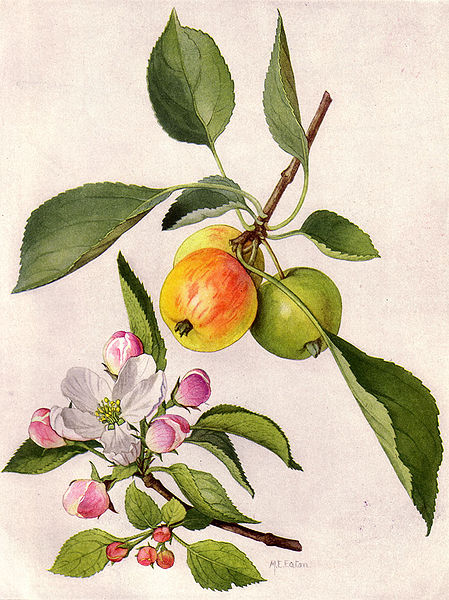
Crop domestication often involves selection for larger fruits. In some crops, humans took plant species with relatively small fruits and, over many generations of artificial selection, developed a plant with much larger fruits. Consider giant pumpkins as an extreme example. Yet in the case of apples, relatively large fruits already existed in the wild. Producing larger apples happened quickly and, perhaps even, unconsciously. Apples were practically primed for domestication, and as Robert Spengler explains in a paper published last year in Frontiers in Plant Science, looking back in time at the origins of the apple genus, Malus, can help us understand how the apple we know and love today came to be.

Apples are members of the rose family (Rosaceae), a plant family that today consists of nearly 5000 species. According to the fossil record, plants in the rose family were found in large numbers across North America as early as the Eocene (56 – 33.9 million years ago). They were present in Eurasia at this time as well, but Spengler notes, “there is a much clearer fossil record for Rosaceae fruits and seeds in Europe and Asia during the Miocene and Pliocene (20 – 2.6 million years ago).” Around 14 million years ago, larger fruits and tree-form growth habits evolved in Rosaceae subfamilies, giving rise to the genera Malus and Pyrus (apples and pears). Small, Rosaceae fruits were typically dispersed by birds, but as Sprengler writes, “it seems likely that the large fruits [in Malus and Pyrus] were a response to faunal dispersers of the late Miocene through the Pliocene of Eurasia.” Larger animals were being recruited for seed dispersal in a changing landscape.

Glacial advances and retreats during the Pleistocene (2.6 million – 11,700 years ago) brought even more changes. Plants with effective, long distance seed dispersal were favored because they were able to move into glacial refugium during glacial advances. Even today, these glacial refugium are considered genetic hot spots for Malus, and could be useful for future apple breeding. As the Pleistocene came to a close, many megafauna were going extinct. This continued into the Holocene. Large-fruited apple species lost their primary seed dispersers, and their ranges became even more contracted.

Humans have had an extensive relationship with apples, which began long before domestication. Foraging for apples was common, and seeds were certainly spread that way (perhaps even intentionally). Favorable growing conditions were also created when forests were cleared and old fields were left fallow. Apple trees are early successional species that easily colonize open landscapes, gaps in forests, and forest edges, so human activity that would have created such conditions “could have greatly promoted the spread and success of wild Malus spp. trees during the Holocene.”

The earliest evidence we have of apple domestication (in which “people were intentionally breeding and directing reproduction”) occurred around 3000 years ago in the Tian Shan Mountains of Kazakhstan, where Malus sieversii – a species that is now facing extinction – was being cultivated. This species was later brought into contact with other apple species, a few of which were also being cultivated, including M. orientalis, M. sylvestris, and M. baccata. These species easily hybridized, giving us the modern, domesticated apple, M. domestica. As Spengler writes, “the driving force of apple domestication appears to have been the trans-Eurasian crop exchange, or the movement of plants along the Silk Road.” Continued cultivation and further hybridization among M. domestica cultivars over the past 2000 years has resulted in thousands of different apple varieties.

The unique thing about domesticated apples is that their traits are not fixed in the same way that traits of other domesticated crops are. Growing an apple from seed will result in a very different apple than the apple from which the seed came. Apple traits instead have to be maintained through cloning, which is accomplished mainly through cuttings and grafting. Apples hybridize with other apple species so readily that most apple trees found in the wild are hybrids between wild and cultivated populations.

Spengler considers the study of apple domestication to be “an important critique of plant domestication studies broadly, illustrating that there is not a one-size fits-all model for plant domestication.” The “key” for understanding apple domestication “rests in figuring out the evolutionary driver for large fruits in the wild – seed dispersal through megafaunal mammals – and the process of evolution for these large fruits – hybridization.” He notes that “domestication studies often ignore evolutionary processes leading up to human cultivation,” which, in the case of apples, involves “hybridization events in the wild” that led to the evolution of large fruits “selected for through the success in recruiting large megafaunal mammals as seed disperses.” Many of those mammals went extinct, but humans eventually assumed the role, selecting and propagating “large-fruiting hybrids through cloning and grafting – creating our modern apple.”

Excerpt from Fruit from the Sands by Robert N. Spengler:

Indeed, the relationship between apples and people is close and complex, spanning at least five millennia. The story of the apple begins along the Silk Road… In recent years genetic studies have resolved much of the debate over these origins. Nevertheless, the ancestry of the apple is highly complex. Cloning, inbreeding, and reproduction between species have created a genealogy that looks more like a spider’s web than a family tree. To growers, the beauty of the apple lies not in its rosy skin but in its genetic variability and plasticity, its ability to cross with other species of Malus and other distant lines of M. domestica, and the ease with which it can be grafted onto different rootstocks and cloned.

See Also: Science Daily – Exploring the Origins of the Apple

———————

Interested in learning more about how plants get around? Check out the first issue of our new zine Dispersal Stories.