In 1931, the Idaho state legislature officially designated Philadelphus lewisii as the state flower of Idaho, several decades after it was originally selected by a committee of Boise women. Affectionately referred to as “syringa” by Idahoans, P. lewisii occurs from British Columbia down into northern California and across into Idaho and Montana. Its native habitats are the bases of rocky slopes, rocky crevices, and stream banks. It was among many plants collected during the Lewis and Clark Expedition (1804-1806) by Meriwether Lewis. Lewis collected two specimens while in north Idaho and eastern Montana – the first near the Clearwater River and the second near the Bitterroot River. The species was later described by Frederick Pursh and named after Meriwether Lewis. Another widely accepted common name for this species is Lewis’ mock orange.
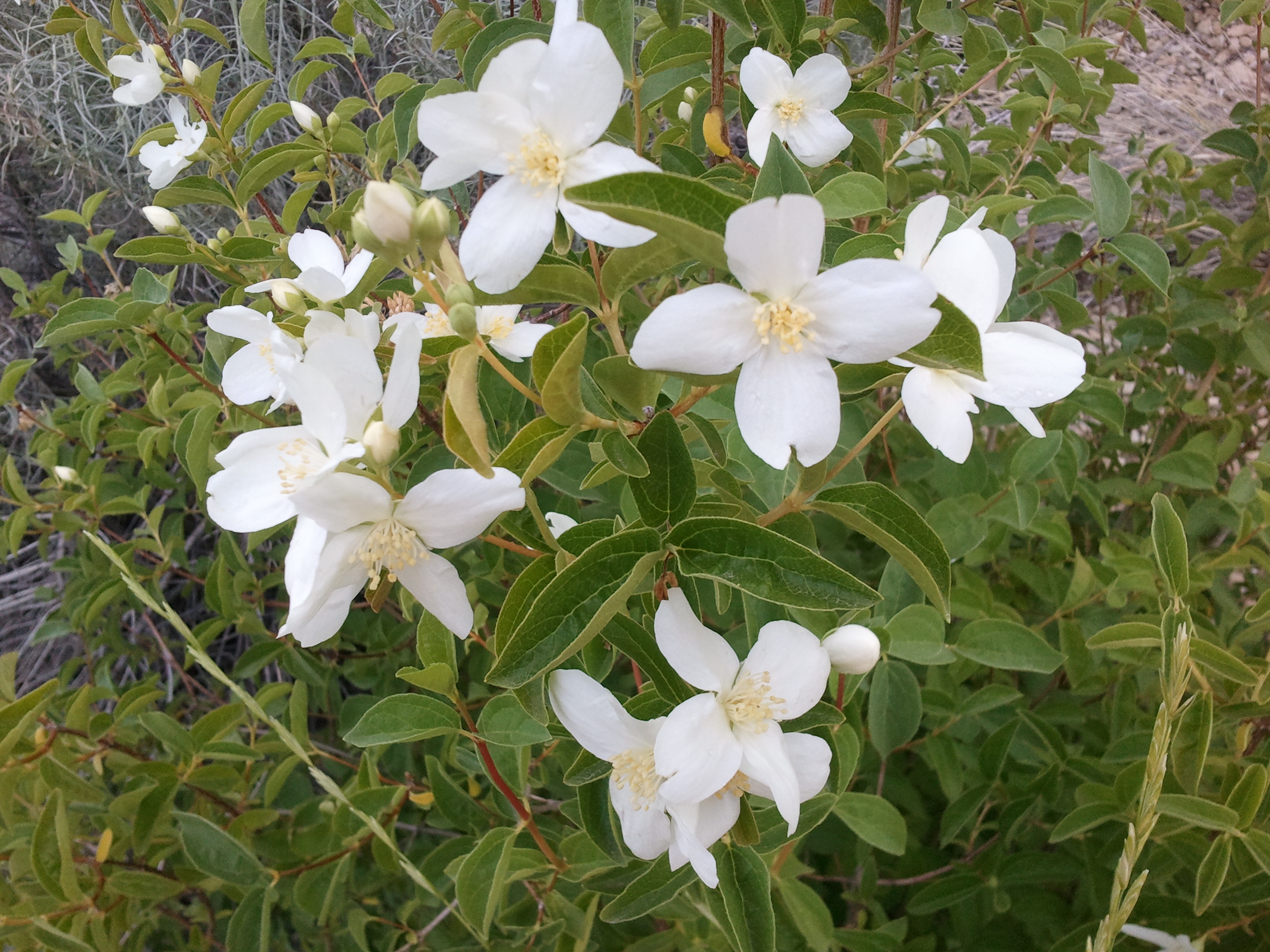
P. lewisii is a deciduous shrub that reaches 6 to 10 feet tall. It has opposite leaves and white, four-petaled flowers that appear in clusters of 3 to 11 on lateral branches. Young branches have reddish-brown bark that eventually peels off to reveal gray bark as the branches age. Many flowers in the genus Philadelphus emit a scent similar to the blossoms of citrus plants and have a general appearance akin to orange blossoms, giving them their common name “mock orange.” The attractive flowers and their sweet aroma are reasons why many people look forward to these shrubs blooming each year. Additionally, Idahoans can be certain that when their beloved state flower is in bloom, summer is imminent.
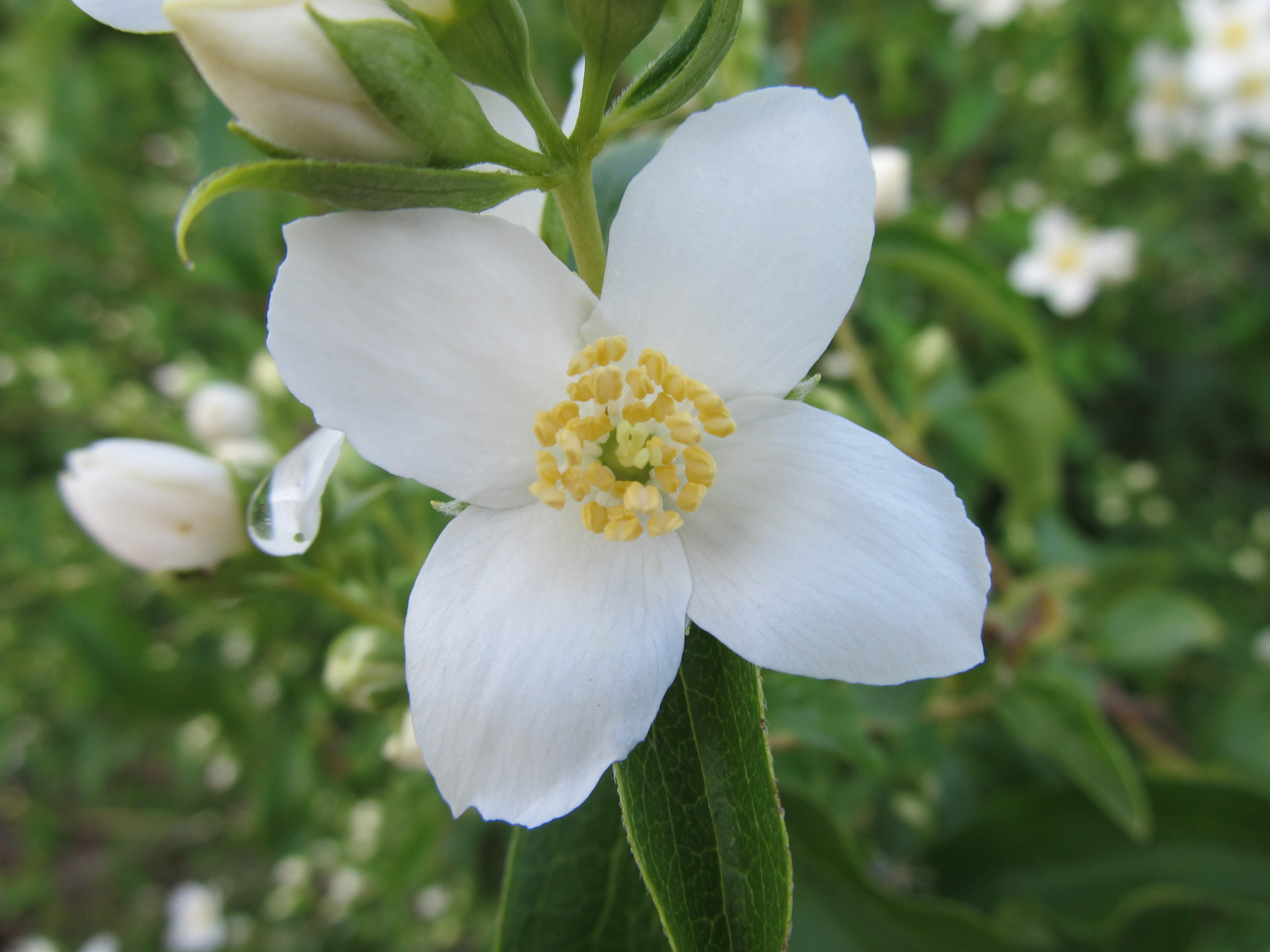
The leaves and bark of P. lewsii contain saponins and can be used to make soap when they are crushed and mixed with water. This quality also makes the plant fire-resistant. The branches and hollow stems of P. lewisii were used by Native Americans to make a variety of useful items including snowshoes, bows, arrows, and pipes. The common name “syringa” was derived from the greek word “syrinx” meaning “tube.” This helps explain why lilacs, an unrelated group of plants that also has hollow stems, was given the latin name Syringa.
Philadelphus is a genus in the Hydrangea family (Hydrangeaceae) that consists of at least 60 species found throughout North America into Central America and in various parts of Eurasia. All are shrubs – some growing to 20 feet tall while others only reach 3 feet at maturity. Most have deciduous leaves, but a few are evergreens. Many cultivars of Philadelphus have been developed by the horticulture industry and are commercially available. Cultivars are often selected for their compact growth habit, abundant and sometimes double flowers, and their strong, sweet aroma.
Check out this article in Pacific Horticulture to learn more about the genus Philadelphus.