Winter Trees and Shrubs: Box Elder

Box elder is a maple that doesn’t often get credit for being a maple. Moreso, it is a tree that is not thought highly of, and it may not even be welcome in certain discussions around maples. You could even say that box elder is a “rogue maple,” as Arthur Plotnick deems it in The Urban Tree Book. It should come as no surprise, but if people are going to talk about a plant this way, it’s only going to make me like it more.

First off, the leaves of Acer negundo are palmately compound, compared to the simple, palmately lobed leaves of other maples. A box elder leaf is generally composed of three leaflets, sometimes five or seven. The center leaflet is on a longer stalk than the side leaflets, which are oppositely arranged. Sometimes the leaves are confused with ash tree leaves (Fraxinus spp.), which is the reason for another common name, ash-leaved maple. It’s also not uncommon for box elder leaves to be mistaken for poison ivy, which is maybe not a plant you’d want to be confused with. In the fall, unlike the beautiful reds, oranges, purples, and yellows of so many other maples, the leaves of box elder turn a drab yellow before dropping, a trait that Plotnick calls “an embarrassment.”

leaf of box elder (Acer negundo)

It’s not really its leaf, however, that bothers people. Box elder is a fast-growing and prolific tree. Basically, it’s weedy, and because it grows so quickly, its wood is generally weak and its structure unpredictable. It falls apart easily, and it doesn’t always grow in typical tree fashion. Sometimes its more of a shrub, and sometimes it leans so far over that it practically lies on the ground. It sprouts and suckers in abundance, and as John Eastman puts it in The Book of Forest and Thicket, it “generally ignore(s) human standards for an attractive tree.”

Maybe before people knew better, or during a time when people just needed a fast growing tree to plant in their developing cities, box elders were widely planted across North America and beyond. That and their ability to spread readily helps to obscure their native distribution. Box elder is naturalized across North America, but its original distribution (whatever that means) appears to be more midwestern and eastern. Box elder grows in a variety of conditions, and is actually quite drought tolerant, which has allowed it to feel right at home in the American west, whether it is truly native here or not.

Identifying box elder in the winter can be pretty easy, especially if you come across a seed-bearing individual. Box elders are dioecious, meaning male and female flowers occur on separate individuals (another thing that sets them apart from other maples). A samara-bearing tree is a female tree, and the samaras often hang from the branches in great numbers. Like other maples, the fruits are paired together, each seed with a prominent wing. The samaras of boxelder point downward and hang from long stalks, persisting on the tree throughout the winter.

persistent samaras of box elder

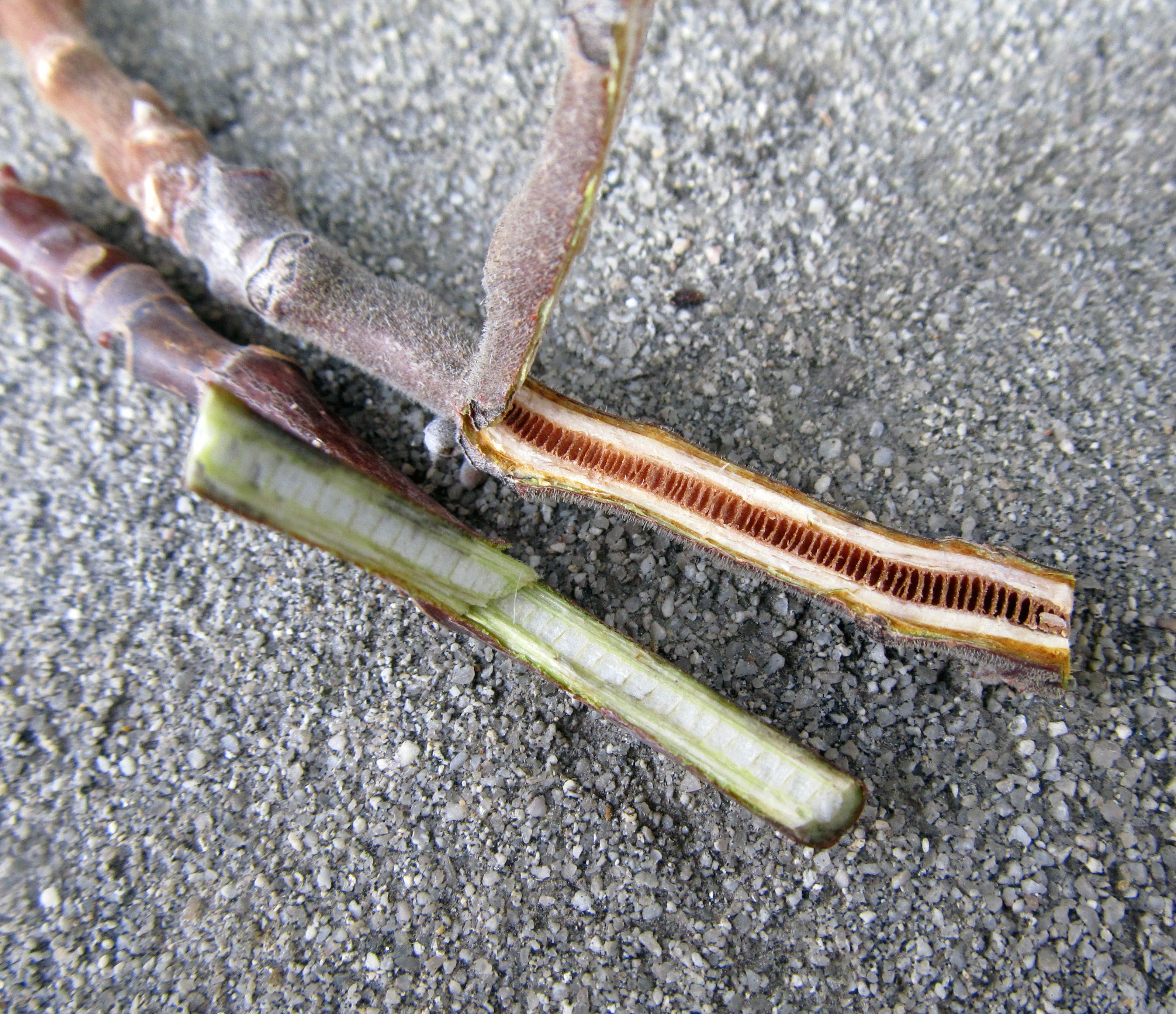
The twigs of box elder are glaucous (covered with a thin, powdery bloom) and can be either green, bluish-white, or reddish-purple. They have tiny, white lenticles, and their buds are oppositely arranged. Leaf scars are a broad U-shape, and scars opposite of each other meet at the tops of the U’s, coming to a raised point. At least three bundle traces (sometimes more) are visible in the scar. Leaf buds are protected by two scales that are covered in dense, white hairs. The scales are similar in color to the twigs, but appear more white due to the fuzz. Lateral buds are 1/8 inch long or longer. Slicing open the twigs lengthwise reveals solid, white pith in the center that blends in easily with the wood.

winter twigs of box elder
winter twigs of box elder, pith exposed

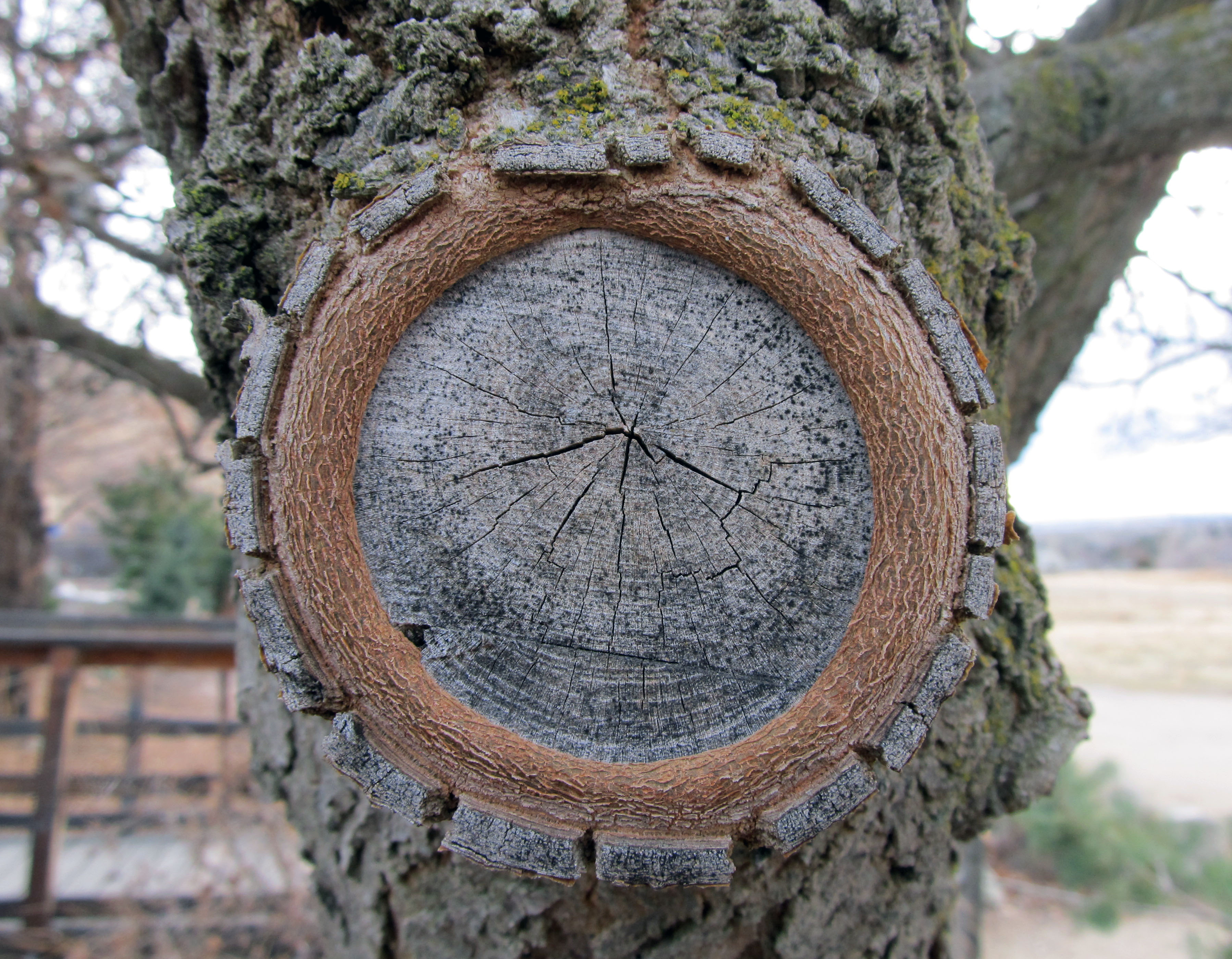
The bark of young box elders has slight vertical ridges and is light brown or grey-brown, with dull orange, raised, wart-like lenticels. It is finely scaly. The scales and ridges become more rough and blocky as the tree ages. Mature bark is light brown to grey and heavily furrowed, with blocky segments breaking apart horizontally.

maturing bark of box elder

A few years ago I was introduced to a massive box elder in Boise, Idaho. It quickly became my favorite tree in the area, and I visit it frequently. For all the hate that box elder can receive, seeing its potential to create an experience that few other trees in the area offer can send all of that negative talk out the window. Visit something like it yourself sometime, and see what it can do for you.

massive box elder

More Winter Trees and Shrubs:

2023: Year in Review

Things were pretty quiet on the blog in 2023, and I apologize for that. I have no excuses really. It’s just life. Fewer posts doesn’t mean I’m any less committed to writing and sharing about plants since the day I started this project, it’s more about quality over quantity. I would never want this to become a half-hearted affair, so even if months go by without hearing from me, just know that there are great things in the works, which I hope will be worth the wait.

Recently, while writing an article for Wildflower magazine, I came across this giant tome, Pollination and Floral Ecology by Pat Willmer. The previous year I had read Jeff Ollerton’s book, Pollinators and Pollination, and really got a lot out of it. These incredible resources on the science of pollination reminded me of a time early in Awkward Botany’s history in which I spent a year posting about pollination. I called it Year of Pollination, and by the time the year came to a close, I was struck by how much I still wanted to share about this topic. So now, armed with these new resources, I think it’s time for Another Year of Pollination.

In 2024, I plan on posting another series of pollinator and pollination themed posts. I may not be able to match what I accomplished in 2015, but I will aim for at least one a month. Just something to look forward to in the coming year.

If this entices you enough to continue to follow Awkward Botany (or to start), please do. Relevant links are here on my linktree. Awkward Botany can be found on a number of different social media platforms, but there are a few that I am more active on than others. With the fall of Twitter, I have moved on to other things. This is where you can find me most often at this point in time:

And now here are links to posts from 2023’s paltry selection that are part of ongoing series. Happy 2024! Fill it with plants!

Winter Trees and Shrubs

Tea Time

Weeds of Boise

Winter Trees and Shrubs: Tulip Tree

At first glance, a tulip and a tulip tree couldn’t be more different. One is a bulb that puts out fleshy, green leaves in the spring, topped with colorful, cup-shaped flowers, barely reaching a foot or so tall. The other is a massive, deciduous tree with a broad, straight trunk that can grow to nearly 200 feet tall. But if you can get a look at the flowers, seed heads, and even the leaves of this enormous tree, you might see a resemblance – at least in the shape of these features – to one of our most popular spring flowering geophytes.

Tulip tree (Liriodendron tulipifera) is distributed across the eastern United States and has been planted widely outside of its native range. Also commonly known as tulip poplar, yellow poplar, and whitewood, it is a member of the magnolia family and is one of two species in its genus (the other being Liriodendron chinense – a tree found mainly in China). Many (if not most) deciduous trees of North America have small, inconspicuous flowers, but tulip trees – like its close relatives, the magnolias – have relatively large, showy flowers. The trouble is actually getting to see them since, at least on mature trees, they are borne in a canopy that is considerably taller than the average human.

Tulip tree flowers are cup-shaped, yellow-green and orange, with a series of prominent stamens surrounding the carpels which are attached to a long, slender receptacle giving it a cone-shaped appearance. As the flower matures into fruits, the tulip shape of the inflorescence is maintained as the seeds with their wing-like appendages form a tight, cone-like cluster that opens as the seeds reach maturity. The wings aid in dispersal as the seeds fall from the “cone” throughout the winter.

seed head of tulip tree (Liriodendron tulipifera)

The four-lobed leaves of tulip trees also form a vague tulip shape. They are alternately arranged, bright green, and up to five or six inches long and wide, turning yellow in the fall. Two prominent, oval-shaped stipules surround the stem at the base of the petiole of each leaf. These stipules come into play when identifying the leafless twigs of tulip trees during the winter months.

leaf of tulip tree (Liriodendron tulipifera) in late summer

The winter twigs of tulip trees are easily recognizable thanks to their duck bill shaped buds which are made up of two wine-red, violet, or greenish bud scales. The terminal buds are considerably larger and longer than the lateral buds, some of which are on little stalks. The twigs are smooth, olive-brown or red-brown, with just a few, scattered, white lenticels. Leaf scars are rounded with a dozen or so bundle scars that are either scattered or form an irregular ellipse. Pronounced stipule scars encircle the twig at the location of each leaf scar. Twigs can be cut lengthwise to reveal pale white pith that is separated by a series of diaphragms.

winter twig of tulip tree (Liriodendron tulipifera)
top right: the chambered pith of black walnut (Juglans nigra); bottom left: diaphragmed pith of tulip tree (Liriodendron tulipifera)

The bark of tulip trees can be easily confused with that of ash trees. Young bark is smooth and ash-gray to grayish green with pale, vertical cracks. As the tree matures, the cracks develop into furrows with flat-topped ridges. The ridges grow taller and more peaked, and the furrows grow deeper as the tree reaches maturity. In the book Winter Botany, William Trelease compares the mature bark of tulip trees to a series of parallel mountain ranges with deep gullies on either side.

maturing bark of tulip tree (Liriodendron tulipifera)

Perhaps even as tulips are blooming, the buds of tulip trees break to reveal their tulip-shaped, stipule bearing leaves. This makes for an interesting show. In The Book of Forest and Thicket, John Eastman describes it this way: “from terminal buds shaped like duck bills, successions of bills within bills uncurl and unfold, revealing a marvel of leaf packaging.”

More Winter Trees and Shrubs:


The photos of tulip tree were taken at Idaho Botanical Garden in Boise, Idaho.

2021: Year in Review

Last year at this time I was newly married in a new home that Sierra and I had just bought together. The year flew by, as they often do, and we’re back around to another Year in Review. Home ownership (among other things) has kept us busy. If you follow this blog, you may have noticed that posts were a bit more sparse than usual. That probably won’t change much going forward, but even if takes me some time to get around to posting, I plan to keep this blog going for the foreseeable future. There are still so many plants to investigate and botanical topics to explore. I hope you will follow along, even when posts are few and far between.

The big news of the day is that Sierra and I recently added a new member to our family. Not a human, but a dog. Her name is Kōura, and I would expect her to make an appearance from time to time both here on the blog as well as on our various social media accounts. We are excited for the many adventures we’ll be having with her in the months and years to come, and can’t wait to introduce her to the world.

Kōura in the snow on Christmas Day 2021

As Awkward Botany enters its tenth year, I feel incredibly grateful for everyone who has supported it along the way. To everyone who has bothered to read a post, leave a comment, share the blog with a friend, and reach out to me by various means, I appreciate you all for participating in my silly, little, plant project. Plant people are the best. Luckily, supporting Awkward Botany is easy. Apart from reading and commenting on the blog, there are social media accounts to follow, monetary donations to make (no pressure), and books to buy from our Bookshop. All relevant links can be found on Awkward Botany’s linktree (link below). Let’s stay phytocurious in 2022!

Awkward Botany Linktree

And now…

A Selection of Posts from 2021

Winter Trees and Shrubs

Book Reviews

Weeds of Boise

Eating Weeds

Drought Tolerant Plants

Tea Time

Awkward Botanical Sketches

Podcast Reviews

2020: Year in Review

This past year was certainly not the year that any of us hoped it would be. We all know why, so there’s no reason to get into it here. Point being, posts on Awkward Botany were a bit fewer and further between in 2020. My day job kept me busier than usual, and my motivation to do much else was pretty much zapped. Regardless, I’m still pleased with what I was able to put out into the world. I’m particularly excited about my new Weeds of Boise project, in which I attempt to catalog the wild urban flora of my hometown. Expect more of that in 2021.

Certainly the biggest news of 2020 is that Sierra (a.k.a. Idaho Plant Doctor) and I bought a house! We started looking in earnest late last summer and weren’t having much luck. Just as we were considering putting our dreams on hold for a bit, we came across a little house in a neighborhood we love. The house was perfect for us, with a big pollinator garden out front and a series of garden boxes in various locations around the property, along with a nice chicken coop (five chickens included!). It was a tiny urban farm looking for new owners, and we were the chosen ones! I like to think that we bought a garden, and it came with a house. This year will be a year of discovery as we watch the yard come to life and fulfill our dream of having a garden of our own. We will definitely keep you posted.

But that’s not all. On the 1st of January, Sierra and I got married in a tiny ceremony in our new backyard. We had planned on getting married in the fall of 2020, but the pandemic quickly put those plans to rest. Now, with a place of our own and a desire to put a tough year behind us, we started the new year off on a positive note. With a number of precautions in place, we were able to celebrate the start of our new lives together with some of our close friends and family. Despite it being the middle of winter, the weather was perfect for our little outdoor gathering. The love and generosity we were shown from so many people that weekend is something we will never forget. 

two nerds getting married

What follows are the usual items found in a Year in Review post – ways you can follow Awkward Botany on social media, links to donate monetarily to Awkward Botany (no pressure), and posts from 2020 that are part of new and ongoing series of posts. New in 2021 is the Awkward Botany Bookshop. Bookshop is a site that makes it possible to purchase books online and support local bookstores in the process. When you buy books through Awkward Botany’s page, we receive a small percentage of the sale, which helps us continue to put out more of the plant nerdy content you’ve come to expect. There is a small selection of books in the store now, and I’ll continue to add more, so check back often. If there are books you’d like me to add to the store, please let me know. 

Follow Awkward Botany on Social Media:

Donate to Awkward Botany:

A Selection of Awkward Botany Posts from 2020

Botany in Popular Culture

Zine and Book Reviews

Weeds of Boise

Tea Time

Podcast Reviews

Awkward Botanical Sketches

Winter Trees and Shrubs