
In a garden setting, a successful groundcover is a plant that is durable and adaptable, spreads readily, and fills in space thouroughly. The point of planting a groundcover is to cover exposed soil and create a sort of living mulch. In fact, groundcovers provide similar benefits to mulch. They prevent erosion, help retain soil moisture, and prevent weeds. It should come as no surprise then, that a plant that fulfills all of these requirements has the potential to become a weed, especially if given the opportunity to escape and establish itself outside of its intended location.
This isn’t a hypothetical. This exact scenario has played out numerous times. A good example of this are the periwinkles: Vinca major and Vinca minor. Both have been popular garden plants for centuries. Their introduction to U.S. gardens came as early as the 1700’s. Today, both species (including cultivars of each) can be found for sale in nurseries throughout the country, even while escaped periwinkles proceed to spread across natural areas and uncultivated spaces. Even in gardens where periwinkles have been intentionally planted, they can be deemed no longer welcome due to their aggressive nature. Eliminating them, however, is a formidable task.

Periwinkles are relatively easy to identify, yet telling the two apart can sometimes pose a challenge. Knowing what to look for can make this a fairly simple task. Vinca major (greater periwinkle) is the larger of the two. Its stems are tough and sprawl up to 5 feet long, rooting adventitiously when in contact with the ground. Vegetative spread also occurs via stolons and rhizomes, modified stems that spread horizontally both above and below ground and whose main purpose is to produce new roots along their length. This extensive rooting creates dense mats of stems and foliage, precisely what you’d want from an effective groundcover. Leaves are arranged oppositely and are semi-evergreen with fine hairs along their margins. They are thick, glossy, simple, dark green, and ovate to ovate-lanceolate in shape. They have a relatively long petiole, and some leaves can even appear heart-shaped.
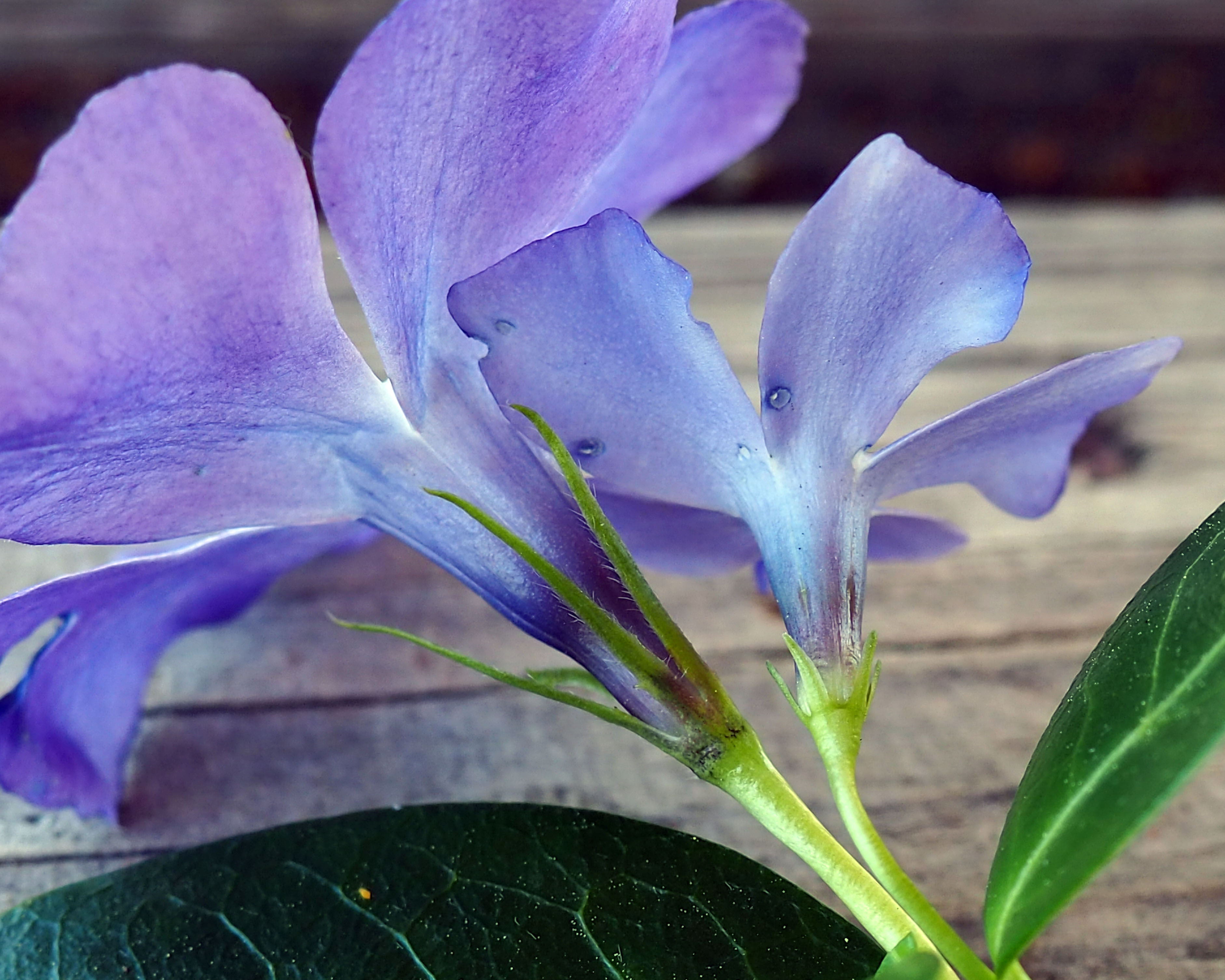
The flowers of V. major are blue to purple and fused at the base to form a tube, separating into five distinct lobes and creating a shape similar to a pinwheel. They are borne on a long stalk in the axils of leaves and measure about two inches wide. Their sepals are long, slender, pointed, and lined with bristly hairs. Fruits rarely form, but when they do, they are narrow follicles.
Vinca minor (lesser periwinkle) is a slightly smaller plant with a similar habit, spreading vegetatively in all the same ways as V. major. Stems are slender and smooth and leaves are evergreen. Compared to V. major, the leaves of V. minor are smaller, narrower, and have hairless margins and short petioles, otherwise they are very similar. Same goes for the flowers, which look identical on both species, except that those of V. minor are slightly smaller (about one inch wide) and borne on shorter stalks. Sepals are shorter, broader, more rounded at the tips, and lack the bristly hairs of V. major.
Because periwinkles only rarely produce seed, their main method of getting around is vegetatively. Fragments of roots or rhizomes hide in soil and are moved from one location to another inadvertently. Periwinkles are often used in hanging baskets and containers, and when these things are cast aside at the end of a season, the perennial roots of periwinkles may continue to grow, spreading out beyond the potting mix and into the soil.
Dump soil, yard waste, and improperly disposed of containers are the main ways that periwinkles find their way into natural areas. Both species can be found in the understories and edge habitats of woodlands, as well as along roadsides and pathways, and in vacant lots and old homesites. They can also be found in riparian areas, where waterways can carry fragments of plants to new locations. The Invasive Plant Atlas compiles reports of both V. major and V. minor growing outside of cultivation and tracks them on a map. They also track which states include them in noxious weeds lists or laws.

The best way to keep periwinkles from continuing to spread outside of cultivation is to refrain from growing them. If you choose to have them in your yard, dispose of plant parts properly. If you keep them in containers, send those containers to the landfill when you are done with them. If your property is adjacent to natural areas, the risk may be too great and you may want to consider a different groundcover. Depending on where you live, alternatives vary. In the Intermountain West, potential substitutes include wild strawberry (Fragaria virginiana), woodland strawberry (F. vesca), kinnikinnik (Arctostaphylos uva-ursi), and wild ginger (Asarum caudatum). Each of these are low growing, evergreen to semi-evergreen, spreading plants that do well in shade and can handle some degree of drought.


 awkward botany