Winter Trees and Shrubs: Box Elder

Box elder is a maple that doesn’t often get credit for being a maple. Moreso, it is a tree that is not thought highly of, and it may not even be welcome in certain discussions around maples. You could even say that box elder is a “rogue maple,” as Arthur Plotnick deems it in The Urban Tree Book. It should come as no surprise, but if people are going to talk about a plant this way, it’s only going to make me like it more.

First off, the leaves of Acer negundo are palmately compound, compared to the simple, palmately lobed leaves of other maples. A box elder leaf is generally composed of three leaflets, sometimes five or seven. The center leaflet is on a longer stalk than the side leaflets, which are oppositely arranged. Sometimes the leaves are confused with ash tree leaves (Fraxinus spp.), which is the reason for another common name, ash-leaved maple. It’s also not uncommon for box elder leaves to be mistaken for poison ivy, which is maybe not a plant you’d want to be confused with. In the fall, unlike the beautiful reds, oranges, purples, and yellows of so many other maples, the leaves of box elder turn a drab yellow before dropping, a trait that Plotnick calls “an embarrassment.”

leaf of box elder (Acer negundo)

It’s not really its leaf, however, that bothers people. Box elder is a fast-growing and prolific tree. Basically, it’s weedy, and because it grows so quickly, its wood is generally weak and its structure unpredictable. It falls apart easily, and it doesn’t always grow in typical tree fashion. Sometimes its more of a shrub, and sometimes it leans so far over that it practically lies on the ground. It sprouts and suckers in abundance, and as John Eastman puts it in The Book of Forest and Thicket, it “generally ignore(s) human standards for an attractive tree.”

Maybe before people knew better, or during a time when people just needed a fast growing tree to plant in their developing cities, box elders were widely planted across North America and beyond. That and their ability to spread readily helps to obscure their native distribution. Box elder is naturalized across North America, but its original distribution (whatever that means) appears to be more midwestern and eastern. Box elder grows in a variety of conditions, and is actually quite drought tolerant, which has allowed it to feel right at home in the American west, whether it is truly native here or not.

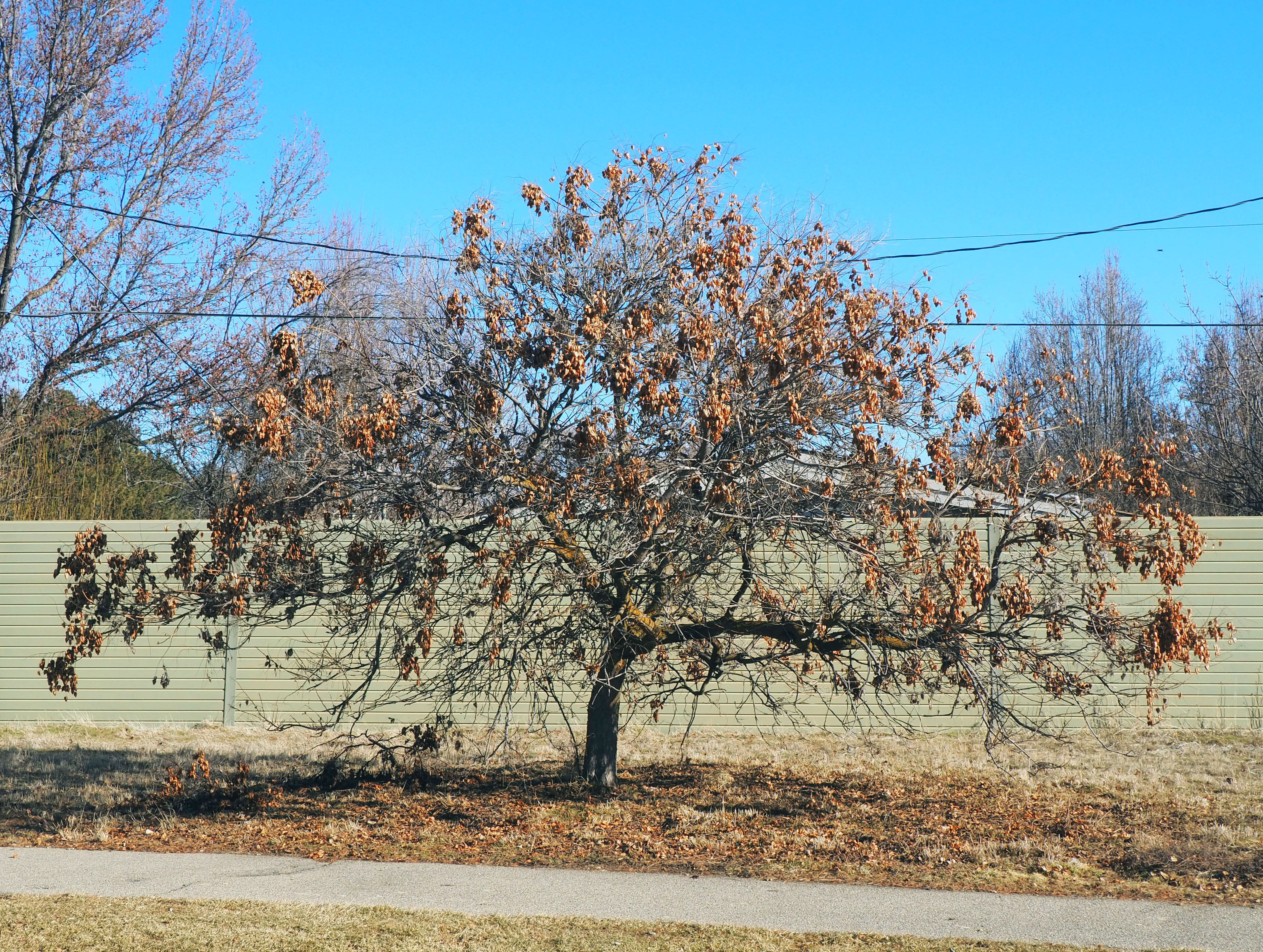
Identifying box elder in the winter can be pretty easy, especially if you come across a seed-bearing individual. Box elders are dioecious, meaning male and female flowers occur on separate individuals (another thing that sets them apart from other maples). A samara-bearing tree is a female tree, and the samaras often hang from the branches in great numbers. Like other maples, the fruits are paired together, each seed with a prominent wing. The samaras of boxelder point downward and hang from long stalks, persisting on the tree throughout the winter.

persistent samaras of box elder

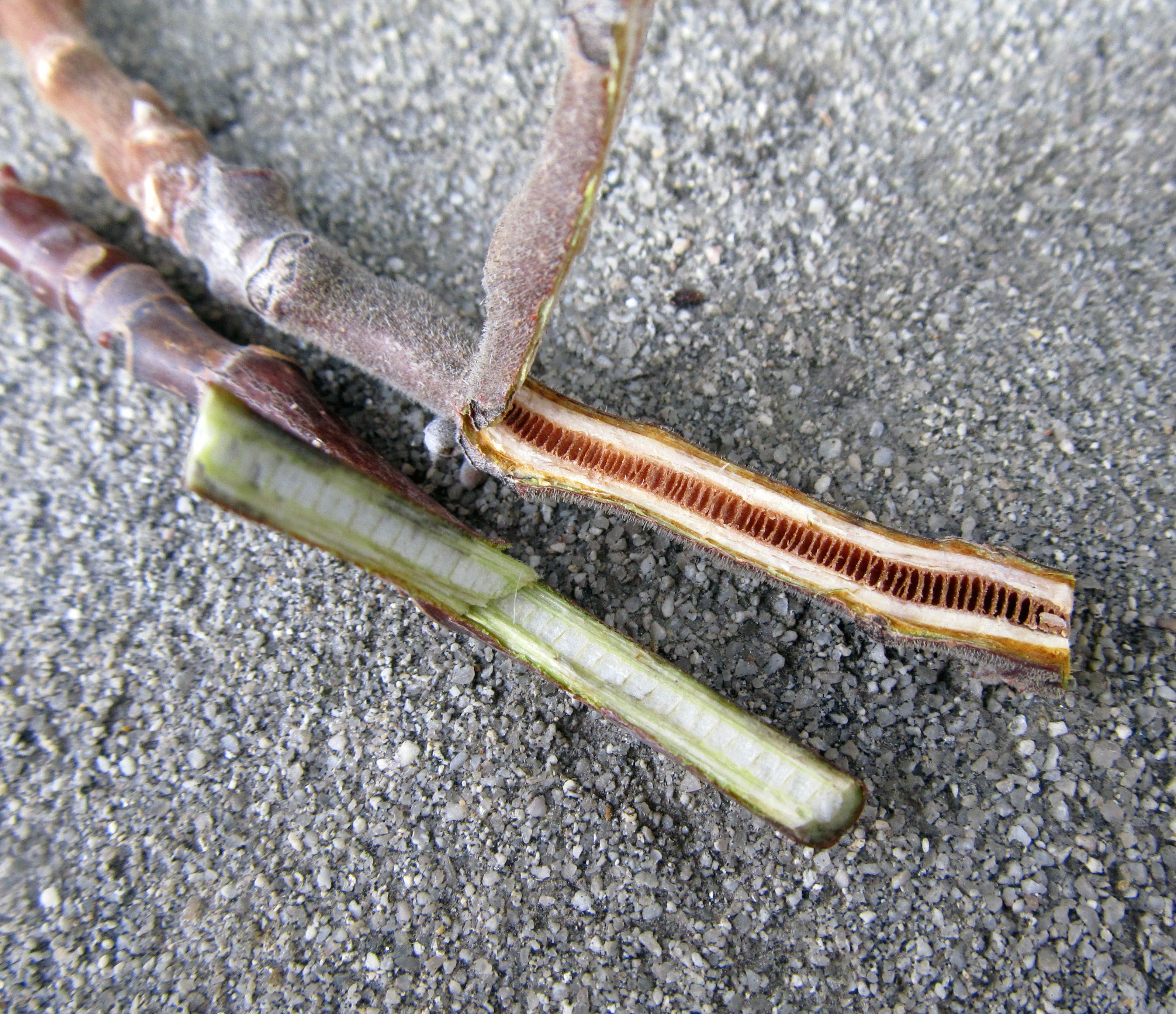
The twigs of box elder are glaucous (covered with a thin, powdery bloom) and can be either green, bluish-white, or reddish-purple. They have tiny, white lenticles, and their buds are oppositely arranged. Leaf scars are a broad U-shape, and scars opposite of each other meet at the tops of the U’s, coming to a raised point. At least three bundle traces (sometimes more) are visible in the scar. Leaf buds are protected by two scales that are covered in dense, white hairs. The scales are similar in color to the twigs, but appear more white due to the fuzz. Lateral buds are 1/8 inch long or longer. Slicing open the twigs lengthwise reveals solid, white pith in the center that blends in easily with the wood.

winter twigs of box elder
winter twigs of box elder, pith exposed

The bark of young box elders has slight vertical ridges and is light brown or grey-brown, with dull orange, raised, wart-like lenticels. It is finely scaly. The scales and ridges become more rough and blocky as the tree ages. Mature bark is light brown to grey and heavily furrowed, with blocky segments breaking apart horizontally.

maturing bark of box elder

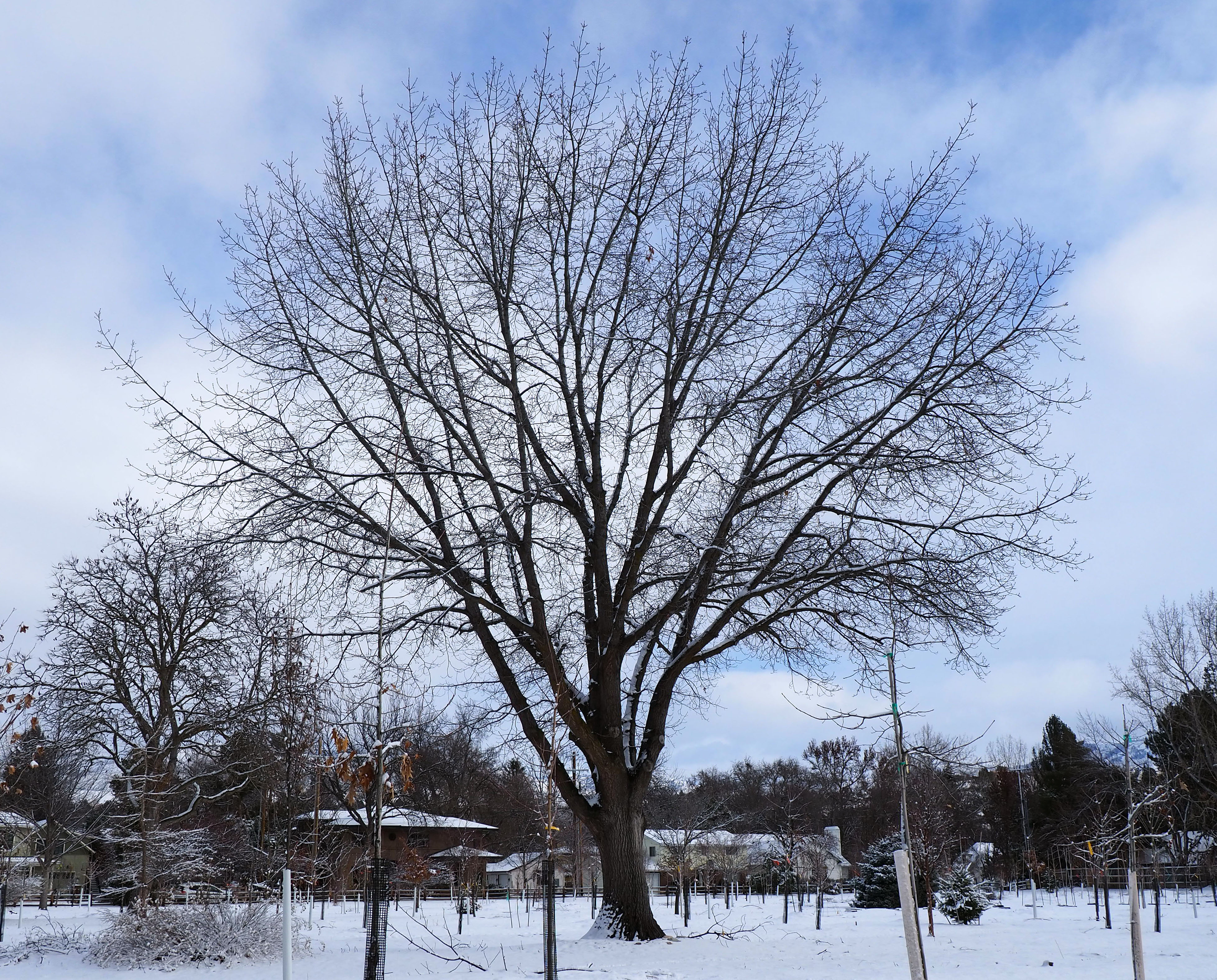
A few years ago I was introduced to a massive box elder in Boise, Idaho. It quickly became my favorite tree in the area, and I visit it frequently. For all the hate that box elder can receive, seeing its potential to create an experience that few other trees in the area offer can send all of that negative talk out the window. Visit something like it yourself sometime, and see what it can do for you.

massive box elder

More Winter Trees and Shrubs:

My Review of Decurrent Trees

Just because it’s winter doesn’t mean there aren’t plenty of plants to look at. Deciduous trees and shrubs become particularly interesting during the winter months with their exposed branches and their growth habits made more obvious. The beauty of a tree’s “skeletal” structure is revealed when it’s stripped of its leaves and set against a winter sky. Winter is also a great time to prune certain trees and shrubs (when appropriate), partly because their branches are so easily viewed and “problem” areas readily reveal themselves. Whether you’re observing a tree’s branching structure simply for enjoyment-sake or because you plan to prune, you may find yourself noticing distinct differences in the growth habits of trees. Distinct growth habits can help you identify trees. They can also tell you something about a tree’s environment or growing conditions.

In the book, The Tree, Colin Tudge defines a tree as “a big plant with a stick up the middle.” Sometimes this “stick” runs straight up from the ground to the top of the tree without interruption and is the tallest portion of the plant. Other times, the “stick” reaches a certain height and branches out into multiple “sticks,” each one reaching out in a different direction – some heading more outward, while others continue to reach for the sky. This is the difference between excurrent and decurrent growth.

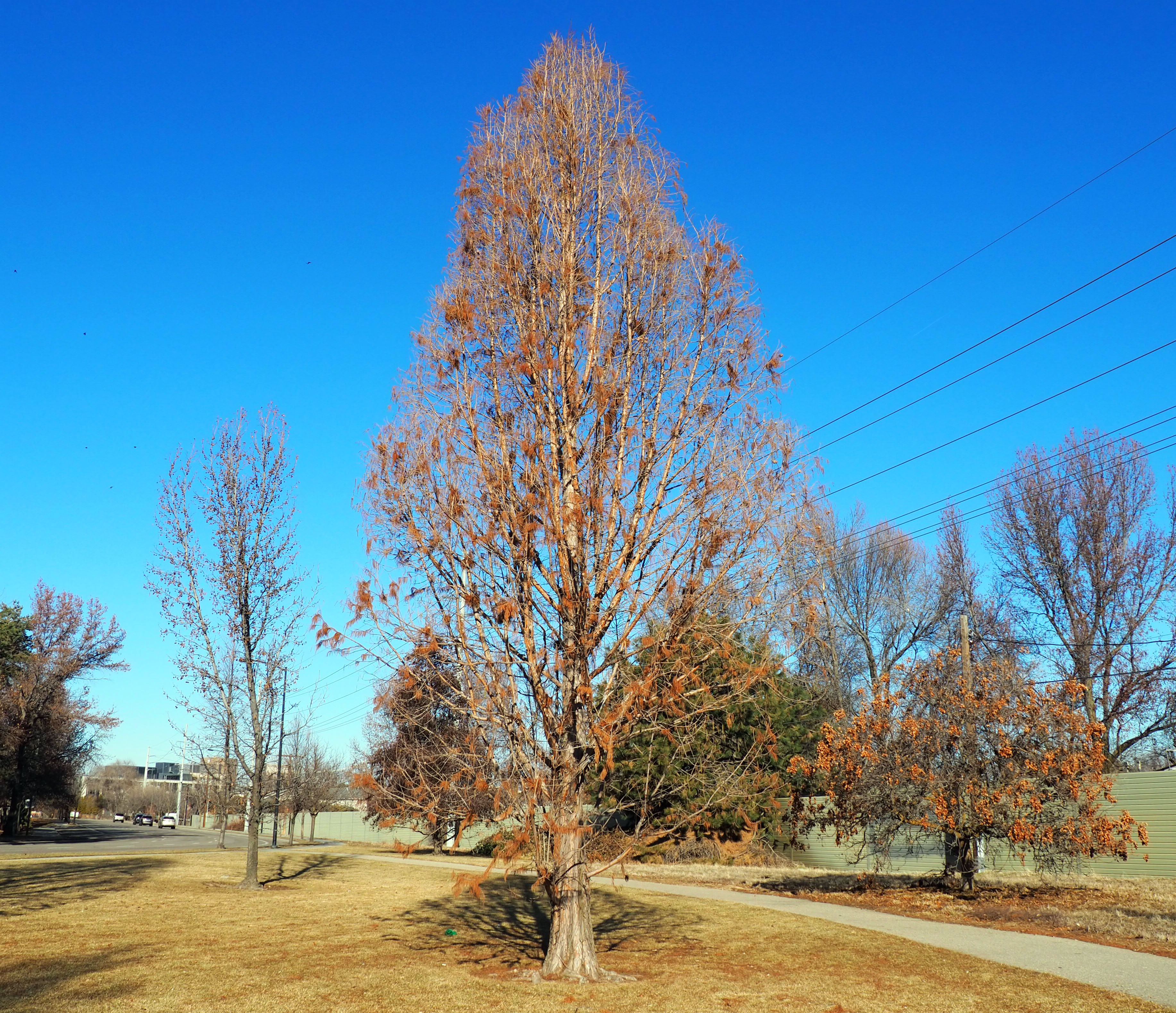
excurrent growth habit: dawn redwood (Taxodium distichum)

A tree with an excurrent growth habit has one central leader – or single trunk – that reaches all the way to the top of the tree. Side branches occur along the length of the trunk and generally get shorter as they move up the tree, producing a pyramidal or conical shape. Think of a typical Christmas tree. Many conifers exhibit excurrent growth, as do several deciduous trees such as sweetgum and pin oak, as well as aspens and other poplars. When a tree divides part way up the trunk, splitting into several large branches – none of which could be considered the dominant branch – it is exhibiting a decurrent growth habit. Trees that generally fall into this category include elms, maples, oaks, and ashes. The growth habit of a tree is largely a result of its genetics, but plants are known for their plasticity, taking on a wide variety of forms depending on their parentage and their circumstances. Trying to identify a tree based only its growth habit, isn’t likely to yield great results.

decurrent growth habit: oak (Quercus sp.)

The environment that a plant is growing in can have noticeable effects on the form the plant takes. A tree growing up in a forest thick with other trees will typically grow straight up in search of sunlight and will branch out very little until it can get up high enough to do so. That same species of tree growing in an open field might instead branch out extensively at a much lower height, taking advantage of the generous amount of space to stretch its branches out wide. As Tudge puts it in The Tree, “one form for the forest, another for the open ground.” Additionally, things can happen in a tree’s life that will drastically alter its form. If, for example, a storm comes through and breaks off a tree’s central leader, several side branches might grow out and upward to take its place, giving an otherwise excurrent tree a decurrent form. The pruning that humans often do (sometimes unwisely) to trees and shrubs, particularly in urban settings, can also alter a plant’s natural growth habit considerably. These are important considerations to make when assessing the forms of trees.

decurrent growth habit: golden rain tree (Koelreuteria paniculata)

I give decurrent growth habits five stars. No shade on excurrent trees. They’re also beautiful. But while trees with excurrent growth habits have otherwise predictable forms, decurrent trees are full of surprises. Their broad and rounded forms provided by their deliquescent branching structures are endlessly interesting, and their capacious canopies ensure that no two trees are alike.

decurrent growth habit: Malus sp. (I presume)

Winter Trees and Shrubs: Tulip Tree

At first glance, a tulip and a tulip tree couldn’t be more different. One is a bulb that puts out fleshy, green leaves in the spring, topped with colorful, cup-shaped flowers, barely reaching a foot or so tall. The other is a massive, deciduous tree with a broad, straight trunk that can grow to nearly 200 feet tall. But if you can get a look at the flowers, seed heads, and even the leaves of this enormous tree, you might see a resemblance – at least in the shape of these features – to one of our most popular spring flowering geophytes.

Tulip tree (Liriodendron tulipifera) is distributed across the eastern United States and has been planted widely outside of its native range. Also commonly known as tulip poplar, yellow poplar, and whitewood, it is a member of the magnolia family and is one of two species in its genus (the other being Liriodendron chinense – a tree found mainly in China). Many (if not most) deciduous trees of North America have small, inconspicuous flowers, but tulip trees – like its close relatives, the magnolias – have relatively large, showy flowers. The trouble is actually getting to see them since, at least on mature trees, they are borne in a canopy that is considerably taller than the average human.

Tulip tree flowers are cup-shaped, yellow-green and orange, with a series of prominent stamens surrounding the carpels which are attached to a long, slender receptacle giving it a cone-shaped appearance. As the flower matures into fruits, the tulip shape of the inflorescence is maintained as the seeds with their wing-like appendages form a tight, cone-like cluster that opens as the seeds reach maturity. The wings aid in dispersal as the seeds fall from the “cone” throughout the winter.

seed head of tulip tree (Liriodendron tulipifera)

The four-lobed leaves of tulip trees also form a vague tulip shape. They are alternately arranged, bright green, and up to five or six inches long and wide, turning yellow in the fall. Two prominent, oval-shaped stipules surround the stem at the base of the petiole of each leaf. These stipules come into play when identifying the leafless twigs of tulip trees during the winter months.

leaf of tulip tree (Liriodendron tulipifera) in late summer

The winter twigs of tulip trees are easily recognizable thanks to their duck bill shaped buds which are made up of two wine-red, violet, or greenish bud scales. The terminal buds are considerably larger and longer than the lateral buds, some of which are on little stalks. The twigs are smooth, olive-brown or red-brown, with just a few, scattered, white lenticels. Leaf scars are rounded with a dozen or so bundle scars that are either scattered or form an irregular ellipse. Pronounced stipule scars encircle the twig at the location of each leaf scar. Twigs can be cut lengthwise to reveal pale white pith that is separated by a series of diaphragms.

winter twig of tulip tree (Liriodendron tulipifera)
top right: the chambered pith of black walnut (Juglans nigra); bottom left: diaphragmed pith of tulip tree (Liriodendron tulipifera)

The bark of tulip trees can be easily confused with that of ash trees. Young bark is smooth and ash-gray to grayish green with pale, vertical cracks. As the tree matures, the cracks develop into furrows with flat-topped ridges. The ridges grow taller and more peaked, and the furrows grow deeper as the tree reaches maturity. In the book Winter Botany, William Trelease compares the mature bark of tulip trees to a series of parallel mountain ranges with deep gullies on either side.

maturing bark of tulip tree (Liriodendron tulipifera)

Perhaps even as tulips are blooming, the buds of tulip trees break to reveal their tulip-shaped, stipule bearing leaves. This makes for an interesting show. In The Book of Forest and Thicket, John Eastman describes it this way: “from terminal buds shaped like duck bills, successions of bills within bills uncurl and unfold, revealing a marvel of leaf packaging.”

More Winter Trees and Shrubs:


The photos of tulip tree were taken at Idaho Botanical Garden in Boise, Idaho.